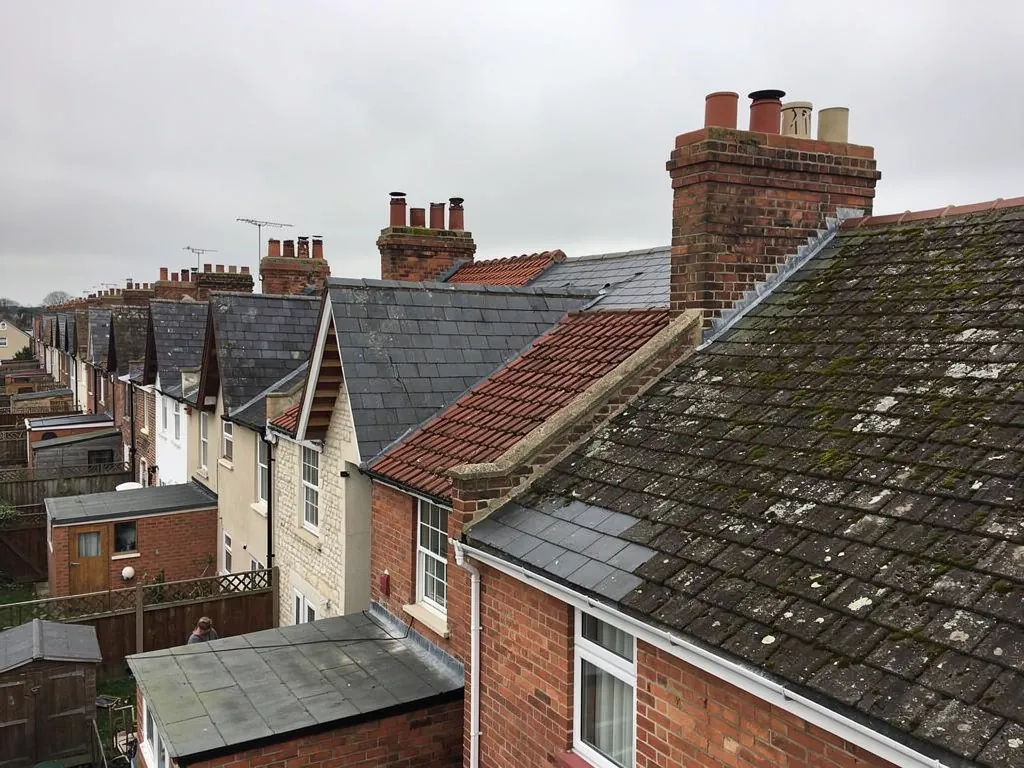
Brick end-of-terrace gable beside a limestone house, slate roofs

Roofers in Shrivenham

Roof repairs, re-roofing, lead flashings and flat roofs in Shrivenham, from the stone houses and cottages near St Andrew's church and Longcot Road to the larger estate buildings and newer housing that has grown around the village.

Shrivenham's roofs, from church tower to Longcot Road

Old stone house with chimney stacks
Stone houses near the church

Elm Tree House, dated to about 1700, is described as built of the local stone, and the old streets near St Andrew's church carry other houses of similar age. Stone-walled houses of this period have thick, solid walls and steep roofs with chimney stacks at the gables. The weak points are well known: mortar-bedded gable copings that have worked loose, chimney flashings that have split where lead meets stone, and valleys that have silted with moss and leaves. Because the walls are old and the timbers beneath the roof have moved over the centuries, repairs need to follow the line of what is already there.

Row of village cottages with pitched roofs
Cottages on Longcot Road

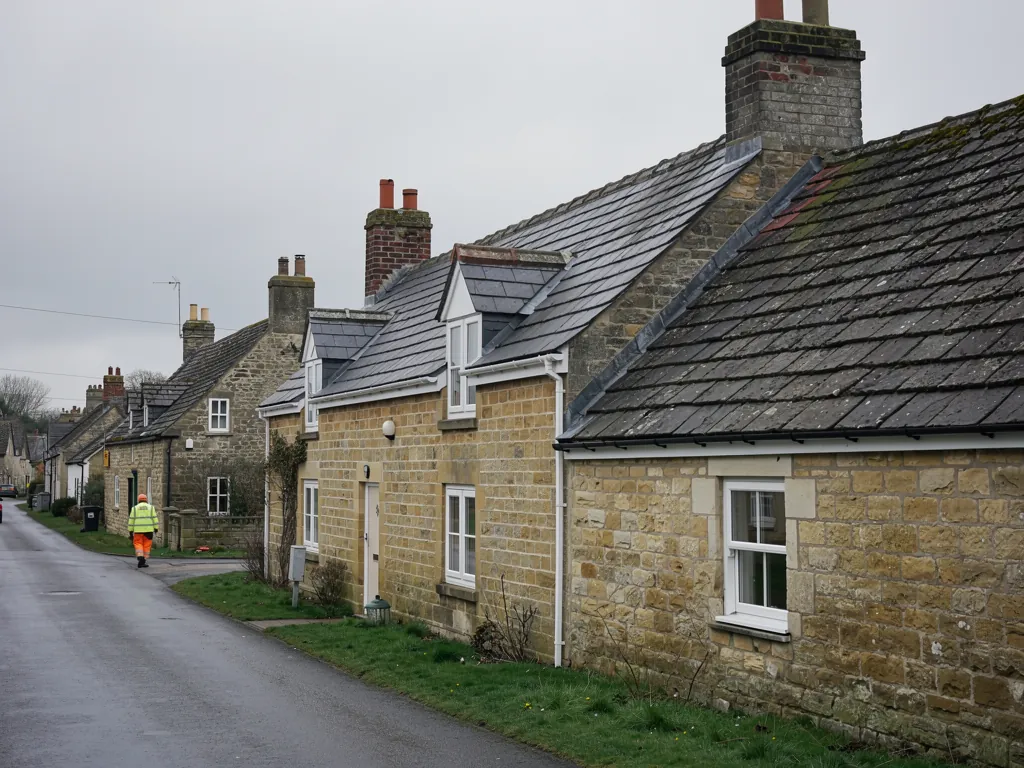
Thatched cottages of the late seventeenth or early eighteenth century stand on Longcot Road, and they are a reminder that Shrivenham was built from what was to hand. Alongside the thatch, the village has stone, tile and slate roofs to look after, and each neighbours the next in a way that makes careful detailing matter. Flashings, party wall abutments and chimney stacks are the places where one roof meets another. A leak on one cottage can travel along the timber and show up in the next, so we trace water to its source before agreeing what to repair.

Large stone hall with hipped tiled roofs
Estate buildings and later housing

The War Office bought the Beckett estate in 1936, and the Royal Military College of Science moved to Beckett Hall in 1946. Beckett Hall is Grade II listed. Large halls and institutional buildings bring big roofs, valleys, parapet gutters and flat sections, where access and safe working matter as much as the covering. Beyond the old core the village has grown with later housing of several decades, whose roofs show their own age: ridge tiles on mortar alone, tired felt, plastic roofline boards and flat extension roofs that have had one repair too many.

From Swindon along the Faringdon road

Map showing Shrivenham and central Swindon. 6 road miles east-north-east of central Swindon.

Distance
6 road miles east-north-east of central Swindon
Council
Vale of White Horse District Council
Council
Vale of White Horse District Council
Conservation area
Shrivenham Conservation Area, designated 3 February 1971
Setting
Village on the Swindon to Faringdon road, historically in Berkshire

Shrivenham roof questions

Is Shrivenham's centre a conservation area?

Yes. Vale of White Horse District Council designated it on 3 February 1971. Matching repairs seldom need an application, but ask the council about changes to material and about any listed building.

Can you repair roofs beside Longcot Road's thatch?

Yes. We work on the stone, tile and slate roofs and chimneys in the village, including those beside the thatched cottages, and we take care with flashings where one roof meets another.

Is St Andrew's church roof lead?

The Victoria County History records that the church roofs are leaded. Lead of that sort can last for generations if the flashings and gutters are kept clear and the sheets are not allowed to crack.

Q1

What roofs stand around Shrivenham's church?

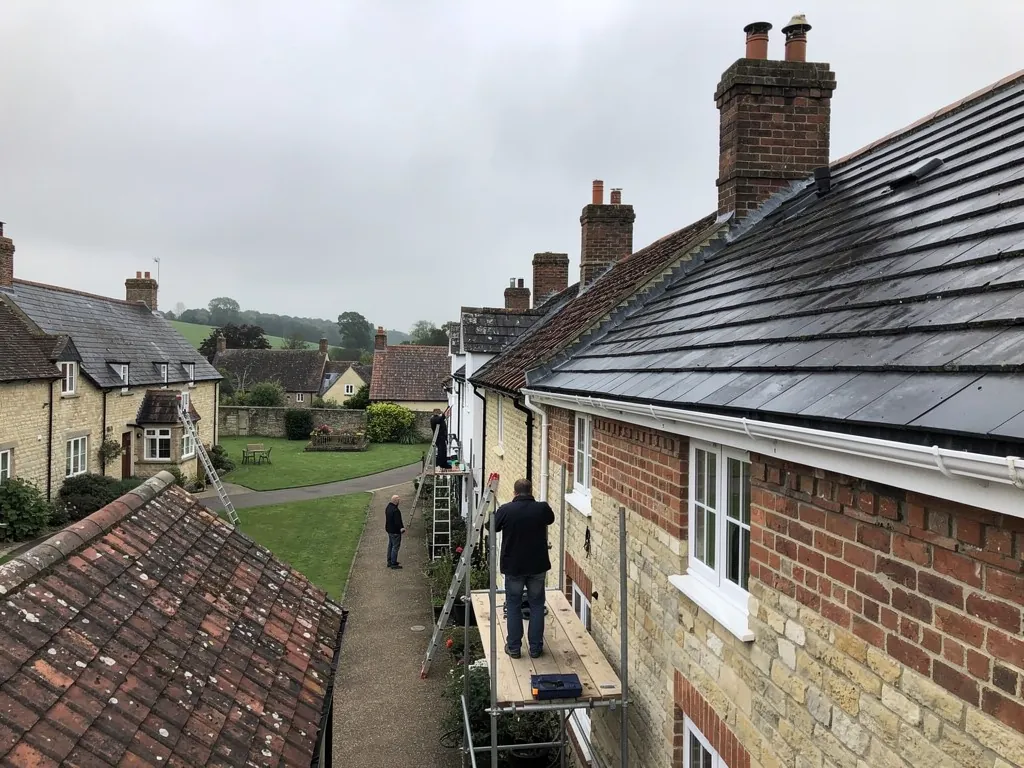
Brick and limestone cottages around a small village green
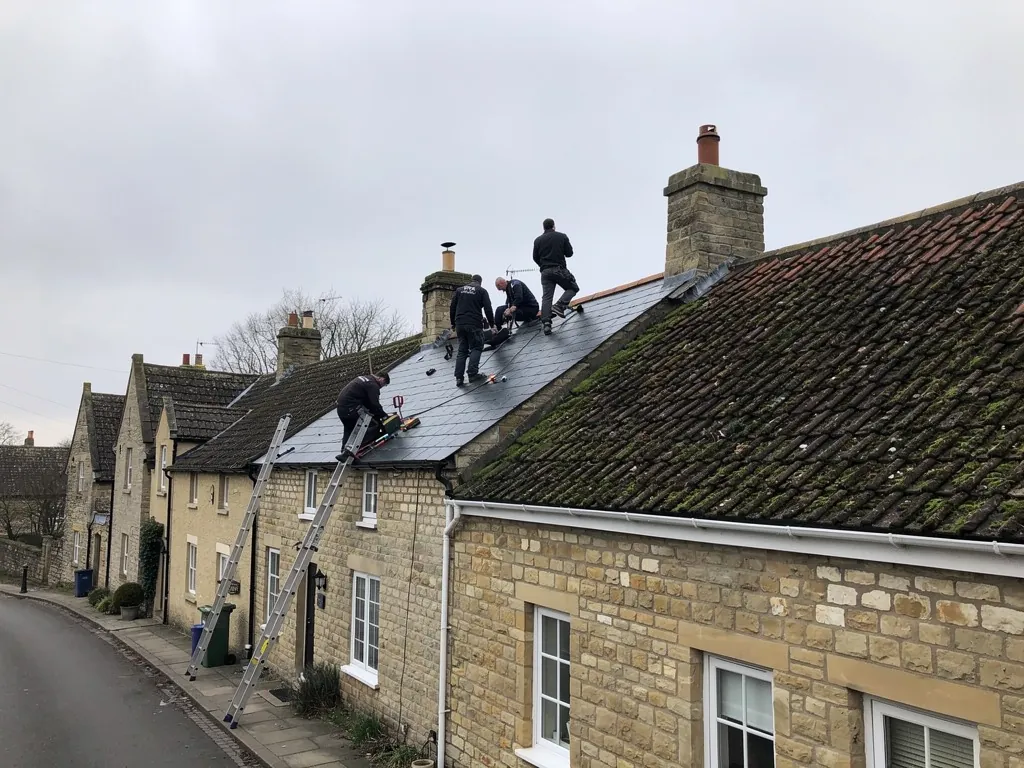
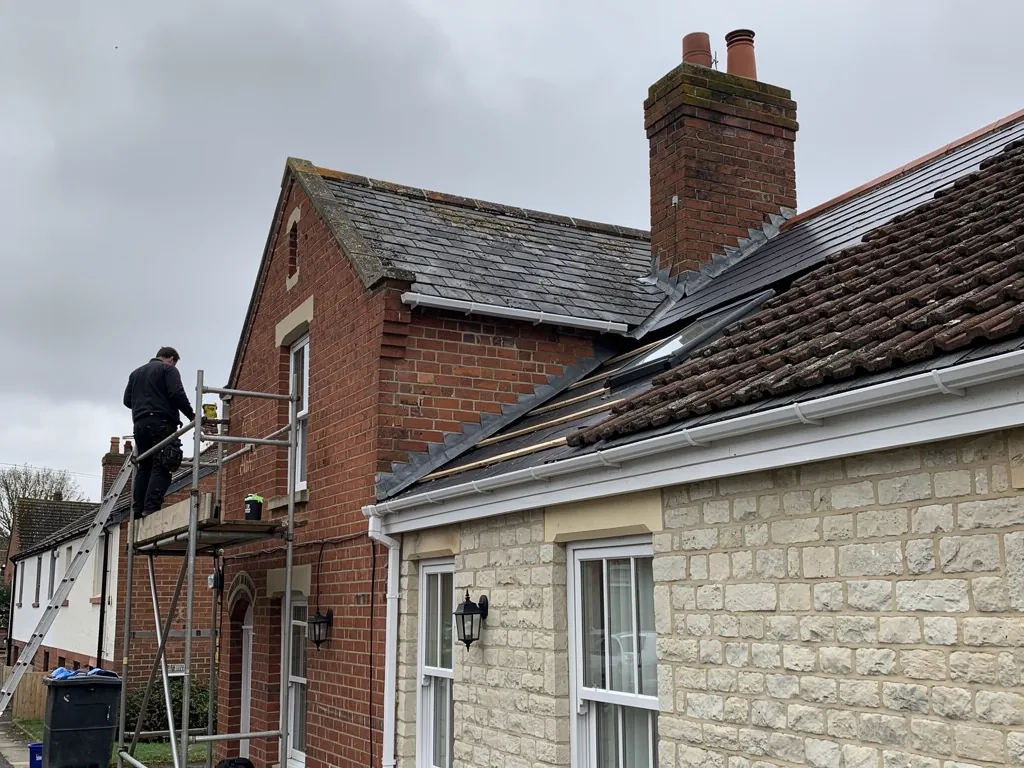
Roofers on a slate roof along a limestone village street

The short answer

A mix of ages. St Andrew's church was largely rebuilt in 1638, with a west wall of the late twelfth century and leaded roofs. Around it stand stone houses such as Elm Tree House, thatched cottages on Longcot Road and later buildings in brick, tile and slate.

Walk through the old part of Shrivenham and the roofs give you a timeline. The Victoria County History describes the church walls as rubble with ashlar dressings, with leaded roofs. Rebuilt largely at Lord Craven's expense in 1638, it has a font of Purbeck marble and a west wall that is older than the rest.

Why is there so much lead on the older roofs?

Lead is the traditional covering for the flatter roofs and gutters of a stone-walled building. It is also the usual material for flashings, the metal strips that keep water out at every abutment and stack. Lead is rated by code; thicker codes such as Code 5 or 6 are used for gutters and bigger sheets, and thinner ones for soakers and small flashings. Our lead roofing page explains the codes. Lead lasts a very long time, but it fails at the joints, where it has been fixed with the wrong nails or left to split in a corner. A MyJobQuote guide (22 September 2026) puts correctly installed lead flashing at over 80 years, so a failure after a few decades usually points to how it was fitted or what has been done around it since.

What about the tiled and slated buildings?

Not every roof in the village is old. Clay and concrete tiles and natural slate cover buildings from several periods, and each has its own fault pattern. The covering, its fixings and every junction are read as one system, and our roof repairs page sets out how a survey works.

The church is in use for worship, so changes to it are governed by the Church of England's own faculty system and not by listed building consent. Houses and halls are different, and the section below on consent explains how.

Q2

How are Shrivenham's old stone houses re-roofed?

The answer

Slowly and carefully. We survey the roof, photograph each slope, and decide whether the existing covering can be saved and re-laid or needs replacing. On an old stone house the walls are heavy and the timbers have moved, so the new work is made to follow them rather than to straighten them.

An old stone house in Shrivenham is a different proposition from a 1990s estate home. The walls are thick, the roof is steep, the timbers may be oak, and nothing is quite square. Re-roofing one means working with the building as it is.

What happens before a Shrivenham re-roof is priced?

Before any quote, we look at the roof from outside, from the loft and, where needed, from scaffolding. We note the pitch, the covering, the condition of rafters, battens and underlay, and any earlier repairs. Each slope gets its own photographs. If only one slope is worn on an otherwise healthy roof, the quote covers that slope alone, since a whole new roof is not always the answer.

How do you make a repair match the old roof?

A repair should look as though it was always part of the roof. For stone, that means stones of matching size and thickness, graded so the biggest sit low down and the smallest near the top. For clay tile or slate it means matching colour, size and texture. Our page on Cotswold stone roofing describes the traditional method, and the same principles apply to stone in this part of the Vale.

Can the timbers take a different covering?

Stone is heavy. A traditional stone roof may weigh about 1000 kg per 10 square metres, according to Cotswold District Council's 2000 guidance, so the timbers have to be sound before anything is laid. Replacing stone with a different covering changes the load. The Planning Portal says a covering that is 15 per cent or more heavier needs building control approval, and Approved Document A treats an increase of more than 15 per cent as significant. We check what the structure can carry before we recommend a covering.

None of this has to be rushed. A roof that is surveyed in dry weather and planned for a settled spell is easier to do well. Stripping only as much as can be made weathertight by the end of each day is standard care on an occupied house, and it keeps a stone or slate roof from being left open to a sudden shower. The ridge and the hips are usually the last parts to be finished, once the slopes either side are complete. Old battens, broken stone and offcuts leave in our skip, not yours.

What we advise

Repair what can be saved, replace only what has failed, and keep every new stone, tile or slate in step with the old.

Q3

Does Shrivenham's conservation area change roof work?

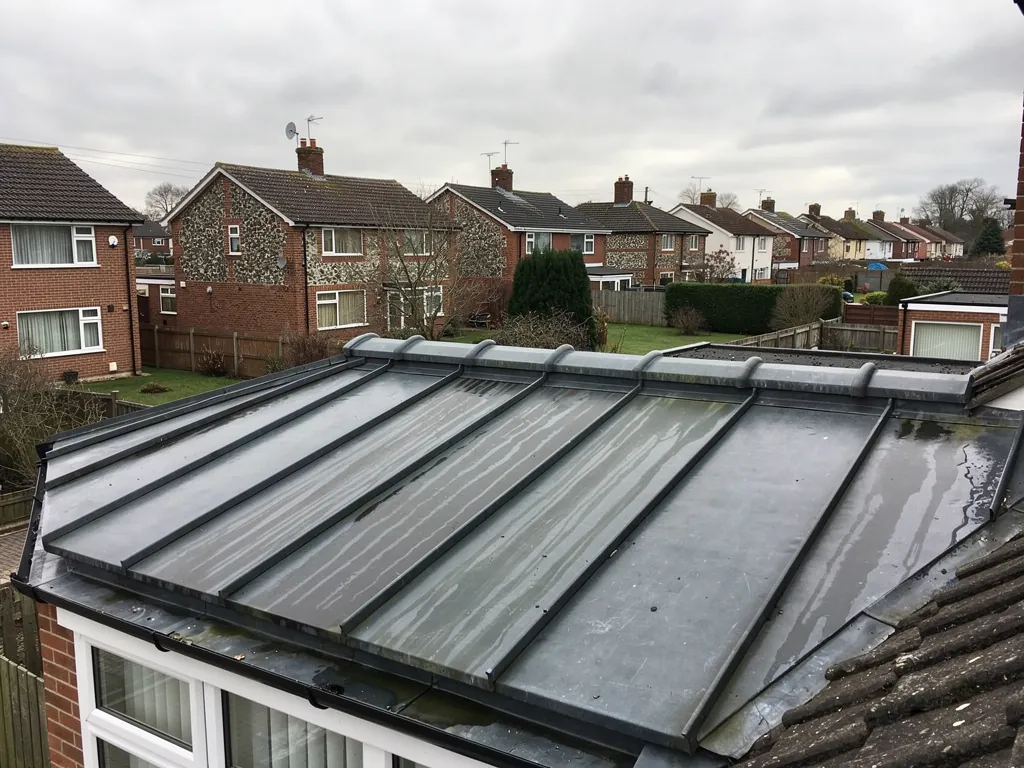
Rolled lead roof covering over a bay above white windows
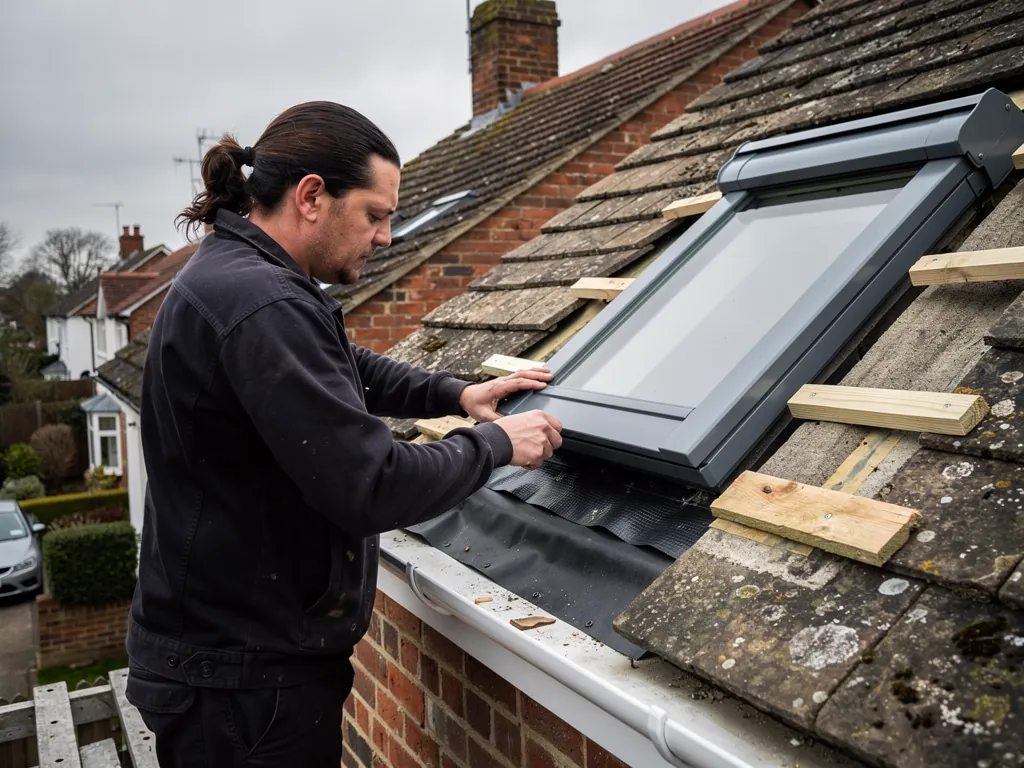
Roofer fitting a roof window frame into a tiled roof opening

The short answer

Only if the work changes how the roof looks. Shrivenham Conservation Area was designated on 3 February 1971, and the council can confirm the boundary. A matching repair rarely needs an application, but listed buildings and changes of material do need the council's agreement.

The question comes up on almost every older roof, so here is how it works in Shrivenham.

How big is the conservation area, and what applies in it?

Vale of White Horse District Council's conservation area map for Shrivenham shows an area of just under 17 hectares, designated on 3 February 1971. That map, number 41 in the council's series, draws the boundary house by house on an Ordnance Survey base. The Vale's only Article 4 direction covers a few houses in Abingdon, so nothing of that sort reaches Shrivenham. Swapping stone for tile, or cutting a new opening into a front slope, is still a question for the planning team first.

Which buildings in the village are listed?

Beckett Hall is Grade II listed, the China House in its grounds is Grade I, and St Andrew's church and the Memorial Hall are also on the list. Altering a protected building's special interest without formal consent is an offence, and on these buildings the covering is part of what is protected. For a house, a barn or a hall, we start from the same material fixed in the same way and tell you before we depart from it.

When does building control get involved?

Re-roofing a large share of a building, or fitting a heavier covering, brings Building Regulations into play. The Vale of White Horse works with South Oxfordshire through SouthVale Building Control, and a registered building control approver is the other route. If your job is notifiable, you hear it at the quote stage and we lodge the notification ourselves. Roof windows follow separate planning rules, which our roof window planning page covers.

If the answer is still unclear, send us photographs and the address. We will say what we think applies and what the council should be asked.

MythOld stone roofs in Shrivenham can only be repaired in stone.

FactMatching is the aim; where a different covering is proposed, the council and the structure decide whether it is suitable.

Roofing services in Shrivenham

Questions from around St Andrew's

Why do Shrivenham's old roofs leak at the chimneys?

Chimney stacks on old stone houses sit where the roof, the wall and the flue meet, and that junction is sealed with lead flashings. Lead splits where it is stretched or stuck down, and mortar around it dries and falls out. A stain below the stack usually points to this joint. Re-dressing the lead and re-pointing the stack is often enough, and we photograph the stack before quoting.

Do you work on thatched cottages in the village?

Thatch is a specialist trade, but a thatched cottage often has chimneys, flashings, neighbouring tiled roofs and porches that need roofing work. We deal with those parts, and talk through the sequence with you so that each trade can do its own job.

Do you cover Bourton, Watchfield and the villages near Shrivenham?

Yes. Bourton, Watchfield, Bishopstone and the other villages around Shrivenham are within the 30 road miles we cover from Swindon. Our list of areas names each one, while this page's phone line, WhatsApp chat and enquiry form all reach the same team.

Are flat roofs on Shrivenham's larger buildings a different job?

They can be. Flat sections of large halls, offices and outbuildings often involve parapet gutters, lead trims and outlets that must be kept clear. How we reach the roof, how we work safely at height and which membrane suits the deck all shape the plan, so a survey comes before the written quote, which then explains what the cost turns on.

Ask us about your roof

Tell us what’s happening and we’ll call you back.

  • Photos of what we find
  • A written quote
  • 10-year workmanship guarantee

Or call 01793 626096

Call Get a quote