Brick end-of-terrace gable beside a limestone house, slate roofs

Roofers in Watchfield

Roofing in Watchfield, the Vale of White Horse village on the old Oxford to Swindon road: leaks, re-covers, chimney stacks and garage or extension roofs, from the older lanes around St Thomas's church to the newer homes and the former RAF land on the village edge.

Watchfield's roofs, from church to airfield

Old tiled cottage roofs beside a church
Around St Thomas's church

St Thomas's was designed by G.E. Street in a late thirteenth-century style and completed in 1858, and the Victoria County History describes a stone building with a chancel, nave and west bellcote. The houses and cottages near it belong to the older part of the village, and their roofs carry repairs layered over the decades. Plain clay tile, natural slate and stone are all possible on buildings of this age, and a patched slope often combines two of them. Before anything is priced we identify the covering, check the battens and rafters beneath it, and look hard at the valleys and chimney flashings, because a faded slope on sound timbers asks for a very different job than one that has let water into the rafters for years.

Pitched chapel roof with a low extension
Chapels and places of worship

Watchfield has more than one place of worship. The Victoria County History records a Primitive Methodist chapel built in 1872, and Saint Alban's Roman Catholic church dates from the twentieth century. Buildings like these tend to have a wide pitched roof over one large room, with a flat or low-pitched roof on the vestry, porch or hall extension behind. Access is tall and scaffolding is a real cost, so we try to find every fault in a single visit rather than return for each. Valleys, parapet gutters and the junction where a flat roof meets the main wall are the first places we look. Where a building is listed or in religious use, its consent route comes before any roof is touched.

Concrete tiled houses with flat-roofed garages
Newer homes near the airfield land

The former RAF Watchfield site now hosts the community-owned Westmill Wind Farm, five turbines that came online in March 2008, and the land around it shows how far Watchfield now reaches past its old lanes. Houses from the later twentieth century can carry concrete interlocking tiles, with flat-roofed garages, porches and rear extensions attached. The usual troubles are ridge and hip tiles with failing bedding, cracked tiles, chimney lead pulling away from the brickwork, and felt or single-ply roofs on extensions that are simply worn out. These are often small, local repairs, and we tell you when that is all a roof needs rather than recommending a strip and re-tile.

From Swindon to the Oxford road

Map showing Watchfield and central Swindon. 7 road miles east-north-east of central Swindon.

Distance
7 road miles east-north-east of central Swindon
Council
Vale of White Horse District Council
Council
Vale of White Horse District Council
Setting
A Vale village on the old Oxford to Swindon road, about a mile north of Shrivenham

Watchfield roof questions

How do I find out if my Watchfield house is protected?

Ask Vale of White Horse District Council if your address has listed status or lies within a conservation area, ideally before work is priced. Matching repairs rarely need consent, but a listed building is treated differently.

Can you match old clay tiles on a Watchfield cottage?

Usually, yes. We match by size, thickness, colour and texture, and use reclaimed tiles where a slope needs them. The survey photographs show which tiles are worth keeping before any are lifted.

Do you repair the flat roofs on Watchfield's garages and extensions?

Yes. Felt, EPDM and GRP roofs are all assessed on survey. A patch is right when the deck is sound and the fault is local; renewal is right when the membrane has failed across the roof.

Q1

How old is the roof on a Watchfield cottage?

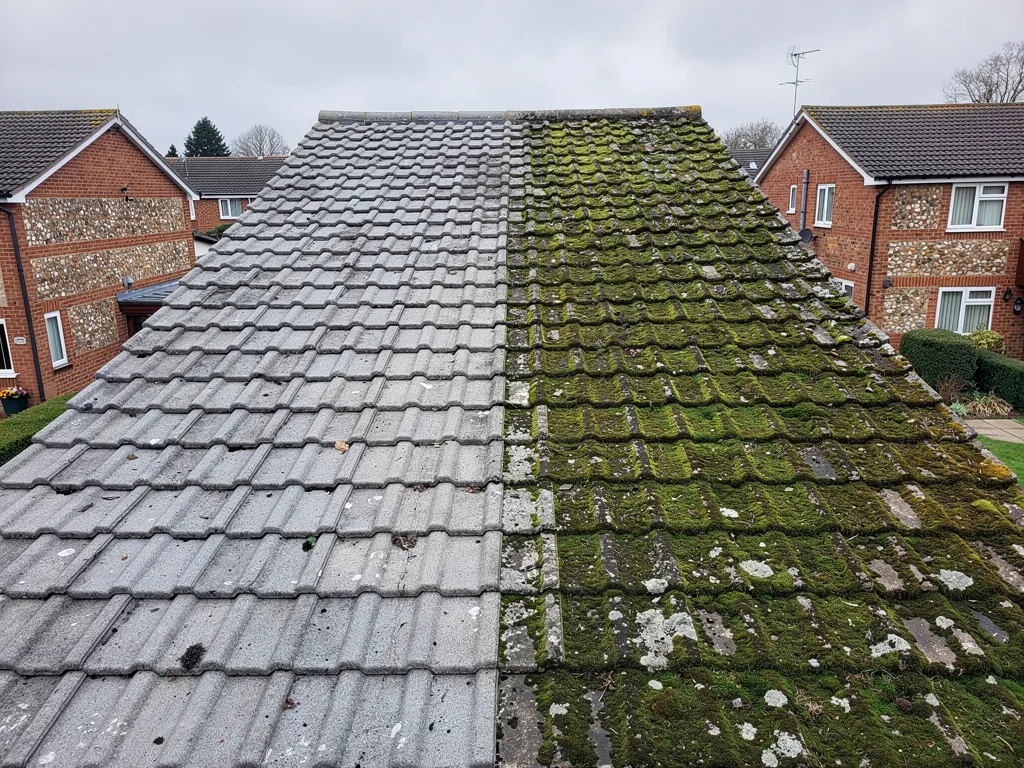
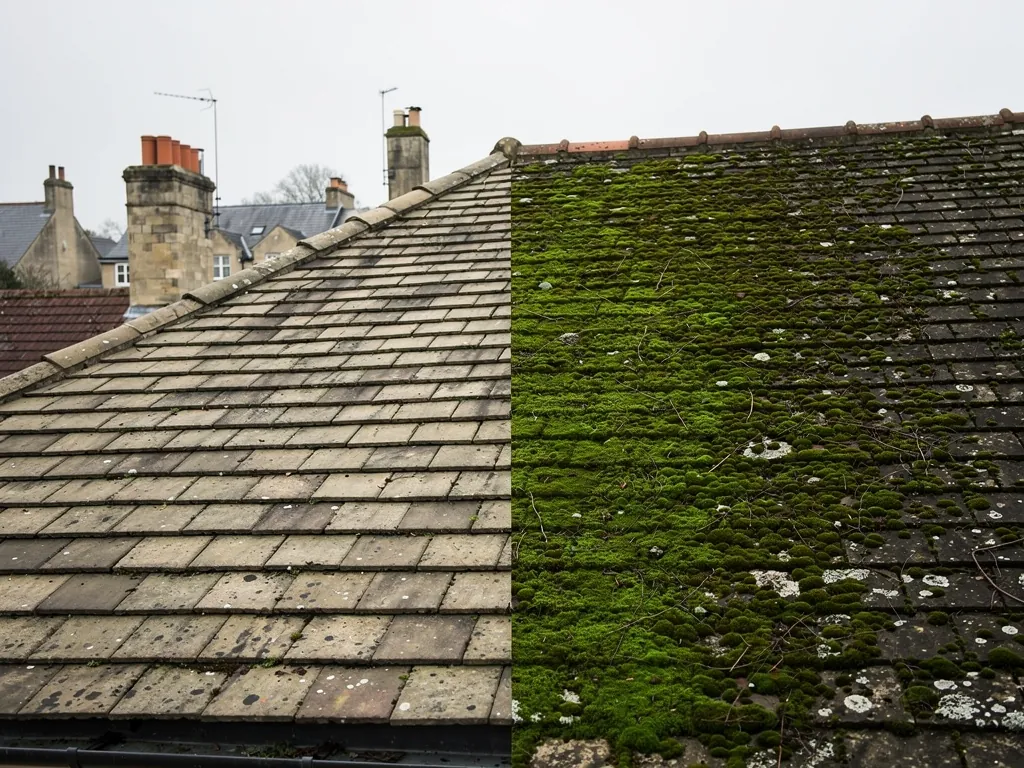
Roof half cleaned, grey tiles beside a moss-covered side
Roof half cleaned beside a moss-covered section of tiles

The short answer

Age is read from the covering, not guessed from the walls. Clay tile, slate and stone each date differently, and many old roofs have been patched in more than one material. We identify the covering and the timbers on survey, photograph both, and tell you whether the roof needs a repair or a re-cover.

A roof is rarely the same age as the house beneath it. Over a few centuries a cottage near St Thomas's may have been re-covered once or twice, patched many times and had a chimney rebuilt, so the roof you see is the sum of many decisions. Reading it is the first job on any survey.

How can you tell which covering is original?

Handmade clay plain tiles have a slight camber and uneven colour, while machine-made ones are flatter and sharper at the edges. Welsh slate is thin and regular, and it spread to villages like this from the nineteenth century as transport improved. Stone is thick and heavy, laid with the biggest pieces low down and small ones near the top. Where two materials share a slope, one of them is a repair, and the join is often where water finds its way in.

What does the loft side give away?

The covering is only half the story. From the loft side we look for daylight, dark water staining on the rafters, softened battens and sagging between the purlins. A roof that looks tired from the lane can be sound underneath, and the reverse happens too: tidy tiles sitting on rotten battens. The underlay is another clue, because an old roof may have none at all, or only a brittle old felt that has cracked along its folds.

Will my cottage need a full re-cover?

Where the carpentry is healthy and the problem is confined, such as slipped tiles, a failed valley or a worn flashing, a repair is the right size of job and you will be told that plainly. Where battens have softened over a whole slope, patching only postpones the bill. Stripping and re-covering with the original tiles, sorted and topped up with matching ones, then serves the building better. Our roof repairs page sets out what a repair visit includes, and the pitched roofing page covers full re-covers.


Q2

Why do ridges fail on later twentieth-century Watchfield roofs?

The answer

Ridge and hip tiles on a later roof were normally bedded in mortar, which cracks and drops out as the roof moves and weathers. Mortar on its own stopped being the accepted fixing with BS 5534:2014, so a repair adds mechanical fixings or changes to a tested dry-fix system.

Homes put up after the war, in Watchfield and across the Vale, share a handful of weak points. None is dramatic, and nearly all of them show up before water reaches a ceiling.

What replaces a ridge that keeps shedding its mortar?

The ridge is the capped line along the apex of the roof, and hips are the sloping lines down its corners. On older work both sat in a mortar bed and were left to hold themselves. Since BS 5534:2014 the mortar has had help: the tiles are fixed mechanically as well. A dry-fix kit tested to BS 8612:2018 swaps the mortar for clips and a vented ridge, and on a roof that has shed its mortar more than once it is often the tidier answer. Our ridge, verge and dry-fix page explains the options.

Why do flashings and valleys leak unseen?

Flashing is the weathering metal, usually lead, that is tucked into a wall joint so rain cannot run behind it. It lifts, splits along its folds and gets tugged by small movements in the chimney stack. A valley is the internal junction between two slopes, and its lining is hidden under the tiles either side, so by the time a stain shows indoors the lining may have been failing for a long time.

Is the garage or extension roof worth patching?

Garages, porches and rear extensions often have flat or low-pitched roofs that age faster than the main roof. Felt blisters and splits, single-ply membranes lose their grip at edges and upstands, and gutters on small roofs silt up unnoticed. You get a plain view on whether a patch can last or a worn short-life roof is better renewed, because paying twice for a patch that was never going to last is the costlier route.

Common faults on a later twentieth-century roof
FaultWhere we lookUsual remedy
Loose ridge or hipTop and corners of the roofRe-bed with mechanical fixings, or fit dry-fix
Cracked tilesSlopes that take the weatherReplace the individual tiles
Lifted flashingChimney sides and wall jointsRenew in lead, dressed and fixed
Failed valley liningInternal junctions of slopesRe-line the valley
Split feltGarages and extensionsPatch, or renew after survey
Q3

Who signs off a re-roof in Watchfield?

Brick end-of-terrace gable beside a limestone house, slate roofs
Industrial units with grey metal roofs beyond a roof under repair

The short answer

Watchfield is in the Vale of White Horse, so building control for notifiable roof work comes through the shared SouthVale service or a registered building control approver. Vale of White Horse District Council answers the planning side. Matching repairs rarely need either, and the route is explained before work starts.

Most roof work in Watchfield needs no permission, because repairs and like-for-like re-roofing count as maintenance. The cases below are the exceptions, and they are worth knowing before a quote is signed.

When does a Watchfield re-roof need approval?

On the Planning Portal's test, no building control application is normally needed while under 25 per cent of the total building envelope and under 50 per cent of the roof is affected. Pass either limit and approval is required, and an insulation upgrade can follow. Approval is also needed when a new covering adds 15 per cent or more to the weight, so a move from clay tile to something heavier starts with a structural check. Vale of White Horse uses the shared SouthVale building control service, with a registered building control approver as the private alternative. When a job is notifiable, we file the notification ourselves.

How do I know if my building is protected?

Is your property listed, or inside a conservation area? That is a question for Vale of White Horse District Council, and it is best answered before work starts. A listed building needs listed building consent for any change that affects its character, and the roof covering counts. The council's own list of Article 4 directions names just one in force, in Abingdon.

What about the village's chapels and churches?

Buildings in religious use have their own rules. An Anglican parish church in use goes through the faculty system, and several other denominations' churches share the ecclesiastical exemption while they are in use. Once a building stops being used for worship, listed building consent applies in the usual way. A former chapel now in other use is treated like any other listed or unlisted building, so check its status with the council first.

MythA new roof always needs building control approval.

FactRepairs and re-covers below the Planning Portal limits do not normally need an application; large re-roofs and heavier coverings are the cases that do.

Questions from Watchfield and Shrivenham way

Do roofs near St Thomas's church need specialist handling?

Not always, but the older ones deserve a careful look first. A stone building with a bellcote has high gables, tight lead detail and awkward access, so we survey from height and photograph what we find. If the roof needs more than a repair, the written quote explains the method and why it suits the building. Smaller outbuildings and porches nearby are usually simpler.

Do you work in Shrivenham as well as Watchfield?

Yes. Shrivenham is about a mile south of Watchfield, and we also cover Faringdon, Highworth and every other place within 30 road miles of the town. The areas page has the full list, and the enquiry form, WhatsApp or a call on 01793 626096 will confirm whether your address is covered.

What do I get in writing before a Watchfield roof job starts?

A written quote that follows the survey, illustrated with pictures taken on your roof. The work carries a 10-year workmanship guarantee in writing. Should the job be notifiable, consent is explained up front and the Building Regulations notification is ours to file, and afterwards nothing is left behind: tools, offcuts and old materials go.

Can you repair a roof that earlier owners patched in several materials?

Yes, and it is common on older village houses. We work out which parts are original, which are repairs and which are failing, then recommend the lightest repair that cures the leak. Sometimes that is a few tiles; sometimes the patches have to be taken back to a single sound covering.

Ask us about your roof

Tell us what’s happening and we’ll call you back.

  • Photos of what we find
  • A written quote
  • 10-year workmanship guarantee

Or call 01793 626096

Call Get a quote