Victorian brick terrace street with slate roofs and chimneys

Roofers in Little Coxwell

Repairs, re-roofing, chimney flashings and lead work in Little Coxwell, the small conservation area village south of Faringdon, from the twelfth-century church of St Mary to the cottages, farms and homes around it.

Little Coxwell's roofs, from St Mary's outwards

Old village church with a pitched tiled roof
The church and the old village heart

St Mary's dates from the twelfth century and was built by Cistercian monks of Beaulieu Abbey as a chapel of ease, which gives the village a core older than almost anything else nearby. Around a building like that you expect older houses, boundary walls and outbuildings, and the council's conservation area, designated in 1971, covers 8.53 hectares of the village. On roofs of this age we start by establishing what the covering truly is today. Old coverings are often patched, and older timbers may have been altered more than once, so we record every slope in photographs before suggesting any work.

Cottage gable with a chimney stack
Cottages and farmhouses in a tiny parish

Little Coxwell is a small village and civil parish, with 132 residents at the 2001 census, and the buildings reflect a place that grew slowly. Cottages tend to have modest roofs with steep pitches and chimney stacks on gables or party walls, and trouble tends to gather at those details, with perished lead, tiles that have crept near the stack and valleys that have sagged. Farmhouses and larger houses have bigger, more complex roofs with several valleys and a lot of ridge. Reading each roof for its covering, its pitch and its age tells us what a sensible repair looks like.

Concrete tiled roof on a newer house
Later houses and garden buildings

Away from the older core, twentieth-century and newer houses mix with garages, garden rooms, porches and extensions. Concrete tiles are a common covering on that kind of work, and they tend to suffer from cracking, from ridge bedding that has come away, and from tired felt or single-ply membranes on the flat sections. The conservation area still matters for these properties if they lie inside the boundary, because some changes need a conversation with the council even on a newer building. Outside the boundary, replacing like with like is usually simple work, priced from the survey photographs.

From Swindon to the Coxwells' edge of the Vale

Map showing Little Coxwell and central Swindon. 11 road miles north-east of central Swindon.

Distance
11 road miles north-east of central Swindon
Council
Vale of White Horse District Council
Conservation area
Little Coxwell, designated in 1971 (8.53 hectares)
Council
Vale of White Horse District Council
Walking route
The Vale Way passes through the south of the village

Roof questions in Little Coxwell

Can I re-roof inside Little Coxwell's conservation area?

Usually, provided the work matches what is there. A different covering, or work on a listed house, is the moment to phone the Vale council before you commit.

Is a lead valley worth repairing on an old cottage?

Often. Lead lasts a long time, so a split or lifted section can usually be repaired or replaced without disturbing the tiles on either side more than necessary.

How near Faringdon is Little Coxwell for roof surveys?

About a mile and a half south of the town, so surveys are easy to arrange. We drive out from Swindon, photograph the roof, and follow up with a written quote.

Q1

Do conservation areas restrict Coxwell roof repairs?

Brick and limestone cottages around a small village green
Rolled lead roof covering over a bay above white windows

The short answer

Not for matching repairs. Re-bedding a ridge, replacing broken tiles or renewing lead in the same materials is maintenance. The council's interest begins with a different covering, new openings in the roof, or any work to a listed building.

The council's conservation area map records that the Little Coxwell area was designated on 3 February 1971 and covers about 8.5 hectares. That is a small area, but a conservation area label tends to worry homeowners more than it should.

Which roof repairs stay simple?

Section 55 of the 1990 planning act says alterations that do not materially affect a building's outward appearance are not counted as development. A matching repair, with the same tile or slate in the same pattern, falls on that side. Most of what we do on older cottage roofs is exactly this: refixing tiles, renewing a worn valley, repointing a verge, lining a gutter.

Which changes deserve a call to the council?

Trading one covering for another, changing the shade or shape of the tiles, adding roof windows or rebuilding a chimney is a different matter. Because a conservation area is designated to protect how a place looks, the council takes an interest in changes visible from the street. The Vale council lists a single Article 4 direction in force, covering a few Thames Street addresses in Abingdon, so the village has none.

What if my house is listed?

Where a house is listed, anything that changes its character, a new type of roof covering included, calls for listed building consent. We will not start work on a listed roof until you have confirmed the position.

These questions belong with the planning team at the district council, and we will describe the work in the terms they need, with materials and method set out plainly.

Our roof repairs page shows what matching work involves on tiled and slated roofs, and the same approach applies to the older buildings in the village.

Before a job goes ahead, we put in writing what is coming off, what is going on and the reason, so you and the council work from the same description.

MythEvery roof job inside a conservation area boundary needs an application.

FactMatching repairs seldom do; a visible change in the look of the roof is what draws the council's attention in the village.

Q2

What does a Little Coxwell cottage roof survey cover?

The answer

The covering, the ridge and verges, valleys and lead, chimneys, gutters and the timbers visible from the loft. Every part is photographed so the written quote can show you what we found, what needs doing now and what can safely wait.

A survey on an older house in a village like this is slower than one on a modern estate, because there is more to read. The photographs are what make it useful, as they let you see exactly what we saw.

What do you check from the ground and the ladder?

We begin with the whole roof from the garden or the lane, looking for slipped tiles, sagging ridges and gaps. Where access is safe we then climb up and take close photographs of tile surfaces, ridge bedding, flashings, valley linings and the stack. Gutters and fascia boards come next, since a blocked gutter causes damp that looks like a roof leak.

What do you look for in the loft?

Inside, we look at the underside of the covering for daylight, damp staining and the condition of the rafters, battens and any old felt. Wet timber, rot and old woodworm are noted but not alarmed over, because a surveyor's job is to describe them.

What does the written quote say?

The written quote lists what needs doing now, what can wait, and why. Our aim is the least work that fixes the fault for good, so when a repair will cure the fault, the repair is the price you see. If the covering is simply worn out and nothing is left to repair, we show you the evidence and explain what a replacement would involve. Our roof inspections and surveys page describes the process in more detail.

Afterwards we clear up and remove all the rubbish. You also receive our ten-year workmanship guarantee, written down.

Q3

When does a Little Coxwell re-roof need building control?

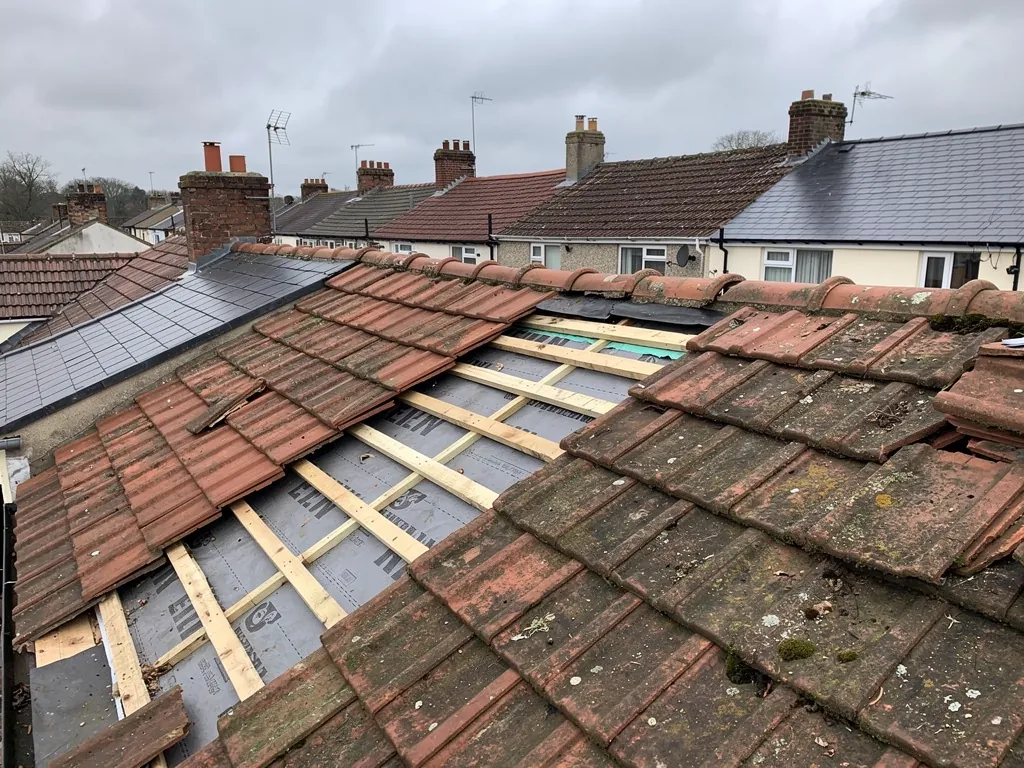
Clay tile roof opened to battens and membrane for repair
Industrial units with grey metal roofs beyond a roof under repair

The short answer

When it goes past the limits in the Planning Portal guidance: 25 per cent of the building envelope or 50 per cent of the roof, structural changes, a covering 15 per cent or more heavier, or a significantly different fire performance. Small repairs sit well below those lines.

Building control is separate from planning. It checks that building work meets the Building Regulations for structure, fire safety and energy use, and a roof falls under it in particular cases.

What are the usual limits?

The Planning Portal sets out when a re-roof or repair does not normally need an application: less than 25 per cent of the total building envelope affected, and less than 50 per cent of the roof. Beyond that, approval is needed, and the work can carry a requirement to improve the roof's insulation.

Do weight and fire performance matter?

A new covering that increases the roof's weight by 15 per cent or more needs approval, and so does one that performs significantly differently in a fire. Approved Document A treats a load increase of more than 15 per cent as significant, so the structure gets checked whenever the material changes.

Who deals with building control here?

The district council runs building control jointly with South Oxfordshire under the Southvale name, while a registered building control approver offers a private route. Which applies to your job, and who submits the notice, is settled with you at the survey.

Is planning a separate question?

These are a separate matter from building control. A job can need one, both, or neither, and we tell you which at the survey.

For larger works, the application is made before the job starts, not afterwards, which is why we raise it early. A tiled roof that needs stripping to the rafters is the usual trigger, since replacing the whole covering and the battens on a large pitch can pass the roof limit by itself. Our roof replacement page explains what that kind of job involves.

On a small village house, a simple conversation at the survey is normally enough to settle the route: we measure the roof against the limits, note the weight of the old and new coverings, and write the answer into the quote. Where building control is involved, the notice is lodged ahead of the first tile coming off, which saves you chasing paperwork later.


When a re-roof may need building control
SituationUsual result
Less than 25 per cent of the building envelope and less than 50 per cent of the roofNo application normally needed
Either limit exceededApproval needed, possible insulation upgrade
Covering 15 per cent or more heavierApproval needed
Structural alterationsApproval needed

Questions from the Vale Way

Why are chimney stacks such a common source of leaks on Little Coxwell cottages?

A stack is where the roof meets masonry, so water finds the junction long before it finds the middle of a slope. Lead flashings crack, the mortar flaunching on top of the stack crumbles, and the brickwork itself can let water through. We check all three on every survey and repair what has failed.

Do you cover the Coxwells and the other villages near Faringdon?

Yes. Little Coxwell, Great Coxwell, Faringdon and the villages round about sit comfortably inside the area we serve around Swindon. Each place is named on our areas pages, and the enquiry form works from any of them.

Is Little Coxwell church roof work different from a house roof?

Yes, mainly in how it is approved. St Mary's is Anglican, so for as long as it is used for worship the ecclesiastical exemption applies and the diocesan faculty route governs changes. A house, listed or not, follows planning and listed building rules, which we explain at the survey.

Can a small lead repair fix a leak beside a Coxwell chimney?

Often. If the lead is split in one place but sound elsewhere, a patch or a short new section may do, and that is the cheaper route. If the lead has gone brittle across the whole flashing, a new one is the proper answer. The survey photographs show which of the two you have.

Ask us about your roof

Tell us what’s happening and we’ll call you back.

  • Photos of what we find
  • A written quote
  • 10-year workmanship guarantee

Or call 01793 626096

Call Get a quote