
Anyone asking what it costs to clear spray foam from a loft wants a number, and a published one does exist. MyBuilder's price guide, updated on 21 August 2026, puts removal at £20 to £50 per square metre, and says a typical job averages about £1,500. That is a national figure for the foam alone, and the final bill on a real house depends on matters no guide can see: how the foam was applied, what it clings to, how high the eaves sit and whether the timbers behind it prove to be dry and firm.
The pages below follow a job in the order it happens: assessment, stripping, disposal, access, then insulation and repairs going back in. They also cover the cost outside the roof itself, because lenders, surveyors and insurers all shape whether removal is worth paying for. Our spray foam insulation removal service page describes the work we carry out.
The headline range and what it assumes
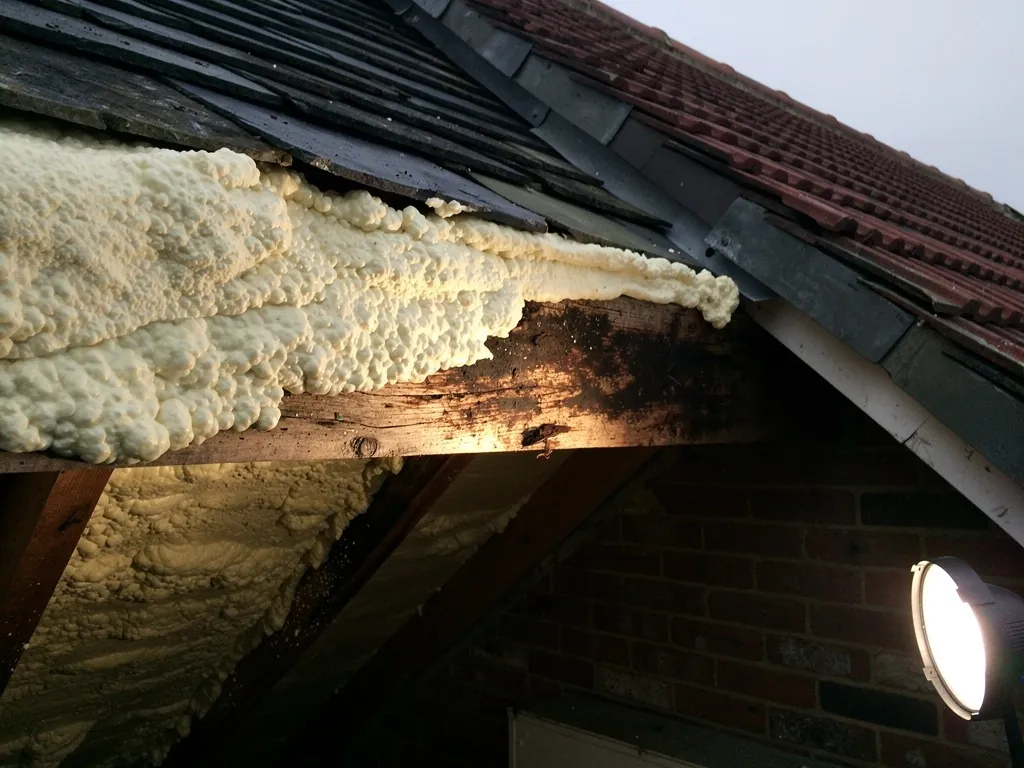
The figure most people meet first is MyBuilder's £20 to £50 per square metre, and an average near £1,500 for a whole job. Read it as a spread, not a price. The low end suits a thin layer sprayed onto a clean surface, where the foam lifts away in sheets. The high end belongs to foam applied deep, over uneven timber, or sprayed hard against the back of tiles and slates, where every strip has to be coaxed off without cracking the covering above.
The same guide splits a whole project into stages. They are worth seeing side by side, because taking the foam off is rarely the only expense.
| Stage of the project | MyBuilder range (updated 21/08/2026) |
|---|---|
| Assessment before work | £100 to £200 |
| Removal of the foam | £20 to £50 per square metre |
| Disposal | £150 to £400 |
| Scaffold | £500 to £1,500 |
| Repairs and new insulation | £500 to £3,000 |
All of these come from one published national guide and are not our prices. A simple roof with good access will land nearer the bottom of each range than a cut-up roof on a tall house. Because every stage depends on what the loft shows, nobody can responsibly give an exact total over the phone. Your own figure arrives as a written quote after we have surveyed.
Assessment: what the first £100 to £200 buys
MyBuilder lists an assessment at £100 to £200. It is the step that stops everyone guessing, and it decides which end of the removal range you belong in.
An assessment is a look at the foam and the roof together. Someone goes into the loft, works out whether the foam is open cell or closed cell, measures how thick it is, notes what it has been sprayed onto and inspects any timber that can still be seen. Moisture readings and gentle probing of exposed wood show whether anything has been getting wet. Rafters buried under thick closed-cell foam cannot be examined until some of it is removed, so a useful assessment names what could be seen, what could not and how that gap might move the final price.
Is the assessment worth doing before deciding on removal?
Usually, yes, because it turns a vague worry into a defined job. You find out whether the foam is the sort that is easy to strip, whether tiles or slates are stuck to it and whether any staining hints at old leaks. After our survey you receive photographs from inside your loft and a written quote, and the spray foam assessment guide lists what is checked and what a report contains.
Some people order an assessment only to satisfy a surveyor or lender, with no plan to remove anything. That is a legitimate use of it, and the report is written to stand on its own.
Stripping the foam: area, depth and what it is stuck to
The per-square-metre rate pays for labour to get the foam off, so start by asking how much roof there is. A modest semi-detached with one pitch has far less to clear than a detached house with several hips and a rear extension, and the area counts every rafter face, gable end and chimney breast that was sprayed, not only the main slopes.
Depth and grip come next. Closed-cell foam is rigid and clings firmly to timber, slate, tile and felt, so it takes longer and produces more waste than a flexible open-cell layer. Foam sprayed straight onto the back of tiles or slates is the slowest case, because the covering has to survive the process. Where it has gone onto a breathable membrane or an old roof with soft lime bedding, the surface is easily marked, and care costs time. Our guides on open and closed cell foam and on the removal process explain the difference.
Why does tight access cost more?
Eaves that taper to a few centimetres, trussed roofs full of timber webbing and lofts crowded with stored belongings slow every strip. Hours on site are the main thing a per-square-metre rate stands for, so awkward geometry pushes a job up the range quickly. A workable gap between rafters and a clear route to the hatch do the opposite.
Height matters too. A loft at the top of a three-storey house means carrying waste further and sometimes erecting scaffold, which the later sections cover.
Disposal: £150 to £400 and why it varies
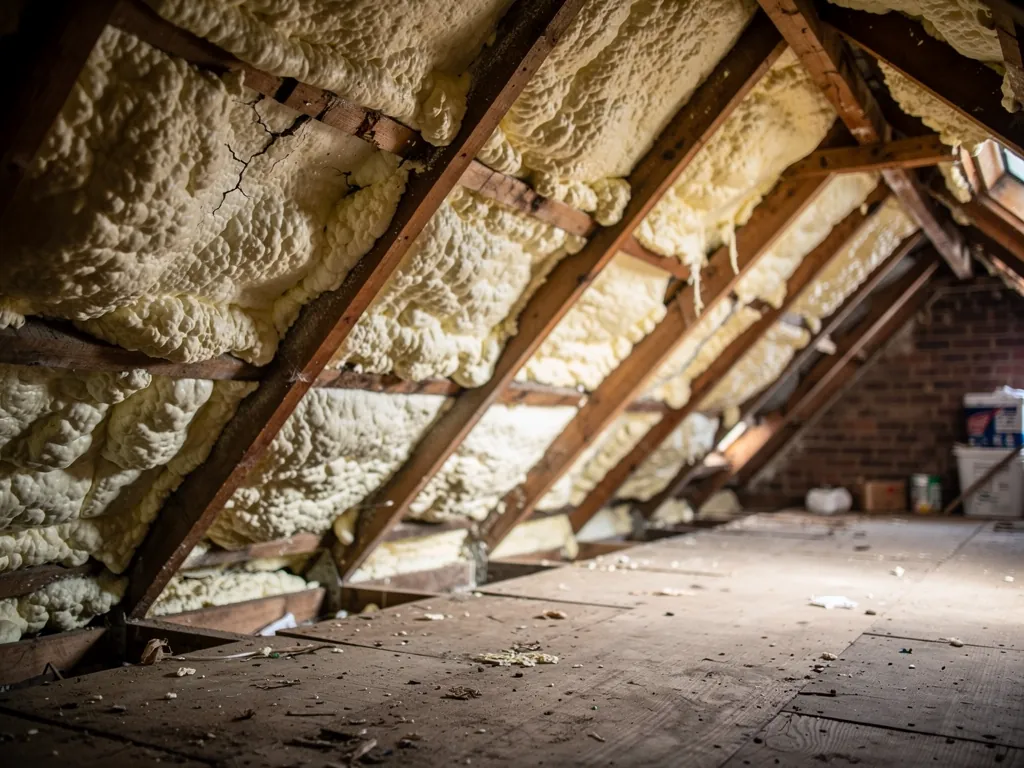
MyBuilder puts disposal at £150 to £400. Removed foam is bulky, light and hard to compact, so a modest roof can fill a surprising number of bags. It also arrives mixed with dust, offcuts and the occasional strip of timber, so it cannot simply go into a household bin.
Foam from a building job is trade waste, and whoever carries it away should be a registered waste carrier. If you are paying a separate firm, ask to see the carrier details. When we take the work on, the waste leaves with us and the site is left tidy, so no heap stays on the drive. Distance to a suitable disposal point and the volume of foam both nudge the figure, which is why disposal tends to sit higher on a large closed-cell job than on a thin open-cell layer.
If a quote does not state who takes the foam away, ask. A low price that leaves the waste with you is not comparable with a higher one that clears the site.
Can I cut the cost by taking the waste to the tip myself?
Household recycling centres often limit or refuse building waste, and loose foam is awkward in a car. The saving is usually small and the effort real, so many people let the contractor deal with it.
Scaffold, VAT and the questions to put to any quote
Foam comes off the underside, so you might expect no scaffold. In practice it features in plenty of jobs, because the covering is often lifted or replaced from outside, rafter ends are repaired at the eaves, or the underlay needs checking from above. MyBuilder shows scaffolding at £500 to £1,500 within its removal guide, a wide spread that reflects house height, the number of elevations and how long the frame stays up.
Put two questions to every quote you receive, ours included. Does the price include scaffolding, or will it be added later? Does it include VAT? A figure that looks lower can be the one that leaves out both, so settle the answers before comparing totals. Scaffold is likelier on a two-storey house with foam sprayed deep into the eaves than on a bungalow.
Can a job avoid scaffold altogether?
Sometimes. If everything can be done from inside and the covering stays untouched, a frame may not be needed. The survey shows which side of that line your roof falls on, and the written quote tells you plainly whether access equipment is part of the price.
It is also sensible to ask how long any scaffold will stay up. Weather delays and repairs found late in the job stretch the hire period, and a clear answer beforehand avoids an argument afterwards.
Repairs and new insulation: the widest range of all
The biggest spread in the guide belongs to the last stage: £500 to £3,000 for repairs and new insulation. The width is honest, because it covers very different outcomes. At one end the rafters are firm, the underlay whole and the loft simply needs conventional insulation fitted. At the other, rafters have been wet, battens need replacing, patches of underlay have failed and the replacement insulation must be designed around ventilation.
Energy Saving Trust advice, last updated on 8 May 2026, warns that a roof which leaks or suffers condensation puts its timbers at risk of rot, with open cell foam the gentler of the two. You will not know which outcome applies until the foam is off and the wood can be seen. How damp and decay are looked for appears in our guide to inspecting rafters after spray foam, and what goes back in is covered in the guide to reinsulating the loft.
This is why the smallest sensible job is not always the one with the lowest figure on paper. We recommend only the work that properly cures the fault, and the survey separates repairs the roof needs from repairs it does not.
Is removal worth paying for?
The price of removal sits beside the price of leaving things alone, and three outside voices shape that comparison. The RICS consumer guide cautions that insulation fitted badly may cause dampness, including uncontrolled condensation, that foam can colour a surveyor's view of a home's value, and that taking it out could damage the existing structure. Our summary of what RICS says walks through the guide.
Lenders matter as well. Reporting in November 2024 found that some lenders turned down mortgages on homes with spray foam, while others weighed each property individually. If you are selling or remortgaging, the cost of removal can be weighed against the cost of a stalled sale. Our guides on spray foam and mortgages and spray foam and equity release cover each route. As the RICS guide itself advises, speak to your mortgage provider and your insurer before deciding.
Whether foam has to come out at all is a separate matter, and the answer is not always yes. Our page on whether spray foam must be removed sets out when it is worth considering.
Removal is a decision about your roof, your lender and your plans, not a rule. A survey with photographs gives you the facts to make it.