
Spray foam goes on as a liquid and cures into something that grips like glue, so lifting it is slow, physical work. No solvent or machine melts it away. Crews rely on blades, scrapers and powered tools in the loft, and the time taken follows the foam type, its depth and the surface it is stuck to. The rafters, battens, underlay and covering all have to emerge in good order, which is why the method matters as much as the speed.
This guide sets out the usual running order: protecting the house, taking the foam off by type, dealing with waste, then examining the roof once it is bare. If you are still deciding whether to go ahead, our answer on whether spray foam must be removed is the better place to start, and the spray foam insulation removal page describes the service as a whole.
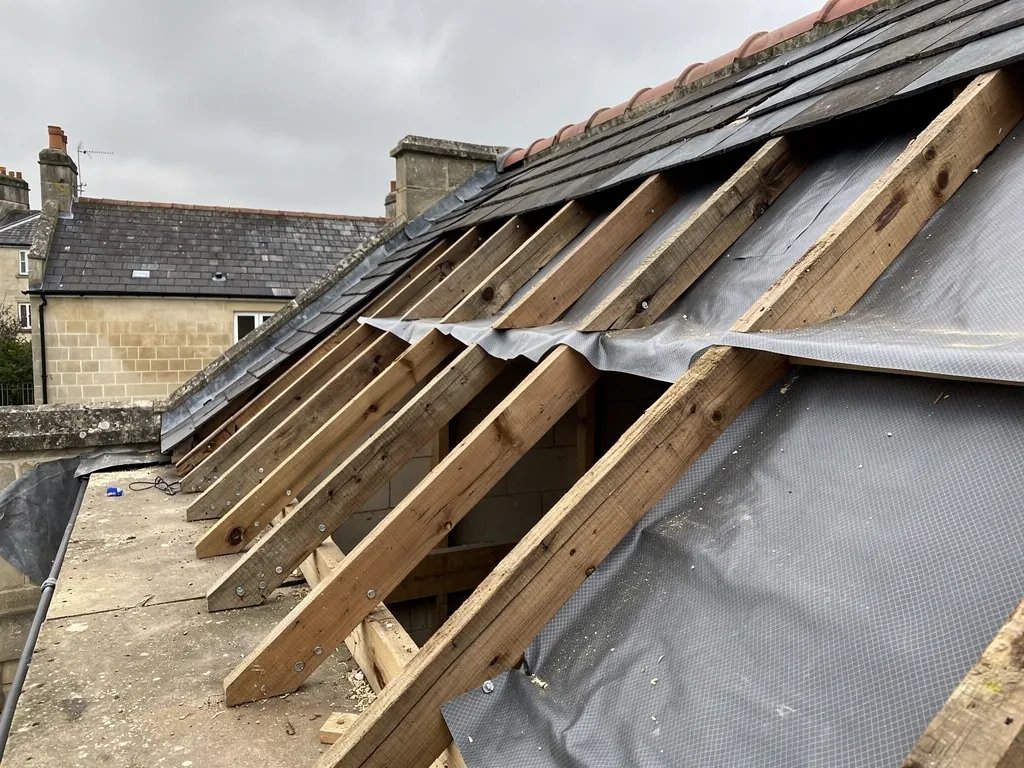
Before anything is touched: protection and preparation
The first job in a loft is to stop the house paying for the work above it. Boards or sheeting go down over the landing and the route from the front door, and stored belongings are cleared or covered. The hatch is sealed with plastic where practical, so fine dust cannot drift into bedrooms. Lights, cables and any tanks are marked so nobody puts a blade through them.
Foam dust is a nuisance rather than a mystery: it is fine, light and gets everywhere. Anyone doing the work wears a proper dust mask and eye protection, and a vacuum with a suitable filter runs alongside the tools to collect dust at the source before it settles. Airing the roof space while work is under way helps as well.
Does the family need to move out?
Most households stay put. A loft job leaves the rooms below usable, apart from the landing and the stairs, which are in constant use for carrying equipment and bags. Pets are best kept in a room away from the hatch, and a bedroom directly under the work area may be uncomfortable on the loudest days.
Not normally for a standard loft job, though much depends on the extent of the foam and how the rooms below are arranged. We explain what to expect during the survey, so you can plan around the noisiest days.
Where foam has been sprayed over tiles or slates, a look from outside may also be needed, so access and any scaffold are confirmed at the same visit. The price arrives in writing after that visit.
Removing open cell foam
Open cell foam is softer and lighter. It has a spongy, crumbly structure of tiny pockets that are not sealed from one another, and it is usually sprayed thickly to reach the same insulation value as a thinner closed cell layer. That depth is why open cell jobs can still be large.
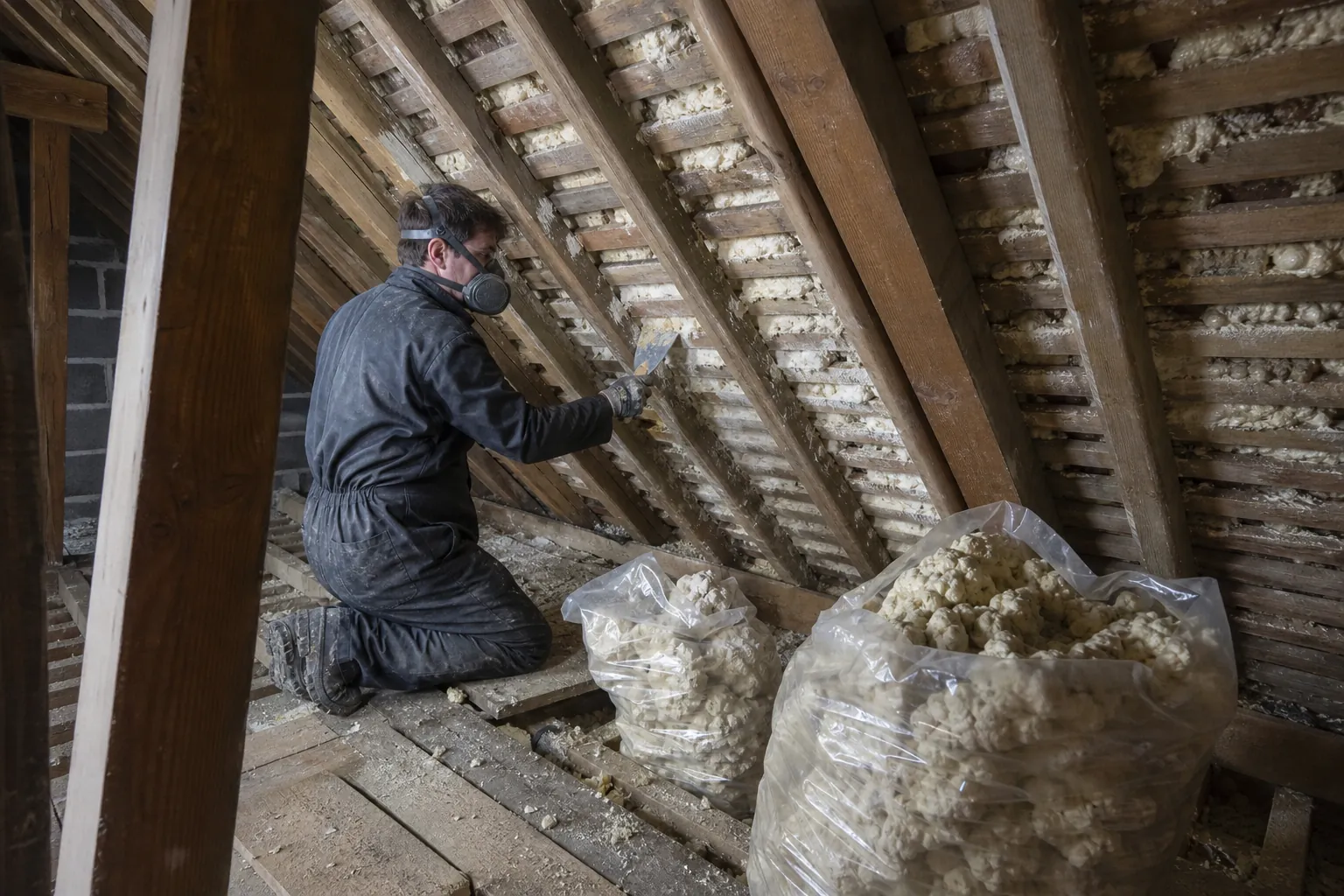
It is cut away with sharp blades or scraped off the rafters with flat tools, working along each timber in turn. Because the material is flexible, it comes away in lumps and can often be peeled from the wood face, although residue clings in the grain of rough-sawn timber. A vacuum follows to pick up the crumbs. Energy Saving Trust advice dated 8 May 2026 suggests rot is a smaller worry under open cell than closed cell, but that does not let anyone assume the wood is sound. It still gets checked once uncovered.
Our guide to open cell and closed cell foam shows how to tell which you have by pressing a thumb into the surface and looking at the colour and texture.
Removing closed cell foam
Closed cell foam is dense and rigid, with sealed cells that grip whatever it was sprayed onto. It is the harder type to remove and the one likelier to leave residue behind.
The usual approach is to cut it into manageable blocks, then lever and scrape each block free of the rafter. Oscillating tools and rotating wire brushes clean up what the blades leave on the face of the timber. Work slows around nail heads, the junctions between rafters and the eaves, where foam has flowed into gaps and set solid. The aim is to lift foam without gouging the wood, because a rafter scored deeply has lost some of its section.
Where the foam was applied straight to the back of tiles or slates, removal is delicate. Slates and clay tiles can crack if foam is wrenched away, and lead details around chimneys and valleys can be dragged out of position. In some cases the covering is lifted in sections so the foam can be freed from outside, then relaid or renewed. Our answer on spray foam on the underside of tiles explains the choices.
Rigid foam can hide a tired roof as easily as it can protect a good one. Expect the covering and the timbers to be inspected as they are uncovered.
Waste, dust and clearing up
Stripped foam is bulky and light, so it is bagged as it comes off and carried out in stages, never dropped down the stairs. Carrying bags through the house is where good protection earns its keep. The bags go off as trade waste, and we leave the site cleared with the waste taken away.
After the bulk is out, the loft is vacuumed from the highest point down, so dust falls towards areas not yet cleaned. Boards and sheeting come up last and the route through the house is wiped over. Fine dust can still appear for a few days, even after a thorough clean, because the vacuum cannot reach every crevice in an old roof space, particularly on top of cupboards and ledges, so we mention that before we begin.
Can foam be burned or left on site?
No. Treat it as waste to be removed by a registered carrier. If you are arranging disposal yourself, ask for the carrier details first. Our guide to spray foam removal cost shows the published range for disposal.
Noise is the other thing to plan for, and the one people least expect. Scraping and powered tools carry through a house, so shift workers, babies and home offices are worth mentioning at the survey. A little warning lets us order the work so the loudest stages fall at sensible times. Neighbours in a terrace or semi-detached house also hear more than you might expect through a party wall, so a quick word with them beforehand is a courtesy that tends to be appreciated, and it costs nothing at all.
The roof checks that follow removal
Removal is only half the job, because the real reason to take foam off is often what it was covering. Once the underside of the roof is visible, every part is examined: rafters, purlins, wall plates, battens, the back of the tiles or slates and the underlay where there is one.
The checks are practical. Timber is probed to see whether the surface has gone soft, and moisture readings are taken along the rafters and at the eaves, where condensation and leaks tend to collect. Nail heads and clips are inspected for corrosion. The underlay is checked for tears, tide marks and sagging. Slates and tiles are looked over for cracks, slipped courses and daylight that was never visible through the foam. Energy Saving Trust guidance links timber rot to roofs that leak or collect condensation, which is why this stage is never skipped.
What we look for, and what follows when damage turns up, is set out in inspecting rafters after spray foam. Photographs are taken at this point, so you can see the same timber we saw.
When the roof is sound, and when it is not
Where the wood is dry and firm, the underlay whole and the covering good, we clean the roof, confirm the ventilation and fit conventional insulation. That route is quickest and usually the least costly, and it is the result everyone hopes for.
If the survey finds soft or stained wood, the repair matches the fault. A small area of surface decay may be treated and left; a damaged rafter end may be cut back with a fresh length fixed beside it; a failed batten or stretch of underlay is replaced. Where the covering is beyond sensible repair, we explain whether replacing the covering makes more sense. We recommend the least work that properly cures what the open roof reveals, and nothing is added for its own sake.
Is the roof ventilated properly afterwards?
Once foam is gone, a roof designed to breathe needs to be able to do so again. Our answer on ventilation after spray foam removal goes through what we check, and the guide to reinsulating the loft covers what replaces the foam.
A roof that has had foam on it for several years may also have settled, with battens bowed or underlay stretched. Those are noted and priced at the same time, rather than discovered after the new insulation is in.
Gutters and fascias get a glance too. If water has been overflowing at the eaves, the ends of the rafters are the first place it will have gone, and a short ladder inspection from outside often explains a stain that looked mysterious from inside the loft. Anything found is photographed and added to your quote, so nothing arrives as a surprise and no work you have not agreed.
Paperwork, lenders and insurers after the work
People often remove foam because a surveyor, a lender or an insurer raised a concern, and the paperwork afterwards can matter as much as the roof. Keep the photographs, the written quote and anything recording what was found beneath the foam.
The RICS consumer guide advises asking your mortgage provider whether its policy permits spray foam, and putting the same question to your insurer. Reporting in November 2024 found some lenders turning down mortgages on foamed homes, with others weighing each case on its merits, so evidence that the roof timbers are sound after removal is worth having to hand. Our guides on spray foam and mortgages and the effect on home insurance explain how each side tends to view it.
How a lender or insurer responds is their decision, and nobody can promise it in advance. What we provide is a clear photographic record of the roof, which is the kind of evidence they tend to ask to see.