
Spray foam insulation arrives as a liquid and expands in place. That is its appeal: it fills awkward gaps and goes on in a day. It is also the source of the trouble that brings most people to this page, because once it has cured on the underside of a roof it is very hard to inspect what lies beneath. Two kinds are sold, open cell and closed cell, and the choice affects how damp is handled, how easy the foam is to remove and how a surveyor or lender is likely to react.
We are not here to condemn all spray foam. The RICS consumer guide warns that poor installation can bring dampness, including uncontrolled condensation, and that is worth holding on to: the risk lies in the workmanship and the roof beneath as much as in the product. The sections below take the two types in turn, then the risks that apply to both. For what removal involves, see the spray foam removal process.
What the two foams are, in plain terms
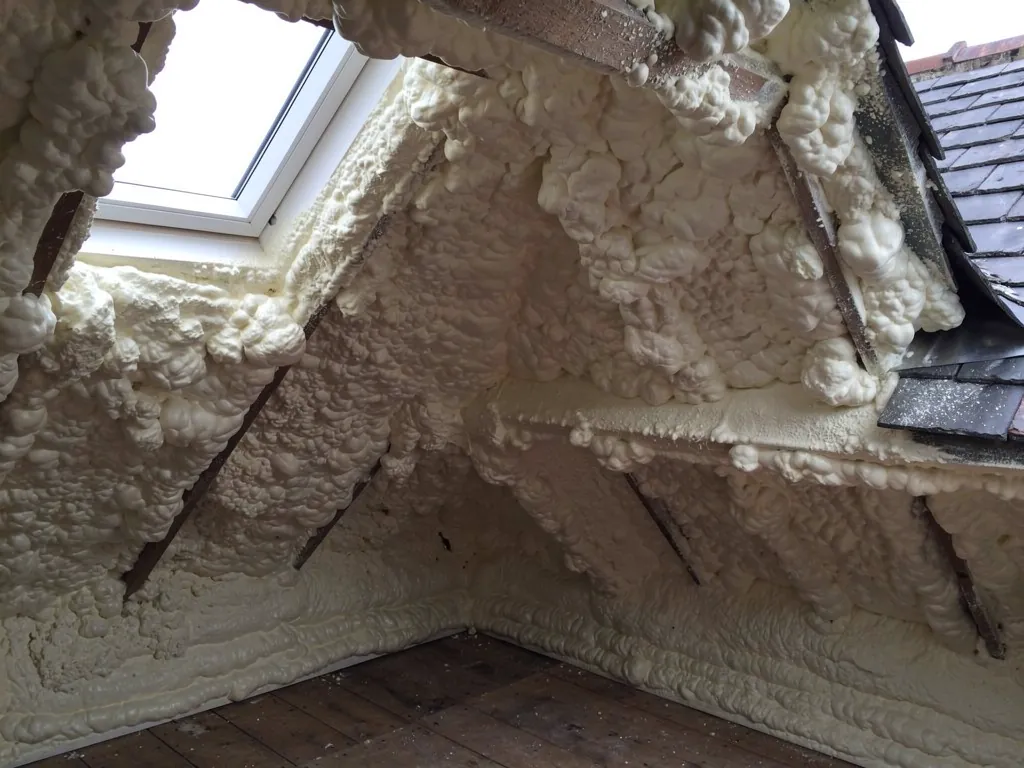
Both foams are polyurethane or similar chemistry mixed at the nozzle and sprayed so that they rise into a mass of tiny cells. The difference is in those cells. In open-cell foam the cells are not fully sealed, so the finished material is soft, light and sponge-like, and air and water vapour can move through it. In closed-cell foam the cells are sealed, so the material is dense, hard and far more resistant to vapour passing through.
You can usually tell them apart by touch. Press a thumb into open-cell foam and it gives and springs back, a bit like a pale kitchen sponge. Closed-cell foam feels firm, resists a thumb and sounds hard when tapped. Colour is not a reliable guide, because installers add dyes, so the thumb test and the installer's paperwork tell you more.
Which one gives more insulation?
Closed-cell foam generally insulates better for a given thickness, because of the gas held in its sealed cells. That is why it is sold where depth is limited, such as between narrow rafters. Open-cell foam needs more thickness to reach the same result, and in a roof that can mean filling the whole rafter depth, leaving no air gap behind it. Neither type, however, is a substitute for a sound roof covering.
How foam ends up on a roof, and why that matters
In a roof, the usual method is to coat the rafters and the tile or slate undersides with foam, so the roof space becomes warm and no longer needs the ventilation a traditional cold loft relies on. This is sometimes called a warm roof or a hot roof. The Energy Saving Trust does not recommend the sales pitch in which a leaking roof is treated with foam from below and the leak itself is left unrepaired.
The foam also sticks fast to whatever it touches. It sticks to the back of tiles and slates, to the felt if there is any, and to the timbers, so the roof becomes a laminated assembly. A slipped tile can no longer be lifted and relaid in the normal way without disturbing the foam. A rafter that begins to rot is hidden. If the roof leaks, water does not fall visibly onto the loft floor, because the foam holds or redirects it.
Does foam ever suit a roof?
It can, where the roof covering is watertight, the installer has worked out the condensation risk and the owner has told the lender and insurer. RICS advises that thermal calculations and condensation risk checks should be carried out by a qualified professional before installation. Problems come where those steps were skipped, or where foam was sprayed as a quick fix over a fault that was never repaired.
The moisture question: why timbers are the concern
Timber rots when it stays damp, and the worry with any foam fixed to the underside of a roof is that moisture gets in and cannot get out. There are two routes. One is a leak from outside, through a cracked tile, a failed flashing or a gap at a valley. The other is condensation from inside, when humid air escaping from the rooms below meets a cold surface and turns to droplets.
The two foams respond differently. Closed-cell foam resists vapour, so it can trap moisture against the rafter faces on one side and the roof covering on the other. Open-cell foam lets vapour pass, and the Energy Saving Trust expects the chance of rotting timbers to be far smaller with open-cell foam, though that is a lower risk and not an absent one. Open-cell foam that gets wet can hold the moisture against the wood, and a roof that leaks above open-cell foam may stay damp for long stretches without anyone noticing.
Rafters rot when a roof leaks or condensation forms, as the Energy Saving Trust points out. Neither foam removes that danger, and both can conceal it.
How do you know if the timbers are sound?
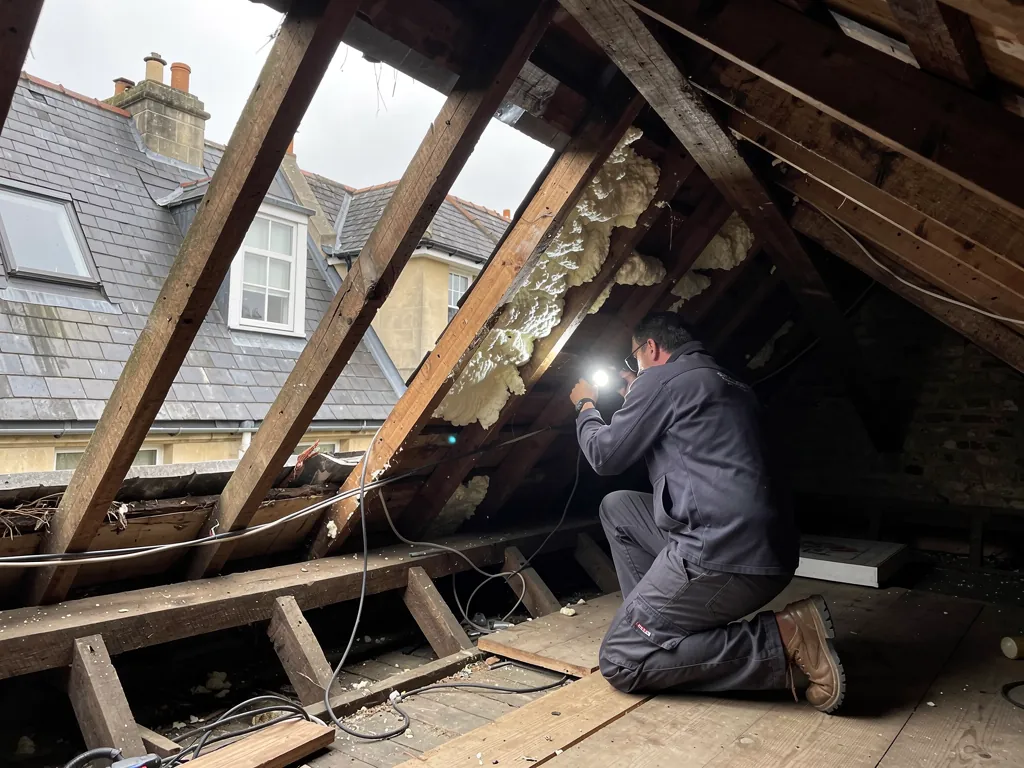
From the loft you cannot see them, and a moisture meter reading taken through foam is only an indication. That is why a proper assessment involves a timber inspection, with the foam opened or removed in sample areas so the rafters can be probed and measured. Our guide to spray foam timber inspection sets out how that works.
Risks both types share: lenders, insurers and valuation
The lending and insurance side does not generally distinguish between the two foams in the way a builder does. It treats spray foam in a roof as a single category that needs checking. RICS tells owners to check with the mortgage provider and the insurer whether foam is allowed at all, and warns that its presence can colour a surveyor's view of what the house is worth.
On lending, the picture has been moving. Reports in November 2024 had some lenders refusing foamed houses outright, with others taking a view on each application. That is a snapshot from one month, not a standing list, so anyone buying, selling or remortgaging should put the question to their own lender. A sale can stall at survey stage, and a buyer's surveyor may ask for a timber report or removal.
Does listing or protection change the position?
RICS says foam should not be put into a listed or otherwise protected building without consent first, and taking it out may harm the fabric underneath. Where a home carries a listing or sits in a conservation area, speak to the council before anything is sprayed or stripped. Our pages on spray foam insulation removal and on reinsulating afterwards explain the practical side, and RICS publishes its consumer guide to spray foam insulation for owners.
Is one type harder to take out than the other?
In general, yes. Open-cell foam is soft and can often be cut, scraped or pulled away in sections. Closed-cell foam is hard and clings firmly, so it tends to come off in smaller pieces, with more effort and more risk of disturbing what it is stuck to. Both leave residue on timbers and the backs of tiles that has to be cleaned, and on slate or old clay tiles the work needs particular care to avoid cracking the covering.
Neither removal job is a case of simply pulling a layer off. The foam is taken out in a controlled way, bagged and disposed of, the timbers are exposed and checked, and any damaged timber is dealt with before new insulation goes in. MyBuilder puts spray foam removal at between £20 and £50 per m² and an average of around £1,500, updated 21/08/2026, with assessment, disposal, repairs and scaffold as further items on some jobs. Those are national guide figures and a roof with difficult access or damaged timbers can fall outside them.
Must spray foam always come out?
No. Whether it should be removed depends on the condition of the roof beneath, the type of foam, how it was installed, and what a lender, insurer or buyer will accept. Our answer on whether spray foam must be removed goes through those factors, and the page on spray foam and roof replacement covers what happens when the covering itself needs renewing.
Working out which foam you have
If you bought a house with foam already installed, the first job is to establish what it is. Look for paperwork: an installer's certificate, a data sheet, a guarantee, a specification or a building control record. Ask the vendor or the installer for the product name, since the manufacturer's data sheet states whether it is open or closed cell. A survey report may also name it.
Without paperwork, go by touch and by sight. Foam that is pale, soft and springy, and can be pressed in, is open-cell. Foam that is firm, dense and slightly shiny or tight on the surface is closed-cell. Standing at the hatch, you can sometimes see the depth of the layer where it meets the eaves. Take photographs of the foam, the rafters and any stains, because those help whoever assesses it, and avoid cutting into the foam yourself, since that can damage the roof covering above it.
What does an assessment look at?
We look at the foam type and thickness, the condition and age of the roof covering, signs of past or present leaks, ventilation, the state of the timbers in sample areas and the paperwork. The findings come back in writing with survey photographs which a lender, insurer or buyer can be given. Our page on the spray foam assessment sets out the steps.
Making the decision with the right information
The sensible order is to find out the facts first and decide after. Establish the type of foam, then the condition of the timbers, then what your mortgage provider and insurer say about it. After that you can choose between keeping it, partly removing it or taking it all out. We aim for the least work that cures the actual fault, and on some roofs that means a dry, well-documented installation left alone.
Where the answer is removal, the work is followed by new insulation, and the choice there is wide: a conventional cold-roof layout with mineral wool and ventilation, or a rigid board system between and over the rafters. Our guide to reinsulating after foam covers the options.
Pictures of the foam and timbers in your loft come with our survey, then a written quote. Work is covered by a 10-year workmanship guarantee, in writing. Phone 01793 626096, or get in touch by WhatsApp or the enquiry form.