
Spray foam in the roof space has turned into one of the questions that surfaces halfway through a sale. The buyer's surveyor climbs into the loft, sees a pale or grey layer sprayed hard against the roof covering, and writes a line about it. The mortgage valuer repeats the line, the conveyancer chases a letter, and what looked like a straightforward chain develops a gap.
Nothing about that is fatal. Plenty of homes with foam are sold, some to cash buyers, some to purchasers whose lenders accept a roof report, and some after the foam has been removed. What helps is knowing your options before a buyer's surveyor does. This guide sets them out in the order sellers tend to meet them, from finding out what you have to the price and timing of each path. For the removal side, see our spray foam insulation removal page.
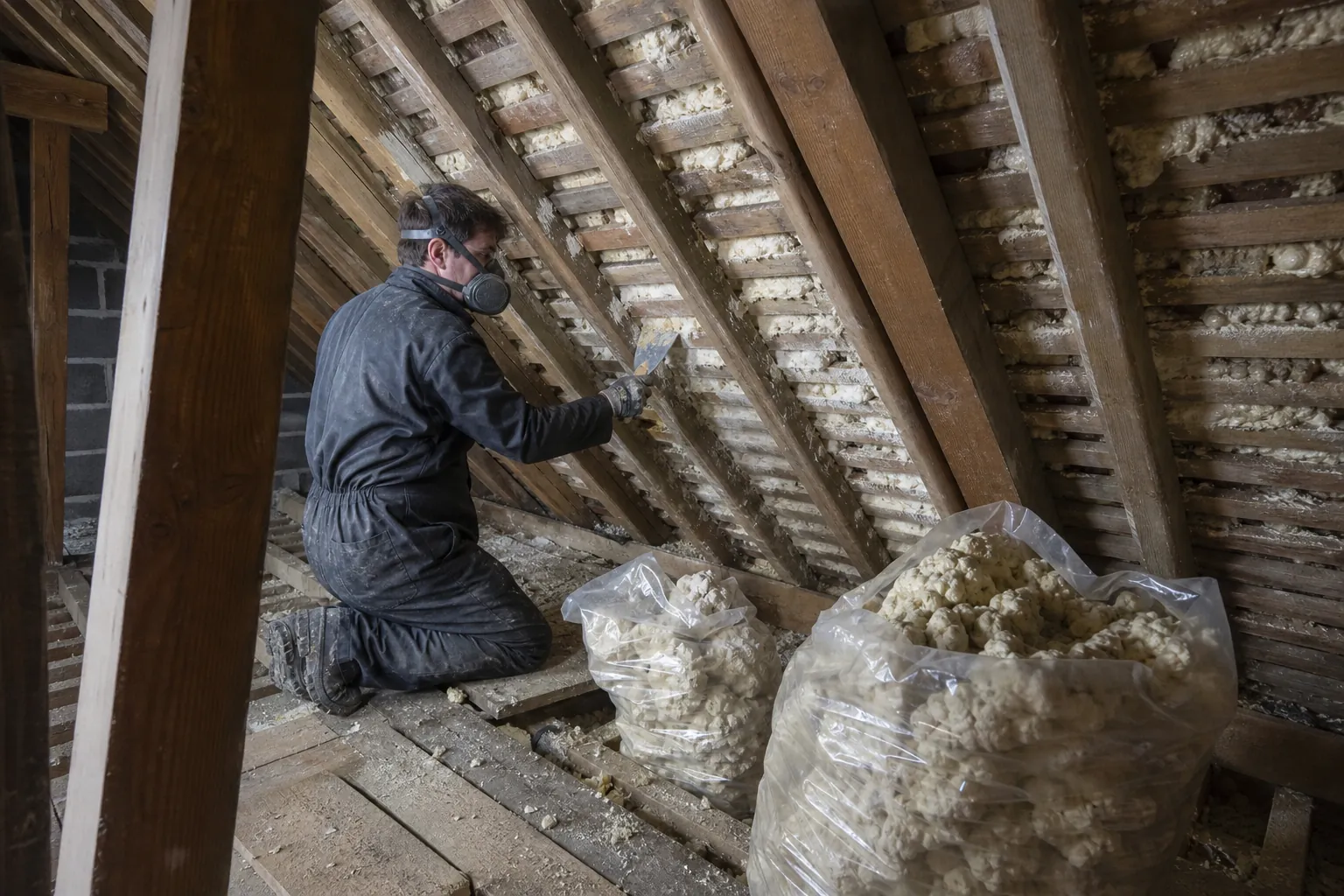
Find out what you actually have before you list
Many sellers do not know the full story of the foam in their own loft. It may have been sprayed by a previous owner, by a landlord, or as part of an energy upgrade nobody wrote down. Before you list, collect whatever paperwork exists: the invoice, any guarantee, the product name, the date and whether a condensation risk assessment was ever done. If none exists, that is worth knowing too, since a buyer's solicitor is likely to ask.
Then go up and look, or arrange for someone to do so. Two things matter. First, whether it is open-cell foam, which is soft, light and pale, or closed-cell, which is dense and hard. Second, what the timbers behind it are like. Where the foam is sprayed over a whole slope, no one can see the rafters, so a general inspection is impossible without cutting or probing. A roofer can take moisture readings through the foam and examine the junctions where timber shows, for example along the eaves or beside a chimney stack.
Should I mention the foam to the estate agent?
Yes, and early. A buyer who hears about foam from the seller's side at the start usually reacts better than one who finds it in a survey in week five. It also keeps your own paperwork honest: the property information you give your solicitor should match what the loft shows.
Our guide to the assessment and report shows what a roofer's inspection covers and what the written output looks like.
What buyers, surveyors and lenders do when they see foam
A buyer's surveyor is asked to give an opinion on condition and value. The RICS consumer guide on spray foam names foam as one factor in a valuer's judgement, and surveyors tend to take that seriously. Their typical responses are to recommend a specialist inspection, to flag the matter in the report or to ask the lender how it wants to proceed.
Lenders differ. Press reporting in November 2024 found some lenders declining foamed homes outright, with others weighing each application on its merits. Positions may have moved since, so a seller should not guess at any particular lender's policy. The general pattern is that a buyer relying on a mortgage is the buyer most affected, and a buyer paying cash is least affected. That alone shapes which route to choose.
Where a lender judges case by case, it decides on paper. A written roof report with photographs and moisture readings gives the buyer's broker something concrete to send, which is better than a verbal assurance.
Will my buyer's mortgage be refused?
Not necessarily. Some will be, some will proceed with conditions and some will go through without comment. The risk is delay rather than certainty of refusal, and delay is what loses sales. Our page on spray foam and mortgages explains how the lender side works from a homeowner's view.
What about equity release buyers and downsizers?
People using equity release on a later purchase face their own lender rules, which can be stricter. See spray foam and equity release if your likely buyer is in that group.
Option one: sell as it is, with a roof report
The lightest route is to commission a roof inspection before you list and offer the report to every viewer who asks. The report is a short document: the type of foam, where it is, what the timbers look like at the points that can be reached, any damp readings, the state of the covering from underneath and a clear recommendation. It does not need to be a removal quote.
This works best when the roof is in fair order. A dry loft, sound timbers and a covering that keeps the rain out make the picture you hope to present, and a report that shows it can settle a buyer's worry in a day. MyBuilder's spray foam removal guide, updated on 21 August 2026, puts an assessment at £100 to £200, which is small against the cost of a failed chain.
What if the report finds a problem?
Then you have learned something you would have learned later, at a worse moment. A report that finds damp timber gives you a choice between repairing before sale, adjusting the price or passing the report to the buyer with a quote. Any of those is easier than a surveyor's discovery two weeks before exchange.
One more point on the report: it should be written by someone who looked, not by the company that sold or sprayed the foam. Buyers and surveyors give more weight to an independent view.
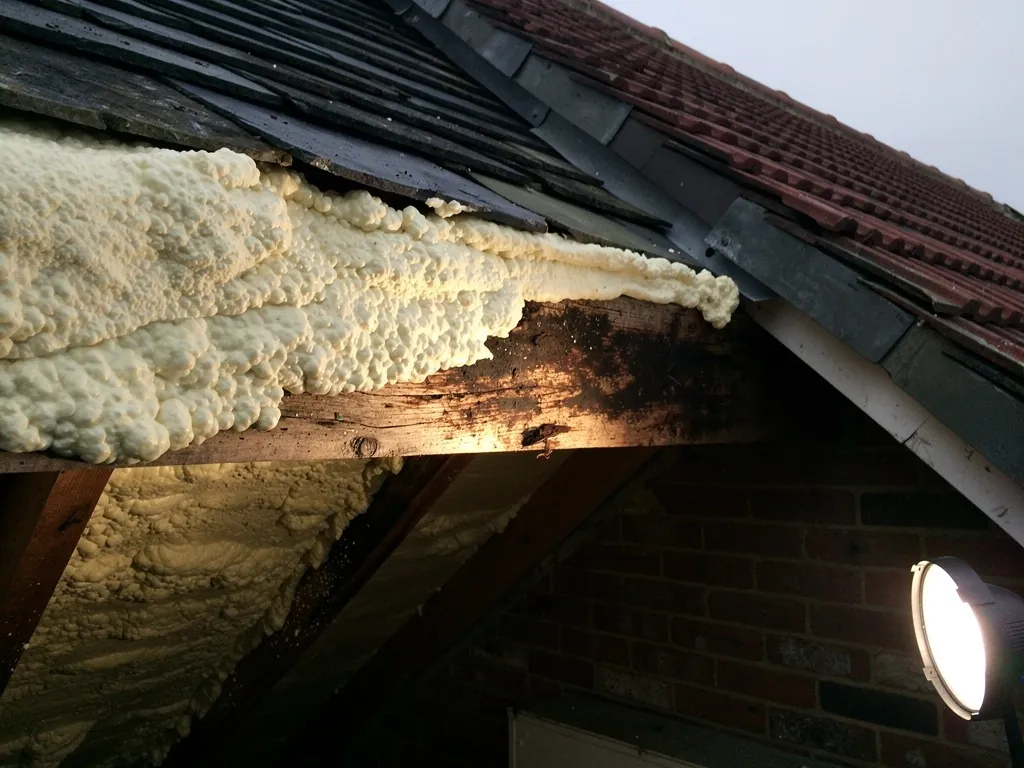
Option two: remove the foam and reinsulate before sale
Removing foam and refitting ventilated insulation takes the issue off the table. The buyer's surveyor sees a clean roof, a record of what was done and a new layer of conventional insulation. For a lender, that is usually the simplest case to consider.
Price follows roof area, which foam was used and what condition the timbers are in. MyBuilder's guide, updated on 21 August 2026, gives a typical figure of £20 to £50 per m² for removal, with an average job of around £1,500, and £500 to £3,000 for repairs and new insulation afterwards. Scaffolding adds to this where the covering has to be lifted. The sums look different on a small terrace and on a large detached house, so only a survey can fix your figure. Our spray foam removal cost page sets out what moves the price.
Is it worth doing before I sell or after the sale is agreed?
Before is usually simpler, because no buyer is waiting and you control the dates. Doing it after an offer is possible and sometimes agreed as part of the sale, but the buyer will want proof the work was done properly and inspected, and that adds a step.
What about the reinsulation?
Taking foam out leaves bare rafters, which would be an obvious point on a buyer's viewing. We fit a ventilated build-up so the loft is finished and thermally sound at handover, and our page on ventilation after removal explains what the roof needs. The 10-year workmanship guarantee comes in writing, so you have a document for the buyer's solicitor.
Option three: adjust the price or offer a retention
Where the roof is sound but the foam is simply unwelcome, some sellers drop the price to reflect the risk or the cost of removal. Buyers often prefer this to a delay, because it puts the decision in their hands. The reduction is a negotiation, and a roofer's written figure for removal and reinsulation gives both sides a number to work from.
A retention is another tool. The lender holds back part of the loan until named work is finished, and the buyer then arranges it after completion. Whether a lender will agree to this for foam is a question for the buyer's broker, not something a seller can promise. Do not offer a retention unless the buyer's lender has said it will accept one in writing.
Does a cash buyer remove the problem?
It lessens it. A cash buyer is free of lender policy, but their solicitor and surveyor still ask questions, and the buyer may still negotiate. A buyer who knows foam is there may price in the risk.
Should I sell at auction?
An auction buyer buys on the legal pack and their own inspection, and the contract binds them on the day. A report and a clear explanation help, but timescales are short and you have little room to repair later. This route suits some sellers and not others, and it deserves a conversation with your agent.
Listed homes, ventilation and the details that trip sellers up
If the house is listed, the RICS guide says foam should not have been installed without prior consent, and the same logic affects removal. A listed home with foam of unknown origin can need a conversation with the conservation officer before any sale or any work. Read our page on spray foam in listed buildings before you decide.
Ventilation is the other detail. A roof that has been closed up with foam often has no eaves vents or ridge ventilation, and a buyer's surveyor will note it. Roofs of different ages need different arrangements, from soffit vents to tile vents to ridge strips. Our answer on whether the roof needs ventilation after removal covers the practical side.
What other points come up?
Three small ones come up often. First, a solar panel installation or a roof window fitted through foam can complicate the survey, because pipes and cables run through the layer. Second, if the foam was sprayed over old felt or a leaking covering, the leak may still be there. Third, a seller's description in the sales details has to match what is in the loft. Describing a roof as newly insulated when it is foamed may need rethinking.
Property information forms ask about works to the roof and insulation. Answer from the paperwork you hold and what the loft shows, and ask your solicitor how the question should be answered if you are unsure.
A sensible order of events for sellers
Pulling it together, the order that causes the least trouble is this. Find the paperwork. Have the loft looked at by a roofer who will write down what they see. If the roof is dry and sound, list with the report ready and let viewers read it. If it is not, decide between repair, removal and a price reduction before the first offer, not after it.
It is also worth speaking to your estate agent about the likely buyer. A first-time buyer with a mortgage and a small deposit is the most exposed to a lender's rules. A cash buyer, or one with a large deposit, may be less so. Either way, a document beats an assurance.
When you want a view of your own roof, send photographs of the loft or book a survey. We photograph the foam, take readings where we can and tell you plainly whether removal is warranted. When a repair or a partial job would properly deal with it, that is what we recommend over the biggest job, and the quote arrives on paper.