
A listed roof is a record of how a building was made. The timbers, the pegs, the lime and the slates or stone tiles were chosen to work together, and most of them cope with damp by letting it move through and dry out. Spray foam does the opposite. It bonds to the back of the covering, seals the structure behind it and is, for practical purposes, permanent.
That conflict is why the surveyors' body wants consent in place before foam goes into any listed or protected building, and why taking it out needs just as much care. This guide covers the consent question, the technical risks to old roofs, what to do if foam is already in a listed house and how to get started. It forms part of our spray foam insulation removal service, and you should read it as background, not as a legal opinion.
Why a listed building needs consent first
The 1990 listed buildings legislation (the Planning (Listed Buildings and Conservation Areas) Act) is the source. Section 7 bars works that would change a listed building's special architectural or historic character unless they are authorised by consent, and section 9 treats a breach as an offence. Whether a particular insulation job counts is a judgement for the local planning authority, and it is not for a contractor or an owner to decide alone.
The RICS consumer guide on spray foam, dated March 2023, is direct about the practical point. Nothing of this kind should be sprayed into a listed or other protected structure until consent has been given. The guide is on the RICS website.
If you own a listed building, ask the council before any insulation goes onto the roof structure, whatever an installer tells you about it being invisible from outside.
Who decides in Swindon?
For a listed building in the borough, the decision sits with Swindon Borough Council's planning and conservation team. The council publishes a conservation contact for general questions, and its planning pages explain how to apply and recommend pre-application advice. Other parts of our area fall under neighbouring councils, such as Cotswold District or the Vale of White Horse, and each has its own officers. Check with the council that covers your address.
What the listing actually covers
People are often surprised by how much a listing takes in. It covers the building as a whole, inside and out, and usually anything fixed to it. The roof structure is part of the protected fabric, even where it is never seen from the street. The loft side of a roof, with its rafters, collars, purlins and old marks of carpentry, may carry much of the historic interest.
In some places the rules go wider. A conservation area adds its own controls, and an Article 4 direction can withdraw permitted development rights so that ordinary changes need permission. In Swindon the council records Article 4 directions at Bishopstone and in the Railway Village, where the cottages were listed in 1970 and the direction dates from 1980. A house in either place needs a careful look at what applies.
This does not mean no insulation is ever possible. Breathable, reversible materials laid in ways the conservation officer accepts are routine. The difference is that they are agreed first.
Does a conservation area alone stop foam?
Not by itself, but it can change which consents apply and how closely the council looks at visible changes. If your property is both in a conservation area and listed, treat the listing as the stricter test.
Why old roofs and foam do not mix
Historic roofs rely on ventilation and on the ability of timber, lime mortar and natural covering to take on moisture and release it. A traditional slate or tile roof has gaps. Wind-blown rain or condensation gets in, then dries out again. Foam sprayed on the underside stops that exchange and holds any water that is already there against the wood.
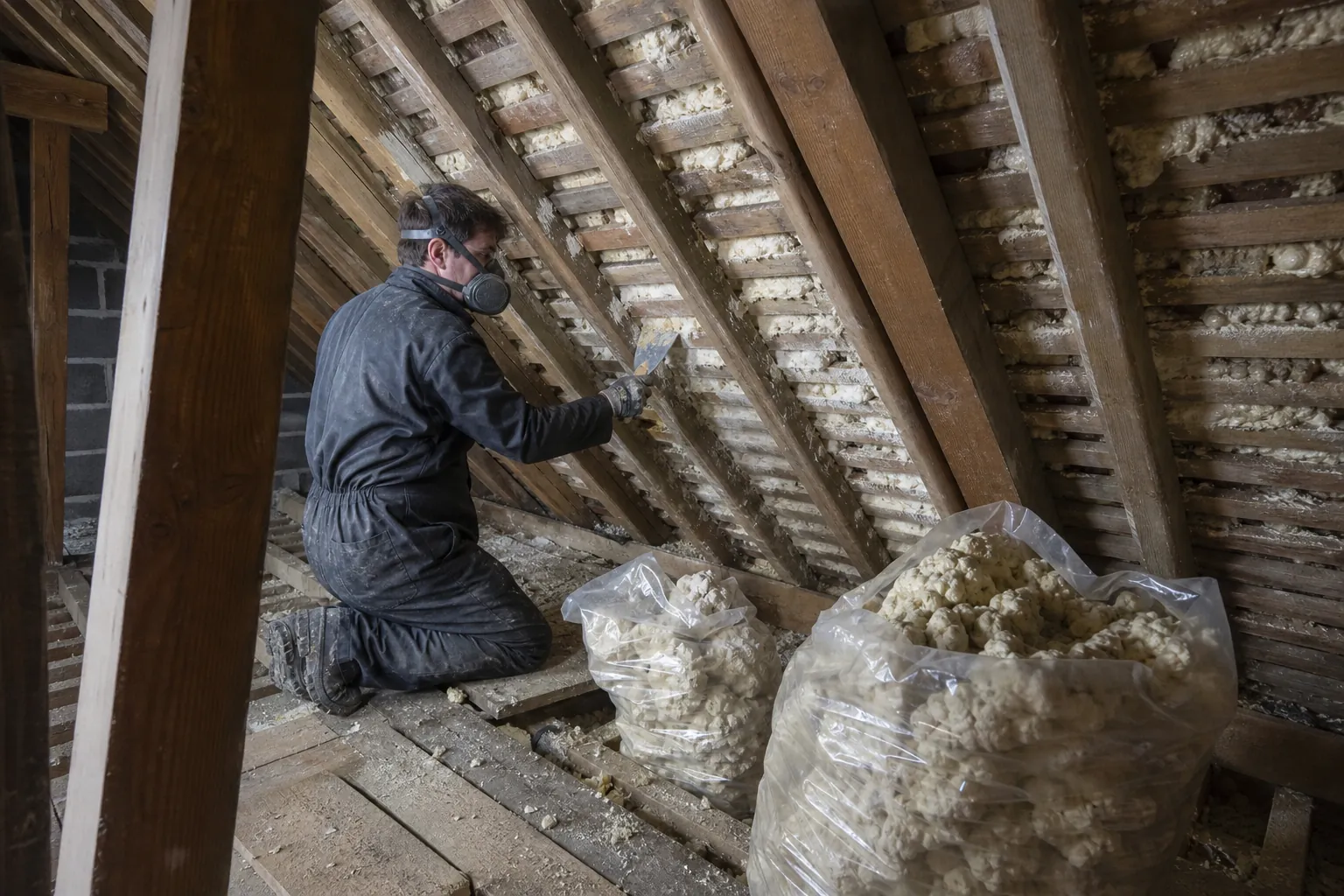
The surveyors' guide warns that incorrectly installed insulation can cause dampness, including uncontrolled condensation, and that taking foam off could itself harm the structure beneath it. In an old building those two warnings meet. If the foam traps moisture against a hand-cut oak rafter, the timber may decay. If you then try to take the foam off, the bond with old, soft wood can pull fibres away.
Our guide to condensation behind spray foam explains the moisture side in more detail.
Is the risk the same for every listed roof?
No. A heavy stone roof, a thatch, a clay peg-tile roof and a Welsh slate roof all behave differently. The age of the timbers and whether the roof has been repaired before also matter. That is why assessment on site beats any general rule.
Cotswold stone slate and other traditional coverings
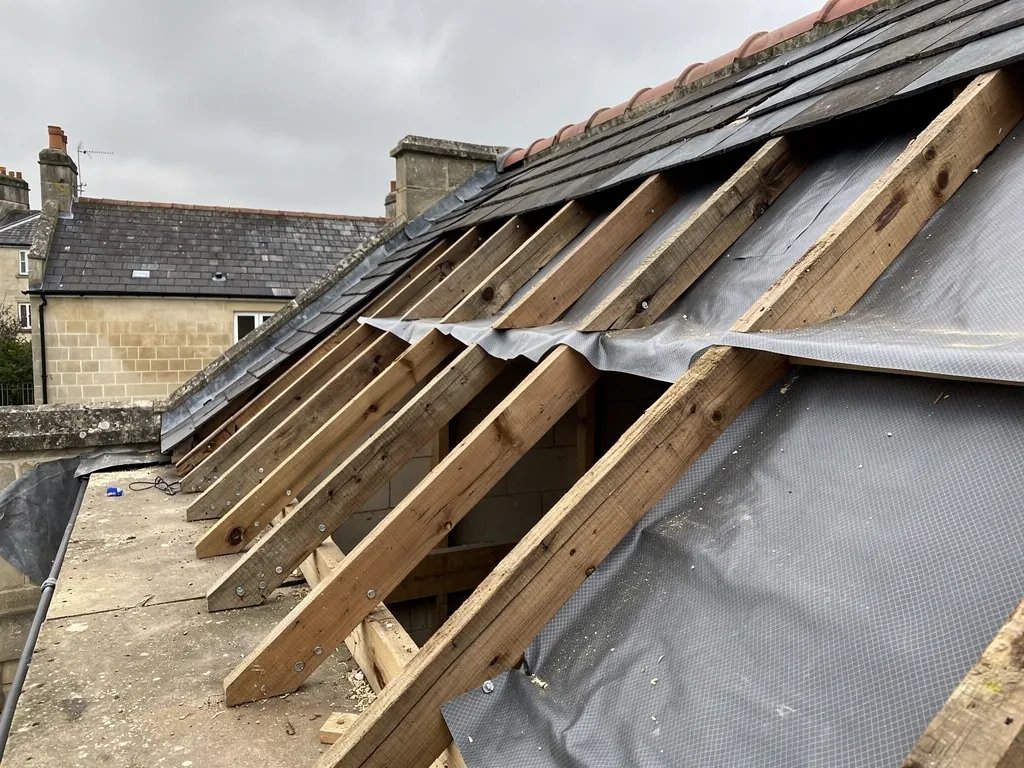
Stone slate roofs are a special case, and they turn up around the Cotswold edge of our area. Cotswold District Council's technical guidance for owners, from April 2000, describes slates pegged to battens with oak through a hole at the head, big ones low down and ever smaller ones towards the ridge. Those roofs are heavy, about a tonne to every ten square metres, and they are meant to be repaired slate by slate.
Foam breaks that approach. If it bonds to the back of pegged slates, individual slates cannot be lifted, re-hung or replaced without the foam coming away with them. The guide also quotes the English Heritage policy that second-hand slates belong only on the building that supplied them, and that artificial substitutes are inappropriate on historic buildings. A roof whose slates have been damaged by foam removal or bonding is therefore difficult to put right with like materials.
The same principle holds for other traditional coverings: clay peg tiles, handmade plain tiles and old Welsh or Cornish slate. The older and more irreplaceable the covering, the less sense it makes to fix anything to its back.
Can foam be removed from stone slates without harm?
It is skilled, slow work, and the answer depends on how the foam went on and how sound the slates are underneath. A method agreed with the conservation officer, and carried out by people who understand stone and pegs, protects both the roof and your position with the council. A fast clean-up by a general crew can strip pegs, crack slates and leave residue behind.
If foam is already in a listed building
Perhaps you bought the house with it, or a previous owner had it done. The first thing to do is find out whether consent was given. Ask the seller's solicitor, check the council's planning and listed building records for your address and look through any paperwork that came with the sale. If there is no consent on file, tell your own solicitor.
The next step is to talk to the council before you touch anything. Even taking foam off is work to a listed building, and it may need consent of its own. The conservation team can say what they would expect to see, which might include a method statement, photographs and a survey of the timbers. Do not be put off by this. Conservation officers are used to problems inherited from earlier owners, and a plan agreed in advance is much safer than a clean-up done in a hurry. Approaching them early is also the best answer if anyone later asks how the foam got there.
Do not start removing foam from a listed building until the council has told you whether consent is needed. Work done first and discussed afterwards is the riskier way round.
What can we do before consent is agreed?
We can survey the loft, photograph the foam and timbers, take moisture readings and put the findings in writing for you and the council. That gives the conservation officer something concrete to respond to. Our guide to the spray foam assessment sets out what a survey includes.
Selling or insuring a listed home with foam
Foam in a listed building raises the same questions as it does anywhere else, with an added one. A buyer's surveyor will ask whether consent was obtained, and a buyer's solicitor will check the records. The RICS guide says foam is something a surveyor may weigh when forming a view of value, and an unauthorised installation in a protected building makes that more likely.
Mortgage and insurance positions vary and change. A report in November 2024 found some lenders declining homes with foam while others weighed each one on its merits. Take that as a dated snapshot: your own lender or insurer is the only one who can say how they treat your property. Our page on selling a house with spray foam covers the sale side step by step.
If you have a certificate or guarantee from the installer, keep it. Whether it is worth anything depends on who issued it and whether they are still trading, a subject we cover in our guide to spray foam certificates.
Should I tell a buyer about the foam?
Yes. Take advice from your solicitor on how to disclose it, and give them whatever evidence you hold. Concealing it rarely works, because a surveyor with a torch will see it.
Starting the conversation about your listed roof
The most useful first move is to gather facts. Have a note of the listing grade if you know it, any consent decisions, the installer's name and date, and photographs of the foam from the hatch. Listed buildings are graded, but the consent rule in the 1990 Act applies whatever the grade. If you are not sure of yours, the council's records or the national heritage list will show it.
After that, a survey from us gives you something to show the council. A surveyor of ours checks the covering from outside, then the foam and timbers from the loft, and writes up the findings with photographs. If the survey suggests that the foam is a problem, we say what we would propose and which parts need the council's agreement first. On a protected roof we lean towards the lightest repair that cures the trouble, which can mean doing less, more slowly, to a plan the officers have seen.
If it comes to work, a ten-year written guarantee covers our workmanship on the roof, and the stripped foam and debris leave the site with us. Ring 01793 626096, use WhatsApp or the form on this page, and attach photographs of the loft if you can.