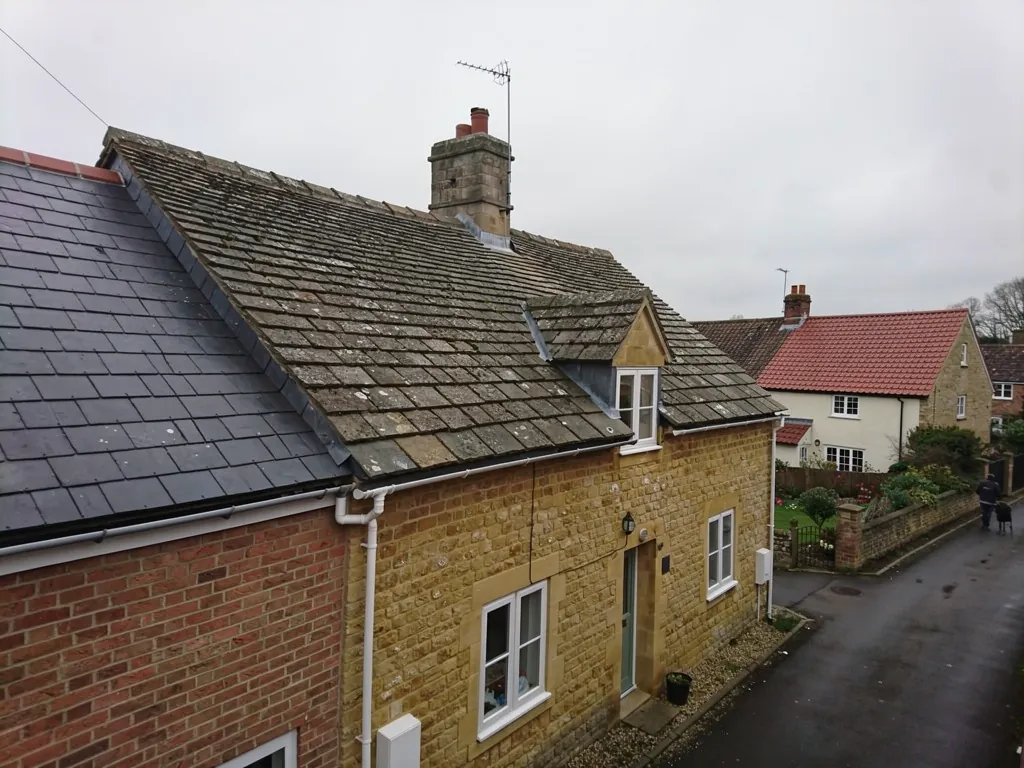
Clay tile and slate rooftops of brick market-town terraces

Roofers in Stanton Harcourt

Lifted stone slates, failing lead, damp chimney stacks and worn ridges, put right across Stanton Harcourt and neighbouring Sutton, from limestone cottages by the church to farm buildings and later homes.

Stanton Harcourt's roofs, from rubble walls to risen-loaf thatch

Rubble limestone walls under stone slate
Limestone cottages and the village core

West Oxfordshire's conservation area appraisal describes the older cottages and houses here as simple plans in limestone rubble, topped with thatch or stone slate. In the seventeenth and eighteenth centuries stone and slate replaced a good deal of the older timber framing and some of the thatch, so the village shows several layers at once, each with its own typical wear and its own sensible repair. Numerous thatched cottages survive, often of risen-loaf form with unusually deep thatch, and they sit beside neighbours whose roofs are stone slate or slate. That mix matters when a stack or a party wall is shared, because a repair on a stone roof has to respect the covering next door as well as the one being mended.

Old stone buildings beside a village church
The great buildings around St Michael's

The church of St Michael, grade I listed and dating from the mid-twelfth century, anchors the village. Beside it stand Pope's Tower from around 1470, the Great Kitchen of 1485 and Manor Farmhouse, all grade I, with Harcourt House at grade II*. Roofs on buildings of that standing are the subject of specialist consent, and the people who own and manage them know it. Their presence sets the tone for the village, though: what is done to an ordinary cottage roof nearby is read against them, and the council's conservation officers look at it in that light.

Tiled roofs on newer homes and farm buildings
Sutton, farm buildings and newer homes

The conservation area takes in Sutton, the smaller linear settlement to the north, and beyond the historic edges sit farm buildings, barns and homes of later decades. Those roofs are a different job from the stone core: clay and concrete tiles, profiled sheets on agricultural buildings, and flat-roofed additions behind older houses. The recurring faults are cracked or slipped tiles, ridges that have lost their fixings, rusted fasteners on sheeting, and leaks where an extension meets an older wall. Because the parish overlies Oxford clay and Thames gravels, buildings here can move a little, and a roof that has shifted should be checked at the wall plate before it is patched at the surface. The same applies to a ridge that has started to dip, which can point to a timber problem long before any water shows indoors.

From Swindon to the Thames terraces

Map showing Stanton Harcourt and central Swindon. 25 road miles north-east of central Swindon.

Distance
25 road miles north-east of central Swindon
Council
West Oxfordshire District Council
Conservation area
Stanton Harcourt and Sutton, designated in 1989
Setting
Thames gravel-terrace village west of Oxford, close to the Devil's Quoits henge
Council
West Oxfordshire District Council

Common worries about Stanton Harcourt roofs

Is work possible on a roof sharing a wall with thatch?

From the stone slate or slate side, yes. Shared walls and stacks get extra care, and you hear early if the neighbouring roof could be affected by the work. A visit to both sides of the wall is part of the survey.

Is a village-wide conservation area a bar to re-roofing?

No. Repairs in matching material rarely call for an application. Altering the covering, the road-facing slope or a chimney is best settled with West Oxfordshire District Council beforehand.

Do clay and gravel soils affect roofs in Stanton Harcourt?

Indirectly. Ground movement can open cracks at gable walls and chimney bases, and water follows those cracks inwards, which is why a leak is followed through the wall as well as across the roof.

Q1

What covers the old cottages in Stanton Harcourt?

Reclaimed Cotswold stone slates sorted by length beside a limestone wall
Cotswold stone cottage with a steep stone slate roof

The short answer

A layered mix: limestone rubble walls carrying stone slate, slate or thatch, with later tile on newer buildings. Stone and slate replaced timber framing and some thatch in the seventeenth and eighteenth centuries, so neighbouring cottages can have quite different coverings.

A stroll through the lanes by the church reads like a page of local history, with the roofs as the lettering. The conservation area appraisal says stone and slate were used extensively in the 1600s and 1700s to replace timber framing and some thatch, and the result is a street where each roof tells you when its owner could afford to change.

Which covering is on my Stanton Harcourt cottage?

Stone slate shows as heavy, irregular courses, with the stones getting smaller towards the top. Welsh slate looks flatter and more regular, with thin edges and a sharper line at the verge. Later clay and concrete tiles are easy to spot by their even size. We identify the covering from the survey photographs, because the right repair depends on it, and we show you the evidence for what we conclude so there is no guesswork in the written quote.

Why do rubble-walled cottages leak at the gable?

Rubble limestone walls are thick but uneven, so the join between roof and wall is rarely a straight line. Lead flashings, mortar fillets and verge details wear first. A slipped verge stone or a split flashing sends rain into the wall head, and it appears as damp indoors days after the roof has dried.

How do I keep repairs from showing?

Matching by size, thickness and tone is what makes the difference. Our Cotswold stone roofing page explains how stone is sorted into courses, and our roof repairs page shows how a leak is traced to its source.

Timber lintels and wall plates under old roofs deserve a look while the covering is open, since decay there is easy to fix early and costly to fix late. Where a slope has been stripped for any reason, we photograph the exposed timbers and send you the pictures.

Coverings seen on older Stanton Harcourt buildings
CoveringWhat to look forUsual fault
Stone slateHeavy, uneven coursesSlipped stones, rotted pegs
SlateThin, flat, regular rowsRusted nails, tired lead
Clay or concrete tileEven, machine-made lookRidge and verge failure
Q2

Can a grade I village roof be touched at all?

The answer

Yes, carefully, and with the right permission. Listed building consent applies to any change that affects the character of a listed building, roofing material among them, while an Anglican parish church, St Michael's included, answers to the faculty system. Repairs in like material are the usual place to begin.

With Pope's Tower, the Great Kitchen and Manor Farmhouse at grade I, Harcourt House at grade II* and St Michael's church at grade I, Stanton Harcourt holds more protected buildings than most villages. Most owners will never need to ask this question. Some will.

Who gives permission for a listed roof?

For a listed house the application goes to West Oxfordshire District Council, which decides listed building consent. St Michael's belongs to the Anglican parish and is in regular use, which places it under the faculty system and outside that route. Churches that have closed, and buildings of faiths outside the exempt denominations, are treated by the council in the usual way. Scheduled monuments are a separate category, needing consent from the Secretary of State.

What counts as repair, and what as alteration?

Refixing stones, renewing a flashing in lead of the same code and rebuilding a ridge as it was are normally treated as repair. Swapping the covering, adding roof lights or reshaping a chimney is alteration. If you are unsure which side of the line your plan falls, put it to the council before the work is priced. A short email with photographs is usually enough.

Why does scaffolding need so much thought?

Ties into old stonework, loads on soft ground and protection for carved or decorative features all shape how access is built. Reach is a real cost driver on buildings like these, and VAT and scaffolding both need confirming in any quote you are considering.

If your cottage stands near one of the great houses, expect the survey to include a close look at the junctions with older walls, as those are the places where leaks begin.


Our view

On protected buildings, repair in kind first and ask the council before anything alters how the roof appears from the lane.

Q3

What does Stanton Harcourt's Article 4 record mean for me?

Rolled lead roof covering over a bay above white windows
Chimney stack taken down below roof level during removal

The short answer

West Oxfordshire has an Article 4 direction for Stanton Harcourt dating from 1954. Ask the council what it covers before assuming it touches your roof. The conservation area, designated in 1989, is the more practical constraint.

An Article 4 direction withdraws specified permitted development rights across a defined area. It can sit alongside a conservation area, and the two together can change what you may do without an application.

What is the 1954 direction?

The national planning dataset lists a West Oxfordshire direction for Stanton Harcourt, dated 1954, under the code of a mid-twentieth-century order. Directions of that age predate the modern domestic rules, so we do not treat it as a roofing restriction. The council can tell you precisely what it covers and whether it touches your property.

What changes inside the conservation area?

The Stanton Harcourt and Sutton conservation area was designated in 1989. Like-for-like work leaves the village as it was and seldom needs an application. Anyone planning new roof windows, a switch of covering or a reshaped chimney stack should put that to the planning office at the outset. Our roof window planning page sets out the rules.

Does a bigger re-roof here need approval?

On the Planning Portal's figures, work affecting under 25 per cent of the total building envelope and under 50 per cent of the roof can normally proceed with no building control application at all. Past either figure, an application is needed, and a covering that is 15 per cent or more heavier also brings it in. Thermal upgrades under Part L can follow too, and old stone roofs are heavy enough that the timbers need checking first.

Should the job be notifiable, we take care of the Building Regulations notification, after agreeing the plan with you. We also leave the site cleared, with waste taken away.

Roofing services in Stanton Harcourt

Questions from around St Michael's church

Why does the gable end of my Stanton Harcourt cottage leak?

Gables on rubble limestone walls often leak at the verge or where the lead meets the wall, not in the middle of the roof. We check the verge stones, the mortar and the flashing, and often the wall head too, because water that gets in there looks like a roof leak. The survey photographs show where it is entering.

Do you repair roofs beside a thatched cottage?

Yes, on the stone slate, slate or tiled roofs around it. We take particular care with chimneys, hot work and shared walls, and we flag it early if a stack serves both properties. Our work is on the roofs around it, and we keep the site tidy so neighbours are not troubled.

Can you reach farm buildings and barns near the village?

Yes. Barns and farm buildings in and around Stanton Harcourt and Sutton fall inside our 30-mile working radius by road. Commercial and agricultural roofs get a survey and a written quote, just as a house does. Phone 01793 626096, message on WhatsApp, or post the enquiry form with your postcode.

Is lead on a stone slate roof worth renewing?

MyJobQuote reports that lead flashing, correctly fitted, can outlast 80 years, but it does wear, split and lift at stacks and abutments, especially where old pointing has failed. Replacing the lead alone is frequently the lightest repair that stops a leak, with the stone left alone. We tell you after the survey whether the lead or the stone is the real problem.

Ask us about your roof

Tell us what’s happening and we’ll call you back.

  • Photos of what we find
  • A written quote
  • 10-year workmanship guarantee

Or call 01793 626096

Call Get a quote