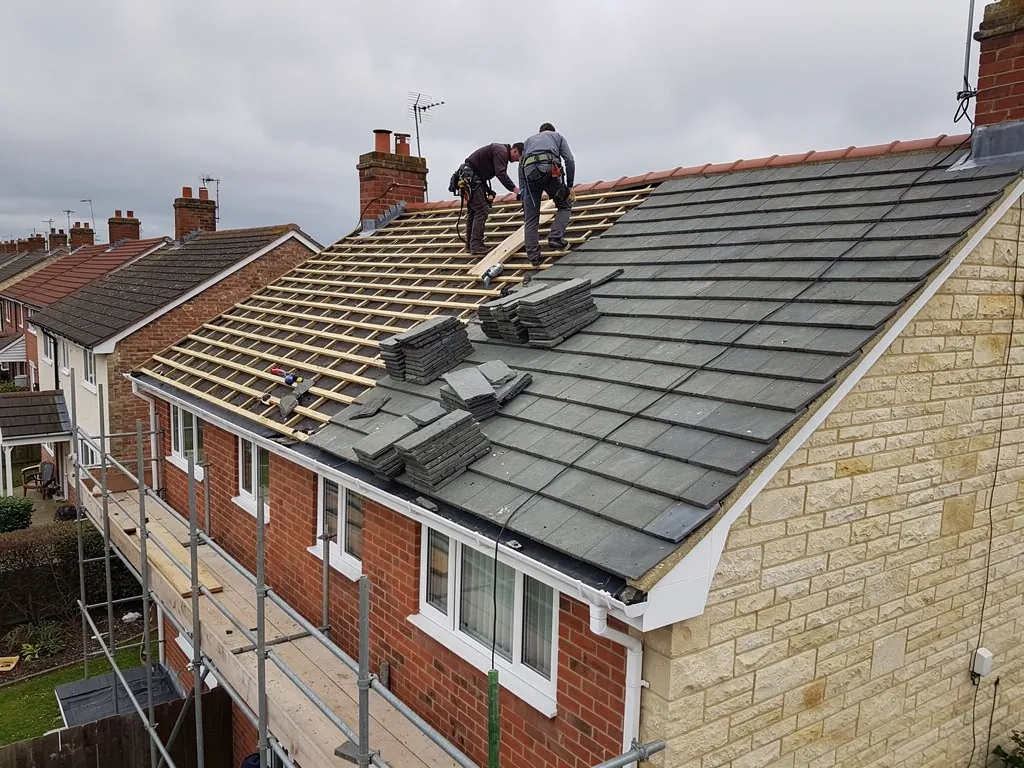
Roofers on a slate roof along a limestone village street

Roofers in Northmoor, Oxfordshire

Northmoor stands between the Thames and the Windrush, and its roofs run from a medieval church to farm buildings and modern houses. We survey, repair and re-cover them, then send a written quote.

Northmoor's roofs between the Thames and the Windrush

Medieval church tower above a village
St Denys and the old village core

The name Northmoor originally meant marsh, and in 1059 Edward the Confessor granted land here to St Denis Abbey in Paris. The parish church of St Denys is Grade I listed, with a Norman font, a thirteenth-century chancel, a fourteenth-century nave and transepts and a fifteenth-century bell tower, restored by C C Rolfe in 1887. A building put together over three centuries has roofs of several ages, with lead gutters, parapet details and valleys where the parts meet. Those are the places water finds first. Work of this kind is planned around the building's records, not around a fixed price per metre, and it begins with a close look from a safe position rather than a quick climb.

Timber-framed farm outbuilding with a long roof
Farm buildings such as the Rectory Farm granary

The granary at Rectory Farm dates from the sixteenth or seventeenth century, was extended in the eighteenth and is Grade II* listed. Farm buildings in a valley parish are often the oldest roofs outside the church, and they take a different kind of wear from houses. Large open timber roofs, long unbroken slopes, wide eaves and few internal ceilings mean that a leak can run for a long time unseen. The survey checks purlins, rafter feet and the condition of battens before it looks at the covering, because a sound frame decides whether repair is worth doing. If any sheeting is old cement, it is treated with caution and left undisturbed until it has been identified.

Red-brick houses and tiled roofs along a lane
Houses, extensions and garages of every age

Around the old centre the village has gathered cottages, farmhouses and houses from many decades, and each age of building has familiar weaknesses. Older cottages keep chimney stacks that need flashing and repointing. Mid-century houses have tiles that have lost their surface protection and underlay that has gone brittle. Newer homes and their garages and extensions bring flat sections, which fail at laps, upstands and outlets. A covering cannot be read from the age of a house, because roofs get replaced; the survey records what is actually on yours, in photographs, and the quote is built from that record.

From Swindon to a Thames-valley parish

Map showing Northmoor and central Swindon. 23 road miles north-east of central Swindon.

Distance
23 road miles north-east of central Swindon
Council
West Oxfordshire District Council
Setting
A Thames-valley village bounded by the Thames and the Windrush, west of Oxford
Conservation area
Northmoor Conservation Area, on West Oxfordshire District Council's record
Council
West Oxfordshire District Council

Questions about Northmoor's church, farms and river meadows

Will Northmoor's conservation area touch my own roof?

Only when the result would look different. A straight swap seldom needs an application, but raise it with West Oxfordshire District Council before swapping a material or altering a chimney.

Can granary-style outbuildings here be re-roofed without losing their character?

Yes, with care. The aim is to keep original timbers and as much old covering as can be saved, and to match anything new. Listed status brings a duty to ask first about changes of that kind.

Does living near the Thames and Windrush mean more moss on the roof?

It can. Damp air, shade and nearby trees encourage moss and algae, which hold water on tiles and block gutters. Clearing them gently is usually the first job.

Q1

How are old farm building roofs repaired?

Torch showing a water-stained rafter beneath slates in a loft
Long flat roof on a 1960s brick building being re-covered

The short answer

From the structure outwards. A farm roof usually fails because of rotten battens, tired fixings or a failed gutter, not because the covering has worn out, so we inspect the timbers first and mend the smallest area that restores a sound, watertight roof.

Farm buildings do not behave like houses. Their roofs are large, plain and exposed, with few of the junctions that cause trouble on a cottage, and with long spans that depend on sound timbers. A leak can run for a season before anyone is standing underneath to notice it.

What do we check before touching the covering?

The purlins, rafters and wall plates. In a granary like the one at Rectory Farm the framing is part of the building's value, and a roof covering can only perform as well as the timbers beneath it. Daylight showing through from inside tells us where water is getting in. Dark patches and soft spots on the wood tell us where it has already been, sometimes for years.

Is a patch or a re-cover the right answer?

If the timbers are sound and most of the covering is intact, a patch in matching material is the leanest repair that works. Where a whole slope has gone, a careful re-cover beats a string of patches that each cost something and each fail at the edge of the last. Our roof repairs page shows how we scope a repair of any size, and the survey photographs mark each fault so you can see the reasoning.

What if the building is listed?

Grade II* status means the council has to be satisfied that a change protects the building's character. Repairing in the same material by the same method is the usual starting point. Should the covering itself need to change, put that question to West Oxfordshire District Council before the work is agreed. A survey can record the existing roof so the conversation has facts behind it.

Q2

Does a Thames-valley setting harm Northmoor roofs?

The answer

It can, mainly through damp. Shade, moisture and falling leaves encourage moss and algae, block gutters and keep tiles wet, so clearing growth gently and keeping the gutters running matter more here than on a dry hilltop. The roof structure itself is no different from any other.

Northmoor lies low in a valley, with the Thames to the east and south and the Windrush along part of its western side. The ground is not the issue for a roof, but the air and the shade around it can be, particularly where mature trees overhang the slopes or where a hedge keeps a gable end from drying after rain.

What does damp do to a roof?

Moss grows on the shaded slopes first, usually the north-facing ones and those under trees. A thin film does little harm. A thick mat holds moisture against tiles and slates, raises their edges and clogs the gutters when it drops. Frost then bites harder on wet tiles than on dry ones. The sensible response is gentle removal by the right method, followed by a look at whatever was hidden underneath. Our roof cleaning and moss removal page explains the methods, including why pressure washing can damage delicate tiles.

Do gutters matter more here?

Yes. Leaves from nearby trees collect quickly, and an overflowing gutter soaks fascias and wall heads. Clearing them twice a year costs far less than repairing a rotted fascia, and it is among the lowest-cost jobs on any house, whatever the roof covering.

Does a damp loft always mean a leak?

No. Condensation also wets loft timbers, particularly where insulation has been pushed over the ventilation gaps at the eaves. We look for both before suggesting any work, so you pay to cure the right fault and not a different one. Ventilation at the eaves and ridge is cheap to put right and is checked as part of any survey, with photographs of the loft timbers recorded for your file.

What it typically costs

  • Flat roof cleaning£300 to £600
  • Tiled roof cleaning£400 to £750
  • Pitched roof cleaning£450 to £850
  • Slate roof cleaning£500 to £1,000
Typical national ranges for a whole roof. What your own roof costs depends on its size, pitch and access, and the survey comes before any quote. MyBuilder roof cleaning cost guide, updated 21 August 2026.
Q3

Who approves roof work near St Denys church?

Brick and limestone cottages around a small village green
Two roofers fitting grey tiles on a part-battened house roof

The short answer

The route depends on the building. A house or farm building is a matter for West Oxfordshire District Council, and a listed one has to be cleared with the council first. The church of St Denys, still used for services, has its roof works decided through the faculty system.

Most roofing in Northmoor is simple upkeep that needs nobody's approval. Questions arise when the work changes a building's appearance or touches a protected one, and it helps to know in advance which case you are in.

Which parts of the village are protected?

Northmoor has a conservation area recorded by West Oxfordshire District Council, and several listed buildings: St Denys is Grade I and the Rectory Farm granary is Grade II*. A scheme that would change how a listed farmhouse or cottage reads needs listed building consent, and a new type of covering plainly does.

How is the church different?

St Denys is an Anglican church still holding services, so roof works follow the faculty process, led by the parochial church council, in place of the council's listed building route. If a church ever stops being used for worship, ordinary controls apply to it.

What about ordinary houses?

Planning permission is not usually involved when a house is re-covered in matching material. A re-roof needs a building control application when it reaches 25 per cent of the building envelope or half the roof area, and a covering 15 per cent or more heavier brings one too. Your building control body decides. We explain it at the survey and deal with the notification where it applies.

Do bats change the job?

Bats and nesting birds have legal protection, so the survey looks for droppings, staining and nests in the loft and under the eaves before work begins, and nothing is disturbed by surprise.


MythOnly the church roof in a village like Northmoor needs special care.

FactOld farm buildings and cottages can be listed too, and a listed roof cannot be altered at will.

Northmoor roof queries, from the church to the river meadows

Why do the roofs on Northmoor's older cottages leak around the chimneys?

Chimney stacks are where lead flashings, mortar fillets and brickwork meet the roof, and each ages at its own rate. Cracked mortar lets water slip behind the flashing, and the stain shows up in a room away from the stack, sometimes weeks after the rain that caused it. We trace the entry point first, then repair or renew the flashing and repoint where needed. A written 10-year workmanship guarantee backs the work.

Do you work in the villages near Oxford around Northmoor?

Yes. The parish and its neighbours fall within our working radius around Swindon, and the areas page names each place. Whichever route you choose, phone, WhatsApp or the enquiry form, you get a survey and photographs of your own roof before any quote.

Can a damaged slate or tile be replaced on a church-side house without scaffolding?

Sometimes, for a small repair in an accessible position, using a roof ladder or a mobile platform, provided the ground and the eaves allow it safely. Anything higher or larger is safer from scaffolding, and the written quote tells you whether it is included. If you compare quotes, check that each one says whether scaffolding and VAT are covered.

How do you decide whether a flat garage roof near the river needs replacing?

By looking at the deck, the laps and the outlets. Ponding water, blisters and soft boards point to replacement; a dry, firm deck with a split seam can often be patched. We photograph each fault so you can see the reasoning and take the smaller job where it will hold.

Ask us about your roof

Tell us what’s happening and we’ll call you back.

  • Photos of what we find
  • A written quote
  • 10-year workmanship guarantee

Or call 01793 626096

Call Get a quote