Roofers on a buff brick estate house with grey tile roofs

Roofers in Pewsey

Roof repairs, re-roofing, chimneys, leadwork and flat roofs across Pewsey, from the old houses near the church and King Alfred's statue to the newer streets that spread out across the Vale.

Pewsey's roofs, from tower to towpath

Old cottages beside a churchyard wall
Around St John's and the village centre

Pewsey's oldest buildings gather near St John's, the parish church recorded in the Domesday Book and listed Grade I. Houses of that age tend to have steep, plain pitches, roof timbers that have drifted out of true over the centuries, and chimney stacks mended more than once. On roofs like these we look first at the places water finds: the valleys, the stack flashings, the verges and the eaves. Old rafters are rarely straight, so a new covering has to be laid to suit the building instead of forcing it flat. Where a house is listed, the covering and its fixings are a decision to reach with the council before anything is ordered, not after it arrives on a lorry.

Brick terrace with chimney stacks and slates
Canal and railway era terraces

The Kennet and Avon Canal, opened along its whole length in 1810, passes the village, and the railway arrived in 1862. Houses from those decades are usually modest, with plain pitched roofs, brick chimney stacks and small lean-to additions at the back. At this age the faults we meet are slipped or cracked coverings, tired leadwork at the foot of a chimney, and gutters patched so often that the fall has gone. A neighbour's chimney may share a party wall with yours, so flashings on a terrace deserve a proper look, from a ladder or a camera on a pole, before a quote is written. Small back additions often hide the oldest, most neglected corner of the roof.

Modern tiled homes on a village estate
Newer homes across the Vale

Away from the centre, Pewsey has estates, bungalows and extensions from more recent decades, often finished in concrete interlocking tiles or other modern coverings. These roofs have their own list of faults: ridge and hip sections whose bedding has crumbled, verges that have lost their mortar, underlay torn behind the battens, and flat-roofed porches, garages and kitchen extensions whose covering ends its life long before the main roof does. Because newer roofs are simpler to reach, a repair is often a short visit, while a whole new covering is suggested only when the survey photographs show that nothing smaller will hold. Gutters and fascias on these houses are worth checking in the same visit.

From Swindon to the Vale of Pewsey

Map showing Pewsey and central Swindon. 19 road miles south of central Swindon.

Distance
19 road miles south of central Swindon
Council
Wiltshire Council
Landscape
North Wessex Downs National Landscape
Conservation area
Pewsey, with a separate Wilcot Road area
Setting
Centre of the Vale of Pewsey, on the Kennet and Avon Canal

Pewsey roof questions

Does Pewsey's conservation area stop a matching re-cover?

Seldom. A repair in matching material leaves the street looking the same, but a listed house, or any switch of covering, should be raised with Wiltshire Council first.

Can you work on roofs near the White Horse and the downs?

Yes. Houses on the slopes and the village edge are well within our area, and exposed roofs get extra attention to ridge, hip and verge fixings.

Do canal-side houses have special roof problems?

Nothing special, but damp air and overhanging trees make moss, blocked gutters and slow leaks more likely, so gutters and valleys are checked closely.

Q1

Which faults show first on an old Pewsey roof?

Torch showing a water-stained rafter beneath slates in a loft
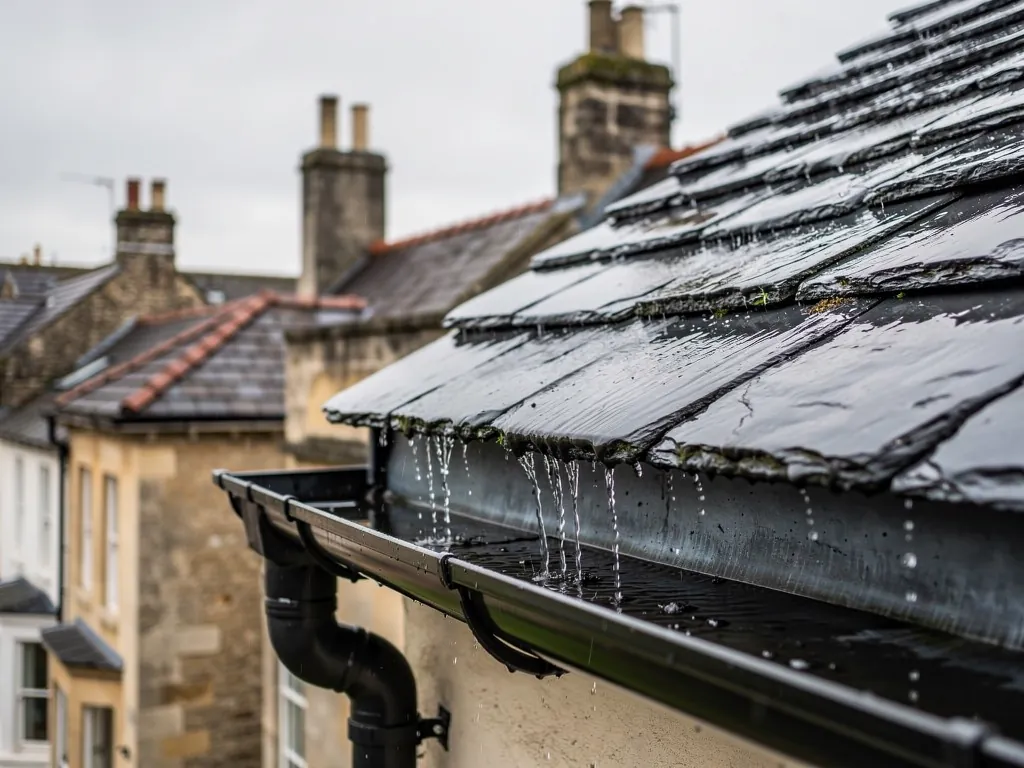
Rainwater running off slates into a black gutter and downpipe

The short answer

Start with the places water collects: valleys, the join between roof and chimney, the eaves and the verges. Then look for slipped or cracked coverings from the ground, and in the loft for daylight, stains and damp timber. Photographs taken on a survey confirm what you can and cannot see yourself.

A village with Pewsey's history has roofs of every generation standing side by side. The streets near the church, the lanes running down towards the canal and the later roads on the outskirts each carry a different mix of ages, and the faults follow the age of the house.

Why check the junctions first?

Water gets in at junctions far more often than across open slopes. The valley where two roofs meet, the flashing where a slope meets a wall and the lead around a chimney stack are where we begin. A flashing is lead or another metal worked into the join where the covering meets anything rising through it, so rain runs over the join instead of into it. Once the lead has cracked or lifted, water runs behind it, and the damp patch can show on a ceiling a good way from the real fault, which is why guessing from indoors so often goes wrong.

What shows on the covering itself?

On a tiled or slated slope, slipped, cracked or missing pieces are usually visible from the ground with binoculars. Old nails fail, tiles lose their nibs, and moss holds water against the surface for weeks. Our roof inspections and surveys page explains what a visit photographs and what the written quote contains afterwards.

What can you see from the loft?

Daylight showing through, dark staining on rafters and battens, and a musty smell each tell you something. So do wet patches around the chimney breast. If the loft can be reached safely, a torch and a phone camera give us a useful starting point before we arrive, though nobody should climb onto the roof itself.

Our habit is to price the narrowest job that cures the leak, so a handful of refixed tiles and a new flashing is a perfectly good result when that is all the photographs show.


Q2

Is repair or replacement right for a Pewsey house?

The answer

A repair suits a fault confined to one spot, with timbers and battens still sound. A new covering suits a slope that is giving up throughout, with the underlay gone or repairs that keep coming back. The survey photographs show which case you have, and the written quote follows whichever answer they give.

The test is simple. If a roof leaks in one place because one thing has failed, that one thing should be fixed. If it leaks in several places because the whole covering has run out of working life, patching only buys time.

What if there is a single fault?

A slipped tile, a cracked ridge section, a lifted lead apron or a clogged valley are all local problems. Mending them properly takes a morning and costs far less than a new roof. A repair also suits the older houses near the church, where keeping as much of the original covering as possible is usually kinder to the building and to its owner's budget.

How do you know a covering is tired?

Signs that a whole slope is finished include widespread slipping, battens that crumble when pressed, underlay in rags, and repairs that keep reopening. Cost is driven by access, the covering chosen, the size and shape of the roof, plus whatever the survey uncovers beneath the old covering. Ask whether any quote includes scaffolding and VAT, because totals can differ widely when those are left out.

What paperwork is involved?

Where a re-roof affects a large share of the building envelope or of the roof, Building Regulations can apply. We explain the consent position, and for notifiable work we lodge the notification on your behalf. Our roof replacement page sets out how a full re-cover is planned from survey to handover.

On a finished job the workmanship carries our ten-year guarantee, given in writing, and when we leave the site is swept and the old materials are gone with us.

Our rule

Fix the fault that is there, and re-cover only when the whole covering has failed.

Q3

What changes for roofs in the North Wessex Downs?

Long flat roof on a 1960s brick building being re-covered
Rolled lead roof covering over a bay above white windows

The short answer

Very little for ordinary maintenance. Pewsey lies in the North Wessex Downs National Landscape, but the council, not the landscape body, decides planning questions. A matching re-cover seldom needs an application, while listed buildings and alterations that change the look call for a conversation with Wiltshire Council first.

People often assume that living in a protected landscape means every roof job needs permission. The reality is more modest, and it helps to know where the lines fall before you commission anything.

Who decides on planning?

The North Wessex Downs became known as a National Landscape in November 2023, although its legal designation did not change. The landscape partnership advises, but it does not decide planning applications. Those go to Wiltshire Council, which is also the body to ask whether your own house appears on the national list or stands inside the Pewsey conservation area. Records show a separate conservation area along Wilcot Road as well, so check the exact boundary for your address.

Do repairs and matching re-covers need permission?

Repairing a roof, or replacing the covering with the same kind of material, does not usually need a planning application, because the building's appearance is not materially altered. Two cautions apply. A listed building needs consent for any works touching its special character, and some areas have an Article 4 direction that withdraws rights that would otherwise apply. Ask the council whether one covers your address.

What if you want to change the roof?

A change that shows from the street, such as adding a window in the slope, needs its own check. Our guide to roof window planning covers that ground in detail.

For notifiable work, Wiltshire Council's building control team or a registered building control approver deals with the Building Regulations side, and we explain what is required before a single tile is lifted.

MythA house in a protected landscape cannot be re-roofed without planning permission.

FactA matching re-cover seldom needs an application; listed buildings and changes to the look are the cases to check.

Questions from the Vale of Pewsey

Do Pewsey's old church-side houses need special roof care?

They need care in the details. Timbers on older buildings move, so a covering has to be laid to suit the roof, and flashings, valleys and stack junctions get a close look. If the house is listed, the material and method are agreed with the council before anything is ordered, and you hear about it from us first. We would rather lose a day to a phone call than put the wrong tile on a protected roof.

Is the White Horse side of Pewsey a long way for you to travel?

Not at all. The village, the slopes below Pewsey Hill, the Vale villages and the lanes along the canal all fall within the area we cover. Our areas page names every place we work in, so you can check your own village there if it is not mentioned on this page.

Can a leak near a chimney be mended without a new roof?

Often, yes. Most chimney leaks come from failed flashing, cracked pointing or a loose cap rather than the covering. We repair the junction, check the stack for movement and tell you plainly whether anything bigger is involved, with photographs to back it up. The chimney repairs page describes what each of those jobs involves.

Should ridge tiles on an exposed edge-of-the-downs house be refixed early?

Usually, yes. Ridge and hip tiles meet the wind first, and since BS 5534 was revised in 2014, ridge and hip pieces are no longer trusted to mortar by itself. Fresh bedding with mechanical fixings added, or a tested dry-fix ridge, makes sense on any roof that stands in the open, and it costs far less than chasing tiles across a neighbour's garden.

Ask us about your roof

Tell us what’s happening and we’ll call you back.

  • Photos of what we find
  • A written quote
  • 10-year workmanship guarantee

Or call 01793 626096

Call Get a quote