Concrete tiled estate rooftops towards green hills

Roofers in Fyfield, Wiltshire

Leak tracing, tile and slate repairs, chimney flashings and re-roofs in Fyfield, the Kennet Valley village below Fyfield Down, where heavy sarsen walls carry roofs of every age.

Fyfield's roofs, from sarsen wall to tiled eaves

Old stone cottage with a tiled roof
Cottages of sarsen stone

A scrapbook compiled by the village Women's Institute in 1956 records that most of the old cottages in Fyfield were built of sarsen stone, and sources on the area note that medieval houses in Kennet Valley villages used sarsen block walls too. Sarsen is extremely hard, laid in thick, irregular courses, so the roof edge rests on a wall that is strong yet never quite level. Verges and eaves have to follow that wall, not a spirit level. When we repair a roof on a sarsen cottage, we pay attention to the wall head, where the rafters sit, since movement there shows up as dipping tile courses or gaps at the gable.

Church tower with lead and tiled roofs
St Nicholas and the older buildings

The church of St Nicholas has thirteenth-century origins, a fifteenth-century tower and a restoration in 1849, and it is listed at grade II*. Buildings of that age have complicated roofs: valleys where aisles meet the nave, lead gutters behind parapets, and timbers mended in different centuries by different hands, each with its own idea of how to keep water out. The same is true, on a smaller scale, of the older houses near it. Their roofs may have been re-covered a time or two, and the layers underneath record each repair. A careful survey of the loft often explains why a particular corner leaks, long before anyone needs to open up the outside.

Tiled houses and garages in a village lane
Newer homes beside the A4

The village sits on the A4 about two and a half miles west of Marlborough, and over the years it has gathered houses, bungalows and outbuildings from many decades. These houses differ widely from one plot to the next, so each roof is judged on inspection rather than assumed. Whether a house is tiled or slated, the familiar faults repeat: tired ridge bedding, cracked tiles, failed underlay, blocked gutters and flashings around chimneys and extensions. Garages, workshops and flat-roofed additions are the other regular job in a village like this, where space around the house usually allows for outbuildings, and where a failing felt roof can quietly rot the joists beneath it.

Out along the A4 from Swindon

Map showing Fyfield, Wiltshire and central Swindon. 15 road miles south of central Swindon.

Distance
15 road miles south of central Swindon
Council
Wiltshire Council
Council
Wiltshire Council
Landscape
North Wessex Downs National Landscape, below Fyfield Down
Setting
Kennet Valley, on the A4 west of Marlborough

Fyfield roof questions

Can a roof sit safely on thick sarsen walls?

Yes. Sarsen is very strong, but its irregular courses mean wall plates and eaves need packing and fixing carefully. We check them whenever tiles or timbers are lifted, and note anything that has settled.

How do I know if my Fyfield house is in a conservation area?

Ask Wiltshire Council's planning team, which holds the boundaries. Asking before the work is priced is quicker than learning the answer once the scaffold has gone up.

Does living below Fyfield Down change roof care?

Slightly. Open downland and valley trees make for damp, mossy slopes and wind at ridges and verges. Fixings and gutter checks matter more on exposed or shaded roofs, and moss is worth removing before it lifts tile edges.

Q1

How do sarsen walls affect a Fyfield roof repair?

Blocked gutter full of leaves overflowing down a brick wall
Brick and limestone cottages around a small village green

The short answer

Sarsen is a hard, heavy stone that gives thick walls with uneven tops. A roof repair must allow for that: eaves and verges are fitted to the wall rather than forced straight, and any packing under timbers is checked. The stone itself rarely fails, but its mortar and the roof edge details do.

Sarsen blocks lie across the downland around Fyfield, and the village has used them for centuries. Medieval houses in the Kennet Valley villages were built with sarsen block walls, the Free family set up a stone-cutting business in Fyfield in the mid-nineteenth century, and sarsen cutting in the village carried on until 1939. That is a long tradition, and it shapes how a roof is repaired.

Why are sarsen wall tops so uneven?

Because the stone is irregular, the top of a sarsen wall is rarely true. Roofers bed wall plates on mortar and pack them to level, and over time that bedding can crumble. If tiles dip at the eaves or a verge looks wavy, the cause is often below the roof covering. We lift a few tiles and look before promising a repair.

Where do the pointing and junctions let water in?

The weak points are mortar joints and junctions. Gable tops, chimney bases and abutments are where roof meets wall, and a gap there lets water into the stone and timber. Lime-based mortar is usually the right choice with old stonework, since it lets the wall breathe.

Can the walls take a heavier roof?

Sarsen walls bear weight well, so the question is the roof timber above them. Our roof repairs page describes tracing a fault back to where the water first gets in. Swapping tiles for something heavier is worth a structural check first.

Hard stone has one more consequence: it does not forgive a careless fixing. Drilling into sarsen is slow, and nails or clips driven into the wall head can split mortar around them. We plan fixings into the timber wherever we can, and use stainless or copper fixings where they must meet the stone, so a repair does not become the next fault.

None of this should put you off a repair. It means the survey looks at the wall head as well as the covering, and the written quote tells you what we found there, with photographs.

Q2

Is it worth surveying a Fyfield roof before winter?

The answer

Yes, if the roof is old, mossy or has had no attention for years. A survey finds slipped tiles, tired flashings and blocked gutters while they are cheap to fix, and photographs the loft side too. The result is a written quote, so you can decide on repair, partial replacement or leaving well alone.

Fyfield's position below the downs, close to the Kennet and a busy road, means roofs face plenty of wind and damp. That rarely causes dramatic damage in a single season, but it wears at old fixings.

What does a survey cover?

We start in the loft, looking for daylight, damp timbers, stained underlay and signs of past leaks. Then we examine the covering from a ladder or tower, checking ridges, valleys, flashings and gutters. Roof inspections typically cost £150 to £500 nationally, according to MyBuilder, updated 21 August 2026, depending on the method used. Photographs of your roof go with the quote.

Is it a repair, a partial job or a full re-roof?

We put forward the narrowest job that ends the fault for good. A few slipped tiles are a repair. A roof whose battens have rotted across a whole slope needs more. A full strip is reserved for roofs that have genuinely failed, and our roof inspections and surveys page explains the difference.

When is the best time for a survey?

Autumn and early spring are good moments, because tiles and gutters can be checked in dry weather and before the worst of winter. A leak does not wait for the calendar, though. Where water is already coming in, the first visit is about stopping it, with the lasting repair planned afterwards.

Gutters deserve a look at the same visit. Overflowing gutters feed damp straight into a wall head, and on a solid stone wall that damp has nowhere to go. Clearing and realigning them is often the least costly fix in the whole report, and it protects the roof edge from the water that rots wall plates and fascias.

Once the survey is done, the quote stands as a written document. You can compare it, keep it and take your time, and the repair can be scheduled to suit you.


What it typically costs

  • Standard roof inspection£150 to £250
  • Drone survey£200 to £400
  • Thermal survey£300 to £500
National typical ranges for the survey alone. Your written quote follows our own inspection. MyBuilder roof inspection cost guide, updated 21 August 2026.
Q3

Who approves a roof job on a Fyfield house?

Terraced house roof stripped to rafters inside scaffolding
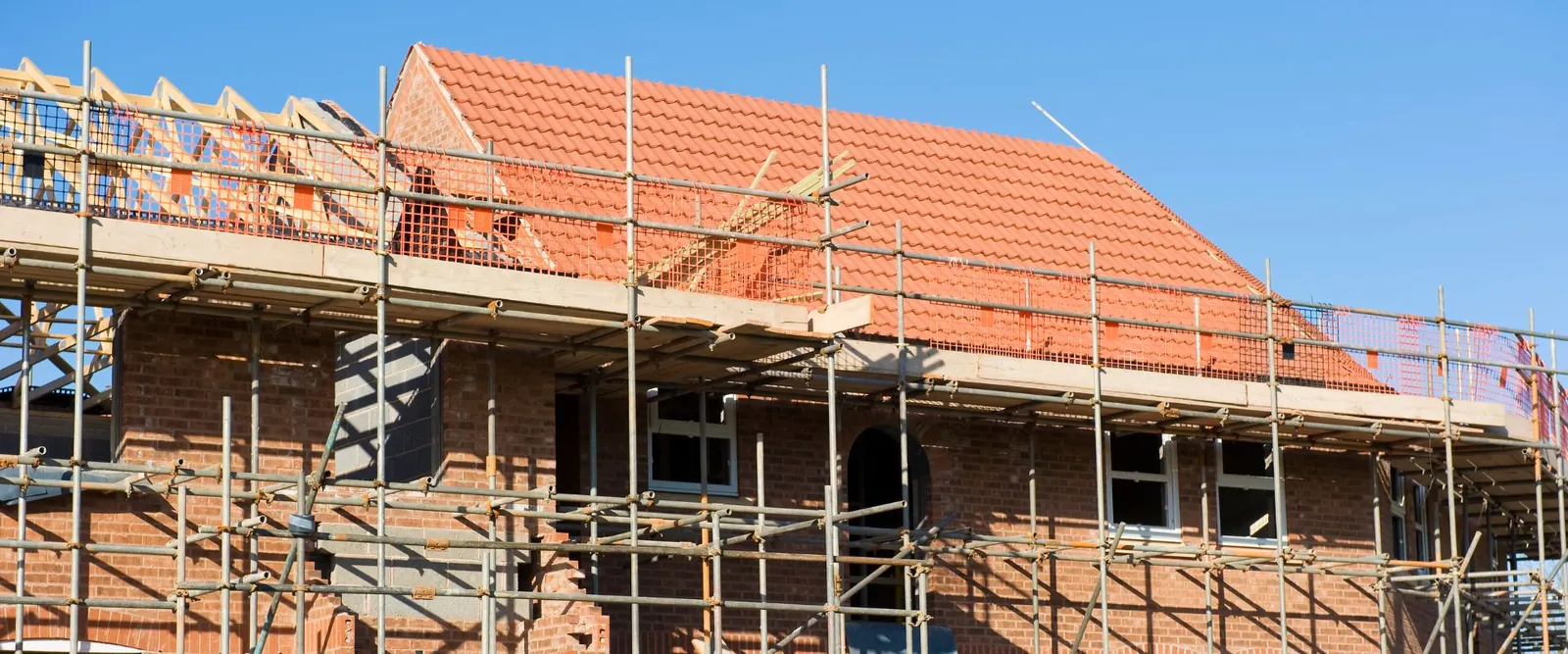
New brick house with a red tiled roof inside scaffolding

The short answer

Wiltshire Council handles planning and building control for the village. A repair using the same materials rarely needs permission. Listed buildings, a different covering and a larger re-roof are the cases that do. St Nicholas Church, listed at grade II*, is dealt with under the Church of England's faculty system.

Fyfield is in Wiltshire Council's area, and a good deal of roof work needs no sign-off at all. Replacing a few tiles, re-bedding a ridge or renewing a flashing is maintenance.

When do larger re-roofs need approval?

Re-covering that reaches 25 per cent or more of the building envelope, or at least 50 per cent of the roof surface, comes under Building Regulations, and the roof's thermal performance may have to be improved. According to the Planning Portal, a new covering that is 15 per cent or more heavier than the old needs approval too. We explain which test your roof meets, and if the job has to be notified, we make the application to Wiltshire Council's building control team or a registered building control approver.

What about listed and protected buildings?

A few older houses near the church may be listed. Where one is, listed building consent is required for any change to its character, and the roofing material counts. St Nicholas, as a Church of England church in use, follows the faculty process instead.

Does the landscape designation change anything?

Fyfield lies in the North Wessex Downs National Landscape. The body that looks after it offers advice, but the council decides planning questions. Whether any part of the village sits inside a conservation area is a question for Wiltshire Council's planning team, so check with them before assuming either way. If you plan new roof openings, our guide to roof window planning explains what applies.

Where scaffolding would stand on a public pavement, a licence may be needed from the council. We raise that during the survey, not on the morning the lorry arrives.

A phone call or short email to the council is usually enough to settle the question. We are glad to read the answer with you and adjust the quote.

Our view

Check listing and landscape status with the council first; a matching repair then rarely needs more.

Roofing services in Fyfield, Wiltshire

Questions from below Fyfield Down

Why does a sarsen cottage roof sometimes dip at the eaves?

Usually because the bedding under the wall plate has crumbled or the plate has shifted on an uneven wall top. The dip is a clue, not the fault itself. We lift a few tiles, look at the timber and mortar beneath, and repair the cause, so the courses can then be re-laid straight along the eaves.

Can you tell a leak from condensation in a Fyfield loft?

Often, yes. A leak leaves a track of staining from one point, usually below a flashing or slipped tile. Condensation shows as widespread dampness and black spotting on cold timber, which points to ventilation rather than the covering.

Do you work on garages and outbuildings as well as houses?

Yes. Garages, workshops and flat-roofed extensions are part of the work, and they often need felt, GRP or EPDM rather than tile. We say which suits the building in the quote, with the reasons, and explain how the falls will drain.

How near to Marlborough do you cover?

Fyfield is about two and a half miles west of Marlborough, well within our area. We also work in Marlborough, Pewsey and the villages of the North Wessex Downs, and the areas page names every village we reach.

Ask us about your roof

Tell us what’s happening and we’ll call you back.

  • Photos of what we find
  • A written quote
  • 10-year workmanship guarantee

Or call 01793 626096

Call Get a quote