Row of stone cottages with steep stone slate roofs

Roofers in Mildenhall

Slate and tiled roofs, brick chimneys and lead flashings looked after in Mildenhall, the Kennet Valley village locals call Minal, on the chalk just east of Marlborough.

Minal's roofs, from thatch to Welsh slate

Thatched cottage with a brick chimney
Timber frame and thatch

The conservation area statement says the oldest houses in Mildenhall are timber framed and thatched, and that thatch is the local tradition. The 17th century cottages in brick and thatch are described as combed wheat reed, with one in long straw. A thatched roof is the thatcher's business, so what comes to us from these streets is the roof beside it: the slated or tiled extension built against a cottage wall, the brick chimney that rises through the thatch line, and the lead that has to keep water out where the two coverings meet. Those junctions need careful detailing, and we plan the method so that open flame stays away from dry thatch.

Brick cottages with slate and tile roofs
Mellow brick, Welsh slate and clay tile

The same statement records that later 19th and early 20th century buildings are in the local mellow brick with Welsh slate or tiled roofs, and that one 17th century building has a plain clay tile roof. Flint and sarsen stone appear in walls too. On the brick houses, the problems we expect are ordinary and fixable: slates that slip when old nails rust, clay tiles that crack, ridges bedded on mortar alone and lead flashings that have cracked where they meet the chimney stack. Matching the colour and texture of a replacement slate or tile matters here, because roofs from several centuries sit shoulder to shoulder along the same lane, and a mismatched patch shows from the road. A careful roofer sorts reusable slates from broken ones before any new stock is ordered.

Village church tower above tiled roofs
Church, manor and the old railway

Grade I listed St John the Baptist church has a tower base dating from the 9th or 10th century, and Poulton House, built in 1706, is Grade II* listed. Buildings of that standing are repaired slowly and in matching materials, and a survey of one begins with a close look at the repairs it has already had, because earlier fixes tell us where the roof moves and where water gets in. The Swindon, Marlborough and Andover Railway ran through the Og valley from 1881 until it closed in 1961, and the Kennet Valley's chalk slopes still frame views from the village. Houses and outbuildings added since the railway's day often have simpler tiled roofs, and extensions bring flat roofs of their own.

From Swindon to Minal in the Kennet Valley

Map showing Mildenhall and central Swindon. 13 road miles south-south-east of central Swindon.

Distance
13 road miles south-south-east of central Swindon
Council
Wiltshire Council
Conservation area
Mildenhall, designated in 1975
Landscape
North Wessex Downs National Landscape
Council
Wiltshire Council

Mildenhall roof questions

Can you repair the slate extension on a thatched Minal cottage?

Yes. The slate or tile roof and the lead at the join are our job, done by methods that keep open flame away from the reed, and the plan is agreed with you first.

Can the Mildenhall conservation area block a roof repair?

Not a repair in matching materials, which seldom needs an application. A listed house, or any plan to alter the covering, is worth raising with Wiltshire Council before work starts.

Do chalk and the Kennet Valley affect how a roof ages?

Only indirectly. A sheltered valley village holds damp and moss on shaded slopes, so gutters, valleys and north-facing slopes get the closest look at survey, and the lofts under them are checked for condensation.

Q1

Can a roofer work safely beside thatch?

Roofer repointing a stone chimney stack above lead flashing
Weathered brick chimney stack with eroded joints and cracked pot

The short answer

Yes, with planning. The risk near thatch is fire, so we choose methods that avoid open flame and hot work close to dry reed or straw, protect the thatch while we are on the adjoining roof, and agree the sequence with you before the scaffold goes up.

Thatch is part of the character of Minal, and a good many of its cottages have a slated or tiled roof against them: a lean-to, a rear wing, an old outhouse. Those roofs need the same care as any other. They also need extra thought about how the work is done.

How is the fire risk kept down?

Dry thatch burns readily, and a stray spark is the last thing a cottage needs. Where lead needs bossing or a flashing is being dressed near the thatch line, we use cold methods and mechanical fixings rather than a gas torch. On a flat roof beside thatch we would specify a covering that is laid without naked flame, which rules some traditional felt systems out of the choice.

Where do junctions and chimneys fail?

The most common faults are at the places two coverings meet. A flashing lifts, a mortar fillet cracks or a chimney stack that has moved lets water run into the wall below. Chimneys on a thatched house also attract specific attention because the stack has to be kept sound and well pointed. Our chimney repairs page explains how the stack, its lead and the flaunching on top are each put right. Where a stack has moved, we also check the wall below it for damp before anything is re-pointed.

How is the thatch protected?

Boards, sheeting and a clear exit route for loose material all matter when scaffolding stands beside a reed roof. We tell you how the thatch will be protected and which days the work is likely to touch it, so you are never surprised by what is happening next door to the reed.

If your cottage has a thatched roof and a newer roof together, send photographs of both and the line where they meet, and the survey will start there.

Q2

Is Mildenhall's Welsh slate worth saving?

The answer

Usually, yes. Welsh slate is hard, long-lived and often outlasts its nails by decades. A roof that leaks after a century of service has typically lost its fixings, not its slates, so refixing and replacing the broken ones beats a full re-roof when the battens and rafters are sound.

Slate roofs in Mildenhall belong to the later 19th and early 20th century houses, when Welsh slate was an easy choice of covering in a brick village. A lot of that slate is still on the roof. What is failing is usually everything that holds it.

What goes wrong first?

Slates are hung on nails, and nails rust. When one fails the slate slips a little, then drops, and the gap lets water onto the batten below. This is nail sickness, and it shows as a scatter of slipped slates across a slope. Lead cracks where it wraps chimneys and walls, and a ridge bedded on mortar alone works loose in the wind.

Should I repair or re-slate?

If the slates themselves are sound, we take the slope off, fit new battens, underlay and fixings, and put the same slates back, with matching ones in place of any that are broken. MyBuilder (updated August 2026) reports that Welsh slate commonly runs past 100 years, so keeping it is often the sound choice. Where slates are flaking apart or the battens have rotted, re-slating the whole slope is better, and the survey photographs make that plain.

What does Welsh slate cost?

MyBuilder, August 2026, gives a typical UK range of £140 to £180 per m² for installed Welsh slate. Roof size, access, scaffolding, the state of the timbers and the lead all change that. After the survey, a written quote fixes the price for your roof, and the work carries our ten-year workmanship guarantee in writing.

Our slate roofing page sets out the methods in full.

Q3

What do the conservation area and the Downs change here?

Blocked gutter full of leaves overflowing down a brick wall
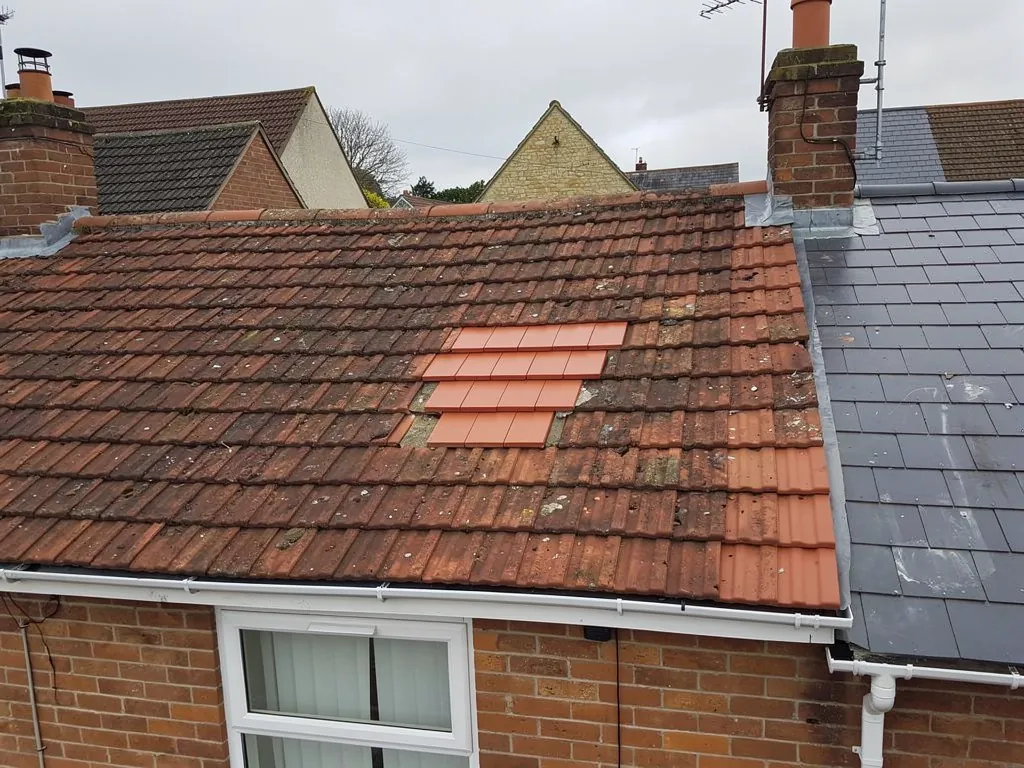
Patch of newly replaced clay tiles on a weathered terrace roof

The short answer

Less than people expect. Mildenhall's conservation area dates from 1975, and the village sits in the North Wessex Downs National Landscape, yet a repair in matching materials seldom calls for a planning application. A listed house, a different covering or new roof windows are the cases to put to Wiltshire Council first.

The Mildenhall Conservation Area was designated on 9 May 1975, and Mildenhall is also inside the North Wessex Downs National Landscape. Neither label stops anyone repairing a roof, but both are reasons to ask before a job that changes how the building looks from the lane or the downs beyond.

Does matching work need an application?

Replacing a covering with the same covering, fixed the same way, is maintenance of the existing building and seldom needs an application. A conservation area leaves that alone, but listed buildings and Article 4 directions follow different rules. An Article 4 direction can take such rights away, so a call to Wiltshire Council's planning team will confirm the position for your address.

What about a change of look?

A change of material, such as slate replacing clay tile, or new openings in a roof slope, is where the council's view counts. A pale modern tile on a brick-and-reed lane can sit badly for decades, so we discuss the look with you as well as the price. Roof windows are covered on our roof window planning page, so we leave the rules there.

Do listed homes and St John's follow different rules?

St John the Baptist is a Church of England parish church, and such churches fall under the ecclesiastical exemption, where the faculty system takes the place of listed building consent. Poulton House, and any other listed home, needs listed building consent before work that alters its character.

The National Landscape partnership gives advice, but the council makes the planning decisions. When a re-roof is large enough to be notifiable, we explain the building control side, which goes through Wiltshire Council's building control team or a registered building control approver, and we make the notification ourselves.


MythA National Landscape address means roof repairs are off limits.

FactRepairs in matching materials carry on as normal; the council looks at altered appearance, and at listed buildings only.

Roofing services in Mildenhall

Questions from Minal and the Og valley

Why do Mildenhall cottages have such different roofs side by side?

Because the village was built, extended and rebuilt over several centuries, and each generation used what was to hand. The oldest houses are timber framed and thatched, 17th century cottages add brick, and 19th and early 20th century buildings brought Welsh slate or tiles. Each roof has its own weak points, so we survey every one on its own terms.

Can you repair a plain clay tile roof like the 17th century one in the village?

Yes. Clay plain tiles are matched by size, colour and texture, broken ones are replaced individually, and the ridge and verges are checked for failed bedding. Where a whole slope has lost its fixings, we recommend a careful re-lay with matching tiles.

Do you reach Mildenhall from Marlborough or Ramsbury?

Yes. Mildenhall is inside the area we cover, a few minutes from Marlborough on the Kennet Valley road, and Ramsbury and the villages along the valley are in range as well. Check the full list of places on the areas page.

Is mortar enough to hold ridge tiles on an old Mildenhall roof?

Not any more. Under BS 5534:2014 a ridge or hip tile is mechanically fixed as well as bedded, so we add clips or screws, or we fit a dry-fix system made to BS 8612. On a roof that catches wind off the valley sides, the ridge is one of the first things we check, and we photograph each run of ridge tiles so you can see which are loose, cracked or sound before you decide on the work.

Ask us about your roof

Tell us what’s happening and we’ll call you back.

  • Photos of what we find
  • A written quote
  • 10-year workmanship guarantee

Or call 01793 626096

Call Get a quote