Roofers on a slate roof along a limestone village street

Roofers in Burbage

Burbage sits on a watershed at the eastern end of the Vale of Pewsey, inside the North Wessex Downs. Its Victorian railway-era houses, church-side cottages and newer homes all get a roof plan that fits the building in front of us.

Burbage's roofs, from church to railway cutting

Pale-walled cottages near a village church
Streets around All Saints

All Saints is the Church of England parish church and is Grade II* listed. It was rebuilt in 1854 by T.H. Wyatt and extended with a south aisle in 1876, keeping only the earlier tower and porch. Houses around a church like this tend to be among the village's older buildings, and the council's conservation area covers part of Burbage. For a roof there, the quiet questions come first: is the house listed, does the conservation area apply, and what is the existing covering made of? We answer those from the loft and the slope before we recommend anything, and we photograph the findings so you can see them too. Nothing is ordered until the quote is agreed in writing.

Victorian terrace with slate roofs and stacks
Railway-era houses

The Berks and Hants Extension Railway was built in the 1860s, and a second line, the Midland and South Western Junction, opened its Grafton and Burbage station in 1882. The village population peaked at around 1,600 with the railway's construction in 1860. Houses put up for that growth belong to the Victorian period, when Welsh slate travelled easily by rail and was widely used across England. Slate of that age is long-lived but suffers from rusted nails, tired lead flashings and ridges bedded on mortar alone, so a survey looks closely at every slope, the chimney junctions and the ridge line, and we note the loft side as well, where daylight through a slope shows where slates have gone.

Detached house on open ground near downs
Canal side and downland edge

The Kennet and Avon Canal, completed in 1810, crosses the parish just north of the village through the Bruce Tunnel, and the village itself stands on a watershed within the North Wessex Downs. Newer houses, bungalows, garages and converted farm buildings sit around the older core. Exposed ground on the edge of the downs gives wind a good run at ridges, verges and porch roofs, so fixings matter, and we check the roof edge and gutter line first on a house that stands clear of its neighbours. Garage and outbuilding roofs, often felt or sheet, tend to be forgotten until they leak, so they go on the survey too.

Out from Swindon to the Pewsey Vale

Map showing Burbage and central Swindon. 18 road miles south-south-east of central Swindon.

Distance
18 road miles south-south-east of central Swindon
Council
Wiltshire Council
Local council
Wiltshire Council
Landscape
North Wessex Downs National Landscape (AONB)
Conservation area
Burbage has a conservation area

Roof questions in Burbage

Does the North Wessex Downs change roof work in Burbage?

Wiltshire Council decides planning questions, and the National Landscape body only advises. Putting back what was there is not usually a planning matter. A visible change of covering, though, should go to the council before work starts.

Can slate on a railway-era house be repaired in part?

Usually. Slipped or cracked slates can be refixed or swapped for matching ones, keeping the cost down. A slope with failing nails is different and is better re-slated as a whole.

Are Burbage's roofs exposed to wind from the downs?

Ridges, verges and gable ends on open ground take the most, so the way they are fixed matters more here than the covering, and the survey looks at them first.

Q1

How are Burbage's Victorian slate roofs repaired?

Concrete tile roof with moss, lifted tiles and a cracked ridge
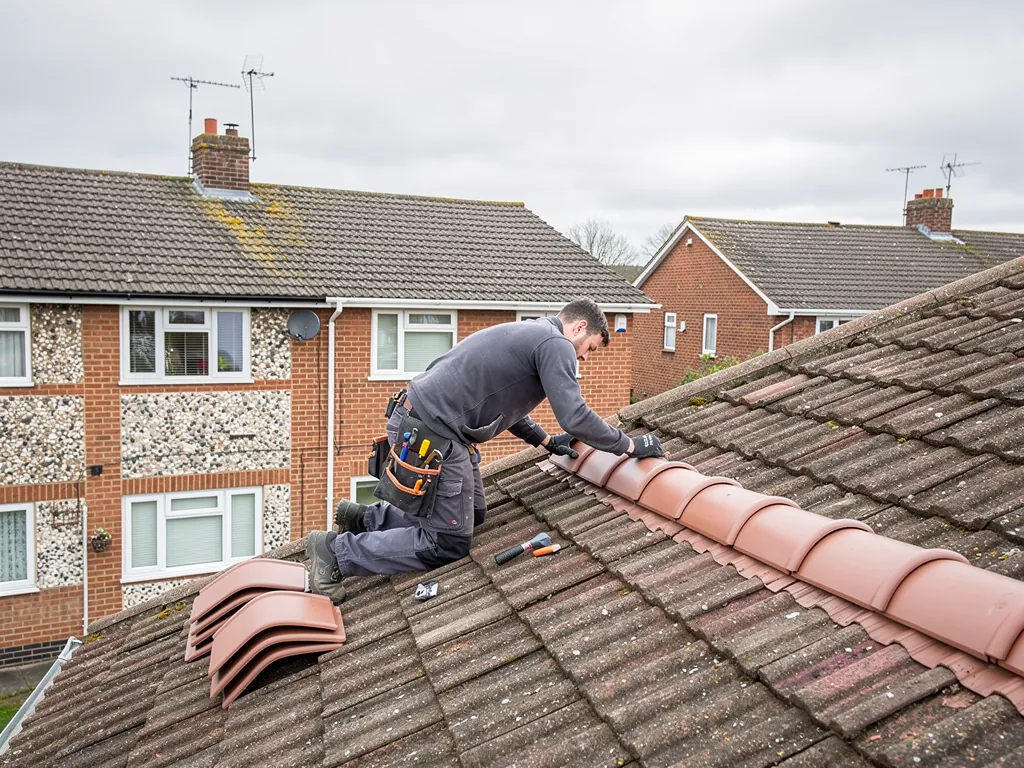
Roofer fixing new red ridge tiles along a concrete tile roof

The short answer

Slate is repaired slate by slate where the fault is local. Refixed or replaced slates, new lead at the chimney and a re-bedded ridge handle most leaks. If the nails along a whole slope are failing, a full re-slate with the sound slates sorted and reused makes better sense than endless patching.

When the railway came to Burbage in the 1860s, building followed. Slate arrived cheaply by rail and houses went up quickly, which is why a Victorian terrace or pair of cottages in a village like this often carries slate. A hundred and sixty years on, those roofs are where our repair work concentrates.

What goes wrong first on old slate?

A slate is held by nails, not by weight. Over time the nails corrode, and the slate slides down a few centimetres or drops out. Other faults come with age: lead flashings at the chimney crack and lift, ridges bedded on mortar crumble, and valleys, the internal channels where two slopes meet, let in water as their lead wears thin. We trace each leak to its cause rather than cover it.

Repair or re-slate?

A few slipped slates are a small repair and we fix them with copper nails or clips, matching size and colour. If a slope sheds slates every year, the fixings are tiring across the whole of it and re-slating is the sounder answer, and the written quote says so plainly. Good slates are lifted, sorted by size and put back, with new battens and underlay beneath, which is the layer of waterproof sheet under the slates that catches anything the slates let through. Our slate roofing page goes through the stages.

How long can slate last?

MyBuilder, in a guide updated on 21 August 2026, says a well-installed slate roof can last 80 to 100 years or more. A roof is not condemned by its age; the nails and flashings usually give out before the slates do.

Q2

Does Burbage's conservation area affect a new roof?

The answer

Slates for slates, or tiles for tiles, seldom call for an application to the council, even where a conservation area applies. Switching material, or altering a listed building, calls for a conversation first. Wiltshire Council's planning team can confirm whether your house is listed or within the boundary, and we will wait for that answer before pricing.

Burbage has a conservation area, and the village sits within the North Wessex Downs National Landscape. That sounds restrictive, yet for most roof work it makes little difference. What counts is any visible change to the building, and a good surveyor will have an eye on that from the first visit.

Does matching work need consent?

Replacing slates with slates of the same type, or tiles with matching tiles, is maintenance. Under section 55 of the 1990 planning Act, maintenance that does not materially affect a building's external appearance is not development at all, which is why a plain repair rarely needs an application. If a previous owner has already swapped the covering for something different, matching the earlier roof can need a conversation with the council.

When should you ask the council first?

Ask Wiltshire Council's planning team before changing the covering, altering a chimney, or adding anything to a front slope. Listed buildings follow stricter rules: an alteration touching the character of a listed house requires listed building consent, and roofing material counts as part of that. Skylights are a separate question; our skylights page explains where the planning rules stand for them.

Which Burbage re-roofs need building control approval?

When re-roofing affects 25 per cent or more of the building envelope, or 50 per cent or more of the roof, building control approval applies, and insulation may need upgrading. At the survey we explain what is notifiable, and we deal with the notification, whether it goes through Wiltshire Council's building control team or a registered building control approver. The council decides planning; the National Landscape body can advise but does not make the decision, so it is not a second layer of permission to wait for.

MythA conservation area means every roof repair needs planning permission.

FactMatching repairs rarely do; it is changes to appearance, and work on listed buildings, that the council looks at.

Q3

Why do ridges and verges matter on the downland edge?

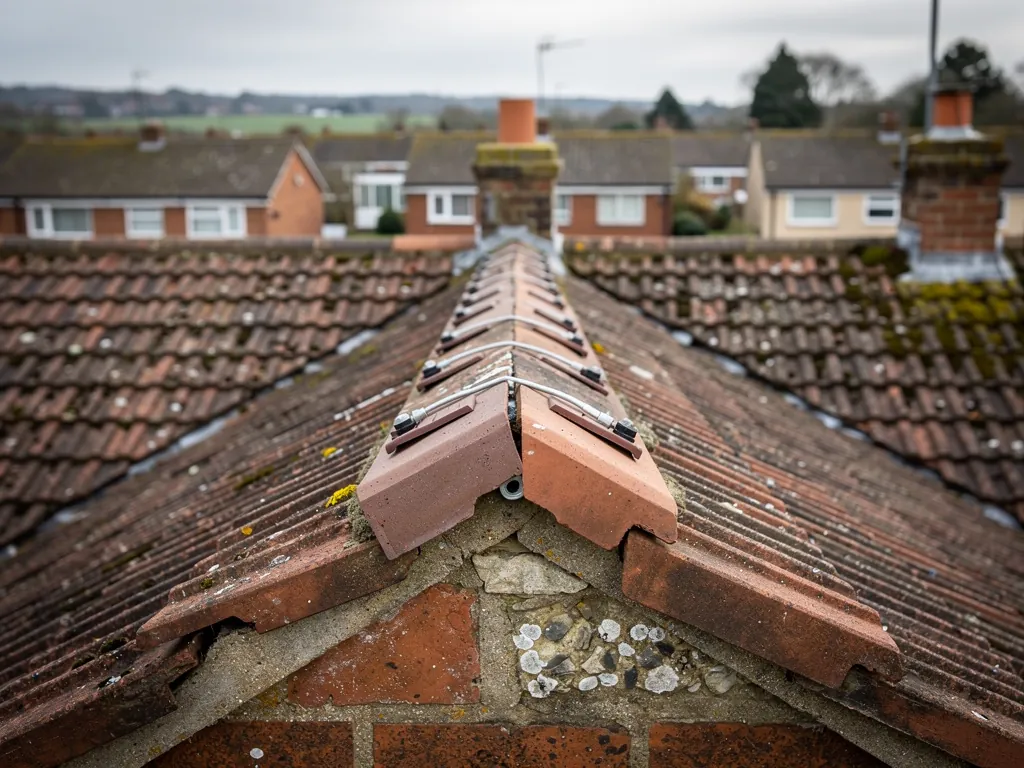
Close-up of clay ridge tiles meeting a brick gable end
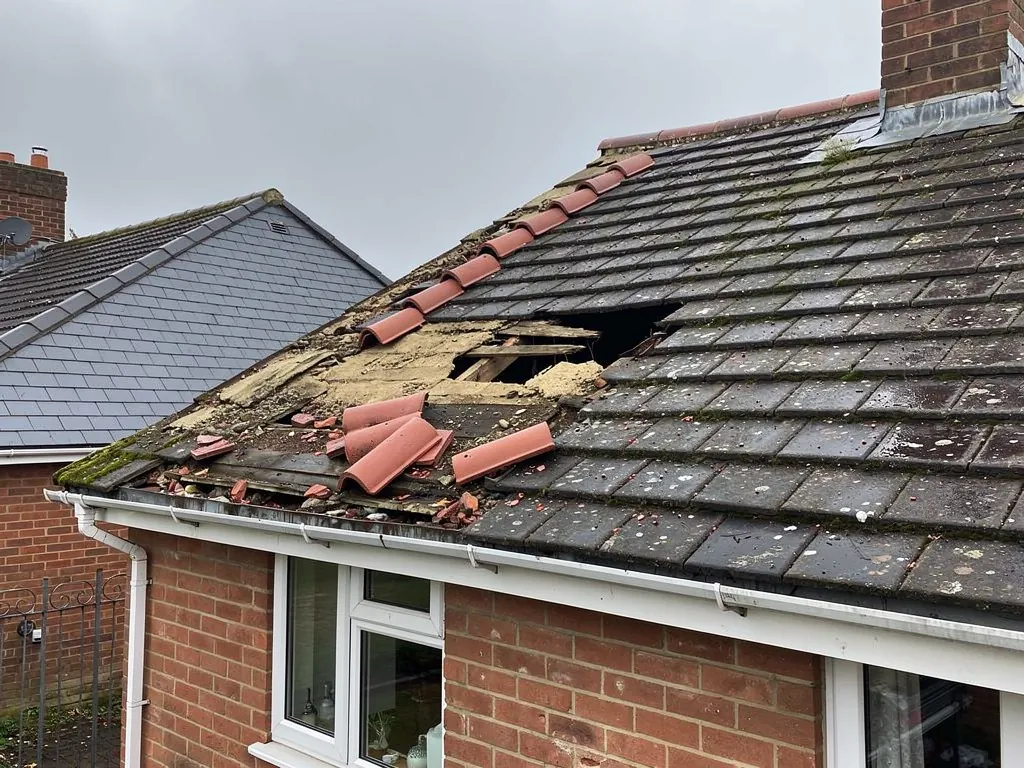
Ridge tiles blown off a concrete tile roof after a gale

The short answer

On open ground the wind reaches the ridge and the gable edges first. A ridge or verge that is bedded in mortar alone can loosen over the years and let tiles lift. A ridge bedded in mortar alone is below today's standard, which asks for mechanical fixings as well; a tested dry-fix system is the other route.

Burbage lies on a watershed at the east end of the Vale of Pewsey, and a roof on the village edge gets little shelter from the land around it. The ridge, the high line where the two slopes meet, and the verges, the edges on the gable ends, are the parts that take the most wind, along with any porch or garage roof standing clear of its neighbours.

How do ridges fail?

Traditional ridge tiles were bedded in mortar. Mortar cracks as the roof moves, then loosens, and eventually a tile lifts. A loose ridge tile is a danger below as well as a leak above, so it is worth acting early, and we would always rather refix one tile than replace twenty after a gale. If you can see cracked mortar from the ground, a closer look is overdue.

Mortar, clips or dry-fix?

The 2014 revision of BS 5534 ended reliance on bedding mortar alone for ridge and hip tiles, so clips or screws are added to the bedding. Dry-fix systems, tested to BS 8612, hold the ridge with clips and screws and a ventilated strip instead of a mortar bed. Both approaches work. We choose between them based on the roof, its tile type and how exposed the house is.

What about the verges?

Verge tiles on a gable need to be fixed and sealed against the wall below. A cracked mortar verge, gaps at the barge board or lifting end tiles are signs of an edge that needs work. Our ridge, verge and dry-fix page shows what is involved, and the survey photographs make it clear which method is suitable. Whichever we choose, the verge and ridge are left clean and sealed, and any broken tile is cleared from the site.


Questions from around All Saints and the old station

Do older Burbage cottages near the church have special roofing needs?

They can. If the house is listed, or lies within the boundary, the first step is checking with Wiltshire Council what applies. After that, the covering, timbers and flashings are looked at together, and the repair is matched to what is there rather than replaced with something different. The same goes for any later re-roof, which keeps the street looking as it did.

Can you reach Burbage from Swindon quickly enough to be practical?

Yes. Burbage is inside the 30 road miles we cover. Marlborough, Savernake and the villages of the Vale of Pewsey around it fall within the same area, and each has its own page under areas we serve.

Is a gutter problem a roof problem in a village like Burbage?

Often, yes. A blocked or sagging gutter sends water down the wall and back under the lowest tiles, which rots the batten ends and fascia. A gutter clear-out or new brackets can solve what looks like a roof leak, and we check the line of the guttering at every survey, along with the fascia behind it, because soft fascia boards point to a long-running drip.

Is a church roof in Burbage covered by listed building consent?

A church used by the Church of England is dealt with through the faculty system instead of listed building consent. Those responsible for All Saints would go through the diocese, not through us. For private houses nearby, the council is the right first call, and we are glad to talk through what a roof survey would show before you decide anything.

Ask us about your roof

Tell us what’s happening and we’ll call you back.

  • Photos of what we find
  • A written quote
  • 10-year workmanship guarantee

Or call 01793 626096

Call Get a quote