Brick and limestone cottages around a small village green

Roofers in Shalbourne

We repair and replace roofs in Shalbourne, from the farmhouses and cottages gathered near the church to the newer houses that follow the stream towards Hungerford, and the quote arrives in writing once we have seen your roof.

Shalbourne's roofs, along the stream

Flint walls and a tiled church roof
Church, manor and farmhouses

The oldest buildings in Shalbourne carry real weight of history. St Michael and All Angels is grade II* listed, built of flint and stone with tiled roofs, and was partly rebuilt and extended by G F Bodley between 1871 and 1873. West Court farmhouse dates from the 15th and 17th centuries and Shalbourne Manor farmhouse from the 16th, both grade II* too. Roofs of that age tend to be steep, with timbers that have shifted over the centuries and chimney stacks that have been taken down and built again. On a listed house the covering, its fixings and the way it meets the walls are decisions to reach with the council before any material is ordered.

Tiled cottages beside a village stream
Cottages and outbuildings by the water

The village grew up along a spring-fed stream that runs north-east to join the River Dun above Hungerford, and its cottages, barns and farm outbuildings follow that line. Buildings beside water and under trees hold moss and damp, and low eaves, lean-tos and small rear roofs are where leaks tend to begin. The usual faults are slipped or cracked tiles, softened battens, blocked valleys and gutters that no longer fall towards the downpipe. Many of these roofs are small and irregular, so we check the loft timbers from inside as well as the covering from outside before suggesting how much of the work is really needed, and how much is not.

Concrete tile roofs on later village homes
Later houses and the old county line

Until 1895 about half of the parish, including its church, lay in Berkshire, and the village still sits on that border near Hungerford. Beyond the old core stand houses from later decades: bungalows, extended family homes and detached garages roofed with factory-made tiles. Their trouble is different in kind. Bedding crumbles under the ridge, verges dry out and crack, underlay splits behind the battens, and porch or extension roofs, often flat or shallow, wear out faster than the main roof above them. Many of these are tidy jobs: find what has failed, fix that, and a small repair buys years before anything larger is needed. A flat porch roof that has started to pond, for example, is far cheaper to re-cover this year than after the timber beneath it has rotted.

From Swindon to the Berkshire border

Map showing Shalbourne and central Swindon. 21 road miles south-east of central Swindon.

Distance
21 road miles south-east of central Swindon
Council
Wiltshire Council
Council
Wiltshire Council
Conservation area
Shalbourne has its own conservation area
Landscape
North Wessex Downs National Landscape (AONB)

Shalbourne roof questions

Is my Shalbourne roof inside the conservation area?

Shalbourne has a conservation area, but its edge falls between houses. Wiltshire Council's planning team can confirm whether yours is inside before you accept a quote or change any material.

Can flint-and-stone walls take a new roof covering?

Usually, provided the wall plates and timbers are sound. We inspect the top of the walls first, since everything above it rests there.

Why does moss return so fast beside the stream?

Shade, damp air and shelter from the wind all help it grow. Gentle cleaning and clear gutters keep it down, while pressure washing is best avoided on old tiles because it strips the surface.

Q1

What roofs surround Shalbourne's church?

Reclaimed Cotswold stone slates sorted by length beside a limestone wall
Roofer repointing a stone chimney stack above lead flashing

The short answer

Around St Michael and All Angels stand some of the oldest roofs in the parish: a grade II* church of flint and stone with tiled roofs, and two grade II* farmhouses from the 15th to 17th centuries. Roofs like these are repaired with care, in materials chosen to match.

Walk the lanes near the church and you pass roofs from several centuries. The parish church was partly rebuilt and extended by G F Bodley between 1871 and 1873, though its walls and parts of its fabric are far older. West Court farmhouse and Shalbourne Manor farmhouse add two more grade II* roofs to the same small area.

Why do old Shalbourne roofs never sit square?

Roofs from before the nineteenth century were built without the straight, regular timbers we take for granted today. Rafters curve, the ridgeline sags slightly and walls lean out of true. A roofer who forces a perfectly flat modern batten line onto such a roof leaves gaps, so the work has to follow the shape of the building instead. Tiles are sorted by size, the sound ones are kept, and any new ones are chosen to blend with the old by colour and texture. A tile that is fresh orange beside weathered brown stays obvious for years.

What does a flint wall mean for the roof above it?

Walls of flint and stone do not give a roofer a clean, level top edge. Wall plates may be uneven, and the junction where roof meets wall is where water most often gets in. We look at verges, eaves and abutments first, because those junctions decide whether the whole roof stays dry. Lead flashings and soakers, the small folded sheets that make the join with a wall watertight, are often the real culprit rather than the tiles themselves.

Our pages on pitched roofing and roof repairs cover the usual jobs in more detail.

Where a roof has been patched many times, the survey photographs show what is original and what has been bodged, and those pictures are what your quote rests on. They also show whether an earlier repairer used the wrong tile, a different size or the wrong fixings, which changes what the next repair should be.

Q2

Should I patch or re-tile an old Shalbourne roof?

The answer

Choose a patch if the damage sits in one spot and the battens and rafters are firm. Choose re-tiling once nails and battens are giving up across a whole slope, because patching an exhausted roof only delays the bill. Photographs from your own roof settle which applies.

People often ask for a patch because they hope it is the cheaper route. Sometimes it is. Sometimes it only moves the leak a metre along the slope, and the second visit costs more than doing the job properly in the first place.

Which faults can be mended without re-tiling?

Two or three cracked tiles, a short length of damaged ridge, lead that has peeled back at a chimney or a valley full of moss can each be dealt with locally. If the battens are firm and the underlay behind them is intact, swapping individual tiles and refixing the ridge is sound, lasting work. We propose just enough work to cure the fault, and the quote says so.

How do I know it is time to strip the slope?

Tiles can last a long time, but the fixings behind them often do not. Nails corrode, battens soften and underlay turns brittle. Once that has spread across a slope, new tiles on old battens are a false economy. Strip back the slope, put new battens and underlay on, and lay the good tiles again with a few matching extras. Concrete tiles are often put at around 30 to 60 years, clay longer, though a lifespan is a range for a decent roof and never a promise.

Extensions follow the same reasoning. A porch or kitchen roof that keeps leaking is often better renewed than patched yet again, and our flat roofing page explains the choices.

If a stripped roof turns out to belong to a listed building, the work is agreed with the council first, and nothing is thrown away that can be reused. Old tiles that are still sound often go back on the slope facing the lane, where they are seen, while newer matching ones go on the back. Sorting them on the ground, by size and by weathering, takes time, and it is the part of the job that decides how the finished roof looks from the road.


Our view

Patch a local fault, re-lay a failing slope, and let the survey photographs decide which.

Q3

Who decides on roof work in Shalbourne's conservation area?

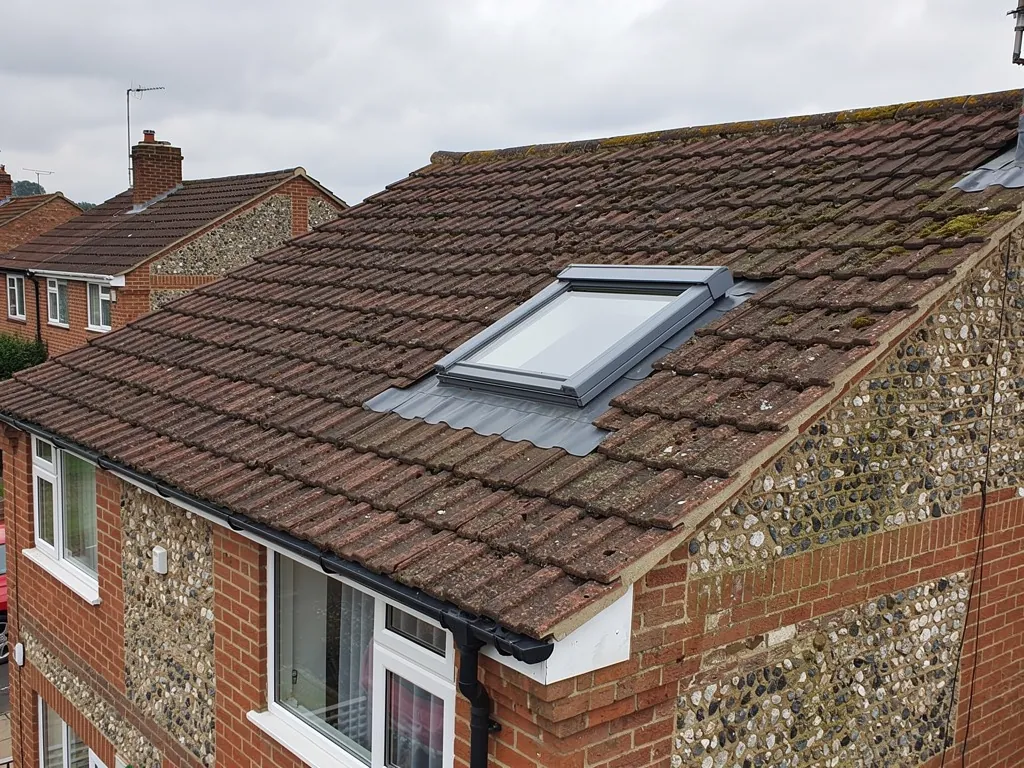
Roof window fitted into a brown tiled roof slope
Long flat roof on a 1960s brick building being re-covered

The short answer

Wiltshire Council decides planning questions in Shalbourne, including those about its conservation area and its listed buildings. Larger roof jobs also go through building control, either the council's team or a registered building control approver. We explain which route applies before work starts.

Shalbourne sits in Wiltshire, so Wiltshire Council answers the planning questions, and the National Landscape designation across the Downs does not change that. Three situations are worth a conversation before anything is ordered.

At what size does a Shalbourne re-roof need approval?

As the Planning Portal sets it out, you can usually skip a building control application if the work touches under 25 per cent of the total building envelope and under 50 per cent of the roof. Pass either limit, or choose tiles that weigh 15 per cent or more than those they replace, and approval comes into play. Stone and clay can be far heavier than slate or thin concrete, so we check what the rafters were built to carry. A whole-roof re-cover may also mean bringing the insulation up to current standards. A registered building control approver, or Wiltshire Council's own team, takes the application, and we handle the notification whenever the job has to be notified.

Does Shalbourne's conservation area limit my choices?

Shalbourne has a conservation area, and the parish holds several listed buildings. Like-for-like work seldom reaches the planning desk. Changing the material, putting a roof window in the lane-facing slope or reshaping a stack is a reason to speak to Wiltshire Council's planning team first. Where a house is listed, consent is needed before you alter anything that gives it its character, and the roof sits squarely within that. Asking costs nothing; guessing wrong can mean putting the work right at your own expense.

Do the church and the Downs change who decides?

St Michael's is an Anglican church, and while it is used for worship its repairs answer to the diocese's faculty system, not to the council. The Downs designation brings advice from the National Landscape team, though it is the council's officers who decide. Our skylights page covers roof windows in full.

MythLiving inside a conservation area rules out any roof work without a planning application.

FactWork that restores the existing look does not usually need one; the council's interest lies in changes of appearance.

Questions from along the Shalbourne stream

Why do roofs beside the Shalbourne stream grow moss so quickly?

Damp air, shade from trees and sheltered slopes keep tiles wet for long stretches, and moss follows. Once established it traps water against the tile and clogs gutters and valleys. We clear it by hand or with a gentle wash and check the surface underneath, since moss often hides cracked or slipped tiles. Clear gutters help more than any treatment.

Can you work on a farmhouse roof that is grade II* listed?

Yes, using the same materials and methods already on the roof. A repair that restores what was there rarely needs consent, but anything that alters the character of a listed building does. We talk it through with you, suggest a word with Wiltshire Council before pricing, and photograph the roof first so the original arrangement can be followed closely.

Do you cover the Wiltshire and Berkshire sides of the old county line?

Yes. Shalbourne is inside the ground we work from Swindon, and the villages and towns nearby, Hungerford among them, fall within the 30 road miles we cover. Our areas page names each place, and a quick call or message settles any doubt about a particular address.

Do gable walls of flint need attention when the roof is renewed?

Often the top courses do. Flint-and-stone gables can have loose pointing or a cracked coping where the verge meets the wall, and fresh roof work is the best moment to deal with it. We look at the wall head and verge together, and flag anything that a mason should see.

Ask us about your roof

Tell us what’s happening and we’ll call you back.

  • Photos of what we find
  • A written quote
  • 10-year workmanship guarantee

Or call 01793 626096

Call Get a quote