Brick and limestone cottages around a small village green

Roofers in Vernham Dean

We repair and renew roofs in Vernham Dean, from the listed cottages and the George Inn in the conservation area to the farmhouses and homes spread across this downland parish.

Vernham Dean's roofs, from the Street to the downs

Cottages with steep roofs and old chimneys
The conservation area and its listed houses

Vernham Dean's conservation area holds 22 listed buildings, all Grade II, according to the Heritage Check listing drawn from Historic England data. Among them are The George Inn, Old Forge, Applethatch and Long Thatch. Names like the last two suggest thatch on some roofs, and tiled roofs stand beside them. Houses of this kind tend to have steep pitches, deep eaves and small dormers or eyebrow details that need careful flashing. A repair here is planned around keeping original materials and the shape of the roof wherever they can be saved, and a listed house needs its consent questions answered before any covering changes.

Clay-tiled roofs beside flint and brick walls
Flint, brick and tile around St Mary's

The parish church, St Mary the Virgin, has flint and stone walls, much modern red brick in the nave and tiled roofs. A rebuild in 1851 took most of it, though a late twelfth-century north nave wall and west doorway survive. That mix of flint, brick and clay tile is a fair clue to what older buildings in the village share. Clay plain tiles hang in overlapping courses and cope well with age, yet they rely on sound battens and fixings. Slipped tiles, moss-covered slopes, loose hip tiles and tired lead around chimneys head the list when we climb onto a roof of this type. Flint walls also mean flashings must be cut into mortar joints with care, since the stones themselves are irregular and brittle.

Rural houses with outbuildings on open ground
Hamlets, farms and newer houses

The parish reaches well beyond the main village. Smaller clusters sit at Woodside, Vernhams Bank, Lower Conholt, Vernhams Street, Little Down and Vernhams Row, so the work is spread over individual houses, farmhouses and outbuildings with long runs of roof facing open downland. Newer homes, garages, porches and extensions bring their own jobs: ridge mortar that has failed on concrete tiles, felt flat roofs, gutters that have dropped and sheeting on farm buildings past its useful life. On a working farm, an old barn roof can be a bigger worry than the house, and we are happy to look at both in one visit. Each roof is surveyed according to what it is actually made of, and the proposal stays as small as the fault allows.

Vernham Dean on the county line

Map showing Vernham Dean and central Swindon. 27 road miles south-south-east of central Swindon.

Distance
27 road miles south-south-east of central Swindon
Council
Test Valley Borough Council
Council
Test Valley Borough Council
Conservation area
Vernham Dean, designated in 1983
National Landscape
North Wessex Downs

Vernham Dean: answers before the scaffold goes up

Does the Vernham Dean conservation area affect a re-roof?

Matching re-covers seldom need an application, but listed houses and visible changes do. Ask Test Valley Borough Council's planning team before committing.

How exposed is a roof at the downland edge of Vernham Dean?

The parish climbs to high downland on its northern boundary, which puts the wind on ridge lines, verge edges and gable tops. How they are fixed gets checked first.

Can you work beside thatched houses like Long Thatch?

Yes, on the tiled, slated and lead parts of a house and on its neighbours. We confirm what is thatch and what is not, and plan access around it.

Q1

What roofs sit in Vernham Dean's conservation area?

Roofer repointing a stone chimney stack above lead flashing
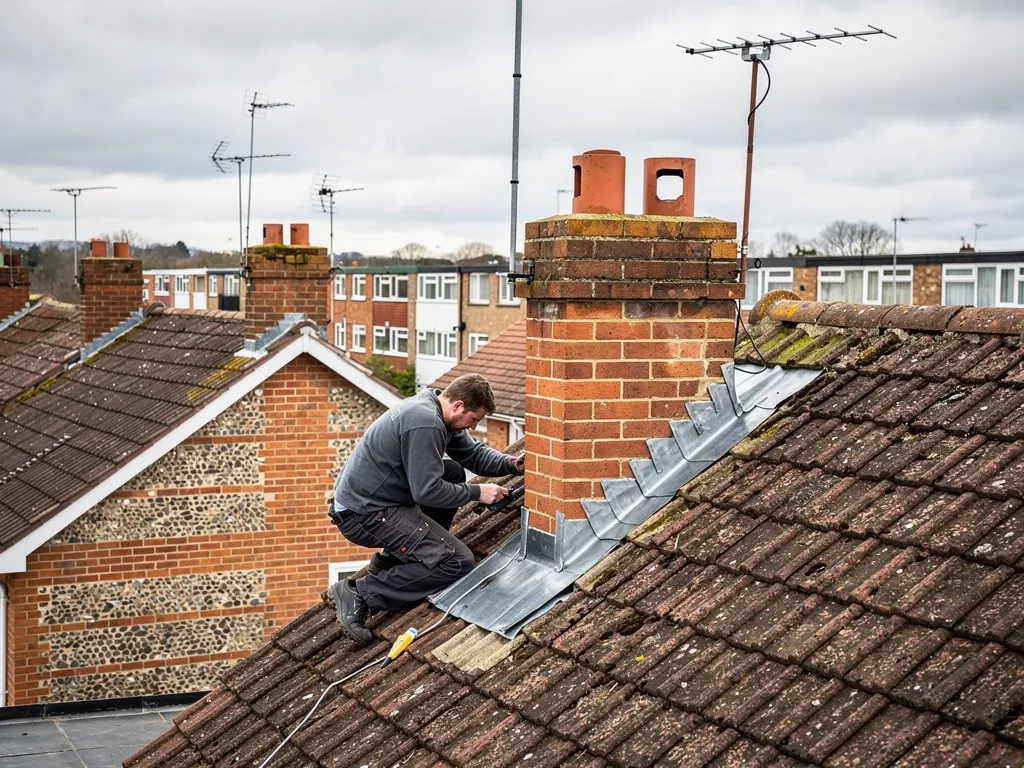
Roofer on a scaffold tower working on a brick chimney stack

The short answer

The conservation area has 22 listed buildings, all Grade II, among them The George Inn, Old Forge, Applethatch and Long Thatch. Expect tile, flint and brick walls and some thatch. Repairs aim to keep original materials and the historic outline of each roof.

Test Valley Borough Council first designated Vernham Dean a conservation area on 4 March 1983, and extended it in 2009 after reviewing where the boundary should run. The area is the historic core of the parish, and its listed houses are the reason it was drawn.

What do the listed buildings tell us about the roofs?

Names such as Applethatch and Long Thatch point to thatch on some houses, while the parish church shows the wider palette: flint and stone walls, red brick and tiled roofs. Older roofs are frequently steeper than modern ones, with eaves details that follow no standard module and a timber structure that has moved with age. A repair has to respect the roof as it is, not an idealised version of it.

How does a conservation area change a repair?

It does not stop you looking after a roof. Matching repairs usually need no consent. Where work would alter how the building looks, such as a different covering, new openings or reshaped chimneys, the council has a say. Listed buildings are a firmer case, because anything affecting character calls for listed building consent. Test Valley Borough Council's planning team can say which side a given job falls on.

Who works beside a thatched roof?

Thatching is a separate trade with its own materials. Our part is everything else on the house: tiled and slated sections, lead flashings, chimney stacks, gutters and any flat roof. Access and working methods are planned with the neighbouring thatch in mind, so nothing is disturbed that does not need to be. Our chimney repairs page covers the stack and flashing jobs that old cottages most often need.

Q2

What does North Wessex Downs status mean for my roof?

The answer

Vernham Dean lies in the North Wessex Downs National Landscape. The council decides planning and the National Landscape body only advises. It does not stop matching re-covers, but it is protected land, so check before reshaping a roof or adding to it.

The parish is downland on the Hampshire and Wiltshire border, with high ground along its northern boundary and clay over chalk beneath. AONBs across England and Wales became known as National Landscapes on 22 November 2023, though the legal designation is unchanged.

Who decides on planning here?

The local planning authority, which for Vernham Dean is Test Valley Borough Council. The North Wessex Downs partnership offers advice without any statutory power, and planning officers are free to decide an application without asking it. Questions about a roof therefore go to the council, not the National Landscape office. Neighbouring councils on the Wiltshire side of the line are separate authorities, which is worth remembering if a relative asks about a house a few fields away.

Does it change what can be done to a roof?

A roof renewed with matching tiles is not normally development at all. Where National Landscape land behaves like a conservation area is in permitted development, which is narrower in places, so new openings or additions to the roof need checking. Our guide to skylights and roof windows covers the planning questions around those, and they are not repeated here.

How exposed are the roofs on the downs?

Open downland offers less shelter than a valley town, so ridges, hips and verges carry the exposure and the way tiles are held matters. Since BS 5534:2014 a ridge or hip is no longer left to its mortar bed alone, so we add stainless clips and screws, or fit a tested dry ridge kit. Facing open slopes, those fixings keep the line in place when the weather turns.

None of this makes a repair complicated. The planning position is checked early, you are told what turns up, and the work stays at the size the fault demands.

Our view

Fix the exposed edges first, because ridges and verges take the weather.

Q3

How are thatched, tiled and slated roofs handled here?

Rolled lead roof covering over a bay above white windows
Roofer dressing stepped lead flashing around a brick chimney

The short answer

Each material has its own faults and its own remedy. Tiles and slate depend on sound battens, fixings and flashings, and lead around chimneys and dormers wears first. A thatched neighbour does not stop work on the rest of a house, but it shapes how access is planned.

A parish with several coverings is one where no single method suits every house. Before a job is priced the questions are simple: what is the roof made of, how is it held on and what has actually failed. Once we have surveyed, you receive a written total price with pictures of your roof; if you hold other quotes, check whether they include VAT and scaffolding.

What goes wrong on a clay-tiled roof?

Plain clay tiles hang from battens on small nibs, with nails in only some courses. Over time battens soften, nails corrode, frost cracks tiles and a mat of moss keeps the surface wet. A few slipped tiles are a quick fix. A whole slope that has lost its fixings needs stripping, new battens and underlay, and the sound tiles laid again with new ones matched in. Condition decides, not age.

Where does lead give way first?

At the details: around chimneys, along abutments, in valleys and on any dormer cheek. Lead lasts a long time when correctly installed, yet it fatigues where it has been stretched, and old stuck-on repairs make things worse. A soaker is a folded lead tab slipped beneath each course beside a wall or chimney, with the flashing covering the join above it. Renewing both in the right lead code is usually a modest job.

Why do tiles lift on exposed ground?

Wind pulls at the verge, the ridge and the edges, and where fixings are missing the tiles move. Checking those edges takes minutes during a survey, and refixing them costs far less than repairing the storm damage that follows when they go. For the process in more detail, see our roof repairs page.

Not sure what covers your roof? Send a photograph taken from the ground and you will get a first impression before anyone visits.


Questions from the George Inn to Little Down

Do conservation-area cottages in Vernham Dean need consent for a re-cover?

Re-covering in like material seldom calls for an application, though a listed house or a visible alteration may. The conservation area dates from 1983 and 22 buildings within it are listed Grade II. Put the question to the planning team at Test Valley before work starts; a short description of the job from us helps them reply quickly.

Is flint walling a problem when fixing a lead flashing?

It needs care. Flint walls are uneven, and the mortar joints are the usual place to chase a flashing in. Cutting too deep or in the wrong spot can loosen the wall, so the cut follows the joints and stays as small as the lead allows. A neat result on flint depends on slow, careful work.

Do you cover hamlets such as Woodside and Lower Conholt?

Yes. The parish includes clusters at Woodside, Vernhams Bank, Lower Conholt, Vernhams Street, Little Down and Vernhams Row, and each of them falls inside our working radius, even though the parish sits across the county line from Wiltshire in Hampshire.

Are ridge tiles on Vernham Dean's older houses bedded in mortar alone?

Many are, because that was the standard for a long time. Since BS 5534:2014 the tiles on a ridge or hip also get mechanical fixings, and on the open downland edge that upgrade sits near the top of our list.

Ask us about your roof

Tell us what’s happening and we’ll call you back.

  • Photos of what we find
  • A written quote
  • 10-year workmanship guarantee

Or call 01793 626096

Call Get a quote