New-build brick and render estate houses with grey tile roofs

Roofers in Collingbourne Ducis

Whether it is a leaking chimney, a worn slope or a tired extension roof, we cover Collingbourne Ducis, from the flint-walled buildings near St Andrew's to the Victorian and newer houses strung along the Bourne valley.

Roofs along the Bourne valley

Flint wall and clay-tiled roof on a church
Flint, stone dressings and the church

St Andrew's church sets the tone for the oldest part of Collingbourne Ducis: flint walls with stone dressings, and a Grade II* listing. The council's community history record notes that its nave and aisle roofs were re-covered in tiles in 1877, a reminder that even the grandest roofs here have been renewed more than once. Flint walls are hard, uneven and unforgiving, so the junction where a roof meets one deserves attention. Lead flashings and soakers have to be dressed into irregular courses, and a roof edge sitting slightly proud of a flint gable is usually a sign that water has been finding its way into the wall below. Houses built in or beside flint need careful abutment work, and that is where leaks on this kind of building tend to begin.

Victorian terrace with slate roof and chimneys
Ironworks and railway years

The Bourne Iron Works made agricultural implements here from the 1860s until the Second World War, and a railway opened in 1882 and carried passengers until 1961. Those decades brought new housing to a village that had been largely farm cottages, and houses of that age across southern England were roofed in either clay tile or Welsh slate. Roofs of that vintage are now well over a century old. The common faults are tired lead at chimneys and party walls, slipped or nail-sick slates, cracked and frost-lifted clay tiles, and ridge lines that were bedded on mortar alone. A repair here often means matching a tile or slate to the street rather than reaching for whatever size is nearest to hand.

Brick farmhouse with tiled roof and outbuildings
Manor houses, farms and newer homes

Collingbourne Ducis also has substantial older houses, among them Sunton House, a Grade II* listed house from about 1710. Buildings of that class and age call for slow, careful work and an early conversation with Wiltshire Council about consent. Around them sit farm buildings, outbuildings and the homes added in the twentieth century, many with concrete or machine-made clay tiles, plus flat or low-pitched roofs on extensions, porches and garages. Those smaller roofs often fail first. A felt or bitumen flat roof that has outlived its life, or a lean-to whose abutment flashing has lifted, is a frequent call-out in villages of this size. Each one gets judged on its own deck, its own falls and its own age, with photographs of the faults that reach you ahead of the written quote.

From Swindon to the edge of the Plain

Map showing Collingbourne Ducis and central Swindon. 23 road miles south-south-east of central Swindon.

Distance
23 road miles south-south-east of central Swindon
Council
Wiltshire Council
Council
Wiltshire Council
Setting
The River Bourne valley, on the edge of Salisbury Plain
Listed landmarks
St Andrew's church and Sunton House, both Grade II*

What people in Collingbourne Ducis want to know first

Can flint walls be fitted with new flashings?

Yes. The lead is shaped to the uneven courses and pointed in, so rain runs away from the flint instead of behind it.

Does a Grade II* house need special roofing?

It needs matching material, laid in the traditional manner, and a word with Wiltshire Council about listed building consent before any change to the covering.

What suits an old flat roof on a village extension?

That depends on the deck and the falls. We check both at the survey, then recommend repair or re-covering, whichever properly fixes the fault.

Q1

What goes wrong on Bourne valley roofs?

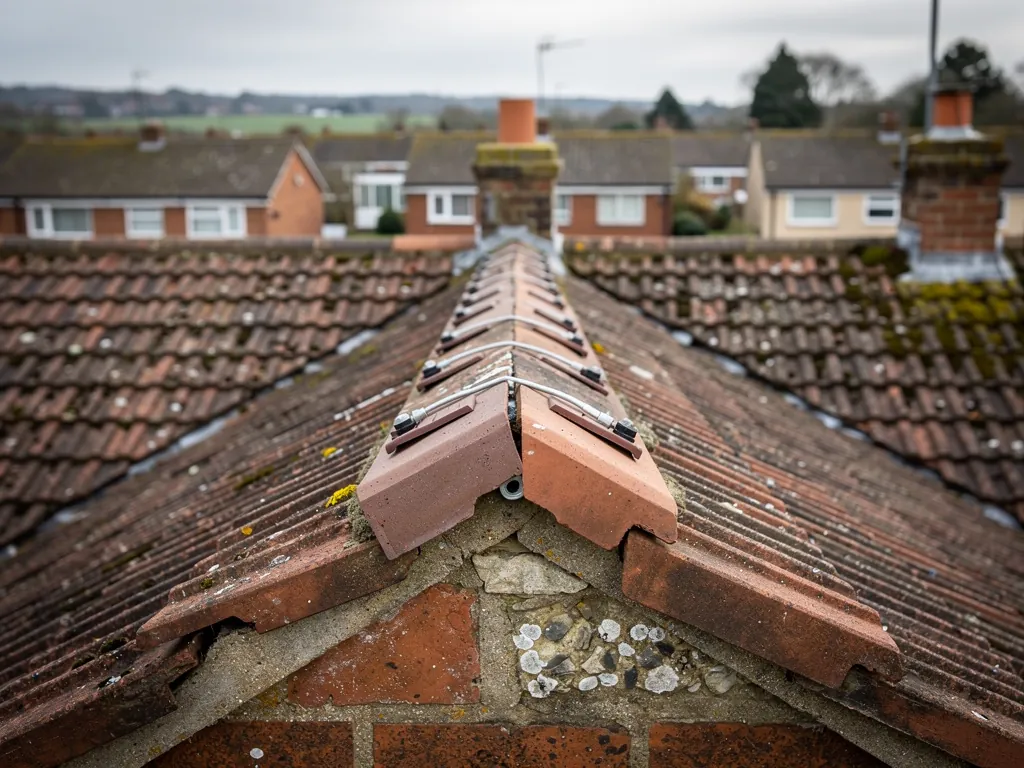
Close-up of clay ridge tiles meeting a brick gable end
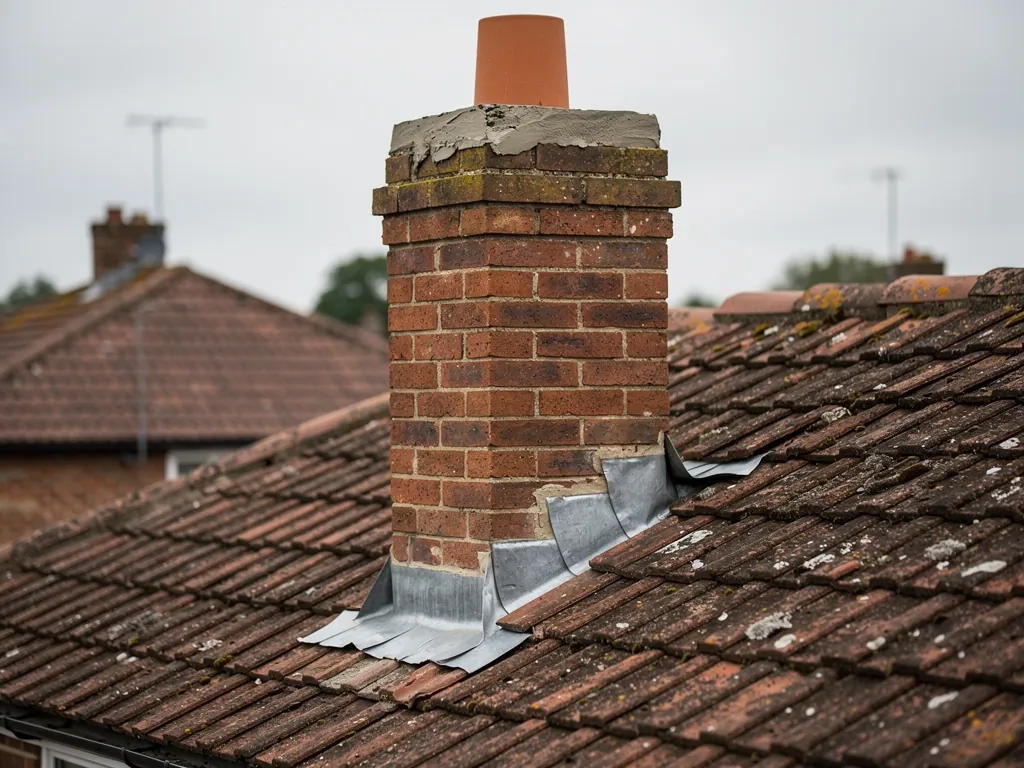
Brick chimney stack with new lead flashing on a clay tile roof

The short answer

Trouble usually starts where materials meet rather than in the open field of the roof: lead flashings against flint and brick walls, mortar-only ridges, slipped slates and cracked tiles. Age matters most, and a roof from the ironworks and railway era is now well past its first covering.

Collingbourne Ducis sits in a shallow valley where the River Bourne runs seasonally, and its houses reflect several centuries of building. Most leaks we investigate in villages like this begin where one material meets another, not on the open tile or slate.

Why do leaks start where a roof meets a flint wall?

Flint and brick gables, chimney stacks and the line where an extension joins an older house are the commonest points of failure. Flashing is the lead or other metal sealing the gap where roof meets wall. Where the wall is flint, the metal has to follow a rough surface, and earlier repairs in sealant or mortar fillets tend to crack within a few winters. Lead dressed in properly and pointed is the longer-lasting answer.

Is mortar still enough to hold a Collingbourne ridge?

Ridge tiles are the capping along the top of a pitched roof, and on older work they sit in mortar bedding alone. BS 5534 now expects them to be held mechanically as well, so any ridge we lift and re-bed goes back with screws or clips, or under a tested dry-fix system, and the mortar becomes a finish rather than the fixing. Our page on ridge, hip and verge work lays out the options.

How do slates and clay tiles fail differently?

Slate usually fails at the nail, so a slope can look tidy from the lane while individual slates are creeping out of place. Clay tiles give up through frost, flaking and cracks. For both, we start with a proper inspection and photographs of whatever is actually wrong. A roof repair is often enough when the faults are local, and when it is, that is what we recommend.

Where one slope has been patched several times, we point that out too. Repeated repairs to a tired covering can cost more across a few years than a single proper job, and you should have that comparison before you decide.

Q2

Is a flint-walled house harder to re-roof?

The answer

A little, yes, because the wall will not behave like brick. It is uneven, hard to fix into and sensitive to water, so the edges of the roof need more thought than the middle. The covering itself goes on in the usual way once the abutments are planned.

Re-roofing a flint-walled house follows the familiar order: strip the old covering, check the rafters, renew battens and underlay, then lay the new tiles or slates. The difference lies at the edges.

What happens at a flint gable verge?

The verge means the roof edge running up a gable wall. On a flint gable the tiles often overhang a rough wall top, and the mortar that once sealed them has weathered away. Before choosing a mortar bed, a dry-fix verge or another detail, we check how the roof is held there and whether the wall top underneath is sound.

Do brick stacks on flint houses need extra care?

Brick stacks standing on a flint house are common here. The flaunching, which is the sloped mortar cap that throws rain off the top of the stack, and the lead around the base are the first parts to go. We open both up at the survey stage, and our chimney repair page covers the repairs in more detail.

Will new tiles stand out against the neighbours?

On a mixed street, a new roof in the wrong colour or texture shows from the lane for years. We match tile or slate to neighbouring roofs where we can, and talk through alternatives where a perfect match is not on offer.

With a listed house, or one near the village centre, the council may want a say on the covering, so ask Wiltshire Council before the work is priced. That conversation costs nothing and avoids a wasted quote.

Thick flint walls are also slow to dry, which makes damp near the roof easy to misread. A stain on an upstairs ceiling can start at a chimney or valley some distance away, so the survey traces moisture upstream to the place it actually gets in.


Our view

On flint, spend the care on the abutments and the covering will look after itself.

Q3

Who approves roof work in Collingbourne Ducis?

Roofer repointing a stone chimney stack above lead flashing
Brick and limestone cottages around a small village green

The short answer

Small repairs need nobody's sign-off. A bigger re-roof may be notifiable under the Building Regulations, which Wiltshire Council's building control team or a registered building control approver deals with, and changing the character of a listed house needs listed building consent.

Collingbourne Ducis falls within Wiltshire Council's area, so the council is the planning authority for the village. Three questions decide whether anyone needs to be involved.

Is a Collingbourne re-roof notifiable?

Swapping a few tiles or slates, rebedding a ridge or renewing lead flashing is treated as maintenance. With a major re-roof, a building control application may be required. The Planning Portal puts the line at 25 per cent of the total building envelope together with 50 per cent of the roof: keep under both and nothing is normally required; exceed them and approval applies, with extra insulation possibly following. Approval is also triggered when the replacement covering is 15 per cent or more heavier than what it replaces. If the job is notifiable, we set out the requirements and handle the Building Regulations notification through Wiltshire Council's building control team or a registered building control approver.

Does Sunton House or St Andrew's change the rules?

Two Grade II* buildings stand out in the village, St Andrew's church and Sunton House. Listed building consent is required for works that would alter a listed building's special character, and that can reach the roof covering. St Andrew's is Church of England, so for as long as it remains in use, alterations are decided through the faculty system instead of by the council. On a listed house our starting point is identical material, fixed in the traditional manner.

Is the village inside a conservation area?

Yes. Collingbourne Ducis has a conservation area of its own, and Wiltshire Council's planners can confirm if a given house lies within its boundary. Laying a matching covering seldom raises a planning question, though a different material or look can.

Mention all three when you send photographs, and we will tell you which apply to your house. Where consent is needed we explain the route, and we do not start until you know where you stand. Site clearance and waste removal are part of every job, and the 10-year workmanship guarantee comes in writing.

MythEvery old village house needs planning permission to be re-roofed.

FactPlanning permission is not usually required for a like-for-like covering; listed status or a different look is what draws the council in.

Further questions about Bourne valley roofs

Why does water seem to come in at the flint gable end?

Because flint is hard and uneven, a roof edge or flashing can leave tiny gaps where rain tracks in behind it. The mark you see indoors may be a metre or more from the real entry point. We follow the damp back along the wall, check the verge and the lead, and fix the cause rather than the stain.

Can you re-cover the roof of a Grade II* listed house?

Yes, using matching material laid as the building was originally roofed. A house on the list needs listed building consent for works that change its character, so we talk the method through with you first and suggest contacting Wiltshire Council's conservation team before any stone, tile or slate is ordered. The written quote follows the survey.

Do you work out on the edge of Salisbury Plain?

Yes. Collingbourne Ducis, neighbouring Collingbourne Kingston and the farms and hamlets scattered around the Bourne valley all fall within our working area around Swindon. If your address is borderline, every place we reach is named on our areas page.

My farm outbuilding has a fibre-cement roof. Is it safe to touch?

Leave it unbroken and undrilled. Intact asbestos cement is usually left alone and monitored, but careful removal is non-licensed work with its own rules, and substantial breakage makes it notifiable. Send us photographs and we will explain the options, including how household waste of this kind is consigned.

Ask us about your roof

Tell us what’s happening and we’ll call you back.

  • Photos of what we find
  • A written quote
  • 10-year workmanship guarantee

Or call 01793 626096

Call Get a quote