1980s estate houses with brown concrete tile roofs

Roofers in Tidworth

Roof repairs, replacement coverings, flat roofs and chimney work in Tidworth, from Holy Trinity's flint and stone at North Tidworth to the long barrack-era streets of South Tidworth and the newer estates in the Bourne valley.

Tidworth's roofs, from two villages to a garrison

Old church roof above flint walling
North Tidworth and the old church

Tidworth grew from two villages, North and South Tidworth, in the valley of the River Bourne, and the older of the two keeps Holy Trinity, a grade II* listed church of the late 14th and 15th centuries built in flint and stone, with later repairs in red brick. Buildings like that show how roofs here were maintained over centuries: patched, rebuilt and patched again. For a house or outbuilding near the church, we look for what the original covering was, what has replaced it, and whether the timbers beneath have been touched by damp. Lead at the abutments and the tiles at the eaves are the usual weak points.

Long terrace of tiled roofs and chimneys
The barrack-era streets of South Tidworth

In 1897 the War Office bought the South Tidworth house and grounds to reach training land on Salisbury Plain, and extensive barracks followed in the early twentieth century, mostly in South Tidworth. Housing built for a garrison tends to come in quantity, in terraces and blocks with big roof slopes, repeated chimney stacks and gutters that run for many metres. That scale shapes the work: a single failed valley or chimney flashing can affect several homes, and a long gutter run with one bad joint can stain a whole elevation. Access, scaffold and neighbours' roofs all come into the planning.

Concrete-tiled slopes across a modern estate
Newer estates, garages and extensions

With a population of about twelve thousand, Tidworth has houses from many different decades, and plenty of garages, porches, lean-to additions and kitchen extensions. Newer pitched roofs often rely on concrete interlocking tiles over a breathable membrane, and the faults are loosened ridges, cracked tiles and failed verge mortar. Flat roofs over kitchens, garages and outbuildings fail differently, at laps, upstands and outlets, long before the pitched roof above does. Taking a flat roof back to the deck, drying it and re-covering it properly is a better answer than another coat of paint-on sealant.

From Swindon south-east to the Bourne valley

Map showing Tidworth and central Swindon. 26 road miles south-south-east of central Swindon.

Distance
26 road miles south-south-east of central Swindon
Council
Wiltshire Council
Council
Wiltshire Council
Setting
The River Bourne valley, beside the eastern edge of Salisbury Plain

Tidworth roof questions

Can you repair roofs on the long barrack-era terraces in South Tidworth?

Yes. We survey each run in sections, repair gutters, valleys and chimney flashings together, and agree access and scaffold with neighbours, so the whole row is sorted in one planned visit.

Does Holy Trinity's grade II* listing affect nearby roofs?

Only if your own building is listed or the council says otherwise. If you are unsure, Wiltshire Council can tell you what is listed, and we hold the quote until you have heard back.

Is a flat roof on a Tidworth garage worth re-covering?

Often, yes. If the deck is sound, a new membrane gives it a fresh life. If the deck is rotten, we replace that first, and tell you so before the quote is written.

Q1

What fails first on Tidworth's terraced roofs?

Blocked gutter full of leaves overflowing down a brick wall
Torch showing a water-stained rafter beneath slates in a loft

The short answer

Usually the details, not the covering. On long terraces and blocks, valleys, chimney flashings, gutters and ridge bedding give up before tiles or slates do, and a fault in one place often shows up as damp in a neighbour's ceiling. Fixing those points in one visit is quicker and cheaper than returning for each leak.

Barrack-era and later terraces in Tidworth were built to a pattern, and the same weaknesses repeat from house to house. That helps, because it means we know where to look.

Why do chimney flashings and valleys leak?

The metal around a chimney is the busiest joint on the roof. Lead moves in the heat and cold, work-hardens and splits, and the mortar fillet holding it into the brickwork loosens. A valley, the trough between two meeting slopes, has a lining that takes the water from both, so a small crack there can soak a ceiling quickly. We open up the junction, replace what has failed and re-dress the lead so it can move without tearing. Our roof repairs page shows how we work.

What about gutters on a long run?

Long gutters need a gentle, even fall towards the downpipes. When a bracket slips or a joint opens, water pools, overflows and runs down the wall, staining brick and soaking the eaves. A repair is often as simple as re-aligning a section and renewing a seal, though old cast or pressed-steel gutters sometimes need replacing by the length.

The loft tells its own story too. Daylight showing through the roof, dark tide-marks on the rafters, soggy insulation and rusted nail tips poking through the underlay are all signs we note from inside, because they reveal the route water has taken long before a ceiling stain appears. A roof with those signs in only one corner is a repair job, and we write it up that way. On a terrace, it helps to coordinate with neighbours. A shared repair means one scaffold and one visit, so the cost of access is spread across the row rather than paid several times.

Each fault is photographed where we find it, so the quote we write afterwards can show you exactly what we saw.


Q2

When is a full re-roof needed in Tidworth?

The answer

When the covering or the timbers beneath have failed across most of a slope, not just in patches. Repeated leaks, sagging battens, tiles crumbling in numbers or a ceiling stained in several places point that way. Only a close survey can tell a roof that wants repairing from one that wants replacing, and you hear which from us.

A roof does not need replacing just because it is old. Plenty of roofs carry on for decades with small repairs, and we would rather mend a fault than sell a new covering that is not needed. Sometimes, though, replacement really is the better path.

What tells you a roof has reached the end?

The signs gather in groups. Tiles shedding their surface in numbers, battens that have gone soft, nails rusted through across a whole slope, and leaks that move around after each repair all say the covering is failing everywhere, not locally. Cost guides give concrete tiles a life of roughly 30 to 60 years depending on the source, and a roof near that age with several of those signs is often cheaper to renew than to keep patching. Our roof replacement page covers what the work involves.

What happens to Building Regulations and insulation?

When a re-roof reaches 25 per cent of the total building envelope or 50 per cent of the roof, approval applies and the insulation may need upgrading. The Planning Portal also says a covering 15 per cent or more heavier needs approval. Wiltshire Council's building control team, or a registered building control approver, deals with it, and notifiable work is notified by us.

Timing matters as well. A re-covering is best planned for a settled spell, with the roof stripped and re-sealed in sections so the house is never left open to the weather overnight. Before work starts we agree where materials will be stacked, how the scaffold will be fitted and how waste will be cleared, and at the end, the site is cleared and the waste goes with us.

A new roof on a terrace also needs a plan for the party walls, the chimney stacks and the verges, so each house ends up weathertight and the line of the roofs stays tidy.

Our view

Renew when the failures are everywhere; repair when the faults are in a few places.

Q3

Do Tidworth's churches and old buildings change roof rules?

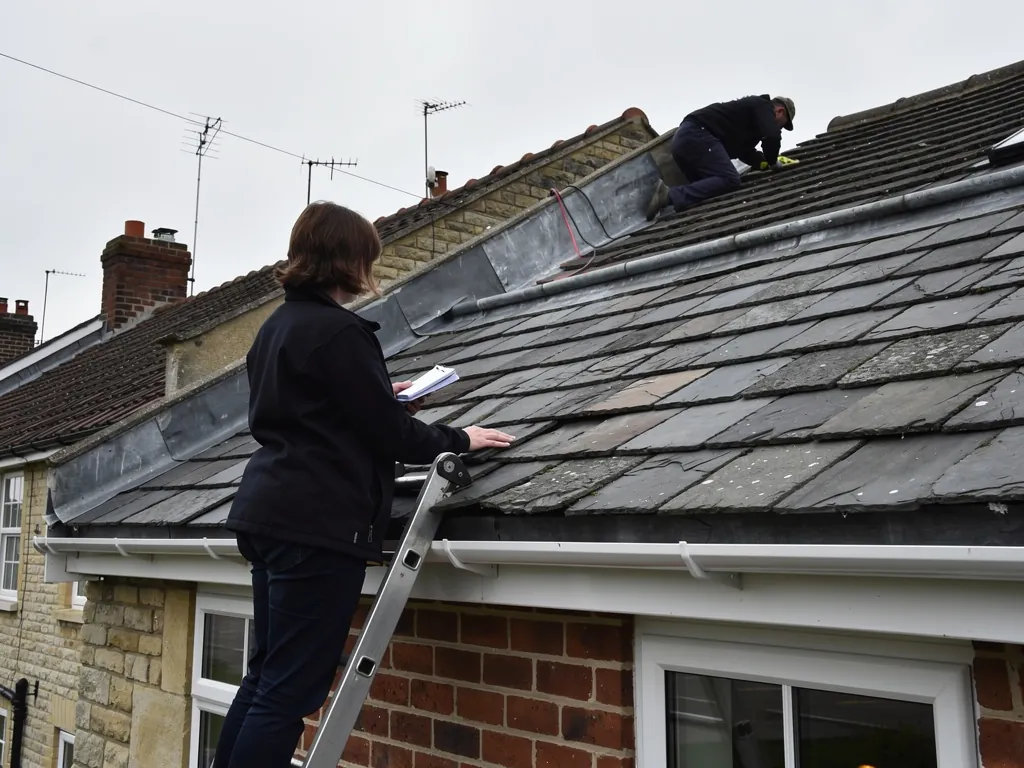
Surveyor on a ladder checking slates with a notebook
Brick end-of-terrace gable beside a limestone house, slate roofs

The short answer

Only for the buildings concerned. Holy Trinity at North Tidworth is grade II* listed, St Mary's at South Tidworth is grade I listed, and the two garrison churches date from 1912. The main denominations run their own consent system for churches in use, while an ordinary house takes the usual route through Wiltshire Council.

Almost every roof job here is an ordinary home, and ordinary rules apply. The few that cap historic buildings take a different path, so it is useful to see where the dividing line sits.

What applies to the churches?

Holy Trinity at North Tidworth is a grade II* church of the late 14th and 15th centuries, and St Mary's at South Tidworth, built in 1878, is grade I and cared for by the Churches Conservation Trust. St Michael's Garrison Church (Church of England) and St Patrick's Garrison Church (Roman Catholic) were both built in 1912. Under the ecclesiastical exemption, a Church of England or Roman Catholic church that is still in use sits outside listed building consent; the Church of England uses the faculty system instead. A redundant church needs listed building consent for work. That is a matter for the parish or trust, not for a house owner.

What if I live near one?

Living near a listed church does not change what you can do to your own roof. A house that is itself listed needs listed building consent for work touching its character, roofing material included, and Wiltshire Council holds the records for your address.

Is planning needed for a normal re-roof?

Putting back an identical covering rarely means a planning application. New roof windows and extensions do raise questions, and our skylights page explains the checks. Where you are unsure, ask Wiltshire Council's planning team before you commit.

The practical check is quick. Look up the address on the council records, note whether it is listed or in a designated area, and send us a picture of the roof. We can then tell you whether your job is routine maintenance or something to run past the council.

If the council replies with conditions, we help you read them against the survey, so the work you are quoted for is the work that is allowed.

MythAll churches are exempt from listed building consent.

FactOnly churches in use by certain denominations are; redundant churches and some chapels are not.

Roofing services in Tidworth

Questions from the Bourne valley and the garrison

Why does a leak in one Tidworth terrace house show up next door?

Because the roof is shared. Water that gets in at a party-wall abutment, a valley or a common gutter can travel along timbers and appear in a neighbouring ceiling. We trace the source from above, repair it at the junction, and tell you what we found so you can speak to the neighbours with facts in hand.

Can you re-roof a block of homes in one scaffold?

Yes, where the owners agree. A single scaffold across several houses cuts the cost of access and avoids repeated disruption. The quote covers the whole block, with each house's chimney, verge and valley details noted. If ownership is mixed, we work with whoever manages or represents the building.

Do you cover South Tidworth as well as the North Tidworth village?

Yes. We cover Tidworth in full, including the two historic villages it grew from, and the surrounding area within 30 road miles of Swindon. Whichever side of the town you are on, the process is the same: a survey with photographs, then a written quote.

Is a felt flat roof on a garage in Tidworth repairable?

Often, when the damage is local: a split at a lap, say, or a lifted edge. Where the felt has blistered widely or the deck beneath is soft, a full re-cover is better. We check the deck, falls and outlets first, then recommend the smaller job that will fix the fault properly.

Ask us about your roof

Tell us what’s happening and we’ll call you back.

  • Photos of what we find
  • A written quote
  • 10-year workmanship guarantee

Or call 01793 626096

Call Get a quote