Brick and limestone cottages around a small village green

Roofers in Ludgershall

Roof repairs, ridge and verge work and flat roof replacement in Ludgershall, the small town where Salisbury Plain meets the Hampshire border, from the streets near St James's church to the homes that grew with the railway.

Ludgershall's roofs, from castle to cul-de-sac

Old village houses with tiled roofs near a church
Around the castle and church

Ludgershall Castle was built by 1103, was a favoured residence of King John, and now stands under English Heritage care with three large walls and earthworks left. The Church of St James is Grade I listed, with 12th-century fabric and an 1873 restoration by J. L. Pearson. Around them the older houses of the town sit on chalk, and roofs here have seen several coverings come and go. An account from around 1757 called Ludgershall a poor thatched village, which tells you how far its building stock has changed since. The older houses are modest buildings, a visit often turns up nothing worse than worn fixings, and repairs on them are best kept modest too: refix, re-bed and replace only what has failed.

Terrace of railway-era houses with chimneys
Homes that came with the railway

Ludgershall station opened in 1882 on the Swindon, Marlborough and Andover Railway, and the town grew in the decades that followed. Where houses of that era keep slate or clay tile, they bring the faults you would expect of buildings well over a century old: slates with rusted nails, cracked clay tiles, tired lead at chimney stacks and valleys, and ridge tiles that were bedded on mortar by itself. Many have been patched several times with whatever was available, so one of the first jobs on a survey is to separate the failing original from the old repairs.

Semi-detached homes under concrete tiles
Twentieth-century growth around the Plain

Military use of the area, with the Salisbury Plain Training Area dating from about 1898 and Corunna Barracks from the Second World War, shaped how Ludgershall grew in the twentieth century. The streets built in those decades tend to be a mix of semi-detached and terraced houses, bungalows and later estates, roofed in concrete tile, with garages, porches and flat-roofed extensions added over the years. On these roofs the usual concerns are ridge and hip fixings, cracked or slipped tiles, rotten fascias and felt flat roofs reaching the end of their lives. Careful maintenance can add many years to any of these, and a look from the ground each year, once the autumn leaves are down, catches the early signs of a slipped tile or a choked gutter. Flat porch and garage roofs deserve the same attention, because they are the ones people rarely see.

From Swindon to the Plain's edge

Map showing Ludgershall and central Swindon. 25 road miles south-south-east of central Swindon.

Distance
25 road miles south-south-east of central Swindon
Council
Wiltshire Council
Conservation area
Ludgershall has a conservation area
Setting
Chalk town on the eastern edge of Salisbury Plain
Council
Wiltshire Council

Ludgershall roof questions

Do Ludgershall's railway-era houses need their slates re-nailed?

Often. Slate fixed with iron nails more than a century ago can slip as the nails rust, so a survey checks them before the roof is judged.

Can a flat garage roof near Ludgershall be replaced on its own?

Yes. A garage, porch or extension can be re-covered separately, provided its falls, its edges and the joint against the house wall are all put right in the same visit.

Who handles building control for work in Ludgershall?

Wiltshire Council's building control team handles notifiable roof work, as does any registered building control approver you appoint instead. Where a notification is due, we look after it.

Q1

What roofs does Ludgershall's long history leave?

Wet slate and clay tile rooftops with chimney stacks after rain
Roofer repointing a stone chimney stack above lead flashing

The short answer

A layered set. Medieval castle and church stand beside modest older houses, late Victorian railway homes in slate and clay, and twentieth-century streets in concrete tile. Each era has its own typical faults, which makes the first task working out which kind of roof you actually have.

Ludgershall has more history than its size suggests. The castle dates to the early twelfth century, King John favoured it, and a mid-eighteenth-century description of the place as a poor thatched village shows how humble most of the housing then was. Chalk lies under the whole parish, and the town's character is the result of centuries of rebuilding on it.

What do I look for on a railway-era slate roof?

From the ground, look for slates that have dropped a few centimetres, patches that do not match the rest, and a ridge line that has begun to wander. Inside, brown marks on a top-floor ceiling or a damp smell in a loft after rain point to a leak above. Victorian slate is thin and brittle, and a roof that has been walked on or patched with the wrong size of slate often shows it.

How does a later concrete tile roof differ?

Concrete interlocking tiles are heavier than slate and rely on clips and nails. They do not usually fail from the tile itself but from the ridge bedding, the verge mortar and the felt underneath. Re-fixing the ridge, swapping broken tiles and renewing the verges can often buy a roof like this many more years.

Some Ludgershall roofs carry chimney stacks that serve fireplaces long out of use. Capped and ventilated properly they can stay as they are, though a stack that is no longer needed is often the first thing to leak, because nobody has looked at its flashing for years.

The roof you have decides the repair, and our ridge, verge and dry-fix page explains how ridges and verges are fixed today.

After the survey you receive a written quote and pictures of the faults found on your own roof, which is the best way to judge whether a repair or something bigger is called for.

Q2

Should I replace or repair a flat roof in Ludgershall?

The answer

It depends on the roof's age, the cause of the leak and the state of the deck beneath. A single leak at an upstand or outlet can be repaired. A roof with widespread ponding, blistering or a wet deck usually needs recovering. Flat roofs typically last 15 to 30 years, according to MyBuilder.

Ludgershall has a good many garages, porches, kitchen extensions and bungalows with flat or low-pitched roofs, and they are the roofs that tend to give trouble quietly. A felt roof may look sound from the ground and still be letting water through a split at the edge.

When is a flat roof worth repairing?

When the leak has a clear single cause: a lifted edge trim, a cracked seam, a blocked outlet or a failed upstand. These can be traced and fixed without taking the whole covering off. The age of the roof matters, since patching one at the end of its life only moves the leak elsewhere.

What does a replacement involve?

The old covering comes off, any wet or rotten boards are replaced, and the roof is re-laid to proper falls before a new membrane goes on. The design fall is 1:40 and the finished roof needs at least 1:80. Typical lifespans differ by material: Less quotes torch-on felt at 10 to 20 years, GRP at 25 to 40 years, and EPDM at 30 to 50 years, while GreenSpec gives EPDM 20 to 30 years.

Our flat roofing page explains how these systems compare for a garage or extension.

If the structure beneath is a timber deck with insulation, the way the roof is built up also affects whether moisture is trapped. We look for that at survey, and the written quote describes what the work involves.

What the published guides say about flat roof life
CoveringTypical lifePublished by
Torch-on felt10 to 20 yearsLess, March 2026
GRP fibreglass25 to 40 yearsLess, March 2026
EPDM20 to 30 yearsGreenSpec
Lead50 to 100 yearsLess, March 2026
Q3

Who signs off roof work in Ludgershall?

Brick end-of-terrace gable beside a limestone house, slate roofs
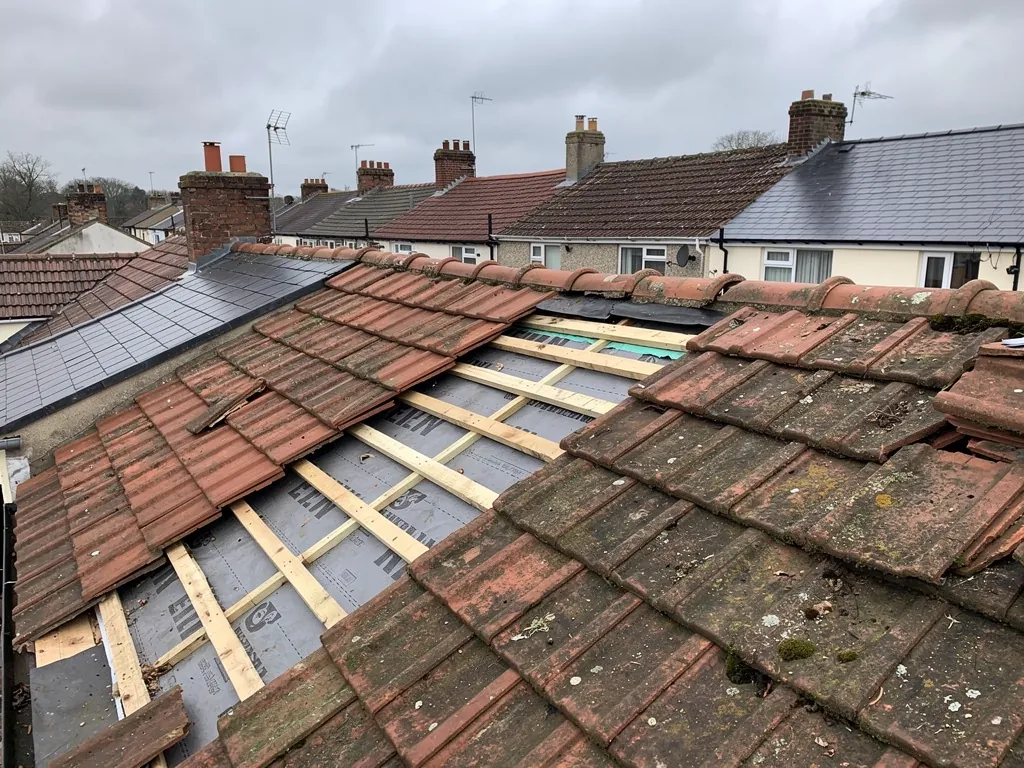
Clay tile roof opened to battens and membrane for repair

The short answer

Ludgershall is in Wiltshire, so Wiltshire Council handles planning, and its building control team, or a registered building control approver, handles notifiable work. The town has a conservation area, and listed buildings such as St James's church have their own consent rules.

Most roof work in Ludgershall is maintenance and needs no permission. Replacing what was there with the same material is the everyday case. Three situations are different, and it is useful to know them before anyone prices a job.

When is Building Regulations approval involved?

An application is not normally required for work touching less than 25 per cent of the total building envelope and less than 50 per cent of the roof. If either figure is exceeded, approval is needed, usually with better insulation. The Planning Portal adds another trigger: a covering 15 per cent or more heavier. We talk to Wiltshire Council's building control team, or a registered approver of your choice, and take care of the notification.

Does the conservation area matter?

Ludgershall has a conservation area. A repair in matching materials seldom raises a planning question, but a change of look, such as a different covering, is something to put to Wiltshire Council first. Whether anything extra applies on your own street can be settled by a short enquiry to the council quoting your address.

What about the church and the castle?

St James's church is Grade I listed and in Church of England use, so work affecting its character goes through the diocesan faculty system, not listed building consent from the council. Ludgershall Castle is under English Heritage care, so its remains are a matter for that body and not for a homeowner's roof.

For houses, the simplest approach is to ask us to describe the work and the materials in writing, then check with the council if there is any doubt. A paragraph on the proposed covering, the fixings and the extent of the work is usually all a council officer needs to give a quick answer, and it also gives you a clear record of what was agreed.

Both bats and nesting birds enjoy legal protection, so signs of either in a loft or beneath tiles mean we pause and talk to you before going further.


MythReplacing slate with concrete tile is a harmless swap on an old house.

FactConcrete is heavier, and a covering 15 per cent or more heavier needs approval; the look of the street changes too.

Questions from the Plain's edge

Are the old terraces near Ludgershall station likely to have slate?

Houses built then frequently had slate or clay tile, though every roof has to be looked at for itself. We check what is actually on yours, then match the size, colour and fixing method for any repair so it does not stand out.

How do you keep a roof secure on an open chalk edge?

By fixing the details that catch the wind: ridges, hips and verges. BS 5534 changed the rules on ridge and hip tiles, so a re-bed here is secured with mechanical fixings, or with a dry-fix system covered by BS 8612, instead of mortar by itself, and we look at the battens and underlay below as well.

Can the roof of a bungalow with a flat porch be done in one visit?

Small jobs can be quick, but how long any job takes depends on what the survey finds. You get the order of work in advance, and tidy-up and waste removal are part of the job.

Do you cover Ludgershall as part of Wiltshire work or Hampshire?

Ludgershall is in Wiltshire, close to the Hampshire border, and sits within the area we serve from Swindon. We work on both the older streets and the newer ones, and our workmanship guarantee runs for 10 years, in writing.

Ask us about your roof

Tell us what’s happening and we’ll call you back.

  • Photos of what we find
  • A written quote
  • 10-year workmanship guarantee

Or call 01793 626096

Call Get a quote