Clay tile and slate rooftops of brick market-town terraces

Roofers in Great Bedwyn

Tiles, slates, chimneys and flat roofs across Great Bedwyn, from the lanes around St Mary's church down to the cottages and villas that grew up beside the canal and the railway.

Roofs along the Dun, from nave to towpath

Cottages grouped around a village church
Around St Mary's church

The village centres on St Mary the Virgin, a Grade I listed church with twelfth century origins and the remains of a Saxon church beneath it. Buildings gathered around a site that old have been altered many times, and their roofs tend to show it: a newer covering laid over an older frame, ridges patched in different decades, lead flashings fitted by different hands. Coverings differ from one house to the next, so on an older roof we begin by looking at what is actually there. That means checking the rafter feet and wall plates at the eaves for rot, then the covering, then the joints around chimneys and walls. The cause of a leak is often in those joints rather than on the open slope.

Brick terrace beside a railway line
Canal and railway buildings

The Kennet and Avon Canal reached Great Bedwyn from Hungerford in 1799, and the Great Western Railway opened a station here in 1862, so the village grew as a stop on a through route. Cottages and houses put up in the canal and railway years are the kind of buildings where Welsh slate or clay tile may be found, because both could be carried in by water or by rail. Roofs of that age share a familiar set of faults: slate nails that have corroded, underlay that has perished or was never fitted, and sheet lead around stacks and shared walls that has simply worn out. A careful survey separates the faults that call for a repair from the ones that call for a section to be re-laid.

Tiled houses and a small flat-roofed extension
Estate church and newer homes

St Katharine's was built by T.H. Wyatt in 1861 as the estate church for Tottenham House, a reminder that building in and around the parish was shaped by a large estate as well as by the canal and the railway. Away from the oldest lanes, where the village has spread, newer houses, bungalows and extensions add other roof types: concrete interlocking tiles, low-pitched porch and garage roofs, and flat-roofed kitchens and utility rooms. Each fails in its own way. Concrete tiles lose their ridge bedding and crack, while flat roofs pond and split at upstands and edges. We look at the roof you have, not the one the street suggests, and we say plainly if a repair will last or a bigger job makes better sense.

From Swindon to the Dun valley

Map showing Great Bedwyn and central Swindon. 19 road miles south-south-east of central Swindon.

Distance
19 road miles south-south-east of central Swindon
Council
Wiltshire Council
Council
Wiltshire Council
Conservation area
Great Bedwyn Conservation Area
Landscape
North Wessex Downs National Landscape

Worth knowing first about a Great Bedwyn roof

Does the Great Bedwyn conservation area affect roof repairs?

Repairs that use matching materials seldom need consent. Changing how a roof looks, or altering a listed house, is a matter to put to Wiltshire Council before anyone climbs a ladder.

Can you reach roofs beside the Kennet and Avon Canal?

Usually, yes. Towpath-side and lane-side houses often have tight access, so the survey looks at ladders, scaffold and where materials can be set down.

Do the North Wessex Downs change what covering I can fit?

Not when the new covering matches the old. Bigger changes, such as new roof windows or extra roof space, are planning questions to put to Wiltshire Council first.

Q1

Which faults show first on an old Bedwyn roof?

Weathered brick chimney stack with eroded joints and cracked pot
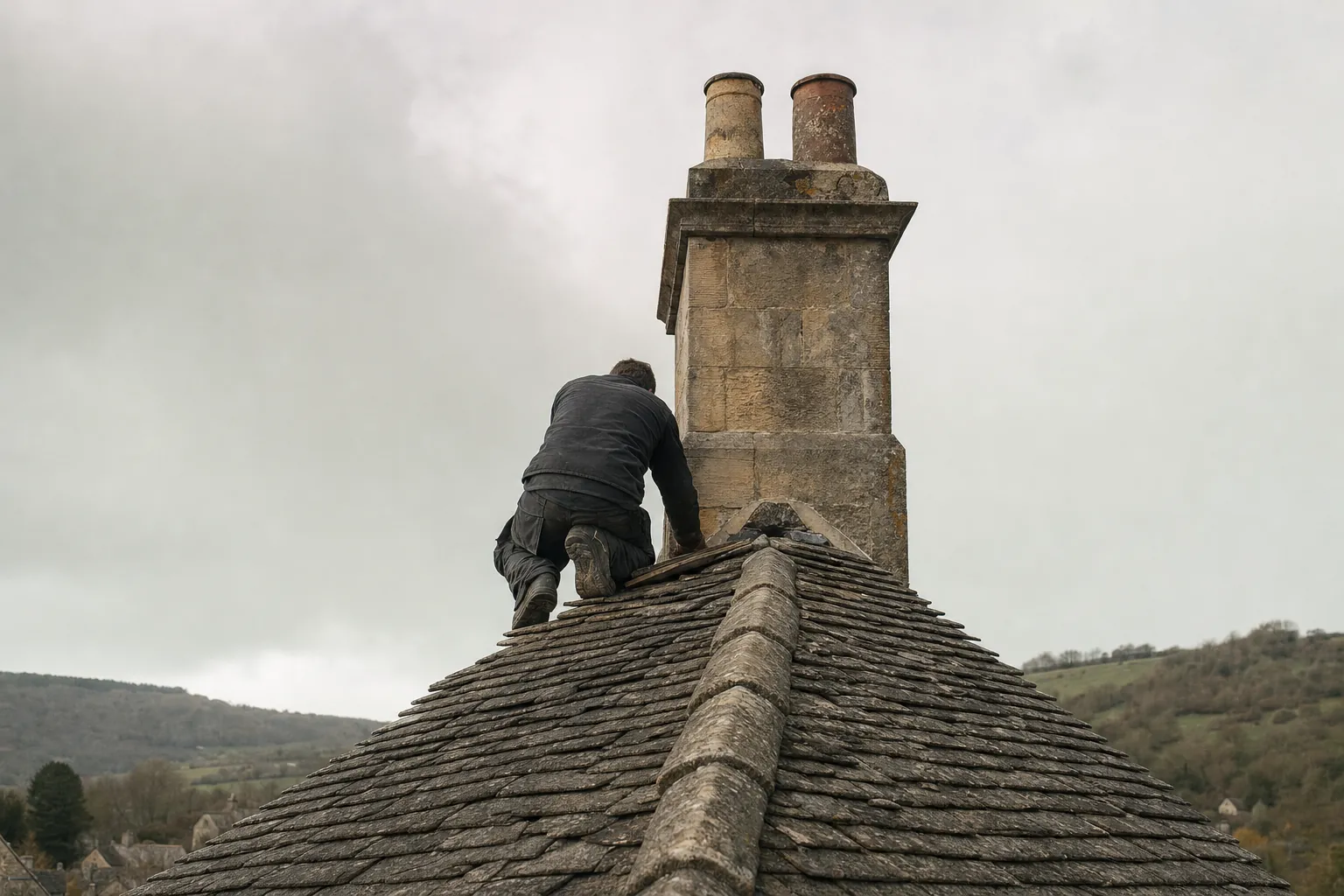
Roofer on a stone slate ridge beside a stone chimney

The short answer

Look at the eaves first, then the ridge, then each junction with a chimney or wall. On an old village roof the tiles or slates can be sound while the timber under them, or the lead around them, has failed. Photographs from the survey show which it is.

Great Bedwyn's oldest buildings sit close to a church with Saxon remains beneath it, and houses of that age have a long maintenance history. Old roofs rarely fail all at once. They fail one detail at a time, and the sensible way to read a roof is to start at the bottom and work upwards.

Why start at the eaves and the frame?

Water that gets past a gutter or a slipped tile tends to run down into the wall plate and the ends of the rafters. Soft timber there is the earliest sign of a long-running leak. If the timbers are sound, repairing the covering is enough. If they are not, the job grows, and you should hear that before the first tile comes off, not after.

How should ridges, hips and verges be fixed?

Picture the ridge as the spine of the roof, where the two main slopes meet at the top. Hips are the sloping spines at a corner that juts outwards, and verges are the sloped edges that finish the roof beside a gable. All three used to be bedded in mortar and nothing else. Since BS 5534 was revised in 2014, mortar by itself has no longer been treated as enough, which is why we add stainless clips or screws, or fit a tested dry system, whenever a ridge is lifted and laid again. On a roof open to the wind, that extra security matters.

Why do chimneys and walls leak?

Flashings are strips of lead that seal the joint between roof and masonry. On a chimney stack they meet weather from every side and are often the first part to give way. Flaunching is the sloping mortar cap around the pots; once it cracks, rain soaks into the stack and works down towards the room below, often months before a stain shows. A chimney repair often cures a leak that looks like a roof fault.

The written quote follows the survey. If your house is listed, our listed roof repairs page explains how we approach it.

Q2

How do you work on tight canal and lane roofs?

The answer

We plan access before we price. Roofs beside the canal, the railway and narrow village lanes may need scaffold built in stages, materials kept off the road, or a lift in place of a stack on the pavement. The survey records what each roof needs, and the written quote reflects it.

Great Bedwyn runs along the Dun valley, with the Kennet and Avon Canal and the Reading to Taunton railway both following the river through the village. That suits a walk and does not suit a delivery lorry. Access shapes how a roof job runs and what it costs, so we deal with it early.

How do we get to the roof?

A scaffold needs ground to stand on. Beside a canal, a towpath or a narrow bank limits where poles can go, and a lane without a verge may call for a licence for the structure. Neighbours also need warning when materials arrive. We prefer to settle all of that before a start date is agreed rather than discover it on the morning.

How do materials and waste get on and off site?

Slates, tiles and battens are heavy. On a restricted site they arrive in smaller loads, or go up by hoist, and rubbish leaves the same way. Nothing is left behind afterwards, however awkward the access: every offcut is swept up and the rubbish travels out with the crew.

What drives the cost on a tight site?

Three things drive the cost of a roof: its covering and size, how hard it is to reach, and what the survey finds under the surface. Two similar-looking houses on different lanes can need quite different plans, and a lorry that cannot park outside means more trips and more labour. Check whether any quote you receive includes VAT and scaffolding, because those are the items most often missing.

For a larger job on a house of this kind, our roof replacement page explains how a strip and re-cover is planned, from the first photographs to the final clear-up.

How the setting changes the job
SettingWhat we plan for
Canal-side houseNarrow bank or towpath, careful placing of scaffold
Station-side terraceShared walls, lead at party walls, parking for deliveries
Village lane cottageNo verge, small loads, notice to neighbours
Edge-of-village houseEasier access, a wider range of coverings
Q3

Who signs off roof work in Great Bedwyn?

Brick and limestone cottages around a small village green
Roofers on a slate roof along a limestone village street

The short answer

Wiltshire Council deals with planning in Great Bedwyn. Notifiable roof work goes to Wiltshire Council's building control team or a registered building control approver, and we arrange the notification. Listed buildings and the conservation area add their own checks, which we raise before pricing.

Plenty of roof work needs no permission. Swapping broken tiles, refixing slipped slates and re-bedding a ridge with matching materials all count as upkeep. Three situations are different.

At what size does a Bedwyn re-roof need approval?

Re-covering a small part of a roof sits below the threshold. The Planning Portal says a building control application is not normally needed under 25 per cent of the total building envelope and under 50 per cent of the roof. Beyond either limit approval is needed, and a better-insulated roof may be part of it. A covering that adds 15 per cent or more to the weight needs approval too, because the rafters have to carry it. Applications go to Wiltshire Council's building control team, or to an approver on the register that you choose yourself. Should the job be notifiable, Skyline sends the notification in and walks you through each step.

What does the Great Bedwyn conservation area mean for a re-roof?

Great Bedwyn has a conservation area, with a character appraisal from 2007 that Wiltshire Council has cited in planning decisions. A council planning report for a house in the village also refers to an Article 4 direction, which removes some permitted development rights, so ask Wiltshire Council about your address before altering anything visible from the street.

How do St Mary's, St Katharine's and listed houses differ?

The village has several listed buildings, including St Mary's, which is Grade I, and St Katharine's, which is Grade II*. Before work alters what makes a listed house special, listed building consent is required. Parish churches of the Church of England that are in use are covered by the faculty system instead. For a house the rule is simple: same material, same method, and a conversation with the council before anything changes.

The North Wessex Downs designation leaves a like-for-like re-roof alone. It bears on larger alterations, and the council makes those decisions.


MythA house inside the conservation area cannot have its roof touched without an application.

FactMending a roof with matching materials seldom needs one; the council cares about changes that alter the way the building looks.

Roofing services in Great Bedwyn

Questions from the Dun valley

Why do older Great Bedwyn roofs leak at the chimney first?

Chimney stacks catch rain from every direction, and the lead that seals them ages faster than the tiles or slates around them. Cracked flaunching and tired pointing add to the problem. On an older house we inspect the flashings, the flaunching and the pointing together, because patching one while ignoring the others only moves the leak to the next weak point.

Can you mend a roof on a listed house near St Mary's?

Yes. We repair with the same materials laid the same way. Consent is rarely needed for that, but swapping the covering or altering details such as verges and chimneys can, so we talk the plan through with you beforehand and suggest a call to Wiltshire Council if the plan moves away from what covers the roof now. The survey photographs give the council something concrete to look at.

Will you travel out to Great Bedwyn from Swindon?

Yes. Great Bedwyn sits inside our 30-mile working radius from Swindon, together with the neighbouring villages and the downland towns around them. A survey visit is arranged the same way as anywhere else we work: ring 01793 626096, message us on WhatsApp, or use the website's contact form, and describe what the roof is doing. The areas page names every place we cover if you are unsure about your address.

What does your guarantee cover on a Great Bedwyn roof?

Our workmanship is guaranteed for 10 years, in writing. That relates to the work we carried out, not wear elsewhere on the roof. The survey photographs and the written quote record what was agreed, so there is never any doubt about what the guarantee refers to when you look back at it.

Ask us about your roof

Tell us what’s happening and we’ll call you back.

  • Photos of what we find
  • A written quote
  • 10-year workmanship guarantee

Or call 01793 626096

Call Get a quote