Rear slate roofs and chimneys of Victorian terraces

Roofers in Kingsdown

Slate and tile repairs, chimney flashings, flat roof renewals and full re-roofs in Kingsdown, from the brewery buildings and the inn at the cross-roads to the houses and extensions around them.

Kingsdown's roofs, from brewery to back extension

Large slate roof on a Victorian works building
The brewery cross-roads

Kingsdown grew up as a hamlet around the Arkells brewery and the Kingsdown Inn. The council's appraisal records that Arkell's first brewed in Swindon Road in 1843, that a new steam brewery went up beside the Kingsdown cross-roads in 1861, was extended in 1867, and gained a large maltings in 1877. It describes the earliest brewery buildings as stone and red brick walling under slate roofs. Industrial roofs of that age are large, plain and built to last, but the same weaknesses show up: slipped slates, rusted fixings, failing gutters on long eaves, and flashings where one roof meets a taller wall. A big slate roof is repaired section by section, not all at once.

Tall slate roof with a decorative cupola
Brewery House and its belvedere

Arkells Brewery House stands on Hyde Road, is dated 1861 and is listed Grade II. The appraisal describes a tall three-storey building with a slate roof, capped by a belvedere and a weathervane. A roof with a small tower on top, a steep pitch and decorative features is not a casual job. Every junction between slate, lead and timber is a place water can find a way in, and every one of them has to be reached safely at height. Because the building is listed, a change to its roofing is a matter for the council's conservation officers, and our starting point is the original slate, refixed where it is sound and matched where it is not. Anything near the belvedere is recorded in close-up before a single slate is lifted, so the decorative work can be reinstated exactly as it stood.

Brick house beside a low garage roof
Houses, garages and extensions

Beyond the cross-roads, Kingsdown belongs to the parish of Stratton St Margaret. Homes of many ages sit side by side, and what they share is the kind of job that reaches our phone: concrete or clay tiled roofs that need ridge tiles refixed, valleys relined, a few tiles replaced after a windy week, and flat roofs over kitchens, garages and porches that have reached the end of their felt. Chimney stacks on older houses need repointing and new flashings. On newer houses the faults are more often at the verges and in the guttering. The survey shows which category your house falls into. On a house with a hipped roof, meaning one that slopes down on all four sides, we also check the hip tiles, because a loose hip is easy to miss from the pavement and leaves a gap for wind-driven rain.

From Swindon to Kingsdown cross-roads

Map showing Kingsdown and central Swindon. 3 road miles north-north-east of central Swindon.

Distance
3 road miles north-north-east of central Swindon
Council
Swindon Borough Council
Conservation area
Stratton St Margaret (Kingsdown), designated 14 September 1992
Setting
A former hamlet in Stratton St Margaret parish
Council
Swindon Borough Council

Kingsdown roof questions

Is my Kingsdown house inside the brewery conservation area?

Only if it sits within the small area drawn round the brewery complex and the Kingsdown Inn. The council's appraisal map shows the boundary, and its conservation team can confirm your address.

Can a large slate roof be repaired in sections?

Yes. We work bay by bay, refixing sound slates, replacing broken ones and renewing lead at the junctions, so the building stays watertight while the work moves across the roof.

Why does the Kingsdown Inn style of steep tiled roof cost more to access?

A steeper pitch needs more scaffold, roof ladders or edge protection, and the work goes slower. The extra safety equipment is the main reason, and the written quote allows for it in the total.

Q1

What does the appraisal say about roofs around Kingsdown brewery?

Roofer repointing a stone chimney stack above lead flashing
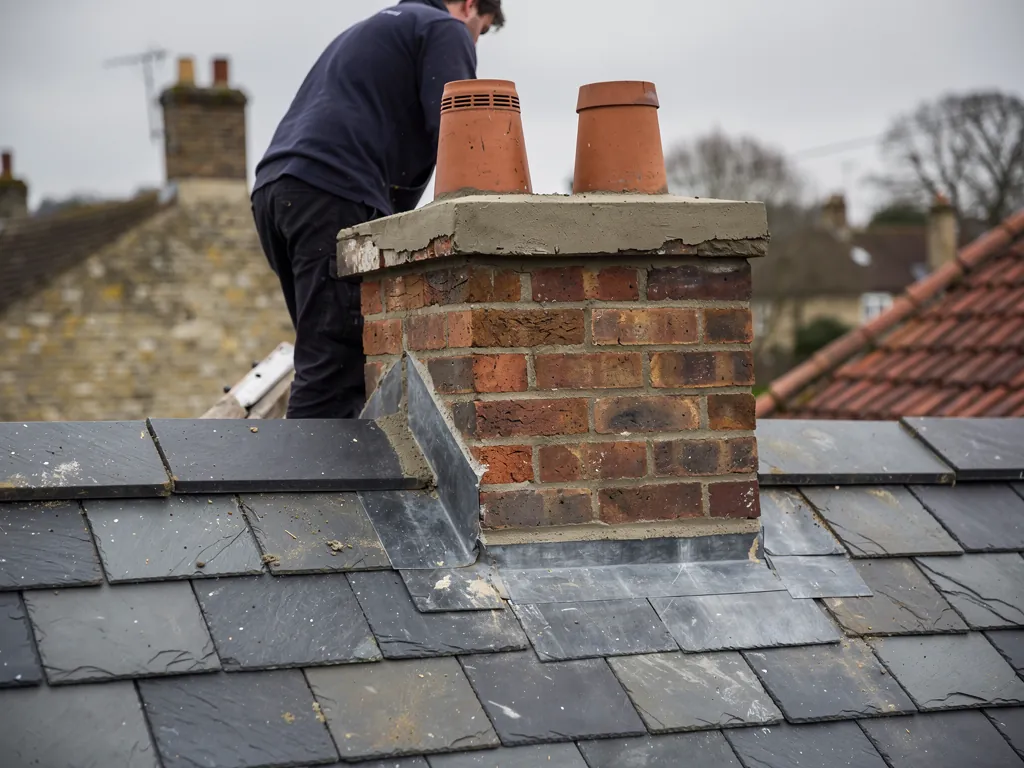
Roofer behind a brick chimney with fresh flaunching around two pots

The short answer

It records stone and red brick walling under slate roofs on the earliest brewery buildings, a Grade II listed Brewery House of 1861 with a slate roof and belvedere, a steeply pitched tiled roof on the Kingsdown Inn, and a tall brick brewery chimney added in 1937.

Kingsdown's conservation area is small, but it holds a concentrated group of buildings that tell the story of a Victorian brewery. The roofs are part of that story, and part of what the council aims to protect.

Why is slate worth keeping on the brewery buildings?

Slate was the natural choice for a works building in the 1860s: light for its strength, fireproof and easy to lay on long plain roofs. A well-built natural slate roof can last a century or more, and MyBuilder's slate guide (updated 21 August 2026) reports Welsh slate commonly passing the 100-year mark. That is a strong reason to keep the covering. Sound slates are refixed, damaged ones replaced and the lead details renewed, and a bay is only stripped when its battens have failed. Recording each slate's position as it comes off lets it go back where it came from.

What about the tiles on the Kingsdown Inn?

The inn has a steeply pitched tiled roof. Steep roofs shed water quickly, which helps, but they put each tile under more strain from wind and from its own weight on the fixing. Tiles are held with nails and clips; where those corrode or the batten behind them softens, tiles slide. Our page on tiles lifting in wind explains how we fix that.

What about the brewery chimney?

The brewery chimney was added in 1937. Tall brick stacks are specialist structures, so we leave work on one to a specialist. For the domestic chimneys around Kingsdown, our chimney repairs page covers repointing, flaunching and lead.

Each building on the site was built for a purpose, and a good repair respects that purpose rather than applying a standard answer. A works building with long plain slopes asks for different fixings, different gutter sizes and a different access plan from a domestic roof, and the quote reflects that from the first page.


Q2

How are steep or tall roofs in Kingsdown reached safely?

The answer

With the right access for the building: scaffold with edge protection for tall or steep work, and a safe platform for the whole job rather than a ladder and a hope. Reaching the roof properly is often the largest single cost, which is why the written quote always allows for it in the total.

Brewery House is three storeys, and the pub and its neighbours have steep roofs. Work at that height cannot be improvised, and access sets the shape of the whole job.

Why does scaffold come first?

A tall building needs scaffold with edge protection and a working platform at eaves level. MyBuilder's scaffolding guide (updated 21 August 2026) gives around £850 to £1,200 to scaffold an ordinary two-storey house and £400 to £900 for high-level chimney scaffold. A three-storey building such as Brewery House sits above the ordinary house range, and the written quote covers the scaffold within the whole-job price after the survey.

When are roof ladders and crawling boards enough?

On a steep pitch where full scaffold is out of proportion to a small repair, a ladder with a hook that grips the ridge gives a safe footing, and crawling boards spread a person's weight across old slates that would otherwise crack. Walking directly on aged slate or stone is how cracked slates are made, so we avoid it.

Why does access cost so much?

The tile or slate itself is often cheap beside the cost of getting to it. That is why we recommend the smallest repair that fixes the fault and why we bundle compatible jobs, a ridge, a flashing and a valley, into one scaffold hire where that makes sense. Our commercial roofing page covers larger and taller buildings, from works to pubs.

Close-up photographs taken from the platform go with the quotation, and they usually explain the price better than a paragraph could.

Cost driver

On tall buildings the scaffold is often the biggest cost, so we group jobs to share it.

Q3

Does roof work in Kingsdown need consent?

Rolled lead roof covering over a bay above white windows
Brick and limestone cottages around a small village green

The short answer

A like-for-like repair seldom needs planning permission, even in the conservation area. Changes to materials or appearance, and anything affecting Brewery House as a listed building, are worth raising with Swindon Borough Council before work starts. Larger re-roofs also trigger Building Regulations.

Kingsdown's conservation area was designated by Thamesdown Borough Council on 14 September 1992, with the appraisal adopted on 10 February 2009. The rules affect a small number of buildings, and for most roofs in the village they matter much less than people fear.

What changes inside the conservation area?

Putting back a slate that has slipped, or renewing lead in the same place, is maintenance. Swapping slate for another material is a change to the appearance and the council may well want to know. The council's conservation area list shows Article 4 directions for two places only, Bishopstone and the railway village, so Kingsdown has none recorded, though the conservation area itself still counts.

When is listed building consent needed?

Arkells Brewery House is listed Grade II. Listed building consent is the permission needed for work altering a listed building's special interest, and a new roof covering can fall within it. Our starting point is like for like, and any departure is agreed with you and the council before the first slate moves.

When do Building Regulations apply?

Under the Planning Portal's rules, re-covering a house roof usually needs no building control application while it touches under 25 per cent of the building envelope and under 50 per cent of the roof. Exceed either limit, or choose a covering 15 per cent or more heavier, and approval is required. The council keeps its own building control service, and we make the notification when the job calls for it. Our slate roofing page explains how a slate re-cover is specified.

MythLiving near the brewery means every roof job needs the council's permission.

FactRoutine repairs are maintenance; the council's interest lies in changes that alter how a protected building looks.

Questions from the Kingsdown cross-roads

Why does water come in at the junction of a lower roof and a taller wall?

That junction is sealed by a lead flashing, usually stepped or a continuous apron, and it takes the runoff from the wall above as well as the rain falling on the roof. When the lead splits or the mortar chase it sits in crumbles, water gets behind it. Renewing the flashing and repointing the chase stops it.

Can slates from the old brewery style of roof be matched?

Usually. A match is judged on size, thickness, colour and texture, and reclaimed slate is a sound source for older roofs. We lay a few beside the originals before ordering so you can judge the match from the ground.

What happens to a flat garage roof once the felt starts to blister?

Blisters mean moisture is trapped beneath the felt. A single blister can be cut out and patched. A roof that blisters in several places is usually close to the end of its life, and the survey will show whether patching is worth the money or whether a new covering is the sounder spend.

Do you cover Upper Stratton and the other Stratton St Margaret streets?

Yes. Kingsdown, Upper Stratton and Lower Stratton are all in the same corner of Swindon and well within the 30 road miles we work across. Phone 01793 626096, use WhatsApp or the enquiry form to arrange a survey. The visit produces pictures of your own slopes, and the quote follows in writing, so you can weigh it calmly against anything else you receive.

Ask us about your roof

Tell us what’s happening and we’ll call you back.

  • Photos of what we find
  • A written quote
  • 10-year workmanship guarantee

Or call 01793 626096

Call Get a quote