Flat-roofed garages behind brick semi-detached houses

Roofers in Pinehurst

Roof repairs, re-roofing and chimney work in Pinehurst, the interwar council estate planned by Sir Raymond Unwin, where houses a century old are reaching the age of their second covering.

Pinehurst's roofs, a century on

Pairs of interwar houses with tall chimney stacks
The Unwin estate

Sir Raymond Unwin planned the large corporation housing scheme at Pinehurst just after 1918, and the estate was virtually completed in 1925. That makes most of its houses about a century old. Roofs of that age are often on their second covering, or have had large areas replaced piecemeal. The original framing is typically a cut timber roof, with rafters and purlins built on site, and it has aged well if kept dry. The faults we look for are tired underlay or none at all, nails rusting through on any slates, worn pegs or clips on clay tiles, and lead flashings that have been patched with sealant instead of renewed. Chimney stacks on paired houses add to the list. Because the houses were built in rows and pairs, the same fault tends to turn up along a whole stretch of the street.

A mixed street of older and newer roofs
Temporary houses and later additions

After the war, temporary houses were added to the estate, which the Victoria County History calls the corporation's only housing estate at that time. Estates that took additions in more than one phase have a patchwork of roof ages, and a street can show a range of coverings. Replacement roofs on interwar houses are often a different tile from the original, so it pays to know what the replacement weighs. A change from a heavier covering to a lighter one is usually straightforward, but a swap the other way needs the roof structure checked, and building control may need to be told. We survey the framing before saying which is realistic. Where a roof has been altered in stages, we also check the joins between the old work and the new, because that is where water tends to find a way in.

A bay window with a small lead roof
Porches, bays and extensions

Houses of the 1920s often have a small porch roof, a bay window with its own lead or tiled canopy, and a rear scullery extension. Each is a separate roof with its own flashings, and any of them can be the source of a stain that seems to belong to the main roof. A bay roof meets the wall at a lead abutment that dries and splits, and a rear lean-to that has been re-covered with felt can easily have outlived the repair. Many owners have since added a rear or side extension with a flat or pitched roof of its own, so one house may carry four or five roofs of different ages. The survey takes each one separately and says which are worth keeping.

From the town centre to Pinehurst

Map showing Pinehurst and central Swindon. 2 road miles north-north-west of central Swindon.

Distance
2 road miles north-north-west of central Swindon
Council
Swindon Borough Council
Council
Swindon Borough Council
Conservation area
None: the estate is not on the council's list
Setting
An interwar council estate on Corallian outcrop

Pinehurst roof questions

Is a 1920s Pinehurst roof on its original covering?

Sometimes, but many have been re-covered in part. We look for mismatched tiles or slates and different felt ages in the loft to see which parts are original.

Can a shared chimney stack be repaired from one side only?

Usually the stack is repaired as one structure, since both houses use it. We discuss access with you and the neighbour so the work is done once.

Does the limestone under Pinehurst affect the roof?

Not directly. The Corallian outcrop is geology, and it concerns foundations and drainage more than the covering. For the roof, the age of the timbers, the fixings and the flashings is what counts.

Q1

What goes wrong on a hundred-year-old Pinehurst roof?

Rolled lead roof covering over a bay above white windows
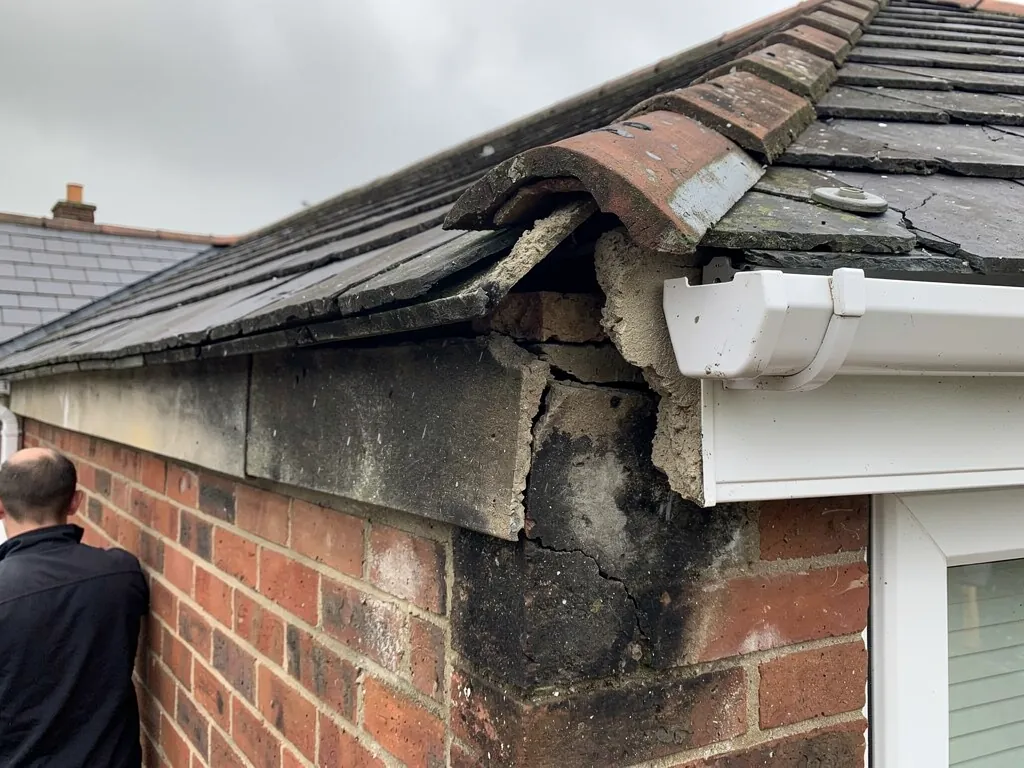
Crumbling mortar and cracked brickwork at a tiled roof eaves corner

The short answer

Time works on the details before the covering. Underlay perishes, nails corrode, flashings split, ridges lose their bedding and timbers at the eaves take on damp. A well-built interwar roof can usually be repaired for a good while, but a survey decides whether to patch or re-cover.

The houses of the Unwin scheme were built to last, and a century later most are still standing square. The roofs are a different matter. A roof is a set of materials that wear at different speeds, and after a hundred years some of them have run their course.

What has happened to the underlay, battens and nails?

Underlay is the waterproof sheet laid beneath the tiles or slates as a second line of defence. Houses of this age may have no underlay at all, or an old bitumen sheet gone brittle and powdery. Without it, wind-driven rain gets past a cracked covering with nothing to catch it. Battens are the small timber laths each tile or slate hangs from, and old ones can be soft at the eaves and around chimneys. Where slates are used, iron nails that have rusted through let the slates slip, and a slipped slate is the usual start of a stain on a bedroom ceiling.

What about the ridges, flashings and eaves?

Ridge tiles on old mortar crack and lose their grip. Lead flashings can last for generations when properly fitted, but sealant smeared over a split lead is a short-term cover, not a repair. Eaves timbers take the worst of the damp, because the gutter overflows there first. A reroof of this kind of house gives the chance to put each of those things right at once.

A roof rebuilt on these houses is also a chance to renew the verge and eaves details at the same time, so that the new work does not stand next to old, tired edges. Our pitched roofing page explains how a full re-cover works, from stripping to re-battening.

When we survey, we photograph the loft side of the roof as well as the outside, because the timbers under the covering tell us more about how the roof has aged than the tiles above.

Q2

What should I know before work on a shared chimney?

The answer

On paired houses, a chimney stack often stands on the party wall and serves both sides. Repairing the stack is ordinary roof work, but taking out a chimney breast is always a Building Regulations matter, and a breast built into the dividing wall also means formal notice to next door.

Pairs of houses share more than a wall. On many of them the chimney stack stands on the dividing line, with one flue for each house inside the same brickwork. Work on it is rarely a matter for one owner alone.

What does repairing the stack involve?

The usual faults are crumbling pointing, cracked or missing pots, a failed cement flaunching on top, and lead flashings at the roof line that have split. Flaunching is the sloped mortar bed that holds the pots and sheds water from the top of the stack. Repointing the brick, relaying the top courses, renewing the flaunching and the lead are all normal repairs. MyBuilder's national guide (updated August 2026) gives chimney repointing as £500 to £2,000, and the survey fixes the real figure for your stack, because height, access and condition move it.

Because the stack is shared, we talk through access with both households before a date is set. One scaffold can serve both sides, and doing the work together is cheaper than doing it twice.

What if a chimney breast is coming out?

A chimney breast is the part inside the house that carries the flue up through the rooms. The Planning Portal states that building regulations approval always applies when a breast is removed, since it forms part of the structure, and it advises asking a structural engineer. When the breast stands on a party wall, the Party Wall etc. Act 1996 adds a notice to your neighbour, served well ahead of the start date, with GOV.UK giving a window from two months to a year, and GOV.UK explains that silence is never treated as consent. Swindon Borough Council's building control team looks after the Building Regulations side.

If all you need is a roof repair, none of this applies. Where a stack is to come down to the roof line, we explain the next steps before the scaffold goes up. Our chimney repairs page has the detail.


Before you start

Tell the neighbour early, because a shared stack means shared scaffold and shared timing.

Q3

Does re-roofing a Pinehurst house need approval?

Roofer repointing a stone chimney stack above lead flashing
Industrial units with grey metal roofs beyond a roof under repair

The short answer

Often it does not. A repair or small re-cover stays below the thresholds in the Planning Portal guidance. A full strip and re-cover usually goes past them, so building control is involved and an insulation upgrade may follow. Approval is also needed when the new covering is at least 15 per cent heavier than the old one.

It surprises people that a roof falls under Building Regulations at all. It does, but only above certain limits, and ordinary repairs sit well beneath them.

At what point does building control apply?

Planning Portal guidance says building control is not usually involved in repairs or re-covering where less than 25 per cent of the total building envelope is affected and less than 50 per cent of the roof. Above either figure, approval comes in. So it does for structural alterations, for a covering that behaves differently in a fire, and for a covering that makes the roof 15 per cent or more heavier. Swindon Borough Council operates its own building control, and a registered building control approver is the private route. If a job is notifiable, we set out the steps and submit the notification on your behalf.

Does a stripped roof need more insulation?

Stripping a roof to its rafters and rebuilding it is renovation of a thermal element, and Part L of the Building Regulations can then ask for better insulation. On a house nearly a century old that is as much a benefit as a cost, but it needs thought, because extra insulation affects ventilation and sometimes headroom.

Is planning permission needed?

Planning permission is not usually needed for a matching re-roof. Pinehurst is absent from the council's conservation area list, so the extra controls that apply there are not in play, though a listed building would be treated differently. Anyone unsure about a particular house can ask the council's planning team.

We would like you to know the position before you accept a quote, so any consent that applies is noted in writing alongside the price.

When re-roofing needs a building control application
SituationApplication normally needed?
Repair or re-cover under both limitsNo
25 per cent of the envelope or moreYes
50 per cent of the roof or moreYes
Covering 15 per cent or more heavierYes

Roofing services in Pinehurst

Questions from the Unwin streets

Why do Pinehurst chimneys leak where they meet the roof?

The join between the stack and the roof is the most complicated junction on the house. Lead flashings and soakers weather and split, and cement fillets dry and crack. Sealant over a split lead stops the drip for a season. A proper repair renews the lead and checks the brick above for damp.

Can you repair a roof on a house I rent out?

Yes, with the landlord's agreement. We photograph the fault, explain the work in writing, and give a written quote the owner can approve. The photographs make it simple for an owner who lives elsewhere to see what is wrong.

Do you cover the roads around the Unwin estate as well?

Yes. We work across Swindon's suburbs, the surrounding villages and every place within 30 road miles. A survey visit to the roads beside Pinehurst is simple to arrange, and the same written quote and photographs follow whichever street you are on.

Are the temporary post-war houses still part of the estate?

The Victoria County History records that temporary houses were added after the war. What remains today varies by street. If your house has an unusual roof for the area, tell us when you ask for a survey and we will look at how it was built before recommending a repair.

Ask us about your roof

Tell us what’s happening and we’ll call you back.

  • Photos of what we find
  • A written quote
  • 10-year workmanship guarantee

Or call 01793 626096

Call Get a quote