Street of 1960s brick bungalows with concrete tile roofs

Roofers in Moredon

Roof repairs, chimney work, re-covering and garage and flat roofs in Moredon, on the estate Swindon's corporation began building on former farmland in 1948.

Moredon's roofs, from the 1948 farmland purchase onward

Rows of post-war council houses
The estate of 1,685 houses

In 1948 Swindon's corporation bought farms at Rodbourne Cheney and Moredon in the north-west corner of the borough, and built a new estate of some 1,685 houses and 12 shops. By 1951 almost all the land available for housing there had been used. A roof from that building programme is now more than seventy years old, so the original covering has often been renewed once already, and the repair history matters as much as the age. Houses of the period may have no underlay beneath the tiles, or only a thin bitumen felt, and a roof that has never had a proper membrane tells us a good deal about how the loft has behaved over the years. Chimney stacks, flashings and eaves timbers are where age shows first, and that is where the survey starts.

Concrete-built houses with pitched roofs
Non-traditional houses

Post-war shortages left a mark on some of the housing. The Victoria County History records that some houses used non-traditional methods, notably the Easiform House built by John Laing and Son and the Airey House, both built substantially of concrete. These are some of the houses on the estate, not all of them, and a pair or short row can sit among conventional brick. A roof on a concrete-built house may be carried differently from a brick one, and fixings, ventilation and the line of the eaves can all behave unexpectedly. We find out how a roof is constructed before we quote, and where its structure is in doubt we say that a structural opinion is worth having.

Flat-roofed garages in a row
Garages, parades and railway land

Moredon Halt opened on 25 March 1913, mainly for milk traffic, and served a siding to Moredon power station, which received coal until 1969. That railway and power station history sits at the edge of the estate, and the buildings around it include commercial and storage roofs as well as houses. Within the estate itself the garages, rear extensions and small parades add flat and shallow-pitched roofs of felt, fibre-cement sheeting or newer membranes. The age of a garage roof raises the asbestos question, which our asbestos chapter below answers. Flat roofs on a shop unit also need falls and outlets checked before any covering is chosen.

On the 1948 estate's former farmland

Map showing Moredon and central Swindon. 3 road miles north-west of central Swindon.

Distance
3 road miles north-west of central Swindon
Council
Swindon Borough Council
Council
Swindon Borough Council, which also runs building control
Conservation area
None at Moredon; the Rodbourne Cheney conservation area lies nearby
Setting
A council estate from 1948 on former Moredon and Rodbourne Cheney farmland

Moredon roof questions

Are Moredon's post-war roofs past their best?

Some are, but age alone does not condemn a roof. At seventy years or more, most of the work is at chimneys, flashings and eaves. We photograph what we find and recommend the smallest job that cures it.

Is Moredon inside a conservation area?

No. The council's list has a Rodbourne Cheney entry, but nothing for Moredon. If your street is close to the Rodbourne Cheney boundary, ask the council's conservation team where the line falls before you alter how the roof looks.

Does a concrete Airey house need special roofers?

It needs care, not a specialist title. We establish how the roof is carried and fixed, check the loading before changing the covering, and suggest a structural opinion if anything looks unusual.

Q1

What do Moredon's seventy-year-old roofs need?

Roofer repointing a stone chimney stack above lead flashing
Wet slate and clay tile rooftops with chimney stacks after rain

The short answer

The work on a roof from the late 1940s or 1950s is at the details: chimney flashings, ridge bedding, valley linings and eaves timbers. The covering itself is often a replacement from a later decade, so the question is how it was fitted, what lies beneath it and how well it has been kept.

The houses on this estate went up in the years after 1948, when materials were short and the aim was to get families under a roof quickly. Some have been re-roofed since, and a survey reads that history from the roof itself.

Why do chimneys and flashings fail first?

Flashing is the lead or metal trim that keeps rain out where a slope butts against masonry. Chimney stacks on houses of this age are exposed on every side, so the pointing weathers and the flashing lets go. Rain then tracks down inside the flue wall and appears as a brown stain on the chimney breast downstairs. What the repair costs turns on how tall the stack is and how it is reached, and the written quote spells that out once we have been up. Our chimney repairs page covers what we check.

What does the loft reveal about the underlay?

If the underlay is missing or perished, wind-blown rain finds its way between tiles into the loft. From inside you may see pinpoints of light, damp patches on the timber or a powdery deposit on rafters. Each of them tells us whether a patch repair is enough or whether a whole slope needs lifting and re-laying.

Is it the eaves and gutters or the roof?

The eaves are the lower edge of the roof, where water leaves the tiles. Old fascia boards soften, gutters sag, and joints weep onto the wall below. A leaking gutter can look like a roof fault, and we separate the two before quoting anything.

A survey of this kind gives you a priority list: what must be done now, what can wait a season and what is cosmetic. That list is worth having even if you decide not to go ahead, because it tells you what to watch from the ground each autumn, such as slipped tiles, sagging gutters or a stack that has started to lean.

Dates in the estate's history that matter to a roof
DateEventWhy a roofer cares
1948Corporation buys the Moredon and Rodbourne Cheney farmsHouses from this programme are now over seventy years old
By 1951Almost all available housing land usedThe bulk of the estate dates from a short building window
1952 to 1955Schools for the estate openSchool buildings bring large roofs of their own
1969Coal deliveries to Moredon power station endIndustrial roofs nearby are a separate type of job
Q2

Does a concrete-built Moredon house change the roofing?

The answer

Possibly, and it is worth finding out before work starts. Some of the estate's houses were built with concrete panels or frames in the Easiform and Airey styles. How the roof is carried can differ from a brick house, so we check the structure first and recommend a structural opinion if anything looks unusual.

The Victoria County History notes that post-war shortages produced houses built by non-traditional methods, and names the Easiform House and the Airey House as examples built substantially of concrete. That does not mean every house you pass is one of them. It does mean that you cannot assume, whichever street you live on.

How do you find out what you have?

The first job is to identify the construction. Look into the loft: is the roof carried on conventional timber rafters bearing on a wall plate, or on something different? A wall plate is the timber that spreads the roof's weight along the top of the wall. A photograph of the loft and of the outside walls is enough for us to start, and you do not need to climb anywhere to take it. If your deeds, survey or a previous builder's record names the type, send that too.

Do loading and fixings change?

Fixings behave differently in concrete from the way they behave in brick. Heavier coverings add load, and Approved Document A calls a load rise of more than 15 per cent significant, whereas the Planning Portal sets approval at 15 per cent or more, so we work to the cautious reading. Either way, a switch to a heavier tile is checked with building control and, where the structure is unusual, with a structural engineer or surveyor, as the Planning Portal advises.

Can the job stay small?

Most repairs, such as a ridge re-bedded, a flashing renewed or a few tiles replaced, do not alter the loading at all. They can go ahead once we know what the roof is fixed to, and the survey photographs record the answer so that nobody has to guess later. If a covering ever does need changing, the old and new weights go side by side in the quote.

Our page on roof repairs describes the process, and our roof replacement page covers the larger job.

Before any quote

Identify how the roof is carried, then choose the covering to suit it.

Q3

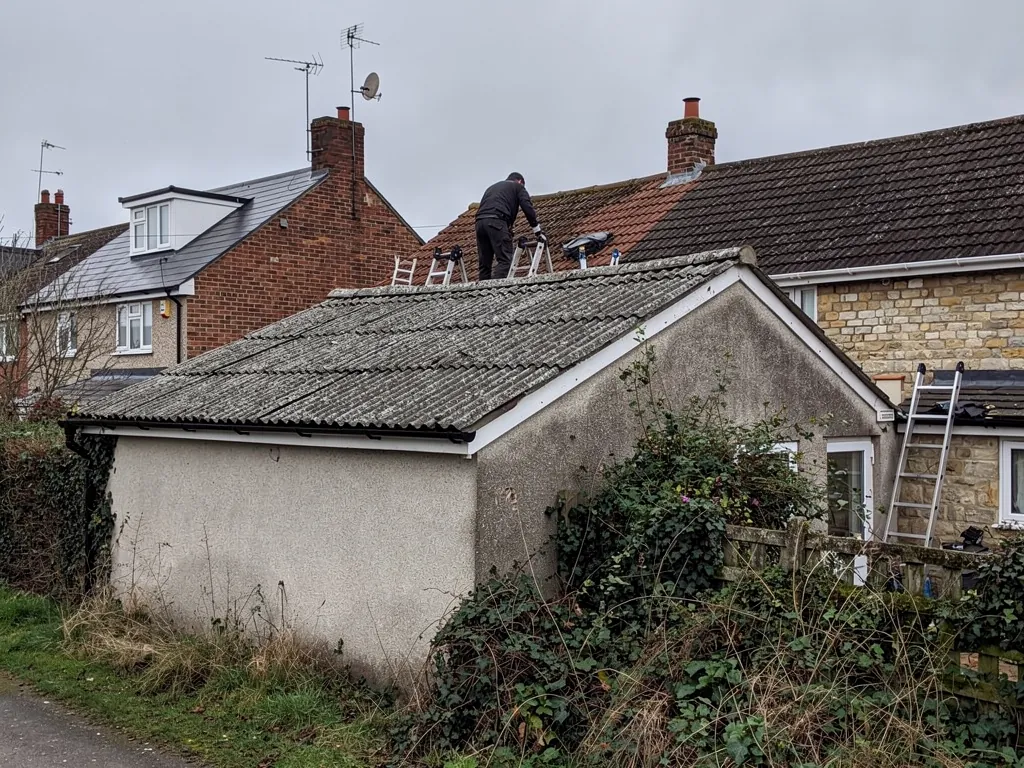
Is my Moredon garage roof made of asbestos cement?

Old corrugated sheet roof on a rendered garage beside houses
Flat-roofed garages behind brick semi-detached houses

The short answer

It may be. HSE's rule of thumb is to presume asbestos where a building dates from before 2000, whether built or refurbished then. Sound asbestos cement sheet can come off as non-licensed work when handled with care. Anything needing a licence is passed to a specialist firm, and you hear what the survey suggests before anything is touched.

Garages on estates of this age were often roofed with corrugated cement sheets, and some of those sheets contain asbestos fibre. You cannot tell by looking, so the safe approach is to treat the sheets as suspect until a test says otherwise.

What does HSE say about cement sheets?

Under HSE guidance, taking asbestos cement roof sheets off with care counts as non-licensed work, and that includes sheets that are weathered but not otherwise badly damaged. Once the sheets are substantially broken, or taking them off would crush them, the job becomes notifiable non-licensed work: the enforcing authority is told before it starts, medical examinations follow and health records are kept. We judge the condition of the sheets first and then explain which category applies.

What about soffits and insulating board?

Asbestos insulating board, or AIB, is a different material and can occur in older soffits. Plain sight does not separate it from non-asbestos board, and HSE lists most removal of it as licensed work, which goes to a specialist firm, so we stop and advise you before going near it.

What about waste and cost?

Asbestos waste from a home needs a consignment note and a registered waste carrier. MyBuilder, updated 21 August 2026, gives a typical national range of £350 to £1,295 for removing a single garage roof, and that excludes any new covering. The written quote after the survey shows our figure.

If you are not sure what your garage roof is made of, send us photographs of the sheets and, if you can see it safely, the underside, and we will point you to the sensible next step. Please do not drill, scrub or pressure-wash the sheets while you wait, since that is how fibres reach the air.


Questions from the 1948 estate

Why does a damp patch keep returning on a Moredon chimney breast?

It usually means water is entering at the stack: failed pointing, a lifted flashing or a cracked flaunching, the mortar crown that holds the pots in place. The stain returns after each wet spell until the cause is dealt with. Our survey works down from the stack and across the loft, and the photographs show the source.

Do you work on shop and parade roofs near the estate?

Yes. They are usually flat or low-pitched roofs, so we check falls, outlets and parapets, and then say whether a repair or a new covering is the right call. On our commercial roofing page you can see how that survey differs from a house visit.

Does re-covering a post-war Moredon house need planning consent?

Rarely. Putting back the same covering seldom needs consent, and Moredon sits outside Swindon's conservation areas. A new roof window, or a different covering on the front slope, deserves a call to the council first.

Will you remove an asbestos cement garage roof?

Where the sheets are intact and can be taken off carefully, yes, as non-licensed work with the right precautions and waste route. If the material is badly broken, or turns out to be insulating board, we explain the next step and do not proceed on our own.

Ask us about your roof

Tell us what’s happening and we’ll call you back.

  • Photos of what we find
  • A written quote
  • 10-year workmanship guarantee

Or call 01793 626096

Call Get a quote