1980s estate houses with brown concrete tile roofs

Roofers in Greenmeadow

Tiled roofs, ridges, valleys and guttering across Greenmeadow, from the older edge of Haydon Wick to the newer streets of a parish that takes in the River Ray and Haydon Meadow.

Greenmeadow's roofs, from Haydon to the Ray

An older cottage roof with mixed repairs
The old Haydon Wick edge

Greenmeadow lies inside Haydon Wick civil parish, which also takes in the former hamlet of Haydon. Until 1928 the area belonged to Rodbourne Cheney parish, and mains services arrived slowly: sewers after 1928, gas in 1930 and electricity in 1939. That tells you something about the oldest houses, which were built before modern roof details existed. Where an older cottage or farmhouse survives, the roof may have a mixed history of patches, with clay tile on one slope and something newer on another, and timbers that have been altered more than once. We look under the covering before we recommend anything, because the structure decides what is possible.

Concrete-tiled houses on a modern estate
Late twentieth-century housing

The parish's own history records that late twentieth and early twenty-first century housebuilding greatly increased the number of properties, and a good part of Greenmeadow belongs to that growth. Houses from a volume-built period share details, so we know where they tend to let water in: the bedding under ridge and hip tiles, the cement or mortar at the verges, the felt behind the fascia and the flashing strips, called soakers where they sit under slates or tiles, along a wall abutment. If your tiles are interlocking concrete, the covering itself may be sound while the details around it are tired, and fixing the details is the cheaper job.

Newer houses beside trees and open space
Newer streets near the meadows

Haydon Wick parish also includes Priory Vale, and the River Ray runs through it, with Haydon Meadow and Mouldon Hill Country Park close at hand. Houses next to green space and trees collect leaf litter in their gutters, grow moss on shaded slopes and sometimes attract nesting birds under eaves. Newer roofs are not maintenance free. Gutters clog, sealant ages, and a roof with a shallow pitch or a long valley can hold damp against the tiles. Regular clearing and a light inspection every few years keep a young roof from becoming an expensive one. Garages and porches get the same attention.

From Swindon north to the River Ray

Map showing Greenmeadow and central Swindon. 3 road miles north-north-west of central Swindon.

Distance
3 road miles north-north-west of central Swindon
Council
Swindon Borough Council
Civil parish
Haydon Wick, which also covers Haydon and Priory Vale
Conservation area
None in Greenmeadow, according to the council's list
Setting
North Swindon, near the River Ray and Mouldon Hill Country Park

Greenmeadow roof questions

Can I re-roof a Greenmeadow house without planning permission?

A like-for-like re-cover usually needs none, as Greenmeadow has no conservation area. Raising the roof or changing its shape is worth checking with Swindon Borough Council.

Why does moss build up on roofs near the Ray?

Shade from trees, damp air near open ground and slow-drying slopes all help moss take hold. Clearing it early protects tiles, and it should be brushed off gently rather than jet-washed.

Are newer Haydon Wick roofs still worth surveying?

Yes. Details such as ridge bedding, verges and flashings can fail on a roof whose tiles are still sound, and a short survey finds those faults while they are cheap to mend.

Q1

How do Greenmeadow's roofs differ from the older parts of Swindon?

Brick end-of-terrace gable beside a limestone house, slate roofs
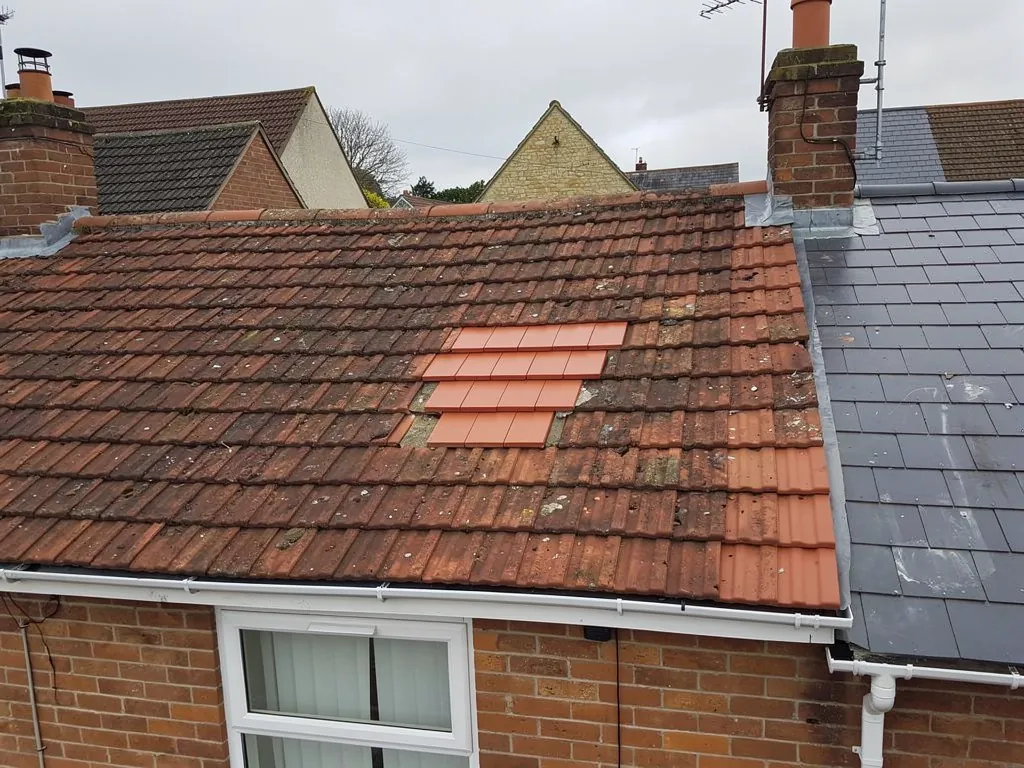
Patch of newly replaced clay tiles on a weathered terrace roof

The short answer

Greenmeadow sits in Haydon Wick parish, where late twentieth and early twenty-first century housebuilding greatly increased the number of homes. Those roofs are younger than the ones in the old town, so the faults are different: failing details at edges and junctions rather than tired slates.

Haydon Wick was a small rural place before the mid-twentieth century, with sewers arriving after 1928, gas in 1930 and electricity in 1939. The big change came later, with housebuilding that multiplied the number of homes in the parish. The result for a roofer is a different set of problems from the ones we see in Swindon Old Town or on the railway terraces.

What do younger roofs fail on?

Where the old town's slates fail by nails rusting, younger roofs tend to fail at joints and edges. A ridge run that relied on its mortar bed alone works loose as the bed crumbles, and the tiles at the end of the run go first. Verges crack where the mortar has shrunk away. Felt underlay behind the fascia perishes, and the first sign is staining on the soffit below. Lead flashing, or the modern equivalents, can lift where a roof meets a gable wall. None of these are dramatic, yet each lets water in slowly.

Should a younger roof be repaired or replaced?

Because the tiles on a younger roof are often in decent condition, our usual advice is to repair rather than replace. We lift the tiles around the fault, renew the felt, refit the flashing and re-bed the ridge with a mechanical fixing alongside the mortar, as BS 5534 now expects. Our roof repairs page covers the common jobs and what moves the price.

A full re-roof only becomes the better answer when battens are failing across a whole slope, when the tiles themselves are breaking up, or when the roof has been patched so often that the patches are the problem. Even then, a survey tells you which slope is worst before anyone suggests doing all of them.

Common faults on younger tiled roofs in Greenmeadow
WhereWhat we usually findUsual fix
Ridge and hipsBedding cracked, tiles looseRe-bed with mechanical fixings
VergesMortar shrunk and falling awayRe-point or fit a dry-fix verge
Wall junctionsFlashing lifted or splitRenew the flashing and soakers
EavesPerished felt behind the fasciaRenew the eaves felt and tray
Q2

Can moss and leaf litter damage a Greenmeadow roof?

The answer

Yes, over time. Moss holds water against tiles, lifts them slightly and blocks gutters when it falls. Leaf litter clogs outlets and sends water over the edge or into the fascia. Neither is urgent on a given day, but both shorten the life of a roof that is otherwise sound, and both are cheap to deal with early and dear to deal with late.

Greenmeadow has more open ground and mature planting than much of central Swindon. The River Ray runs through the parish, and Haydon Meadow and Mouldon Hill Country Park lie close by. That is a good thing for a walk, but it shapes roof maintenance.

Why does shade matter so much?

North-facing slopes and roofs under trees stay damp longer, and a damp tile is where moss starts. On concrete tile, moss roots in the textured surface and in the gaps between tiles. On a pitched roof with a long gutter run, one season of leaf fall is enough to block a downpipe. Water then overflows at the eaves, soaks the fascia and runs down the wall, which is how a roof problem becomes a damp patch indoors.

How can moss be cleared without harm?

We remove moss by hand, brushing it off and treating the surface, rather than pressure-washing. Too much pressure wears the face off a concrete tile and drives water under the laps, so the roof ends up wetter than before the clean. Gutters are cleared by hand and checked for sagging brackets and leaking joints while we are there. You can read more on the roof cleaning and moss removal page.

Nesting birds under the eaves are protected while they are using a nest, so we plan the work around them and do not disturb an active nest. If we find signs of bats during a job, we stop and explain the options before going on.

Gutters that are cleared once a year, and a quick look at the slopes after autumn, cost far less than the repairs that follow a neglected downpipe. If you would rather not go up a ladder yourself, a survey with photographs shows you the roof from above without any risk, and the written quote lists only what the roof needs. See our pitched roofing page for how the slopes, the eaves and the ridge fit together.

Q3

Who approves roof work on a Greenmeadow house?

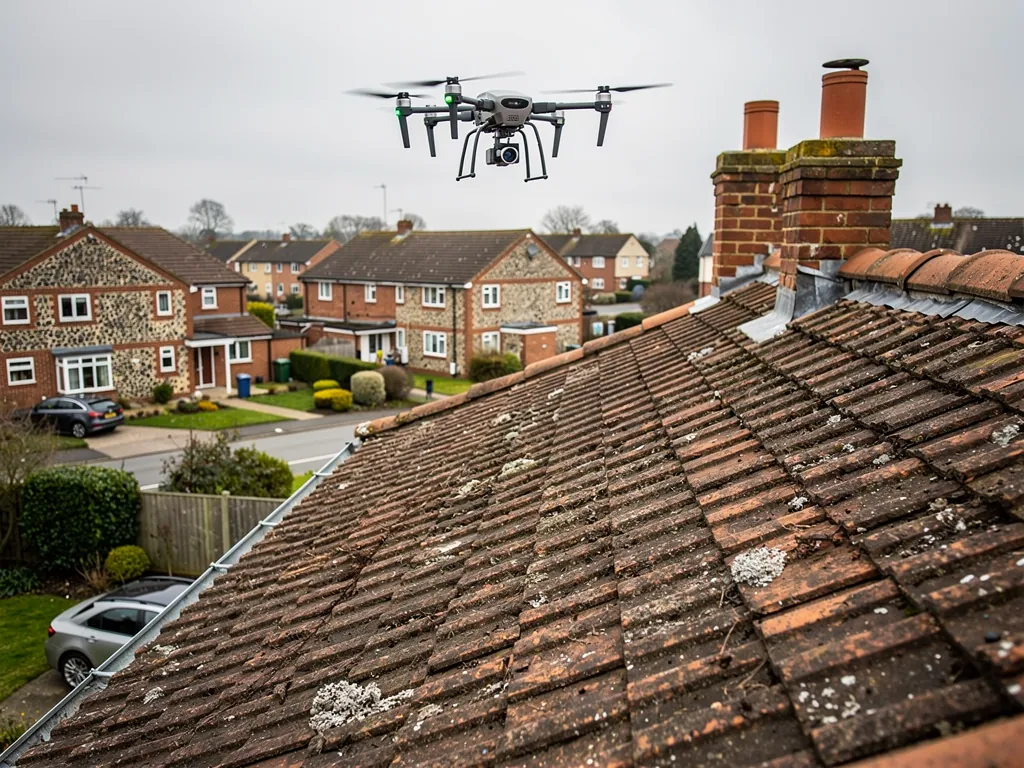
Drone hovering above a tiled roof during a roof survey
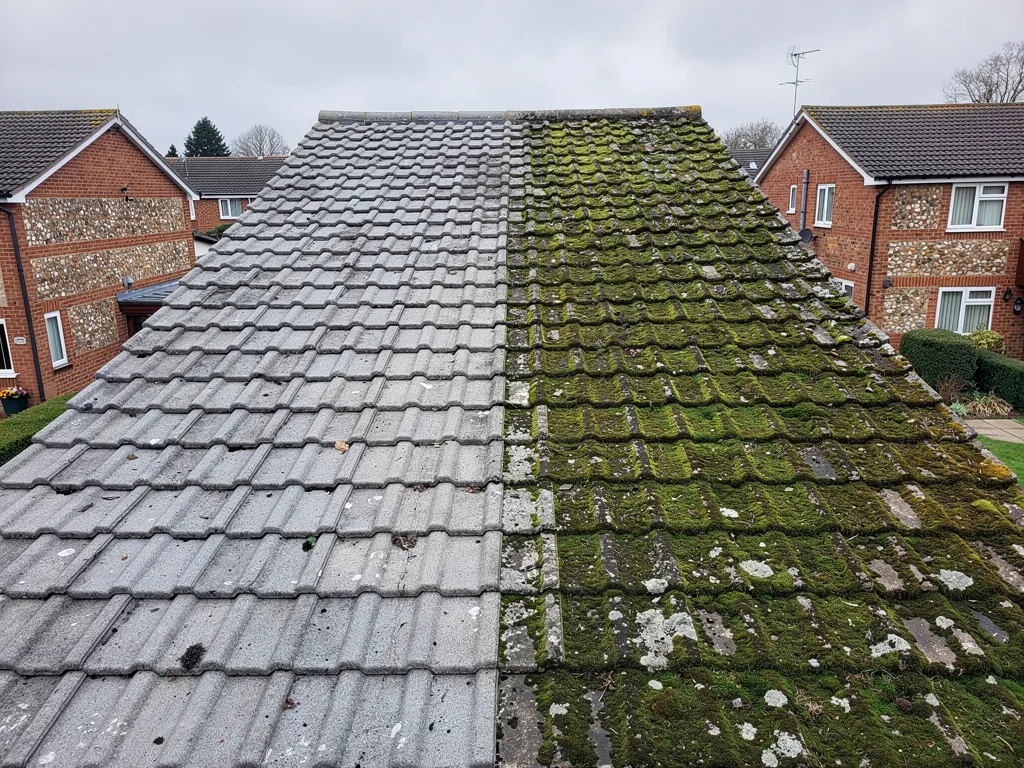
Roof half cleaned, grey tiles beside a moss-covered side

The short answer

Greenmeadow comes under Swindon Borough Council, which runs its own building control team, though you may also use a registered building control approver. The council's list of conservation areas has no entry for Greenmeadow, so planning consent is rarely a hurdle for a matching re-cover.

Most roof work in Greenmeadow is maintenance and needs no consent. Replacing slipped tiles, renewing a flashing, re-bedding a ridge and swapping a gutter are all repairs. A few jobs do bring in the rules, and it helps to know which.

What if a larger area is re-covered?

A re-roof needs no building control application while it affects less than 25 per cent of the total building envelope and less than 50 per cent of the roof. Go over either line and you are into approval territory, with the Part L energy rules possibly asking for better insulation while the roof is open. New tiles that are heavier than the old are a second trigger: the Planning Portal puts it at a covering 15 per cent or more heavier, which needs approval before the work starts. If your job is notifiable, we explain this before you sign and arrange the notification ourselves, which keeps the paperwork off your plate and the work on the right side of the rules.

Does a Greenmeadow re-roof need planning permission?

Greenmeadow is not a conservation area and the council's Article 4 directions cover only two other places in the borough, so a re-roof in similar materials is not a planning matter. Planning permission enters the picture for bigger changes, such as a loft conversion with a dormer, and for those Swindon's planning officers are the people to ask first. It is far cheaper to ask early than to redraw plans later. Our roof replacement page explains when a whole new covering is justified.

What about wildlife in the roof?

With the river, the meadow and the country park close, the parish has a good deal of wildlife, and bats and nesting birds are both protected by law. We look for signs during a survey and plan the work around them, and we tell you at once if something changes the programme.

When the roof is finished, the scaffold and debris go, the waste leaves with us, and a written 10-year workmanship guarantee comes with the final paperwork. If a question comes up later about what was done and where, the survey photographs and the quote are there to answer it, and you can ring or message us on WhatsApp at any point.


Our view

On a younger roof, fix the details first and replace the tiles only when they have failed.

Questions from around Haydon Wick

Is my Greenmeadow roof too new to need attention?

Not necessarily. Late twentieth-century and newer roofs are still prone to failed ridge bedding, cracked verge mortar, perished eaves felt and lifted flashings, and those faults can start well before the tiles wear out. A survey photographs each area, tells you whether a fault is cosmetic or active, and gives you a written quote for the smallest job that deals with it.

What should I do if a Greenmeadow ceiling stain appears after rain?

Move anything valuable out of the way, put a bowl under any drip and take a photograph of the stain. Do not poke at a bulge in the plaster. Ring us and we will prioritise a leak and make it safe first, then survey the cause. A stain under a wall often points to a flashing, while one near the eaves can point to the gutter.

Do you work on the Priory Vale side of Haydon Wick?

Yes. Priory Vale and the other streets of Haydon Wick parish are well within the area we cover from Swindon, and we work on the older houses around Haydon as well as the newer estates. If you are unsure whether your address is on our list, the areas page shows every place we serve.

Is jet-washing a good way to clear moss from concrete tiles?

Usually not. A pressure jet can wear away the tile surface and force water under the laps, which makes leaks more likely rather than less. Careful brushing, a suitable treatment and a clean gutter do the job without the damage, and we can tell you at the survey whether the tiles are strong enough to be worth cleaning.

Ask us about your roof

Tell us what’s happening and we’ll call you back.

  • Photos of what we find
  • A written quote
  • 10-year workmanship guarantee

Or call 01793 626096

Call Get a quote