
Ask five people how a roof gets inspected and you will hear five answers: someone up a ladder, a drone buzzing overhead, a camera on a pole, a torch in the loft, a person walking the slope. All of them are real, and all of them are used. The useful question is which one fits the roof in front of you and the decision you have to make.
Steep slate, a low flat roof behind a parapet, a hipped tile roof over a conservatory and a pitched roof with a dormer all present different problems. This guide goes through each method in turn, says what it shows and where it falls short, and finishes with how we combine them. The wider service is on our roof inspections and surveys page.
Looking from the ground
The lowest-effort and quickest look is from the pavement, the garden or the road opposite. With binoculars or a zoom lens it takes minutes, needs no access and works in wind that would stop anyone climbing. It is how most buyers' surveys view a roof, and it is how many homeowners first notice a problem.
It has real use. From the ground you can spot slipped or missing slates, a sagging ridge line, a leaning chimney stack, moss patches, vegetation growing from a gutter and the general state of the roofline. You can see patterns across a whole slope that disappear once you stand close to it.
What does a ground view miss?
Anything small, anything on a rear slope hidden by an extension, anything behind a parapet or on the far side of a ridge. Cracked tiles look whole from the road. Nails that have rusted through cannot be seen at all. Flashings tucked under the edge of a covering look sound until they are touched. A ground view tells you whether a closer look is needed. It rarely tells you what the closer look will find.
A clean view from the ground is a reason to relax a little, not a reason to stop checking. Plenty of leaks start in details too small to see from the road.
Ladder and roof-edge inspection
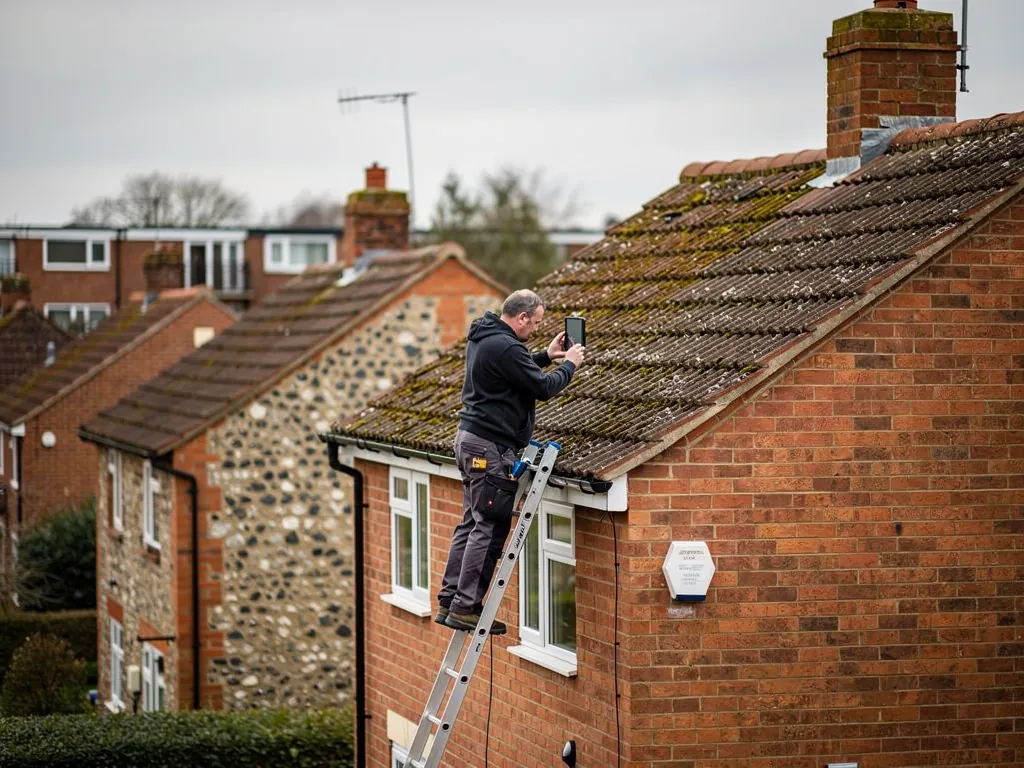
A ladder against the gutter line or eaves takes a surveyor close enough to see the condition of individual slates and tiles at the lower edge, the state of the gutters and fascias, and the first few courses of the covering. It is quick, it needs little set-up, and on a low single-storey roof it can be enough.
The limits are physical. A ladder reaches the edge, not the middle. The ridge and the chimney stack are usually out of reach on a two-storey house, and a ladder leaning on a gutter or a fragile fascia risks damaging both. Anything past the first few feet of slope has to be judged from a distance again.
When is a ladder the right choice?
On a low roof where you need to feel and lift the covering at the edge, or where the question is gutters and fascias and not the roof proper. It also suits a quick check of an outbuilding or porch. For a full survey of a house roof, it is one tool among several.
Does a ladder inspection count as a survey?
It counts as part of one. The quality depends on what is written down: which elevations were checked, which were not, and what photographs were taken. A bare verdict of looks fine from a ladder is thin evidence. Our page on what a roof survey includes lists what a proper record should name.
Direct roof access, scaffold towers and platforms
Where a roof has to be assessed closely, the surveyor gets onto it or alongside it. There are several routes: a roof ladder or crawling board hooked over the ridge, a scaffold tower beside the eaves, a mobile platform or a full scaffold if work is planned anyway. Each puts a person within hands' reach of the roof surface.
This is the method that finds what the others cannot. Gentle pressure on slates shows which are held by sound nails and which move. Tapping flashings reveals loose lead. Lifting a ridge tile shows the state of the bedding underneath. Chimney pointing can be probed, the condition of a valley lining can be seen from above, and the underside of a loose tile can be checked for cracks.
Is walking on a roof safe for the roof?
Not always, and that is a reason the method is chosen with care. Old slates, stone slates, fragile roof lights, asbestos cement sheets and aged flat roof coverings can break under weight. A surveyor who respects the covering uses boards to spread load, avoids stepping on the weak, and decides not to go up at all where the risk to the roof or to themselves is too high. Safe access also depends on the weather: wet slate and a strong wind rule out a climb.
Why does close access push up the price of a survey?
It takes equipment and time, and the safest way onto one roof differs from the next. Nobody should be asked to risk a fall to save a few pounds on an inspection.
Pole cameras and fixed-height cameras
A camera on an extending pole sits between the ground view and a full climb. The operator stands safely at the edge of the building, raises the camera to roof height and views the image on a handheld screen or phone. The method suits rooflines that are hard to see, such as the far side of a low roof, a gutter run behind a conservatory, or the back of a parapet.
It gives a closer look at the covering than binoculars, records what it shows, and costs little in time. It can be pointed at one suspicious spot and photographed from several angles. We have a separate short answer on how a pole camera roof inspection works.
What can a pole camera not do?
It cannot touch anything. You see a slate that looks cracked, but you cannot tell whether it is loose. It reaches only as far as the pole and the angle allow, so the middle of a tall roof is out of range. Bright sun can wash out the image, and a camera held at the end of a long pole shakes in wind. It is a good way to look, and a poor way to test.
Where does it fit in a survey?
As a supplement: useful for gutters, low roofs, valleys and areas the surveyor does not want to climb onto. It earns its place on roofs where access would be difficult or the covering is fragile, and works well alongside a ground view and a loft check.
Drones
A drone takes a camera to any height without a person leaving the ground. In practice that means a quick, wide set of images of the whole roof, including ridges, rear slopes and chimney tops that would otherwise need a climb. The photographs and video can be reviewed afterwards, enlarged and shared, which makes drones useful for a record and for explaining findings.
They are especially handy on tall or steep buildings, on large roofs, on commercial units and on roofs with fragile coverings where stepping on the surface would cause harm. Our guide to drone roof inspections and their limits covers the details.
What does a drone struggle with?
Touch, depth and anything hidden. It cannot lift a slate to see the nail. It struggles with the underside of eaves and the inside of a valley hidden by overhanging branches. Wind can ground it, and the image shows the surface and not what lies beneath. A drone can also make cracks look worse or better than they are, depending on the light.
What does MyBuilder say it costs?
MyBuilder's roof inspection guide, updated 21/08/2026, gives a general range of £150 to £500 for an inspection, with drone surveys typically £200 to £400 and standard inspections £150 to £250. What you pay for your own roof is set in the written quote that follows the visit. For the full picture of what drives survey prices, see our guide to roof survey cost.
From inside: the loft, and thermal imaging
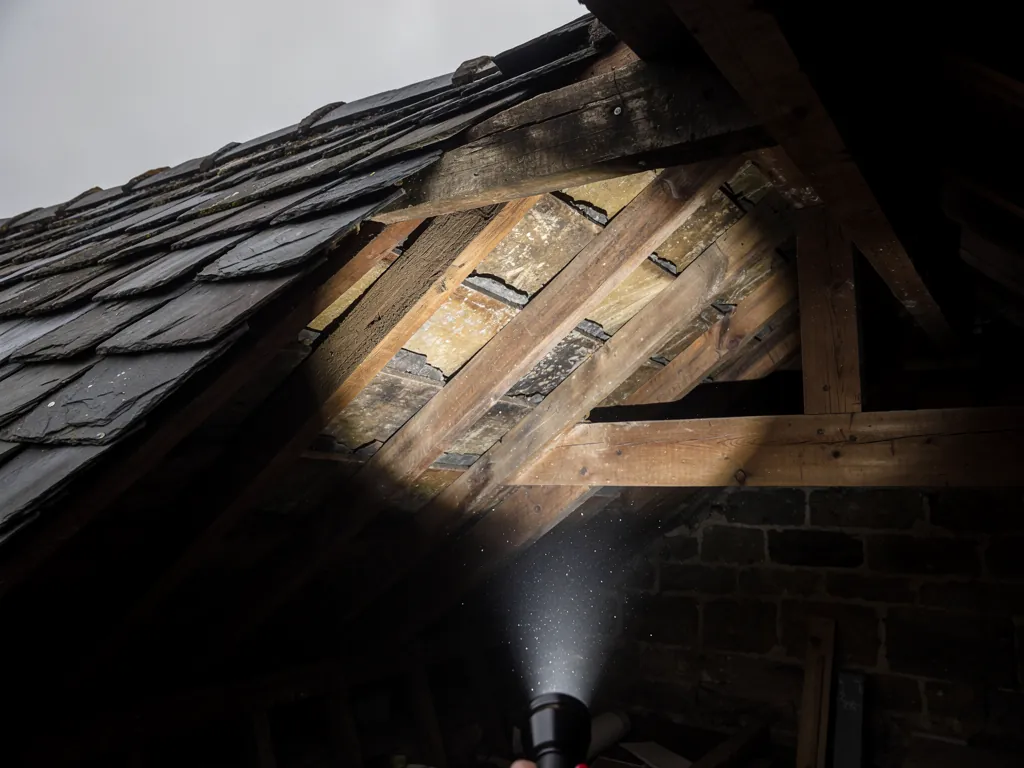
The loft is the other half of any roof inspection. From inside you see what the covering is doing to the structure beneath: dark staining on rafters, wet marks along the underside of the boarding, daylight through the covering, insulation that has been wetted, nails that have rusted and dripped, and timbers that have been attacked by rot or beetle. A damp loft often tells you about a roof fault long before any slate shows it.
It is also the only place to check ventilation, vents at the eaves and ridge, the state of the underlay where there is one, and the brickwork of the chimney breast as it rises through the roof space. Our answer on what to check in your loft gives a homeowner's version of the same walk-round.
What are the loft's blind spots?
It cannot show the outside of the covering. It can be crammed with boxes, boarded over, insulated to the rafter tops or simply too low to crawl into. Some houses have no loft access at all, as with flat roofs, or loft conversions where the structure is hidden behind plasterboard.
Where does thermal imaging come in?
A thermal camera shows surface temperature differences, which can hint at wet insulation or missing insulation, particularly on flat roofs. It is a specialist extra with limits of its own, and our page on thermal imaging roof surveys explains what it can and cannot prove. On flat roofs it often sits alongside a hands-on survey, as described in our flat roof survey guide.
Choosing a method, and how we combine them
The right choice depends on three things: the roof, the question and the risk. A simple pitched tile roof with a suspected slipped tile may need only a ground view and a loft check. A Victorian slate roof with a leak needs close hands-on access and the loft. A large commercial flat roof may suit a drone for the overview and a walk-over for the details. A landlord checking several houses may want a drone sweep followed by targeted visits, as outlined in our guide to roof inspections for landlords.
| Method | Best for | Main limit |
|---|---|---|
| Ground view | First look, patterns across slopes | Cannot see small defects |
| Ladder | Eaves, gutters, low roofs | Reaches the edge only |
| Roof access | Fixings, flashings, ridges | Needs safe conditions |
| Pole camera | Hidden or hard-to-reach spots | No touch, short reach |
| Drone | Height, whole-roof record | Surface only |
| Loft | Leaks, timbers, ventilation | Cannot see the outside |
What do we usually do on a survey?
We start with a view of the whole roof, add close access or camera work where the roof calls for it, and go into the loft where there is one. The quote comes in writing with pictures of your own roof, and it names anything we could not reach. Our aim is the minimum work that cures the fault, so the method should find what is wrong and never pad out the scope.
Unsure what your roof needs? Send us an enquiry through the contact page and say what you have noticed.