
A flat roof rarely fails all at once. It gets a little worse each winter, and the first sign is often a small stain on a ceiling or a puddle that stays after the rain has stopped. By the time water drips, the damage underneath may already be wider than the visible patch. A condition survey is the point at which someone reads the roof properly, before you spend money on a repair that the roof cannot hold.
This guide explains what that survey covers, in the order we usually work: the covering, the deck, the details, the drainage and the moisture question. It also explains how the findings turn into a plain choice between patching, overlaying or renewing. For the wider picture, our roof inspections and surveys hub sets out how the different surveys fit together, and the flat roofing page covers the work itself.

The membrane: reading the waterproof skin
The membrane is the waterproof layer on top, and it is where a survey starts because it is the part you can see. On a garage or a kitchen extension it is usually one of three things: bitumen felt (often called torch-on felt after the way it is laid), one sheet of EPDM (a synthetic rubber), or a fibreglass-reinforced plastic coating known as GRP. They age differently, so the survey begins by working out which of them you have.
On felt we look for blistering, splits along the laps, areas where the surface granules have worn away and any place where the layers have lifted or become brittle. Felt that crackles underfoot or shows alligator-style cracking has usually lost its flexibility. On EPDM the signs are different: seams that have opened, patches of lifting adhesive, and punctures from branches, tools or a dropped slate. On GRP we look at crazing in the surface gel, cracks at the joints where a board edge has moved, and any area where the colour has chalked.
Typical lifespans give context rather than a verdict. Third-party guides put torch-on felt at roughly 10 to 20 years (Less, March 2026), EPDM at around 20 to 30 years (GreenSpec) and GRP at 25 to 40 years (Less). MyBuilder's flat roof guide, updated on 21 August 2026, describes flat roofs generally as lasting 15 to 30 years. Careful laying and a sound deck push a roof towards the upper end; poor workmanship pulls it down.
The deck underneath, where the real damage hides
Under the membrane sits the deck, usually plywood, OSB or timber boards laid across joists. It is the structure the whole roof depends on, and a membrane laid over a soft deck will fail however well it was applied. The survey checks the deck by walking the roof and feeling for give: a spongy patch, a springy board or a dip underfoot all suggest something has softened below.
Water that gets under the membrane travels, so the wet spot on the ceiling is seldom directly under the hole. It follows the deck, runs down a joist, then drips where it finds a gap. That is why a survey looks from both sides: from above at the surface, and from below at the ceiling and, where there is a void or an access hatch, at the underside of the boards. Dark staining, a rotten smell, fungus on timbers and rusted fixings all point to an older leak.
Can a rotten deck be repaired in part?
Sometimes. A small patch of damaged board can be removed and a new piece fitted, with the membrane patched or renewed around it. But if the deck is soft across much of the roof, a localised repair buys little time, and renewal is the sensible choice. This is the point where the survey changes a conversation about a quick fix into one about a new roof, and it is better to learn it from an inspection than from the next leak.
Details: upstands, edges, outlets and penetrations
Most flat roof leaks start at a detail rather than out in the middle of the membrane. An upstand is the section of waterproofing that turns up the face of a wall or a rooflight kerb; it should rise high enough to keep water from splashing over the top and be sealed under a flashing, the strip of metal or membrane that bridges the join. The edge trims, where the roof ends at a gutter or a fascia board, need to carry water cleanly into the gutter without letting it track back underneath.
Outlets and pipes are the other common weak point. A rainwater outlet that has become partly blocked, loose or badly sealed lets water pool around it. Soil vent pipes, flues, aerials and cable entries all pierce the covering and each one needs a neat, sealed collar. Rooflights set into a flat roof have their own kerb and flashing, and the survey checks the seal between the glazing and the frame as well as the kerb itself.
We photograph each detail close up and note its condition, because these are the parts where a repair usually works well. Re-forming a corner, replacing a flashing or fitting a new outlet is often a small job that gives the roof several more years, provided the field of the roof around it is still sound.
A flat roof with a good membrane and failed details is a repair job. A roof with failed membrane and failed details is usually a renewal.
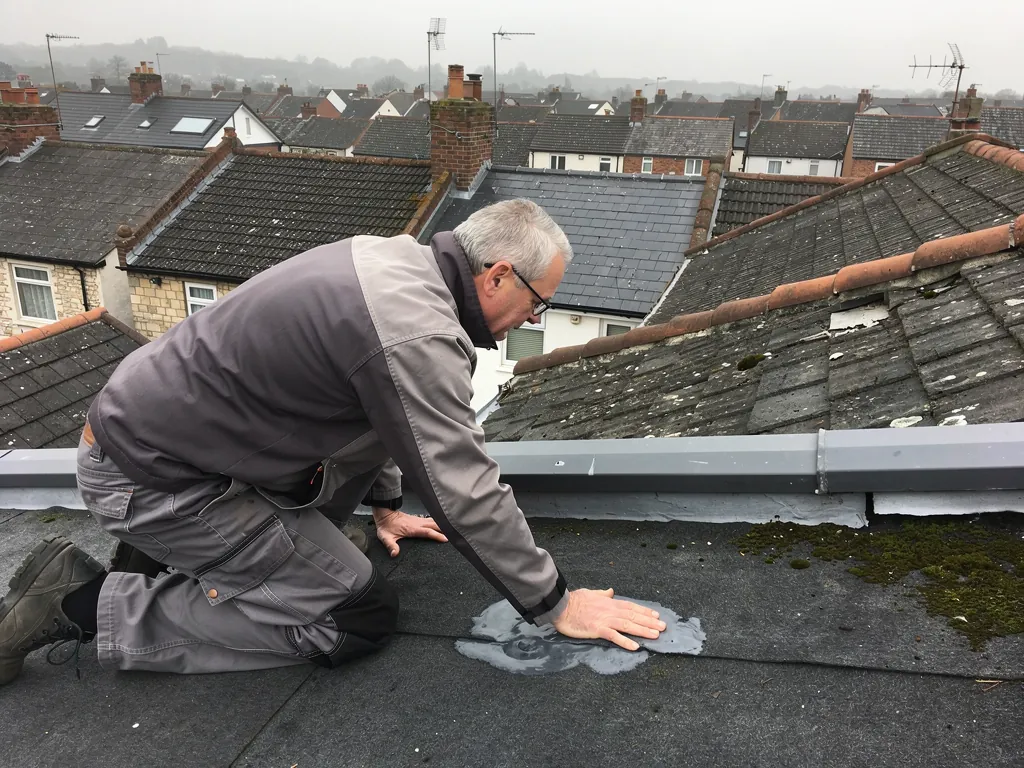
Falls, ponding and drainage
No flat roof should be truly level. It is built with a slight fall towards the outlet so that water runs off. For flat roofs covered with felt or single-ply, BS 6229:2018 sets 1:80 as the minimum finished fall, with the roof designed to a fall of 1:40 to allow for construction tolerance and the deflection of the deck (IKO's summary, February 2021). Many older extensions were laid close to level, and some have sagged since.
The survey looks for ponding, which is water standing on the surface for a long time after rain has stopped. A shallow dip that dries within a day or so is common and is not always cause for concern. Deep or permanent pools are a different matter, because standing water works at every seam, carries dirt that grows algae and freezes in winter. Ponding around an outlet usually means the outlet sits too high, or the deck has dropped.
Drainage beyond the roof counts too. We check that the gutter runs freely, that the downpipe is clear and that water discharged at the end of the run does not splash back against a wall. A blocked outlet can turn a modest roof into a swimming tray in a heavy downpour, and the survey shows whether that risk is real. If the fix is a fresh set of falls, it is often most economical to fit them at the same time as new covering, and our written quote after the visit sets out what that means for your roof.
Moisture: finding water you cannot see
Water inside a flat roof build-up often leaves no mark on the surface. The insulation may be soaked while the membrane looks fine, or the deck may be damp from condensation rather than a leak. To tell the difference, a survey uses moisture checks as well as eyes and hands.
A moisture meter reads the dampness of timber or ceiling plaster by touch, and gives a quick, if approximate, indication of where to look. Thermal imaging, which shows differences in surface temperature, can map wet insulation because wet material holds and loses heat differently. It works best in the right conditions, usually after a day of sun and as the roof cools, and it points to areas worth opening rather than proving anything. Our thermal roof surveys page explains when it is worth the cost.
Is it a leak or condensation?
Warm, damp air from the room can condense on a cold deck, especially where a warm-roof upgrade or a vapour barrier is missing. The staining looks like a leak but appears in cold weather without rain. The way to separate them is to note when the damp shows, check the ceiling vapour control and ventilation, and where necessary make a small opening in the covering to see what lies beneath. The answer decides whether you need a new membrane or a change to the build-up, and a patch of felt does not cure condensation.
What the survey tells you about repair, overlay or renewal
After the checks, the findings fall into three broad outcomes. The first is a repair: the membrane and deck are sound and the problem is a split, a failed detail or a blocked outlet. The second is an overlay, where a new membrane goes over the existing one because the deck is still good and the old covering is tired. The third is renewal, with the old layers stripped back to the deck, defective boards replaced and a full new build-up laid.
Which one applies depends on evidence, not preference. If the survey finds wet insulation or a soft deck, an overlay would trap the water and is the wrong answer. If the deck is dry and sound, stripping everything would be needless cost. Our advice is the lightest job that settles the matter for good, explained plainly with photographs to match.
Renewal can also trigger a building control question. Approved Document L counts a flat roof given a fresh waterproof covering as a renovated thermal element, and the whole roof may need improving to a stated U-value where more than half of its surface is renovated. Where work needs a Building Regulations notification, we explain the consent and file it, and our guide on a survey before a re-roof shows how that fits the planning of the job.
Older and awkward flat roofs
Some flat roofs need a different eye. A lead or zinc flat roof on a period building is a very different animal from a felt garage, with its own jointing, rolls and falls, and its own long lifespan when looked after. Terrace houses may have a flat-roofed rear addition or bay, tucked between two walls where access is tight. A dormer cheek or a porch roof can be both flat and hard to reach.
For these we plan the survey around the building. On a period house the details often matter more than the field, and the repairs have to suit the character of the property. Our period roof surveys guide covers what changes when the building is old.
Photographs are the other half of the job. A flat roof is awkward to picture from the ground, so close shots of each defect, with a wider shot to show where it sits, make the written findings clear to anyone who reads them later. We explain how those images are taken and used in the guide to roof inspection photos. If the roof is a lean-to against a neighbour's wall, we also look at the junction on their side where we can see it, since a failed wall flashing there is a frequent route for water into both houses.