
Moss has a reputation as either a disaster or a nuisance, and neither is quite right. A few green tufts on a shaded slope are not going to bring a roof down. A thick mat running along the lower courses, packed into the valley and spilling into the gutter is a different story, because by then the moss is changing how the whole roof sheds water.
The damage comes from four things: the water a moss mat soaks up and keeps against the tile, the frost that then works on that wet surface, the way growth pushes into joints and laps, and the blockages it creates where water is meant to run away. Each is slow, and each is easier to deal with early. We go through each below, then look at when moss can safely stay. For methods and prices, see the main roof cleaning and moss removal page.
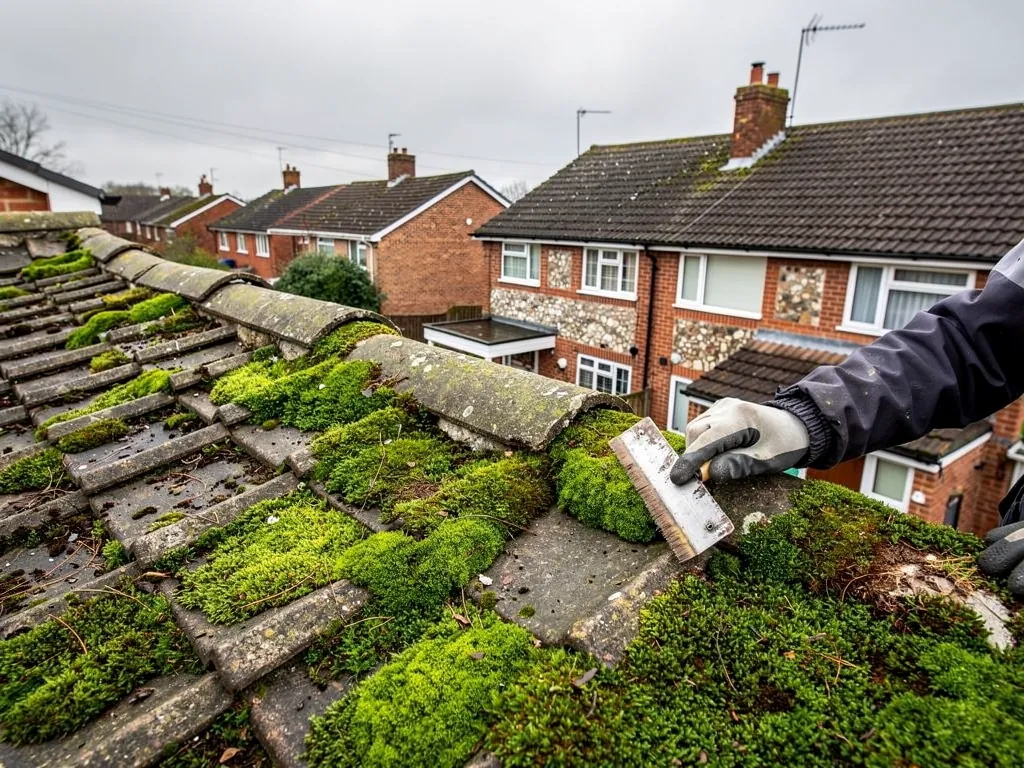
A moss mat is a sponge on your roof
Moss has no true roots, only fine hair-like anchors, and it is built to soak up and keep water. A healthy cushion soaks up rainwater like a sponge and releases it slowly. On a roof, that means a tile under a moss mat stays damp long after a clean tile beside it has dried.
This is the root of most moss damage. A tile is designed to get wet and dry out again, shedding water downhill. Take away the drying and you change the conditions the tile works in. Concrete tiles are porous and take up moisture into the body of the tile. Clay and slate absorb far less, but even they stay wet at the surface, and the joints under a moss mat stay wet too.
Dust, pollen, leaf fragments and bird droppings also settle in the mat and break down into a layer of organic material, which holds more moisture and gives the next generation of moss somewhere to start.
Where it grows matters. Shade and slow drying favour moss, which is why north-facing slopes, roofs under trees and the lower courses near the gutter go green first. Our guide to why moss grows on a roof goes through the causes, and our answer on why moss is worse on the north side covers that slope.
Frost, wet tiles and surface breakdown
The next step in the damage runs through winter. Water held in a tile or against its face freezes when the temperature drops, and ice takes up more space than the water it came from. That pushes the surface of the tile outwards and, over repeated freezing and thawing, it flakes.
Concrete and clay
On concrete tiles the damage appears as a roughened, crumbling surface, and once the top layer has gone the tile is more porous and holds more water the following year. On clay, it shows up as spalling, where thin flakes of the face break away. Both make the tile weaker and more likely to crack.
Slate
Natural slate is dense and takes up very little water, so frost damage is less common. Where slate does suffer is at the fixings, because a damp mat above the nail holes keeps the nails wet and speeds up rust. Slipped slates in a roof that has been mossy for years are often a nail problem first and a moss problem second.
The effect is gradual and hard to see from the ground. By the time you notice flaking, the tile has usually been under stress for several winters. A roof that has been mossy and exposed to hard frost for years will often show the early signs on a close look, including loose granules in the gutter and a rough, sandy feel to the tile face.
Frost damage is the reason timing matters. Removing moss before the cold months leaves the tiles drier going into winter, and our guide to the best time of year to remove roof moss explains the seasons in detail.
Lifting tile edges and forcing open the laps
Moss grows into the places where tiles overlap. These laps are narrow gaps by design, tight enough to shed water but open enough to let a little air through. A moss cushion that starts at the edge of a tile will creep into the gap, thicken and slowly push the upper tile away from the one below.
On interlocking concrete tiles, which have a channel and a rib along their sides, the moss packs into the channel and blocks it. Water meant for the channel then banks up and spills over the rib, soaking the batten and the underlay beneath. On plain tiles, with their small overlapping courses, moss settles between the courses and raises the tail of each tile fractionally, which opens a path for wind-driven rain.
This is the point where moss stops being cosmetic. Lifted tiles are less firmly held. The clips and nails that fix them are working against a tile that is being nudged upwards, and in strong wind a lifted tile is easier to catch.
What it does to the underlay
Water that gets past the laps lands on the underlay. Modern breathable membranes cope with a little moisture, but old felt, or no underlay at all on a Victorian roof, lets damp reach the timbers in time. Persistent wetting of the battens and rafter tops is how a small problem at tile level becomes rot in the roof space.
If moss is lifting tile edges or sitting in the laps of an interlocking tile, that is a case for cleaning soon, not leaving it for another winter.
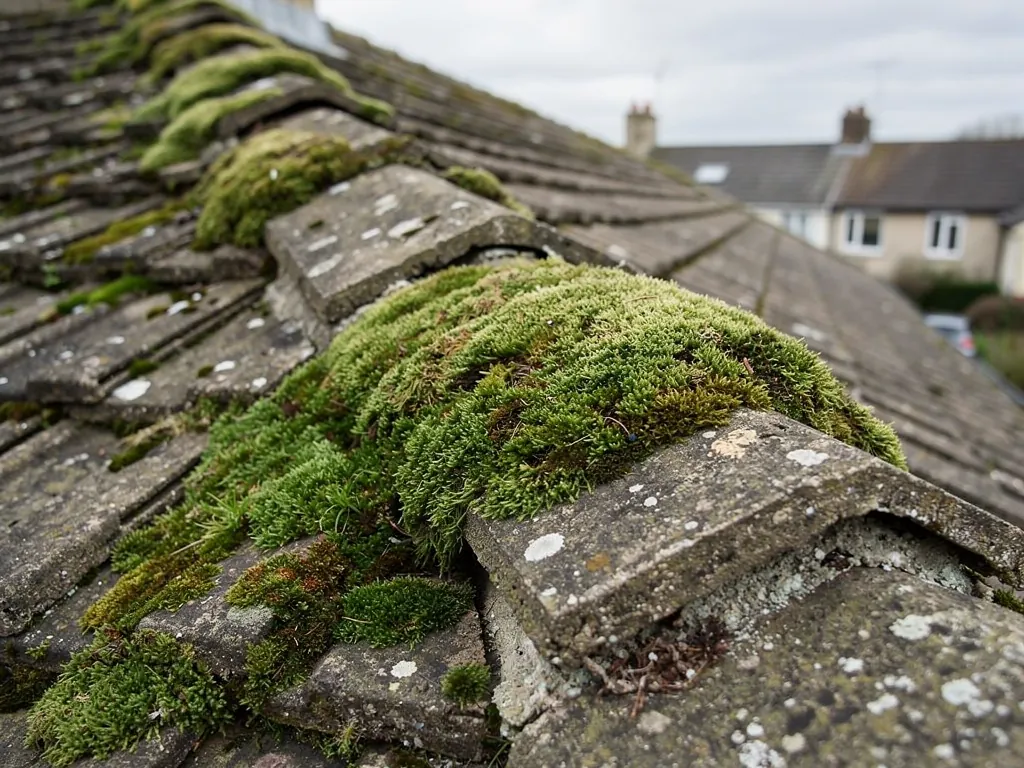
Blocked valleys, gutters and downpipes
Moss on its own is bad enough, but lumps of it that break away are a bigger problem. Moss dries out in summer and gets loosened by wind, birds and rain, and the pieces wash downhill into the valley and the gutter.
Every valley gathers the rain from both neighbouring slopes into a single narrow gutter of its own. A clump of moss lodged there narrows the channel, and then catches leaves and grit, until the water cannot get away fast enough in heavy rain. It then rides up over the edge of the valley lining and onto the roof timbers, so the ceiling stain you find is nowhere near where you would have looked. Our answer on what happens when a roof valley is blocked covers the effect.
Gutters suffer in a similar way. Moss, grit and the loose granules shed from concrete tiles collect in the gutter and form a compacted layer. Water then overflows at the front or, more damaging, backs up behind the gutter and wets the fascia boards and the head of the wall. A downpipe blocked with moss clots does the same job. See our guide to moss in gutters and the gutter cleaning guide in our gutters, soffits and fascias section.
One practical point: removing moss from the roof always sends debris towards the gutter, so a roof clean and a gutter clear are best done together. Cleaning the slope and leaving the gutter full only moves the problem a few feet.
Flat roofs and low pitches
Moss is not only a tiled-roof issue. Flat roofs and low-pitched coverings collect it too, and the effects are a little different.
On a flat roof covered in felt, EPDM or GRP, moss and algae grow where water sits. Standing water is a problem in its own right, and moss makes it worse by holding more of it and blocking the outlet. A mat sitting at the outlet can stop it draining altogether. Roots and spores can also settle into small splits in felt, and as the moss lifts it can open a split further. It is also slippery underfoot.
Flat roof coverings are not as tolerant of rough cleaning as a tile. Scraping with a hard tool can cut or gouge the membrane, and strong chemicals can affect some surfaces. The right approach is a gentle one, which our guide on flat roof cleaning describes.
Low-pitched tiled roofs
A tiled roof at the shallow end of its range sheds water more slowly, so it dries more slowly and gathers moss sooner. Lean-to roofs and porches are typical, as are roofs under overhanging trees.
Garages and outbuildings
Garage and shed roofs are often forgotten for years, and being lightly built they feel the extra wet weight sooner than a house does.
On any roof, check the outlet and the lower edge first.
When moss is cosmetic and can wait
None of this means every green patch needs removing. There are situations where leaving moss alone is a reasonable decision, and we would say so.
A thin, dry-looking covering of moss on the upper part of a south-facing slope is a low priority. It dries quickly, it is not in the laps or valleys, and it does not feed water towards anything vulnerable. A roof with sound tiles, a good underlay and clear gutters can carry a little moss for a long time. On a roof that is close to replacement anyway, spending on cleaning is rarely sensible.
What tips the balance towards action is a set of signs you can check yourself from the ground:
- moss mats thick enough to see from the pavement as raised cushions
- growth packed along the lower courses and in the valley
- green or brown debris in the gutters, or water spilling over the gutter edge in rain
- tile granules in the gutter or scattered on the path under the eaves
- tiles at the edge of a mat that appear lifted or tilted
A roof can be checked more safely from the ground, with binoculars if needed, than by climbing up. Please do not walk on a mossy roof: wet moss is as slippery as ice and the tiles can break underfoot.
If you are selling, moss is something buyers and surveyors notice. Our answer on roof cleaning before selling looks at what it signals to a buyer and whether a clean is worth doing first.
What to do about it and what it costs
If the signs above apply to your roof, the order of work is straightforward. Clear the moss and debris, treat what is left so it does not return quickly, then clear the gutters and look at anything the moss has been hiding. The choice of method depends on the covering, and our guide to roof moss removal methods weighs hand scraping, soft wash and steam against each other.
On cost, national guides give a rough idea. MyBuilder's roof cleaning guide, updated 21 August 2026, says cleaning typically starts from around £300, with pitched roofs at £450 to £850 and tile roofs at £400 to £750. What moves a particular quote is the size of the roof, the pitch, the height of the building and the access it needs, how heavy the growth is and the method chosen. Before accepting anything, find out whether the total covers VAT and scaffolding. Our guide to what roof cleaning costs goes through the factors.
The better question, as ever, is not the price of a clean but whether the clean is the right job. Once the moss is off, we can see the tiles. Sometimes that shows a roof that is sound and only needs the growth removed. Sometimes it shows cracked, lifted or failing tiles that a clean will not fix, and we would recommend the smallest repair that cures the fault instead of a bigger one.
To find out which applies to you, ask for a survey. It produces close-up photographs of your tiles, then a written quote, and the work itself is covered by our written 10-year workmanship guarantee. Ring 01793 626096 or message us on WhatsApp.