
Roof cleaning prices vary more than most people expect, and the reason is simple: the label covers very different jobs. One roofer scrapes moss off by hand and sweeps it into a bag. Another soft washes the whole slope with a treatment. A third brings hot water through a steam lance. Each takes a different time, uses different kit and suits a different kind of tile.
The figures below come from MyBuilder's published roof cleaning guide, updated on 21 August 2026. Treat them as national figures from a third party, never as a Skyline price list. We do not publish a price list for cleaning because the number depends on the particular roof, and the written quote follows our survey of it. What this guide gives you is a sense of the market, so a quote that lands far outside it prompts a question. The wider picture sits on our roof cleaning and moss removal page.
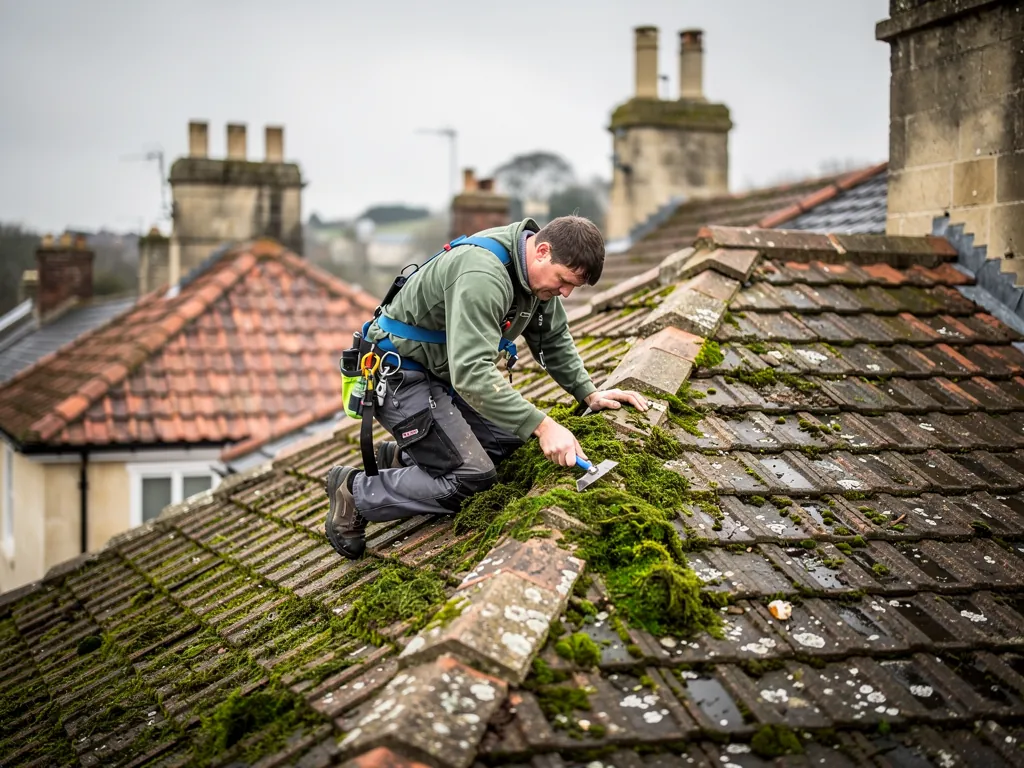
The headline range, by roof type
MyBuilder says moss removal and roof cleaning start from around £300. Its ranges by roof type are set out below, and they show a pattern worth noticing: flat roofs sit at the bottom, natural slate at the top.
| Roof type | Typical UK range |
|---|---|
| Flat roof | £300 to £600 |
| Pitched roof, general | £450 to £850 |
| Concrete or clay tile | £400 to £750 |
| Natural slate | £500 to £1,000 |
Source: MyBuilder roof cleaning cost guide, updated 21/08/2026.
Flat roofs cost least because there is less surface to treat, less risk of slipping and no ladders to move along a slope. Slate costs most because it is easier to damage and slower to work on. A slate has to be cleaned gently, and the person doing it often cannot stand on the slope freely, so the job takes longer for the same area.
The ranges are wide for a reason. MyBuilder is averaging across small garages, terraced houses and large detached roofs, and a single figure cannot describe all of them. Think of the band as a place to start the conversation about your own roof, not a price to expect.
Why is a pitched roof dearer than a flat one?
Height and steepness. A pitched roof needs safe access, edge protection on many houses and more time spent moving around. A bungalow with a low, accessible slope is often a simpler job than a three-storey Victorian terrace, even if the floor areas are similar.
Do these ranges include VAT?
The guide does not tie its ranges to a VAT position, so ask. A quote that leaves VAT out can read well below one that includes it. Whoever quotes, find out if the total takes in VAT and any scaffold hire.
The price by method, per square metre
The same MyBuilder guide gives rates by method, which is how many roofers think about the work. Again these are national typical figures.
| Method | Typical UK rate |
|---|---|
| Manual scraping and brushing | £5 to £10 per m² |
| Pressure washing | £10 to £15 per m² |
| Soft wash with treatment | £15 to £20 per m² |
| DOFF steam cleaning | £20 to £30 per m² |
Source: MyBuilder roof cleaning cost guide, updated 21/08/2026.
Read the table as a spread of effort and equipment. Scraping is mostly labour. Pressure washing adds a machine and water. Soft washing adds a treatment that has to be mixed and applied carefully. Steam cleaning, which uses hot water at gentler pressure, needs specialist equipment and so costs the most.
The lowest rate on paper is not always the lowest bill in the end. The same guide cautions that a jet wash may mark or damage fragile tiles. A tile stripped of its surface, or knocked out of place by a jet, is dearer to put right than the gap between two cleaning methods. Our guides on moss removal methods and pressure washing roofs explain what each one does to the covering.
What moves a price up or down
Two houses with the same roof area can attract quite different quotes. These are the things that account for the gap.
Access
A detached bungalow with a clear drive is one thing. A terrace with a narrow back alley, a roof that can only be reached over a neighbour's garden or a three-storey house needing a tower or scaffold is another. Scaffolding alone can change the arithmetic: MyBuilder lists around £850 to £1,200 for a typical two-storey house, with a chimney scaffold at height priced at £400 to £900. For a roof that needs it, the scaffold may be the largest single item in the total.
How bad the growth is
Light algae staining is quick to treat. A thick mat of moss packed into overlaps, valleys and behind chimneys takes much longer to lift. Heavy growth also tends to reveal more: slipped or broken tiles, perished pointing and blocked gutters all turn up once the roof is exposed.
Roof complexity
Valleys, dormers, chimney stacks, roof windows and solar panels all slow the work, because each needs careful hand work around it rather than a clean sweep along the slope. A plain gable is faster than a hipped roof with a dormer and a lean-to.
What is included afterwards
Clearing the gutters, taking the debris away and applying a treatment to slow regrowth can each be included or left out. The written quote should say clearly what is covered, so two prices can be compared on the same basis.
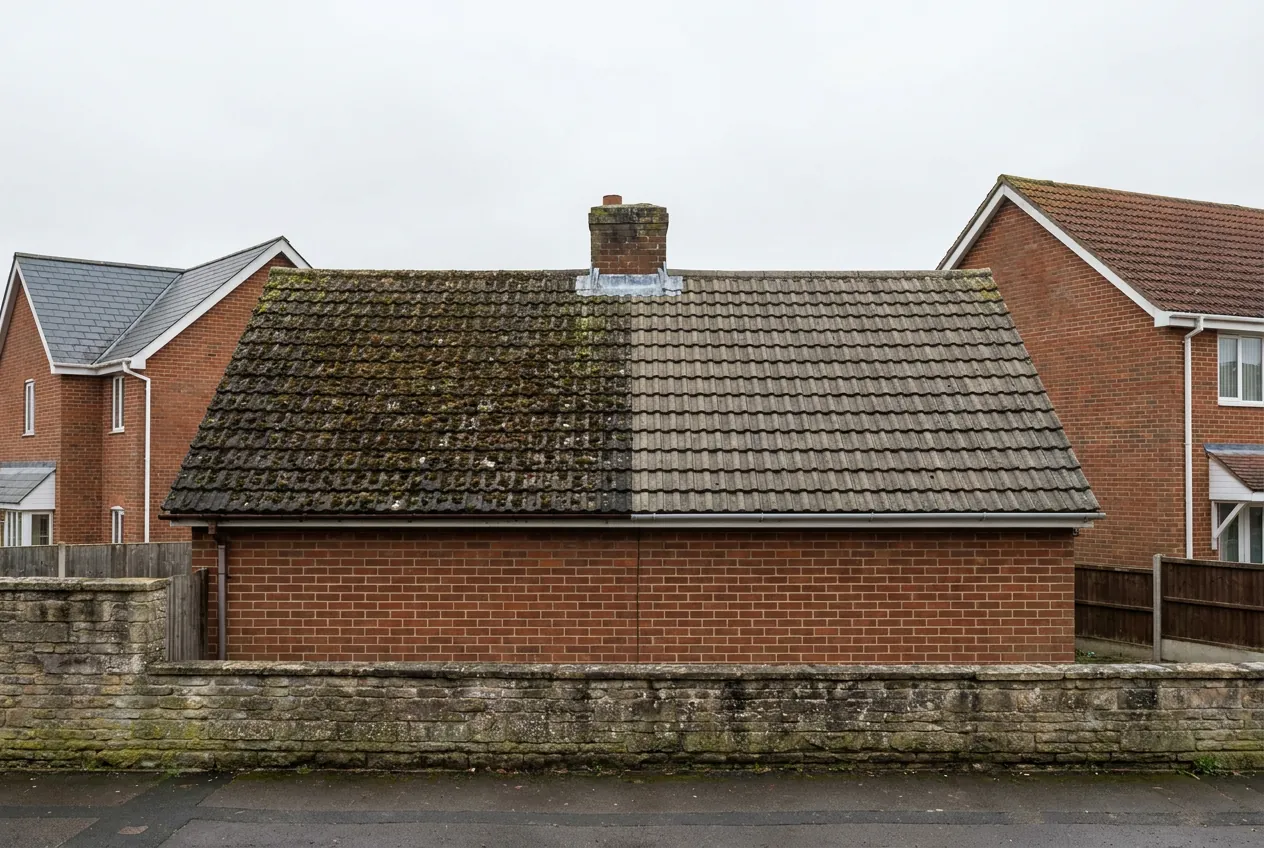
The cheap quote and what it may leave out
A rock-bottom figure for a roof clean deserves a closer read, and not because every low quote is a bad one. The point is to understand what the work involves before deciding. A few questions are worth putting to anyone who quotes.
- Is the quote a total, and does it include VAT?
- Is scaffolding or a tower included, or does the access come as an extra later?
- Which method will be used on my particular covering, and why?
- What happens to the moss and debris, and will the gutters be cleared?
- Is any treatment applied afterwards, and what aftercare does it need?
A roofer who quotes without seeing the roof is guessing. Moss hides cracks and slips, so a figure given over the phone can change on the day. That is one reason we survey first and send the survey photographs with the quote, so the numbers and the condition of the tiles are in front of you together.
If a quote for a clean is far below the published ranges, ask which method is being used and whether the roof will be walked on. Both affect whether the tiles come through undamaged.
Door-to-door offers to clean a roof "while we are in the area" deserve the same questions. A written quote you can study in your own time costs a day at most, and that day is rarely the difference between a sound roof and a failing one.
A worked example: turning the rates into a total
The per-square-metre rates and the headline ranges do not always line up, and seeing why helps when a quote arrives. Suppose, purely as an illustration, that 40 m² of a pitched roof needed treating. At the soft wash rate of £15 to £20 per m², that works out between £600 and £800. At the pressure wash rate of £10 to £15, it is £400 to £600. With manual scraping at £5 to £10, it is £200 to £400, though that is below the general starting point of around £300 for a job and shows how small areas tend to be priced on a minimum.
Now picture a larger roof, say 80 m². Soft washing at the same rate comes to £1,200 to £1,600, above the pitched range in the table. Neither figure is wrong. The headline ranges describe typical jobs, while a rate multiplied by area describes a particular one. Large roofs, steep roofs and heavily grown roofs sit outside the middle of the band.
What does that mean for my quote?
It means the useful question is not whether a figure falls inside a published range but what area, method and access it assumes. A written total that states the method and says what it covers can be tested against these rates in a minute. A total that states nothing cannot.
How do I know the area?
Roof area is larger than the footprint of the house, because the slope adds length, and an overhang adds more. We measure from the survey and say what we have used. If a quote does not say, ask.
Cleaning against the cost of leaving it
Moss is slow to do harm, which is why people put the job off. It holds water against tiles, lifts edges as it spreads, and sheds into gutters until they block. If you are weighing the cost of cleaning, the other side of the scale is what moss can do in the meantime. Our guide to whether moss damages roof tiles covers that in detail.
There is a second cost, which is the repair that follows when a blocked gutter overflows into a fascia, or when a tile cracks under the weight of wet growth. Those repairs depend on what the survey finds, and they are a different job from the clean itself. The sensible comparison is not cleaning versus nothing, it is cleaning on a sound roof versus cleaning after a fault has been left to grow. Where a repair is needed, we put forward the lightest repair that cures the fault, and any repair work we carry out comes with our 10-year workmanship guarantee in writing.
Will a clean be needed again?
On a shaded roof or one beneath trees, usually yes, in time. Cleaning removes what is there. It does not change the shade, the trees or the porous surface of the tile, which is why some roofs are cleaned and treated in cycles. A cost guide that quotes a single visit is describing the first clean, not the lifetime cost.
Cleaning cost and the insurance question
People sometimes ask whether an insurer will pay for roof cleaning or for damage that moss has caused. Cleaning is maintenance, and standard home policies commonly treat the cost of maintenance and gradual deterioration as the homeowner's own responsibility. That is general information rather than a view on any one policy, and no roofer can tell you how an insurer will respond.
If you are weighing a claim for damage that you think moss contributed to, read the policy wording and talk to your insurer first. The Financial Ombudsman Service explains how it looks at storm and wear and tear complaints on its website, and Which? has written about why insurers decline claims where a roof was poorly maintained. Our guide on moss damage and insurance goes through the questions to ask.
What you get from us is a clear record: survey photographs of the roof, a written quote and a note of what we found. Those are useful whatever you decide to do next, and they are worth keeping with the house paperwork.
Should I get more than one quote?
Yes. Two or three written quotes, each with the survey details behind them, show whether the gap is in the method, the access or the scope. Put the questions from the earlier section to each, and you will see the differences quickly.