
Pressure washing is the first thing many owners think of when a roof turns green. The patio came up like new, so why not the roof? The difference is that a patio is flat, solid and built to be wet. A roof is a layered, overlapping system designed to shed water downhill, and a jet aimed at it works against that design.
This does not mean pressure washing is always wrong. On some hard, sound coverings, in skilled hands and at a low setting, it can be done without harm. But the risks are real, they are not always visible on the day, and they tend to show up months or years later as flaking tiles, damp in the loft or moss that returns faster than before. This guide explains what happens to each covering, what to ask a contractor, and what to choose instead. The wider options are in our roof cleaning and moss removal section.
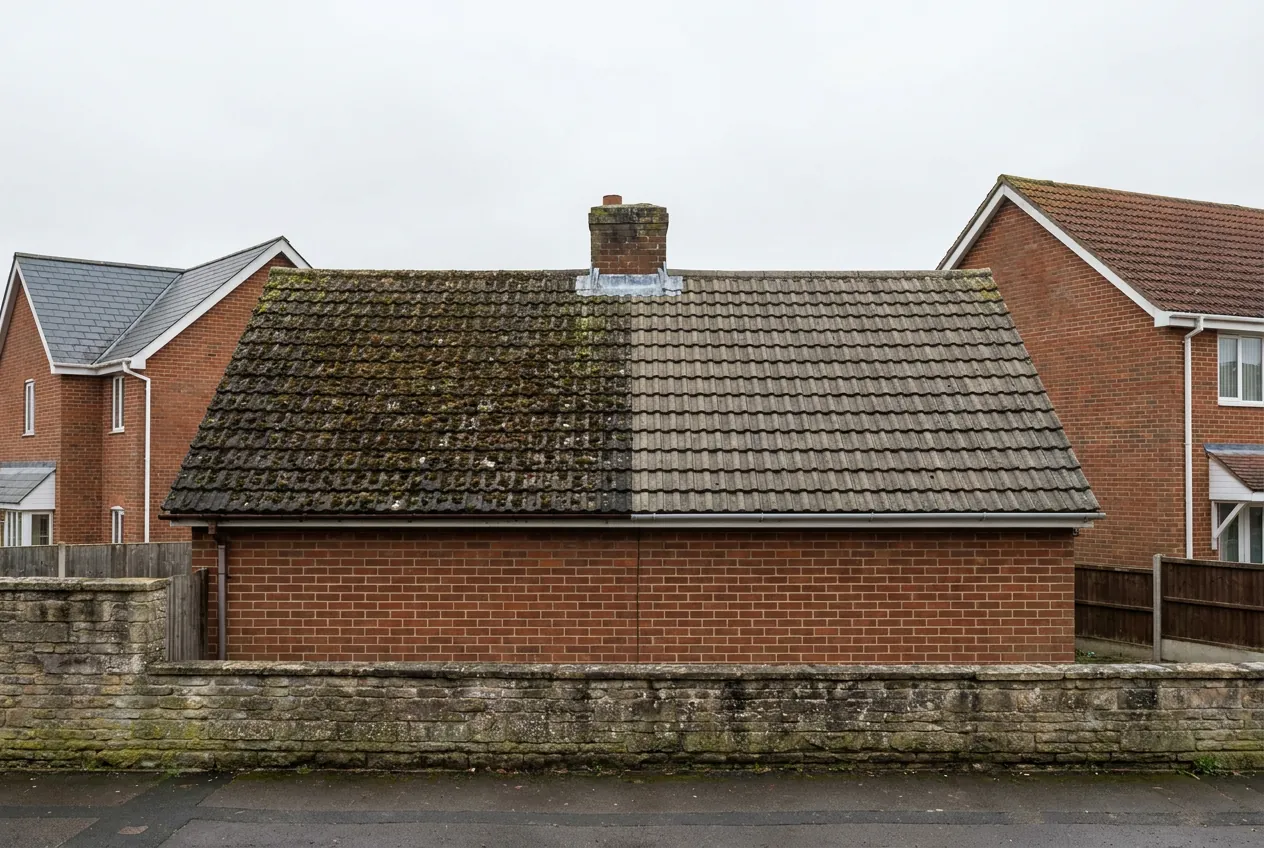
Why it is so tempting
The appeal is easy to understand. A pressure washer is cheap to hire, a firm with one can start the same week, and the result on the day looks dramatic: green roof going in, pale clean tiles coming out. It also feels like a thorough job, because the force is obvious.
That visible force is the problem. Moss is attached lightly and does not need much to lift it. The tile beneath, however, has its own surface, and the jet cannot tell the difference between growth and a coating. If the pressure is high enough to move stubborn lichen, it is high enough to move the face of a weathered tile.
There is also a mismatch between the tool and the structure. A roof covering sheds water because each tile overlaps the one below and the water runs down. A jet pointed upslope pushes water against that direction, up into the laps and under the tile, and onto the underlay and battens.
Price plays a part. MyBuilder's roof cleaning guide, updated 21 August 2026, puts pressure washing at £10 to £15 per m², cheaper than soft wash at £15 to £20 and DOFF steam cleaning at £20 to £30. The same page says pressure washing may damage delicate tiles. A lower price per square metre is the reason many people choose it, and a damaged covering is the reason some of them regret it.
The question to ask is not what it costs today but what it does to a covering you may have to live under for decades. Our guide to roof moss removal methods puts all four options side by side.
What the jet does to concrete tiles
Concrete tiles are the most common casualty. A concrete tile is made from sand and cement, and the colour you see is a thin surface layer applied during manufacture, which gives the tile its colour and some protection against weather. Over the years that layer wears down naturally, but it is still doing a job.
Stripping the face
A strong jet can blast that layer off in patches. What is left is the rougher, more porous body of the tile. It looks clean on the day, but it now soaks up more rain and offers more grip for the next round of moss and lichen. Owners often notice the roof going green again within a short time, and wonder why. The tiles have become a better home for growth than before.
Streaks, stripes and uneven colour
Pressure marks often show as pale tramlines where the jet passed. They can be seen from the street. Once the surface is stripped it cannot be put back, and a roof that has been patchily blasted may need a coating to even out the appearance, which is a cost you did not plan for.
Weathered tiles
A concrete tile that is already crumbling or has lost granules is more at risk. The jet can break the edge or crack the tile, and a cracked tile is a leak in waiting. If the roof is old, a survey before any cleaning method is chosen is the safer starting point.
Our guide to why moss grows on a roof explains why a roughened surface welcomes it back.
Clay, slate and stone slate
Harder coverings fare better, though none is immune.
Clay tiles
Fired clay is tough on the face and takes pressure more readily than concrete. The weakness is at the edges and on older tiles. Old handmade plain tiles can be thin, brittle and laminated in layers, and a jet can lift flakes from the edges or open hairline cracks that were holding together. Glazed or heavily textured clay can lose its finish where the nozzle lingers.
Natural slate
Slate is dense and smooth, and a light wash does it little harm. A strong jet, however, can split thin slates along their layers and drive water into the small gap at the head of each slate. Slates are also held by nails, often iron on an older roof, and a roof under pressure can lose slates that were only just holding. A roof that has slipped slates already should not be blasted.
Stone slate
Traditional stone slate is the most vulnerable. It is softer, thicker and laminated, and it is often hung on pegs or old nails. A pressure jet can flake the surface, strip the lichen and weathered patina that give the roof its look, and shake loose pegs and slates. It is also often protected, so check the cleaning method with the council first where the property carries a listing or sits in a conservation area. Our guide to cleaning listed roofs covers the questions.
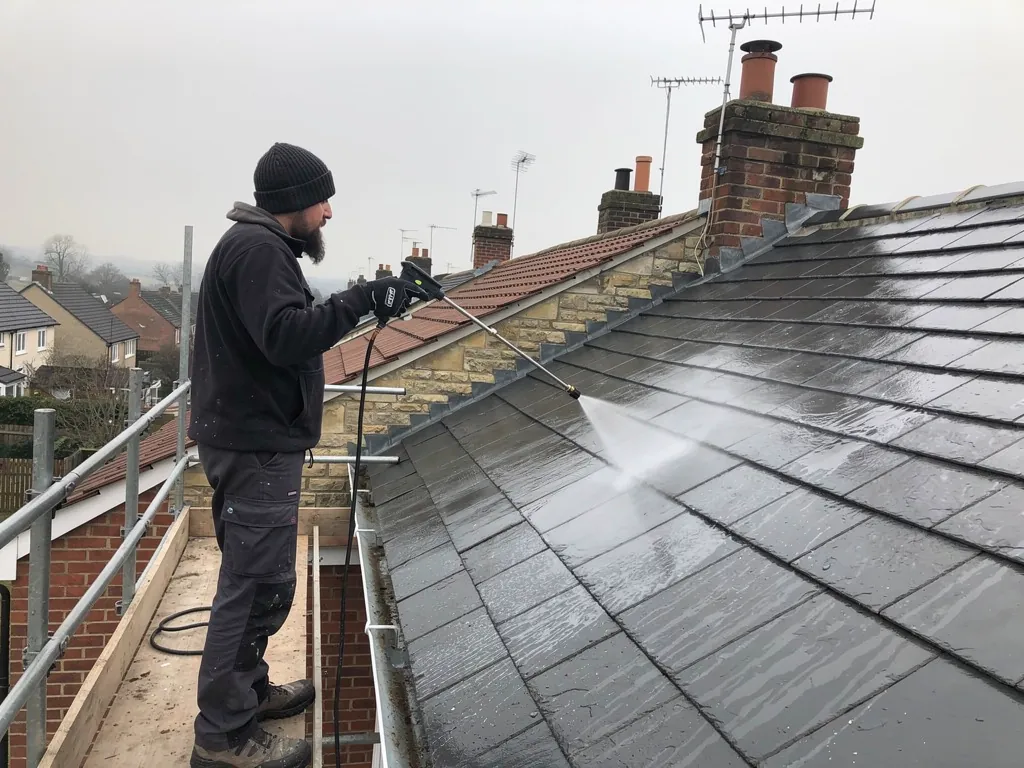
Water under the laps and into the roof space
Some of the worst damage is out of sight. A pressure jet pours water onto the roof very quickly, and angled upslope it is forced into every overlap between tiles.
Under the tiles sit battens, which hold the tiles, and the underlay, a membrane intended to catch the odd drop of wind-driven rain and let it run down. Modern breathable underlays cope with a bit of moisture. They are not built for a jet of water driven under the tiles by force. Old felt and roofs with no underlay are more exposed, since water goes straight through to the timbers and the loft.
The result can show up inside the house within hours: a brown stain across a bedroom ceiling the day after the clean, or drips in the loft. It can also show up later as staining, damp insulation and, if timbers stay wet, rot. When the leak appears after a roof has been washed, owners often assume the roof was already failing. Sometimes it was, and the water simply found the weak point. Sometimes the jet created it.
The loft is where the evidence lies. A competent contractor will check the roof space before and after, and tell you what they find. If you have a roof window or a tight eaves detail, the risk is higher still, because those details are designed to resist water falling downwards, not blasted upwards.
Flashings and pointing
Lead flashings, mortar fillets and pointing around chimneys and verges can also loosen under a jet. Mortar that was sound enough for years can be washed out, leaving gaps that were not there before.
Garage and shed roofs, and asbestos cement
Outbuildings need a separate warning, because their roofs are often different from the house.
Many older garages have corrugated or flat sheets of cement-based material. For a garage built or altered before 2000, HSE guidance is to presume it contains some. Asbestos cement is stable when intact, but it is a material that must not be blasted, scrubbed hard or broken up. A pressure jet can damage the weathered surface and break the sheet, and the dust and run-off then carry the problem to the ground, the gutter and the neighbouring garden.
Do not pressure wash a roof you suspect is asbestos cement, and do not allow anyone else to. HSE classes careful handling of cement sheeting as non-licensed work, yet substantial breakage makes it notifiable, so the time to find out is before cleaning begins. Asbestos waste from a household also has to be consigned properly, with a consignment note. We would want to identify the material first and talk through the options with you.
Felt shed and garage roofs are a different risk: the jet can lift the felt, tear the laps or drive water through nail holes. EPDM and GRP flat roofs can be cut by a concentrated stream. Our guide to flat roof cleaning describes the gentler way to deal with them.
If someone does want to pressure wash
You may be offered pressure washing by a firm that uses it carefully, and on some hard coverings that can be reasonable. Here is how to tell a careful operator from a careless one.
Ask what pressure they use and what nozzle. A fan nozzle held well back from the surface, at low pressure and angled downslope, is very different from a pencil jet held close. Ask what direction they work in: always downslope, never upslope into the laps. Ask how they protect the roof space, windows and roof lights, and what they will do about the gutters, which will fill with debris.
Ask what the covering is and what condition it is in. A contractor who has not looked at your tiles cannot know whether they will survive. Ask whether the moss will be treated afterwards, since a blast without treatment leaves the roots and spores in place, and moss will return.
A sensible quote names the pressure, the nozzle and the direction of work, and says how the roof space will be protected. If it names only a price per square metre, ask for more.
You can also ask for photographs before and after, taken close up on a sample patch. Work on one small area first. If the tile face changes colour or loses grit on the test patch, stop.
Gutter clearance is part of any clean. All the loosened growth ends up in the gutter, so it should be cleared at the same visit.
Gentler routes and the next step
For nearly every roof there is a way to get the moss off without a high-pressure jet, and it often costs more per square metre and less once the years are counted.
Hand scraping and brushing removes thick growth with precise control and lets the roofer inspect every tile as they go. A soft wash with a biocide kills the growth at low pressure and keeps working for weeks; our guide on soft washing and biocide treatments explains the process. Steam cleaning loosens growth with heat and a light rinse, which suits fragile and historic coverings. Each is described, with typical costs, in the methods guide linked above.
If you are tempted to do the job yourself with a hired washer, please think twice. Working on a roof is dangerous, wet moss is slippery, and tiles break under a boot. Our guide to DIY moss removal explains the risks and the few jobs that can be done safely from the ground.
The decision is easier with the facts about your own roof. A survey gives you photographs of the tiles, the valleys and the lead, and a written quote naming the method and the access. The aim is a modest fix that cures the fault, which may be a gentle clean, a repair or nothing at all. Anything we do carries our written 10-year workmanship guarantee.
Ring 01793 626096 or use WhatsApp when you want the roof looked at.