
Listing protects a building's character as a whole, and the roof usually carries much of it. Old slates, hand-made clay tiles and split stone all carry marks of their making, and a clean that strips those surfaces cannot be undone. That is why the usual shortcuts for dirty roofs, a pressure jet or a harsh chemical wash, do not belong anywhere near a listed roof.
The legal side deserves equal care. Whether a clean needs listed building consent depends on what is being done and what it does to the building's character, and the body that decides is the council, not the contractor. This guide sets out the gentle methods we use on old roofs, the questions to put to the council, and the situations where cleaning should stop and a conservation specialist be called. Our wider roof cleaning and moss removal page covers the ordinary jobs.
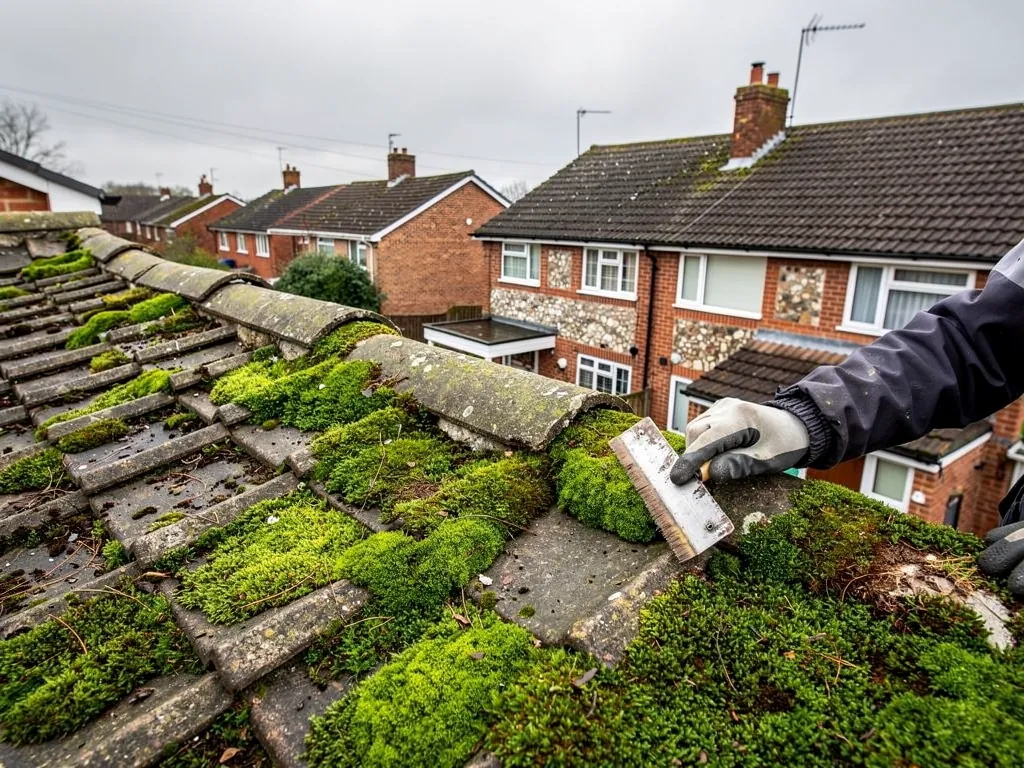
Does cleaning a listed roof need consent?
Section 7 of the 1990 Act on listed buildings forbids unauthorised works to a listed building when they affect its historic or architectural character, and section 9 makes breaching that an offence.
Whether routine cleaning counts is not a question a contractor can settle for you. Brushing off loose moss with a soft tool may sit comfortably within ordinary maintenance. Anything that changes the surface or appearance of the roof is a different matter: coatings, chemical treatments that alter colour, stripping lichen from historic stone or replacing damaged material with something new. The safe route is to put the question to the conservation officers first and keep the reply in writing.
Who do I ask in Swindon?
Swindon Borough Council publishes its conservation area information online, and its page lists the team's email address for enquiries. Check with Swindon Borough Council's conservation area pages for the current contact. In neighbouring districts, the equivalent council department makes the decision, so the same principle applies in Wiltshire, the Vale of White Horse, Cotswold District and West Berkshire.
Listing, conservation areas and Article 4 directions are different things
People often use "listed" for any old building in a protected street. In fact there are several layers, and each changes the answer.
A listed building is individually protected, inside and out. A conservation area protects the character of a whole district, and adds controls over demolition, trees and some external works, yet it does not by itself put every roof job under consent. A like-for-like re-roof seldom calls for planning permission, but listed buildings and Article 4 areas are the caveats. Under an Article 4 direction the council withdraws chosen permitted development rights over a set area, so jobs that are normally free may need an application.
Swindon has all three. The council lists 27 conservation areas on its page, and notes Article 4 directions for Bishopstone and the Railway Village. In the Railway Village the council's appraisal describes roofs that are generally slate and says that aerials and satellite dishes on roofs and chimneys will be resisted. It also records that the Article 4 direction there adopted in 1980 covers matters such as painting the exterior and alterations, and the 1980 leaflet adds that most of the properties there are listed.
What about churches and chapels?
Churches still in use can fall under the ecclesiastical exemption, but only for five denominations: the Church of England, with its faculty system, and then the Roman Catholics, Methodists, the Baptist Union and the URC. Quaker and Unitarian buildings sit outside it, and a church that has stopped holding services loses the exemption and needs listed building consent. For a scheduled monument, a separate scheduled monument consent applies. If your roof falls into any of these categories, tell us at the start.
What gentle cleaning means on an old roof
The principle is to remove the minimum that needs removing, with the least force that does the job. On a historic roof, that usually means dry or lightly damp work by hand rather than a wash.
What do you use instead of a pressure jet?
Soft brushes, wooden or plastic scrapers and hand removal for thick moss, working from the ridge downward in a way that does not drag debris under laps. A pressure jet drives water under slates and tiles, removes the soft outer face of weathered stone and clay, and strips the patina that tells you the roof is old. MyBuilder's cleaning guide flags the risk to delicate tiles from pressure washing. A handmade tile or ancient stone slate fits that description.
Is low-pressure washing ever acceptable?
Sometimes. Water at low pressure, applied with a soft brush, can lift algae and dirt from sound slate without harming it. We use it sparingly and watch how the surface responds. If the face of a tile or slate is powdery, flaking or laminating, we stop; the roof is telling us it is too fragile for anything beyond a brush.
Hot-water methods are sometimes suggested as gentle. They can be, but heat and moisture still stress old materials, and the lack of chemicals does not make the method harmless on a brittle surface. Our page on DOFF steam roof cleaning explains what the method does, and why on a listed roof we would want the council's view first.
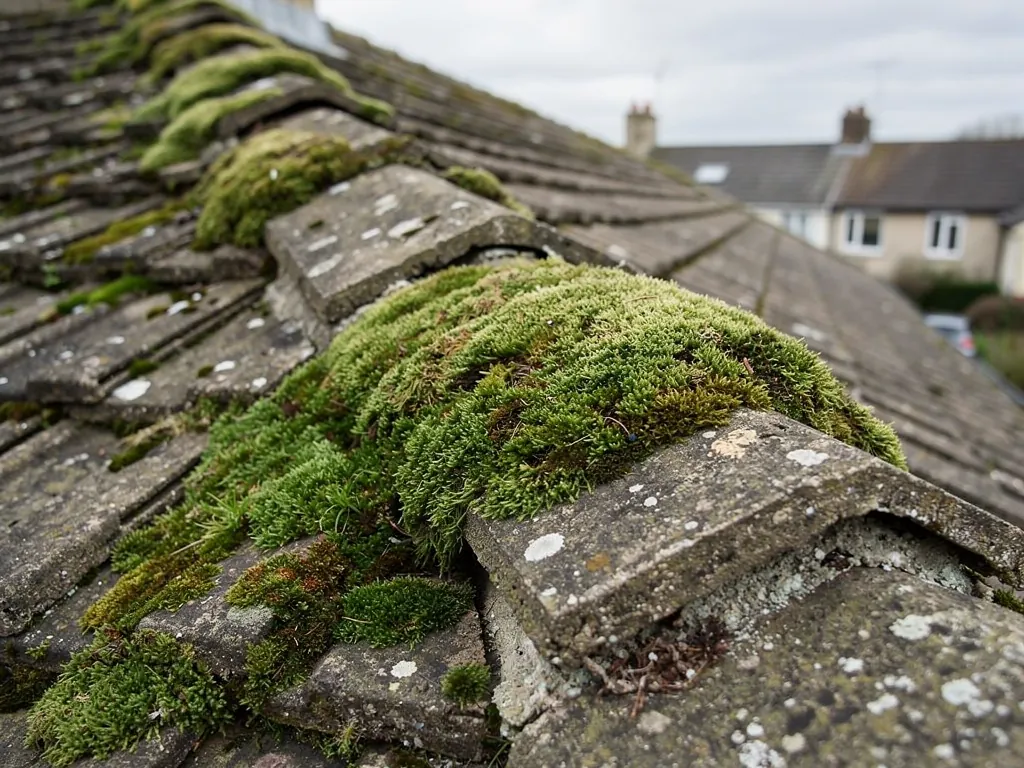
Slate, clay and stone each need a different touch
A listed roof is rarely modern concrete. The covering tells us which approach to take.
Natural slate. Good slate is dense and tough, but old slates are held by nails that may have rusted thin, and a slate can look sound while hanging by a thread. Walking or kneeling on them can crack them, so we rely on roof ladders and crawl boards and handle each slate as little as we can. In Swindon's Railway Village the roofs are described by the council as generally slate, which makes this the covering many local listed owners will have.
Handmade clay. Clay plain tiles and pantiles can be soft on the surface and frost-damaged beneath it. Cleaning them is mostly a matter of brushing, with moss lifted rather than scoured away.
Stone slate. Cotswold-style stone slate roofs, found towards the Cotswold edge of our area, are heavy, and the stones shrink course by course from eaves to ridge (diminishing courses). Cotswold District Council's traditional guidance claims that yearly scraping can double a stone roof's life, which reflects how seriously old roofers took moss on stone. It also says that the stones are held by pegs, often oak, hung over battens, and a rough hand can snap them. We work with a light touch, and our Cotswold stone roofing page covers repair and relaying.
Never swap stone for stone. Council guidance reproducing English Heritage policy says sandstone and limestone slates should not be substituted for each other or mixed.
Moss, lichen and when to leave a roof alone
Not all growth is a problem. A thin film of lichen on stone or old tile can be harmless, and removing it from a historic surface may change its appearance more than the lichen ever did. Moss is different because it holds water against the roof and can lift edges, block gutters and keep a surface permanently damp.
Should lichen come off a listed roof?
Often it should stay. Lichen grows slowly, clings to the surface rather than rooting into it, and is part of the weathered look of many historic roofs. The question is whether it is causing harm, such as blocking a drip edge. Our guide on lichen on roof tiles sets out when removal is worth doing. On a listed building, removing lichen is exactly the type of decision to run past the conservation officer.
What about chemicals?
Biocides and moss killers run off the roof into gutters, soak into masonry below and can discolour stone and brick. Some leave a stain for months. On a historic roof we would only consider a treatment if it is gentle, tested on a small area first and agreed with the council. Coatings and sealants that change how a roof looks or breathes are a separate and much bigger question, covered in our guide to roof coatings on houses.
Sometimes the best answer is no cleaning at all. Where the covering is sound and the moss thin, a better use of money may be clearing gutters and valleys and putting any repairs in order, which is the real work of keeping an old building dry.
Access, protection and the building around the roof
Listed buildings often have awkward access: steep pitches, high eaves, narrow lanes, delicate boundary walls and gardens that deserve care. Scaffolding is sometimes the only safe way to reach an old roof, and where it stands against a listed facade, it has to be put up without damaging the stonework or rendered finish. A scaffold licence may be needed in a street, and cost rises accordingly. Ask every contractor whether their price covers scaffolding.
Run-off needs attention too. Water, loosened moss and treatment residue should not be left to wash down historic masonry, and lime mortar is soft enough to be stained or eroded by a careless wash. We protect walls and plants below, clear debris as we go and take it away.
Can a conservatory or lean-to on a listed building be cleaned the same way?
Not necessarily. A later glazed or polycarbonate extension is not the same material as the historic roof and may be cleaned differently, though it still sits within a listed property's curtilage. Our answer on cleaning a conservatory roof safely covers the practical side.
Wildlife is another consideration. Old roofs and chimneys are favoured by nesting birds, and bats are protected too. If we see signs of either, work stops until the right course of action is clear.
What a visit to a listed roof involves
A survey comes first. You receive photographs of the roof and then a written quote. Because the building is listed, the survey also asks what the roof is made of, what condition it is in and whether anything about the job might need the council's agreement. Nothing starts on a listed building until any answer the council needs to give is in your hands.
The survey often finds more than moss. Slipped slates, failing mortar at the verge, perished lead and cracked pegs show up as soon as the cover is cleared. We steer towards the smallest repair that genuinely deals with the defect, which on a listed roof often means careful repair of what is there rather than renewal. The cost of cleaning depends on roof size, height, access and how much growth there is, and the figure comes as one total after the survey. MyBuilder's guide, updated 21 August 2026, gives £450 to £850 as typical for cleaning a pitched roof, but a listed roof needing hand work and special access will not follow an average.
If a notification is due, we set out the Building Regulations position and file it. Our workmanship carries a 10-year guarantee in writing. And since timing matters on delicate roofs, our guide to the best time of year to remove roof moss will help you choose a window.