
You will see "steam cleaning" offered for roofs, and the name is a little loose. DOFF is a brand of hot-water cleaning equipment, and the roofing trade uses its name for the method: water heated far above what a domestic tap delivers, applied at gentle pressure through a wand. The heat does much of the work that force does in a pressure wash, which is why the method is popular for fragile coverings.
That reputation is partly earned and partly marketing. The method has real advantages on old and delicate roofs, and real limits around seams, damaged tiles and regrowth. This guide explains what happens on the roof, which materials suit it, what national guides say it costs, and how it compares with the alternatives. For the general picture, start with our roof cleaning and moss removal page.
What DOFF cleaning actually is
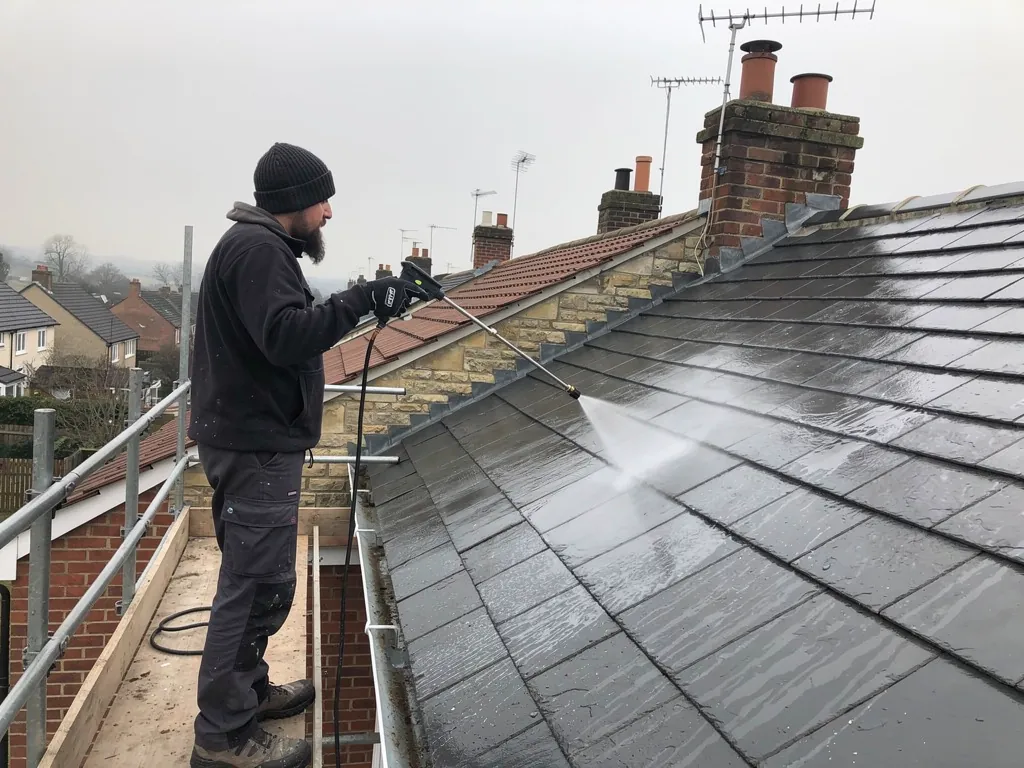
A DOFF machine heats water in a boiler and delivers it through a hose to a wand with a fan-shaped or rotating nozzle. The water leaves the nozzle very hot but at much lower pressure than a standard jet washer, so it behaves more like a rinse than a blast. Despite the nickname, what reaches the roof is hot water, not dry steam.
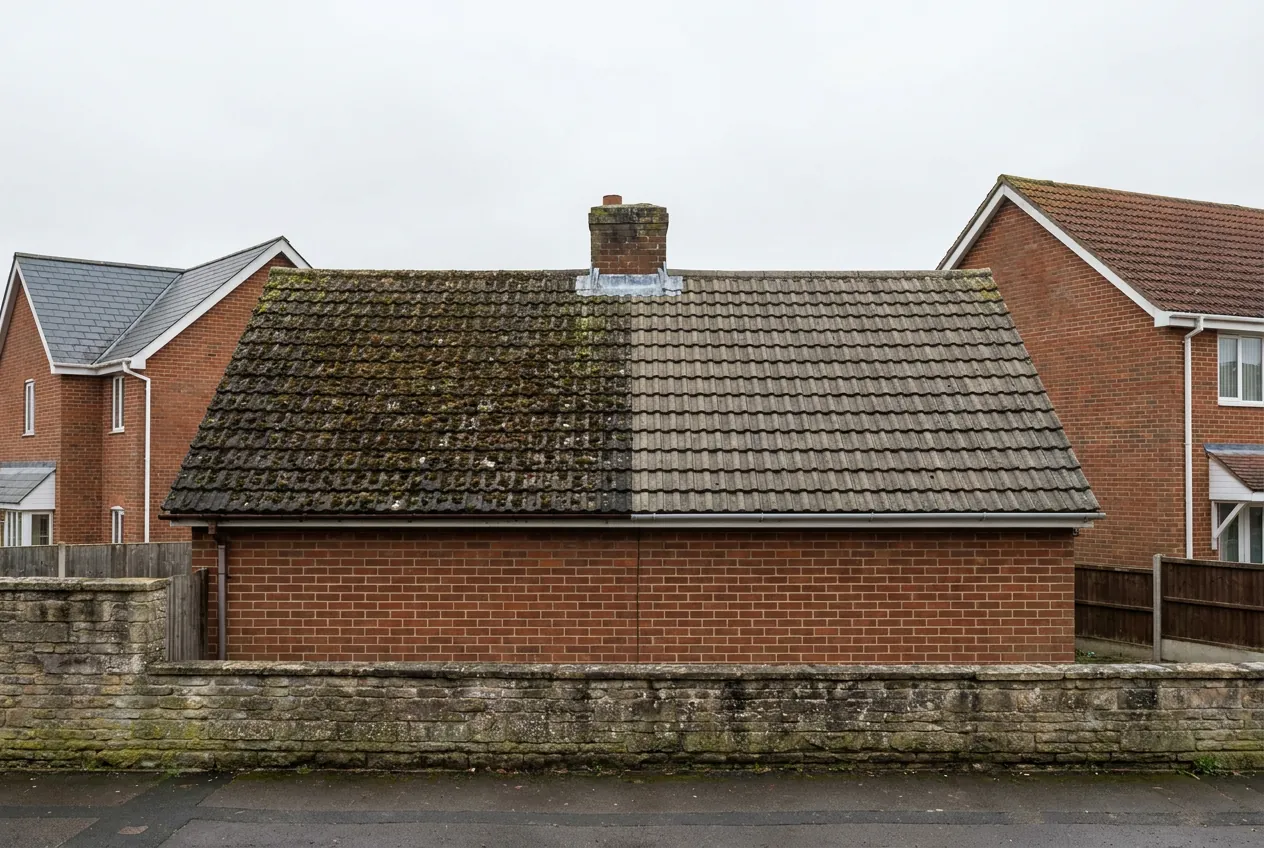
Heat is the working ingredient. Moss, algae and lichen are living organisms with soft tissue, and hot water breaks that tissue down and loosens its grip on the surface. The operator then moves the wand across the roof, usually from the ridge downward, so that loosened growth is carried along with the water into the gutter. The rest is rinsed off in the same pass.
Is it really chemical-free?
The cleaning itself needs no chemical. That is a genuine point in its favour for roofs that drain onto planted borders, ponds or a neighbour's greenhouse. Some firms add a treatment afterwards to slow regrowth, which is a separate step with its own considerations. Our guide to whether moss damages roof tiles explains why clearing the growth matters in the first place.
Where it works well
The method suits coverings that do not tolerate force. Natural slate is the classic case: it is dense but its edges are thin, and a hard jet can drive water under laps or chip the surface. Clay tiles, handmade tiles with soft faces and old concrete tiles that have lost their top coat all benefit from a gentler approach.
It also suits roofs where growth is thick or embedded. Lichen in particular, which clings tightly and is slow to lift, tends to respond better to heat than to brushing alone. On a shaded north slope with a deep mat of moss, hot water softens the growth so that it can be lifted without scraping the surface beneath.
The low pressure is helpful near other delicate details too: pointing under the ridge, the edges of verges, flaunching around a chimney and the seals around roof windows. These are the places where a pressure jet does the most harm, and where a gentler method lowers the odds of causing a leak while trying to prevent one.
Does it suit listed or heritage roofs?
Sometimes. It is gentler than a jet, yet old, brittle material can still be strained by heat and wet, and a listed building needs the council to confirm what may be done. Our guide to cleaning the roof of a listed building sets out the consent questions.
Concrete tiles deserve a mention. Plenty of newer houses carry them, and they come in for moss because their surface is rougher than clay. Hot water lifts growth from that texture without stripping the coloured top layer, which a jet can do. Where a concrete tile has already lost its colour coat and turned chalky, there is little left to protect, but the tile itself remains sound enough for a careful clean.
Where it does not suit, and what can go wrong
No method is right for every roof, and hot water has its own risks.
On flat roofs, hot water near seams, laps and upstands can soften adhesives and lift edges. Felt, EPDM and GRP each need individual treatment, and many flat roofs are better cleaned with a soft brush and cool water. Our guide to flat roof cleaning goes through each covering.
Damaged or porous tiles are another concern. Where a tile is cracked, delaminating or soft on the face, any water, hot or cold, can get in and, in winter, freeze. A gentle method does not make a failing tile sound. Equally, a roof with no underlay, which is common on older Victorian slate roofs, can let water through gaps once it is disturbed, so the loft beneath is checked before and after.
Hot water also has a safety side. Operators work at height with a hose and a hot wand, in conditions that can make the surface slippery. Water that runs onto a path or patio below should be managed, and it is sensible to move cars and garden furniture and close the windows. We also check overhead cables, glazing and solar equipment before starting.
Hot-water cleaning removes growth. It does not repair slipped slates, failed pointing or worn nail fixings, and it can expose those faults once the moss has gone.
How it compares with other methods
Cleaning methods sit on a spectrum from force to chemistry, and DOFF falls in between.
Pressure washing
A jet uses force to blast growth away. It is quick, and on tough surfaces it can work, but it also strips surface granules from concrete tiles, drives water under slates, and can remove the protective face from clay. The MyBuilder cleaning guide says it may harm delicate tiles.
Soft washing and biocide
Soft washing applies a chemical wash at low pressure and lets it kill the growth over days or weeks, after which rain brings it down. It is gentler on the surface than a jet and is often cheaper than hot water, but it depends on chemistry and the weather. Our page on soft wash and biocide compares the two approaches in more depth.
Manual removal
Scraping and brushing by hand suits light growth and gives the operator close contact with the roof. It is labour-intensive on big roofs, and a scraper that digs in can damage a surface. In practice many jobs combine methods: a hand pass to remove the thickest growth, then hot water or a soft wash for what remains.
The right choice turns on the covering, the thickness of the growth and the surroundings. Our survey picks the method for the roof, rather than the roof for the machine.
What DOFF cleaning costs
MyBuilder's roof cleaning price guide, updated 21 August 2026, quotes typical rates by method. It gives manual scraping at £5 to £10 per m², pressure washing at £10 to £15, soft wash at £15 to £20, and DOFF at £20 to £30. Those are national figures from one guide, not Skyline prices, and a guide of this kind averages many jobs.
The pattern is worth noticing: the gentler methods cost more per square metre because they take longer, need more equipment and demand more care from the operator. On the same guide, whole-roof cleaning is quoted at £450 to £850 for pitched roofs, with slate towards the upper end.
What pushes a DOFF quote up or down?
Roof area is the starting point. After that come pitch and height, which decide how the operator is held safely; access, which may mean scaffolding or a tower where a ladder is not enough; and how thick the growth is. Water supply matters too, since the machine needs a good flow and a tap within reach. Extras like gutter clearing, moss collection and a treatment to slow regrowth all affect the price.
After the survey, one total price arrives in writing. Whoever else you ask, ask whether their figure includes VAT and scaffolding, since that can shift the comparison a good deal. And treat very low quotes with caution; a method that takes time cannot be done well in a hurry.
Will the moss come back?
Yes, given time. Removing moss does not change the conditions that grew it. A shaded slope under a tree, a damp north-facing pitch and a porous tile all invite regrowth, and hot water cleaning does not alter any of that. Some people hope that heat will sterilise the roof and prevent regrowth. It removes the growth that is there; it does not prevent spores landing later.
How quickly the roof greens again varies enormously. It depends on how much shade and moisture the roof sees, the tile surface, and any steps taken afterwards. A treatment applied after cleaning can slow regrowth, though the effect has limits. Metal strips along the ridge are another option, and our answer on whether zinc strips stop roof moss covers their strengths and limits.
What should I make of a moss-free guarantee?
Read the wording before the headline. A promise that a roof will stay moss-free for years rests on conditions that nobody controls: the weather, the trees and the neighbours. Our page on what a moss-free guarantee really means shows how to read one. What we guarantee in writing is our own workmanship for ten years, not the sky above your roof.
Timing, preparation and aftercare
Hot-water cleaning needs a safe, dry-ish day. Frost, ice and strong wind all rule it out, and rain makes the roof slippery and the work harder to judge. Our guide to the best time of year to remove roof moss covers how the seasons affect the choice.
What do I need to do beforehand?
Make sure we can reach an outside tap or tell us if there is none. Move cars, bins, garden furniture and washing out of the splash zone, and close windows. Tell us about any known leaks, loose tiles or cracked slates, and about neighbours' boundaries, because a roof wash can send water, moss and debris into places you may not expect.
What happens afterwards?
Once the growth is off, we clear the gutters and the debris, check the roof visually and photograph anything that needs attention. A freshly cleaned roof shows slipped slates, cracked tiles and crumbling pointing clearly. Photographs of them accompany any written quote for repairs, and our advice is to do just enough for the fault, so two replacement slates never become a whole new covering. Our site is left clear and waste is taken away.
After that, the best aftercare is simple: keep gutters flowing, cut back branches that shade the slope, and look at the roof from the ground after the autumn leaves have fallen.