
Cleaning the flat roof on a garage, a back extension or a dormer looks like a simple job: it is flat, it is low, and it is covered in green. That impression is what gets coverings ruined. The waterproof layer on most flat roofs is only a few millimetres thick, and a jet washer, a stiff brush or the wrong chemical can cut it, strip its surface or lift its seams in a single afternoon.
What follows covers the three coverings we meet most often, which are bitumen felt, EPDM rubber and GRP fibreglass, and what each one will and will not put up with. It also covers the problem that often sits behind the green: water that does not drain. If you are weighing up a clean against other work, our flat roofing page sets out the choices, and the wider roof cleaning and moss removal service covers the rest.
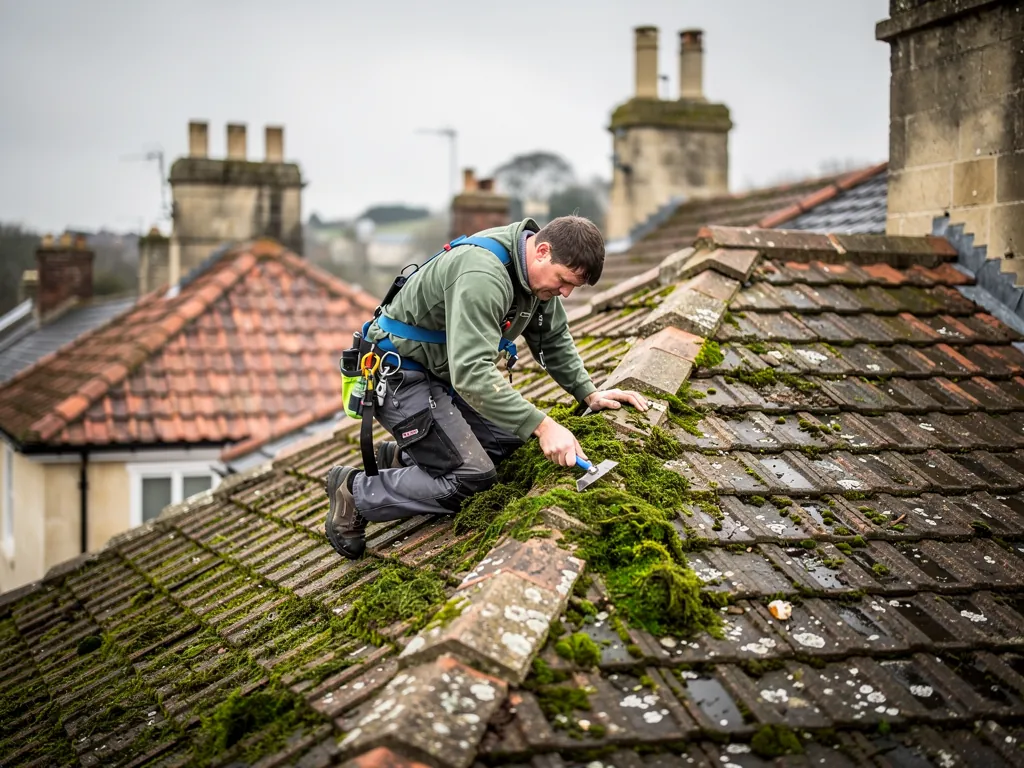
Why flat roofs grow things, and why it matters
A flat roof is not truly flat. It is laid to a slight fall so that rain runs to an outlet, gutter or drainage channel. Even so, water stays on it longer than on a pitched slope, and every shallow dip, lap and corner holds a film of moisture. Add the dust, pollen and leaf litter that settle on a low roof and you have exactly what algae, lichen and moss like.
Green growth on a flat roof is rarely a cosmetic issue alone. Moss keeps seams permanently damp by holding water on the surface. Roots and rhizoids can work into the edges of laps, and leaves and silt can block outlets, so a roof that should drain in an hour stays wet for days. Standing water works on any weakness in the covering, and freezes in winter.
Is ponding the same as moss?
No, but they feed each other. Ponding is water lying on the roof for a long period after rain, commonly a result of too little fall or a deck that has dipped. Moss grows in the pond, and the moss then slows the drainage further. Guidance for flat roofs recommends a minimum finished fall of 1:80, designed at 1:40 to leave room for tolerances and deflection. A roof that ponds badly is telling you about the structure, not just the surface.
Bitumen felt and torch-on
Felt roofs are the most common on older garages and extensions. Modern torch-on systems are built up in layers, with a mineral-chipped or granulated cap sheet on top that protects the bitumen from sunlight. That protective top surface is what a careless clean destroys.
Pressure washing is the usual culprit. A jet strips the granules, exposes the bitumen to the sun and leaves a roof that ages visibly within a few seasons. The cleaning guide at MyBuilder cautions that pressure washing may harm delicate tiles, and bitumen felt is no tougher, and a felt roof is exactly that. Hard brushing has a similar effect. On felt we use soft brushes and low-pressure washing, and we treat the surface gently around laps and upstands.
Age matters as much as method. Typical lifespans quoted for torch-on felt run from about 10 to 20 years, according to Less, with a good job lasting at the upper end and a poor one failing earlier. If the felt is blistered, splitting or thin, cleaning will not rescue it, and we will tell you that straight. Our survey photographs show what is happening, and a patch or a new covering may be the more honest recommendation than a clean.
EPDM rubber membranes
EPDM, a synthetic rubber, comes as one large sheet that is glued down at the edges. It is tough and flexible, and it tolerates a lot, but it has its own rules. Typical service life is quoted at around 20 to 30 years or more, depending on the source.
EPDM does not like solvents, petrol-based products and some oils, which can swell or soften the rubber. It is also vulnerable to sharp tools: a scraper, a stiff steel brush or a dropped hand tool can nick the sheet, and a nick is a leak waiting for a wet day. Edges, corners and the glued seams at upstands are the places where cleaning pressure does the most harm.
Our usual approach is a soft brush with water and a mild, membrane-safe cleaner, working with the fall of the roof so loosened dirt runs to the outlet and not into the laps. Where a manufacturer has published care instructions for its membrane, we follow them over our own habits. We also keep to the walkways or lay boards, so that feet and kneepads do not grind grit into the surface.
Can I use bleach or a moss killer on EPDM?
We would not use household bleach on any membrane without checking the product data first. Strong chemicals can discolour or degrade the surface, and run-off can harm planting and stain walls. A moss treatment suitable for the specific membrane is a different matter, and we choose with the covering in mind. Our guide to whether moss damages roof tiles looks at the same question on pitched roofs.
GRP fibreglass
GRP stands for glass-reinforced plastic. It forms a hard shell: layers of fibreglass matting set in resin, finished with a topcoat that gives the roof its colour and gloss. Typical lifespans quoted run from about 25 to 40 years. It is one continuous shell and strong, which is why it is popular on small extensions and dormers, and also why people assume it can take any amount of scrubbing.
The topcoat is the weak point. Abrasive pads, hard brushes and aggressive chemicals scratch or dull it, and once the gelcoat is worn the glass fibres beneath are exposed to water and sun. A scratched GRP roof can start to craze, chalk or let moisture into the laminate.
We clean GRP with a soft brush, clean water and a gentle cleaner, and we look closely at the surface as we go. Cracks at the edge trims, fine crazing across the field and softness underfoot all point to a roof close to retirement. A cracked GRP roof cannot be cleaned into health, but it can sometimes be repaired or re-coated if the laminate is sound.
Never use a wire brush, a scraper or a hard bristle brush on GRP or EPDM. Once the surface is cut or scratched, cleaning has become damage.
How a careful flat roof clean is done
The order of work matters more than any single tool. We start with the roof's edges and outlets, because that is where water leaves and where blockages do harm. Loose litter, leaves and silt are lifted by hand and bagged, not washed into the drain. Gutter outlets, rainwater heads and any overflow pipes are checked and cleared so the roof is not left to flood while it is wet.
What method do you use on the surface itself?
The answer turns on the covering and its condition. For light algae and dirt, a soft brush and low-pressure water is often enough. For moss, we loosen it by hand or with a soft tool and rinse it away, then treat the surface if the covering allows. Hot-water methods can be gentle on some coverings, but they have to be used with care around seams, which our guide to DOFF steam roof cleaning discusses.
What if the deck is too weak to stand on?
Many flat roofs were never meant for foot traffic, and old decks can be soft. We use crawler boards to spread load, check the deck before committing weight, and work from the edge where we can. If the structure feels spongy, cleaning stops and the survey turns to repair.
Finally we look over the whole surface. A cleaned roof shows every defect it was hiding: pinholes, failed upstands, cracked mastic, lifted laps and open seams. Anything we find is photographed, so the next decision is yours once you have seen the photographs.
Roof lights, upstands and the details around the edge
Most flat roof leaks begin at a detail, not in the middle of the sheet. When we clean, we pay attention to where the covering turns up at a wall (the upstand), where it finishes at the edge (the trim or drip), where it passes round a rooflight kerb, and where pipes and vents come through.
Each of these is a place where cleaning can do harm if rushed. Mastic and sealant around a rooflight can be dislodged by a stiff brush, and an upstand that is held with an old adhesive can lift. Perished sealant, a lifted corner or a cracked trim is far better found and recorded than washed over. If we find a failed detail, we show you the photograph and include the repair in the one written price we send after the survey.
Skylights and rooflights on a flat roof need a gentle clean too. Polycarbonate and acrylic domes scratch easily and can become cloudy if cleaned with abrasive products, and glazing seals can be disturbed by pressure. If the rooflight is also causing problems, such as condensation or leaks, our skylights page covers repair and replacement.
Should I worry about green staining on the walls?
Moss and algae on a flat roof often come with green streaks on the wall below, from the water that leaves the roof. Cleaning the roof reduces this, but the wall may need its own wash, and we do not apply chemicals that could drip onto render or brickwork without protecting it first.
Cost, frequency and when cleaning is the wrong answer
MyBuilder's roof cleaning guide, updated 21 August 2026, puts typical cleaning of a flat roof at £300 to £600. That is a national range, and what moves a particular quote is roof size, access, how much growth there is and what the survey finds. After the survey you receive one total price in writing. Ask any contractor whether VAT and access equipment are in theirs. Our guide to what roof cleaning costs goes through the factors in more detail.
How often does a flat roof need cleaning?
It depends on shade, trees and drainage. A roof under overhanging branches may need a look every year, while an open, well-draining roof may go much longer. A quick check from a window or a ladder at the eaves after autumn leaf fall, with the gutters, is a good habit.
When is cleaning the wrong answer?
Cleaning will not repair a roof that is split, blistered, ponding heavily or soft underfoot. A tired covering that is past its best will not be helped by a clean, and the survey will tell you that plainly. In that case the sensible options are a repair or, if the fault is general, a new covering. Where a new waterproof layer is fitted, Part L of the Building Regulations can call for better insulation too. We explain what applies and look after the notification where one is needed.
The photographs from the survey sit alongside the written quote. Our workmanship is guaranteed in writing for ten years, and we leave the site clear when we go.