
Lichen worries people for the wrong reasons. It looks like something eating the roof, so the instinct is to get it off at once. In practice lichen is slow, flat and light, and a patch of it can sit on a tile for years without holding water or lifting anything. Moss is a different matter, and the two are often lumped together under one word.
The useful question is not whether lichen is there but what it is sitting on. A thin scatter of crusty orange spots on old clay or stone slate is one situation. A thick grey crust over a whole concrete tile slope, running into the valley and the gutter line, is another. This guide explains what lichen is, how to tell it from moss and algae, what it does to different coverings, and when we would clean it or leave it. For the wider picture, see our roof cleaning and moss removal page.
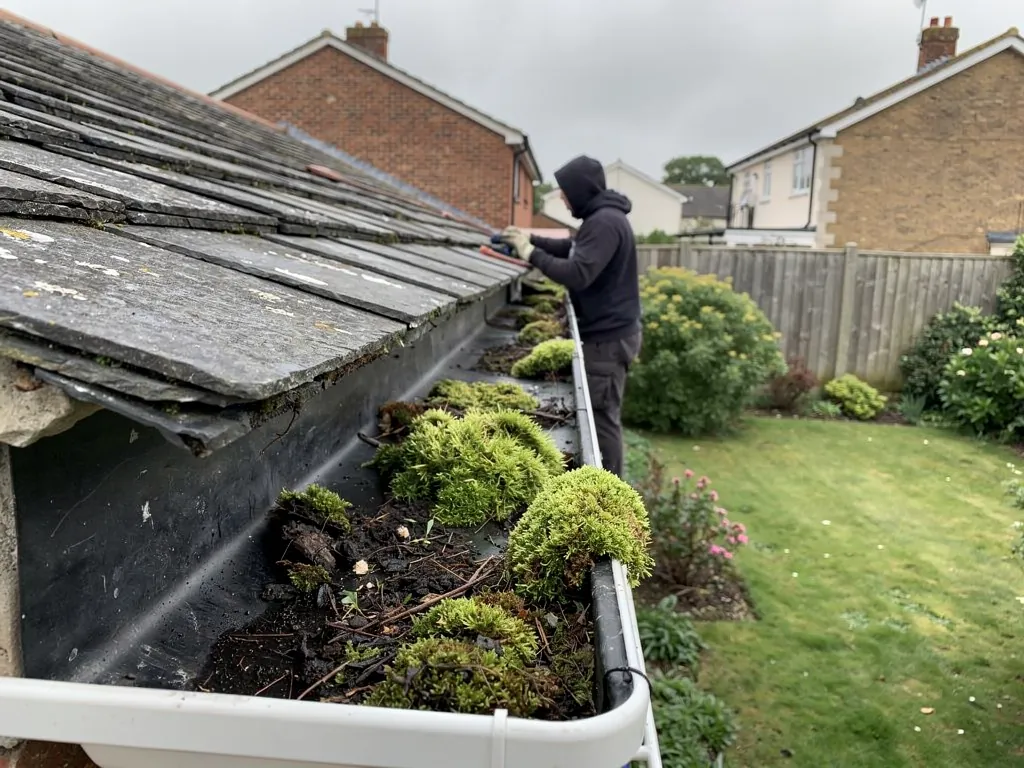
What lichen actually is
Lichen is not a plant. It is a partnership between a fungus and an alga, or sometimes a type of bacteria, living together as a single organism. The fungus gives the structure and grips the surface; the alga makes food from daylight. That arrangement lets lichen live on bare, dry, exposed surfaces where almost nothing else would, which is why a roof, a gravestone and a garden wall all suit it.
It has no roots. A lichen attaches itself with fine threads and absorbs water straight from the air and from rain across its whole surface. When it dries out it goes dormant and brittle, and when it gets wet it softens and starts working again. That cycle is why a patch can look dead in July and green in November.
It also grows very slowly. A crust that is the size of a coin may have been in place for a long time, and a roof covered edge to edge has generally gone untreated for years. It settles most readily on stable, rough surfaces such as an old tile, a weathered slate or a pitted concrete face.
Many roof lichens form a flat crust that cannot be lifted off in one piece. Others are leafy or tufted, with small curled edges that stand a little way off the surface. Colours run from pale grey and green through yellow to the bright orange you see on stone slate and chimney pots. A lichen colony is often taken as a sign that the air around the house is reasonably clean, because many species struggle where pollution is heavy.
Telling lichen from moss and algae
Three different things grow on British roofs, and they call for different treatment. Getting the diagnosis right saves money, because a roof with only light lichen rarely needs the work a mossy roof does.
| Growth | What it looks like | What it does |
|---|---|---|
| Moss | Soft green or brown cushions and mats, thickest along edges, laps and in valleys | Holds water against the tile and pushes into joints |
| Lichen | Flat grey, green, yellow or orange crusts and rosettes, hard to scrape off | Sits on the surface and takes moisture from the air; slow to spread |
| Algae | Dark streaks or a green film, usually running down the slope | Mostly staining, spreading where the tile stays damp |
A simple test is touch. Moss is thick, springy and comes away in handfuls. Lichen feels like dried paint and needs a blade to shift. Algae smears and has no thickness at all.
The three often sit side by side. A north-facing slope might carry a green mat of moss at the eaves, a grey crust of lichen higher up where it dries faster, and dark streaks below the ridge. Our guide on why moss grows on a roof explains why some slopes collect growth and others stay clean.
If you are unsure which you have, photographs taken from the ground with a zoom lens are enough for a first opinion, and the survey photographs we take of your roof settle the question properly.
Does lichen damage tiles and slates?
The answer depends on the material and on how long the lichen has been there. Lichen does not hold water in the way a moss mat does, and it does not push between tiles. On a sound, hard covering a light cover of lichen is mainly a cosmetic matter.
Why porous surfaces are different
Lichen produces mild acids as part of how it grips a surface, and its threads can work into tiny pores. Over a long period this can roughen and slowly wear soft or porous faces, such as an old concrete tile whose surface has already started to flake, or a softer stone. A hard-fired clay tile or a dense natural slate gives it much less to bite into.
What happens when it is thick
A heavy crust that has built up for years keeps the tile face damp for longer after rain, because the lichen takes up water and releases it slowly. That extra dampness matters on a covering already well into old age, since a wet tile is the one that suffers when frost arrives.
Thick lichen also hides what is under it. Cracks, slipped slates and the early signs of nail failure are harder to see through a crust, so a heavily covered roof is difficult to inspect from the ground.
Lichen on its own rarely causes a leak. The worry is what it can conceal, and how it behaves together with moss in the same part of the roof.
That last point matters for the next decision. Where lichen and moss share a slope, the moss is usually the one that needs attention first, and our guide on whether moss damages roof tiles covers it.
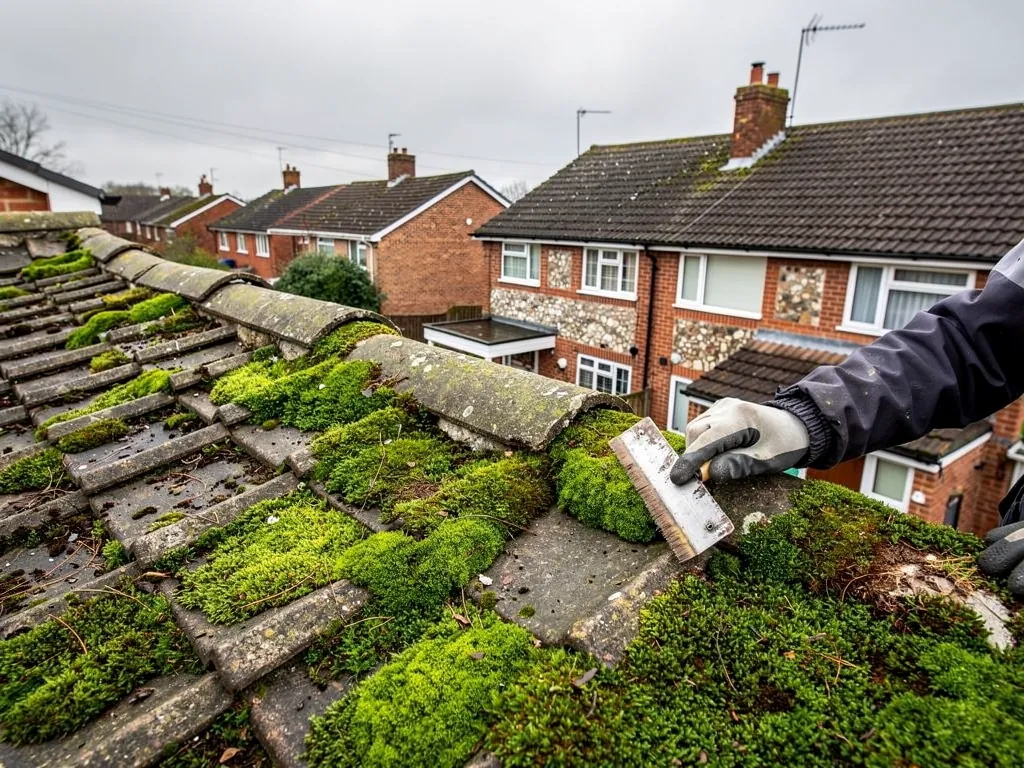
When we would leave lichen alone
There are roofs where the right advice is to do nothing, and we will tell you once we have looked at the roof. The common cases are these.
Old stone slate and clay
On traditional stone slate and on aged clay, a scatter of lichen is part of how the roof looks. Roofs of this kind are often prized for their weathered colour, and the growth sits happily on a surface that is already rough and absorbent. Hard cleaning of stone slate often causes more harm than the growth it removes, because the edges of old stone laminate and flake when scraped or blasted. If you live in a conservation area or the building is listed, cleaning methods are also worth checking with the council before anyone starts.
Light, patchy cover
A few isolated rosettes on the higher parts of a slope, well away from valleys, gutters and laps, do no work against the roof. Removing them gains very little, and every cleaning visit puts a person on the covering and adds wear.
Roofs that are already failing
Where the covering is breaking down, cleaning can be money spent on tiles due for replacement. A roof with brittle, delaminating faces may not survive being walked on and washed, so repair or replacement comes first. For older buildings, use our guide to cleaning listed and heritage roofs as a guide.
When removing it makes sense
Lichen is worth treating when it is doing something beyond looking weathered. These are the situations where we would normally recommend a clean.
First, where it forms a thick crust over concrete tiles. The coloured surface layer on a concrete tile is part of what protects it, and a heavy lichen cover that has been worked into that layer is better dealt with sooner than later. Second, where it sits in the same places as moss: the lower courses, the valleys and the gutter line, where debris and moisture collect.
Third, where a roof is being prepared for something else. A coating, a re-pointing of the ridge or a new set of solar panels all go onto the roof better when the surface is clean, and a coating will not bond properly to a crust. If a protective finish is part of your plans, our guide to coating a house roof explains how clean the surface has to be.
Fourth, where the growth is hiding the condition of the roof. If we cannot read the tiles for cracks and slipped fixings because of the crust, a clean lets us see what is really there before we recommend any repair.
Fifth, appearance. Plenty of owners simply prefer a clean roof, and that is a fair reason if the covering is sound, as long as nobody has told you the lichen is about to bring it down.
Cost depends on the roof, so the written quote follows the survey. As a reference point, MyBuilder's cleaning guide, updated 21 August 2026, puts typical tile roof cleaning at £400 to £750, with slate at £500 to £1,000.
How lichen is removed and why it takes time
Lichen is harder to get off than moss, and that shapes the method. Moss comes away with a scraper or a brush. Lichen has gripped the surface, so scraping or blasting it off risks taking the tile face with it.
Biocide and patience
The gentle route is a soft wash with a biocide. The treatment is applied at low pressure, left to work and allowed to kill the organism, which then loosens over the following weeks and is washed away by ordinary rain. Our page on soft washing and biocide treatments sets out how that works. For lichen the wait can be longer than for moss, so a roof may still look patchy a few weeks after the visit and then clear gradually.
Why scraping is a poor choice
Dry scraping a lichen crust off concrete or soft clay is the quickest way to damage the face. On slate it can scratch. A light brush can help with loose edges; forcing a stubborn crust is where harm happens.
Pressure
High-pressure washing is the same trap on a larger scale: it strips the surface and drives water under the laps. Our guide to pressure washing roof tiles explains the risk.
The point of working slowly is that the roof is the thing you are keeping. A method that leaves the covering intact and the lichen still visible for a few weeks is better than one that clears it in an afternoon and shortens the tile's life. Your quote will be written after the survey and will name the method we propose and the access it needs.
Keeping lichen from coming back
Lichen returns slowly, and that is in your favour. A treated roof does not usually look the same again within a season, and many properties will go a long time before lichen is noticeable. What speeds it up is what feeds it: shade, a surface that stays damp, trees dropping debris and a rough or worn tile face.
Simple habits make a difference. Keep gutters flowing so the lower courses can drain. Trim back branches that overhang and shade the slope, if the tree is yours to trim. Do not leave moss to build up, because a mossy edge gives lichen a damp foothold. Glance at the slopes from the pavement in spring and autumn, with binoculars if you own a pair.
A biocide treatment discourages regrowth for a while and a protective coating can stretch that further, but neither is permanent. Our answer on how long roof cleaning takes sets out what to expect on the day and in the weeks after.
If you are weighing up whether to clean at all, send us a few photographs or ask for a survey. We will tell you if the roof is fine as it is, if a clean is justified, or if something else on the roof needs attention first. Anything we carry out is backed by a written 10-year workmanship guarantee. To book a survey, ring 01793 626096 or use WhatsApp.