
Two houses on the same street can have very different roofs. One has stayed a clean, even grey for years. The other, a few doors along, carries a thick green blanket on its back slope. Nothing about the tiles explains it, and neither owner has done anything unusual. The difference lies in how long each roof stays wet and how much light it gets.
Moss is not a sign of neglect, and it is not caused by one bad winter. It is a simple plant that takes advantage of a damp, sheltered surface and a few spores arriving on the wind. This guide works through the conditions that let it settle: shade and orientation, trees and debris, the texture and pitch of the covering, and the things that feed it. Knowing the cause helps you decide what, if anything, to change after a clean. For the wider service, see our roof cleaning and moss removal page.
What moss needs, and what it does not
Moss is among the simplest land plants. It has no true roots and no vascular system for drawing water up from the ground. Instead it soaks up moisture through its leaves and anchors itself with fine threads called rhizoids, which grip tiny irregularities in a surface. It does not need soil. A film of dust, pollen and droppings on a tile gives it all the nutrient it requires.
It reproduces by spores, which are light enough to travel on the wind and settle on any roof in the district. That means a roof cannot be kept out of reach of moss. Spores arrive everywhere, on new roofs and old ones, in town centres and country lanes. Whether they take hold depends on whether the spot stays wet enough for long enough.
That is the key point. Moss does not die in a dry spell. It shrivels, turns brown and goes dormant, then greens up again when the next wet period arrives. A roof that dries quickly and gets plenty of sun gives it little chance to establish. A roof that stays damp for most of the week gives it ideal conditions.
Is moss on a roof alive or dead in summer?
Brown, crisp moss in a dry August is dormant rather than dead. It is waiting. This is why a roof can look clean in summer and furry again by November, and why a one-off scrape rarely settles the question. A treatment that kills the plant, such as the one described in our guide to soft washing and biocide treatments, deals with the dormant moss as well.
Shade and the direction a slope faces
Sun is the roof's best defence. Warmth and light dry the surface, and drying is exactly what moss cannot tolerate for long. A slope facing roughly south gets the longest exposure and tends to dry fastest after rain. A slope facing north gets the least direct light and stays wet longest.
This is why the back slope of a house is so often the green one, while the front, facing the road and the sun, looks fine. If you were to compare the two slopes after a wet spell, the north-facing one would still be damp when the other had long since dried. The north side of a house is the classic example.
Orientation is only part of the picture, because shade comes from many things besides the sky. A tall neighbouring house throws a shadow across a slope for much of the day. A garage or extension built against the main roof shelters the area beside it. A chimney stack leaves a patch in its lee. Even a high fence or hedge changes how quickly the lower courses dry out.
Why is moss thickest at the bottom of a slope?
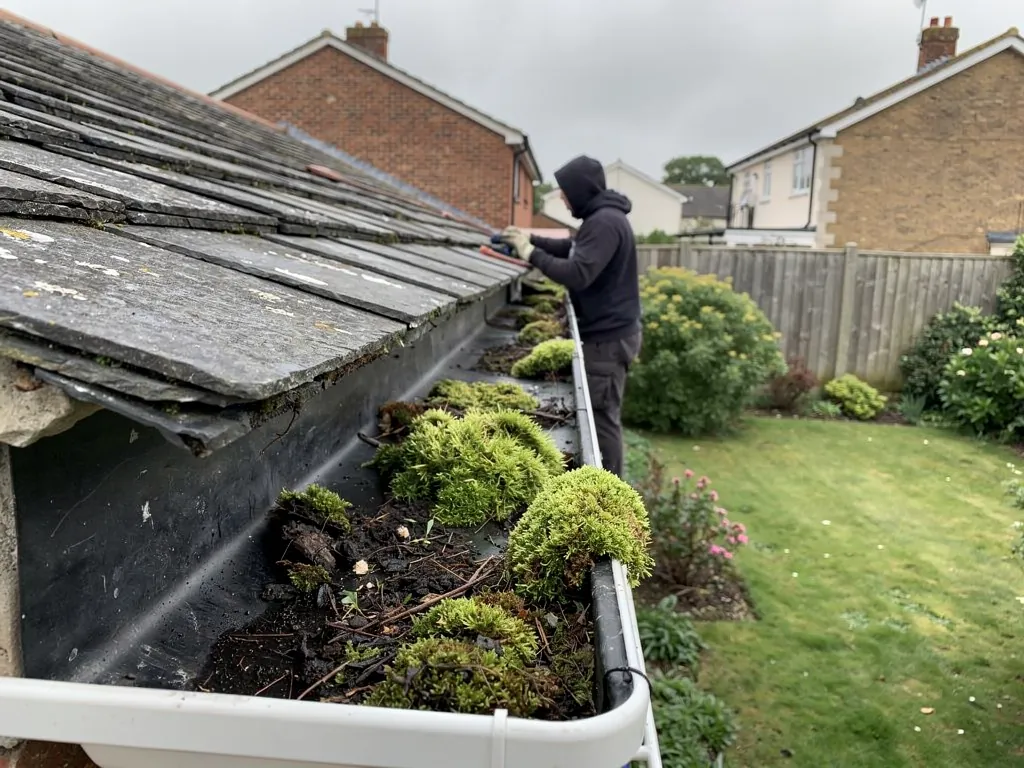
Water runs down the slope, so the lower courses stay wet longest, and the eaves are often in shade from their own overhang. Debris also collects there. Moss often starts in a band near the gutter, where there is moisture, shelter and a little dirt, then creeps upward over several winters.
Overhanging trees and the debris they drop
Trees do more than block the light. Branches over a roof cast shade, drip long after rain has stopped, and drop a steady supply of leaves, twigs, blossom and seeds. Each of those matters.
Leaves that settle in valleys, behind chimneys and along the gutter hold water against the tile and break down into a thin compost. Moss thrives in that mulch. The drip from branches means a roof under a large tree stays wet for hours after the rain has gone, and the canopy cuts the light that would otherwise help it dry.
Some trees are worse than others. Evergreens shade the roof all year, so there is no leafless winter spell when light can reach the slope. Trees that drop sticky residues or heavy seed fall give moss extra material to feed on. A mature tree close to the house also tends to shelter the whole plot, slowing the wind that would help dry the roof.
Should I cut back the trees?
Trimming branches that overhang or touch the roof is one of the most effective changes you can make. It lets in light and air, reduces drip and cuts the debris that collects in gutters and valleys. Check whether the tree is protected, which is a question for the council, and whether it belongs to you or a neighbour before any work starts. A tree surgeon is the right person for anything above head height.
Texture: why some coverings hold moss more readily
The surface of the covering matters as much as the light. Moss needs something to grip and something to hold water against its stems, and different materials supply different amounts of both.
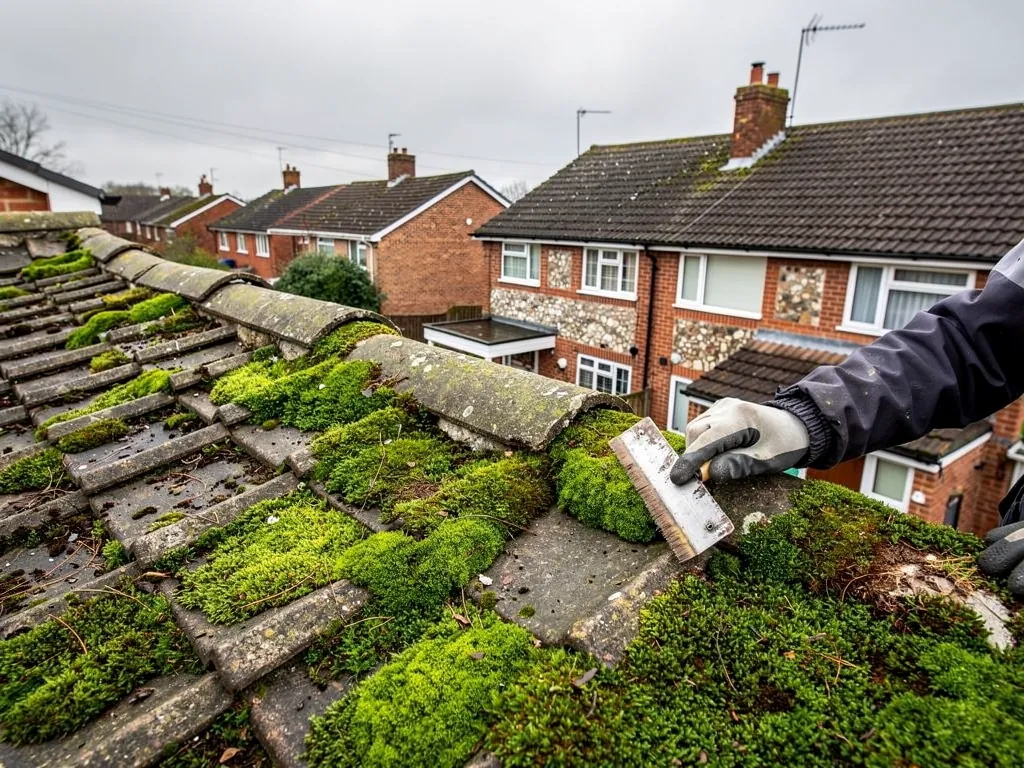
Concrete tiles are the clearest example. They are made from cement and sand, and the surface is slightly granular and porous. As the tile weathers, the thin outer skin wears and the face becomes rougher and more absorbent, holding moisture for longer. Moss, algae and lichen find plenty to hold on to. Our guide on how to clean concrete roof tiles explains what that means for the cleaning method.
Clay tiles are less porous but are often textured or sanded, and plain tiles lie in overlapping courses with many small gaps where water and dirt collect. Natural slate is smoother and sheds water well, yet moss still settles along the overlaps and on weathered edges, and lichen grips it firmly. Stone slate has a rough, uneven face, and in shade it gathers growth readily.
The detail of the roof matters too. Every overlap, lap and joint is a small shelf where dust settles and water lingers. A roof with many valleys, dormers or abutments has more of these places than a plain gable.
Does a new roof stay clean?
For a while, yes. New tiles have an intact surface and few spores in residence, and the roof looks clean for the first few years. As the surface weathers and the first spores establish, the pattern starts to follow the shade and damp described above.
Pitch, gutters and slow drainage
A shallow roof sheds water more slowly than a steep one. Water runs off a steep pitch quickly, and wind helps dry what is left. On a low pitch, water lingers in laps and across the face of the tile, and the surface stays damp longer. Coverings have minimum pitches set by the manufacturer for this reason. Marley, for example, lists a minimum of 15° for some interlocking concrete tiles, and Marley's clay plain tiles range from 30° to 40°. A roof close to its minimum is more likely to hold moisture than a steeper one in the same material.
Gutters have a part to play as well. A gutter that overflows, sags or backs up keeps the lowest courses of the roof wet. A gutter full of moss and leaf litter becomes a seed bed in its own right. Spores shed from there spread up the slope.
Poor ventilation is a less obvious contributor. A roof void where warm, moist air escapes through the covering in cold weather can leave the underside of tiles damp, which slows drying from below. It is rarely the main cause, though on some houses it adds to the other factors, and the survey would note it. Light, shelter and the age of the surface still do most of the work.
Can a roof be too flat for its covering?
It can. A tile laid below the pitch its maker specifies may leak as well as grow moss, which is a roofing fault rather than a cleaning one. If a roof stays persistently wet for no obvious reason, we check the pitch and the lap as part of the survey. Our guide on whether moss damages roof tiles explains why that matters.
What feeds moss, and what slows it down
Moss needs very little food, but what it gets makes a difference. Bird droppings, airborne dust, pollen and the fine grit shed by ageing concrete tiles all supply nutrients. Even a clean-looking roof collects enough of this to feed a thin film of moss.
Some metals affect the picture. Run-off from copper or zinc is hostile to moss, which is the idea behind metal strips fixed near the ridge. They help on the area below them and do little elsewhere.
What really slows regrowth is anything that shortens the wet hours. That means letting in light by trimming trees, keeping gutters clear and in fall, repairing slipped tiles and mortar, and cleaning before growth is thick. Treatments and coatings help at the margin, but they cannot change the weather or the shade. If you are weighing a coat, our guide to roof coatings on houses sets out where they help and where they cause problems.
Will moss damage my roof if I leave it?
Slowly, and in the wrong places. Wet moss presses water against the tile, can raise tile edges as it spreads, and drops debris into the gutters over time. A thin film on a sound roof is mostly cosmetic, but thick growth in valleys or along the eaves is worth dealing with. We look at which it is when we survey.
After the survey, the written quote arrives with photographs taken on your roof, and it proposes the smallest job that deals with what we find. A 10-year workmanship guarantee, in writing, backs any repair we do.