
Ask three firms how they remove moss and you may hear three different answers: a scraper and brush, a chemical wash, a jet of steam or a pressure lance. They are not interchangeable. The method has to fit the covering, the pitch, how thick the growth is and what you want from the roof afterwards, whether that is a quick tidy for a sale or a surface that stays clean for several seasons.
The wrong choice can cost more than the moss ever did. Too much pressure strips the face from a concrete tile, a hard scrape cracks a brittle slate, and a wash that is rinsed straight off leaves spores behind to restart the growth. This guide describes each method in plain terms, what it does well and where it does harm, so you can read a quote with some confidence. For the full service, see roof cleaning and moss removal.
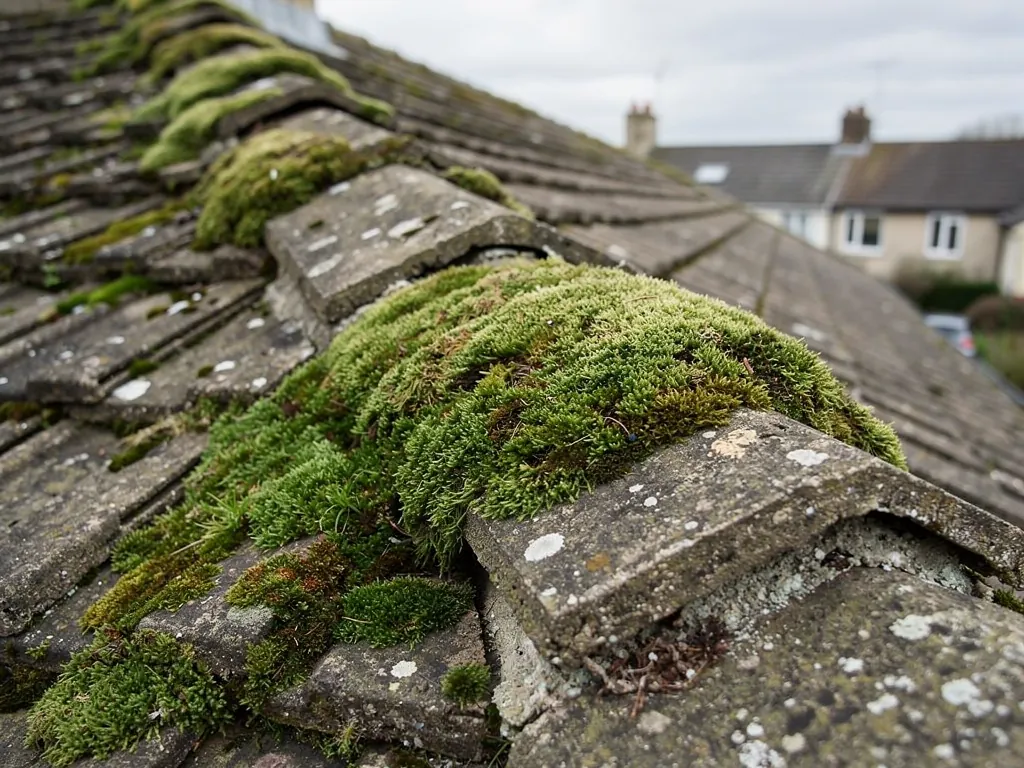
Start with the covering, not the method
The sensible order is to establish the covering and its age first, then pick the method. Doing it the other way round, which is what happens when a firm only owns one machine, is how tiles get damaged.
Natural slate is dense and smooth, and it tolerates gentle washing well but cracks if it is walked on carelessly or hit with a hard tool. Clay tiles are tough on the face, though old plain tiles can be brittle at the edges and laminate if they are blasted. Concrete tiles carry a coloured surface layer, and that layer is what a harsh method removes. Stone slate is soft, layered and often protected, and it needs the lightest touch of all. Fibre-cement and reconstituted slates are more fragile than they look.
Condition matters as much as material. A roof with plenty of tiles already cracked, lifted or crumbling will not take a hard clean, and in that case the question may be whether to repair first. Pitch matters because a steep roof is harder to work safely, and access matters because the cleaner has to reach the roof without damaging the building. Scaffolding, a tower or a platform may be needed, and that is part of what drives the price.
What the growth is also tells us
Heavy moss needs removing before treatment, while a light covering of algae or lichen can often be treated alone. Our guide on lichen on roof tiles explains why that distinction changes the method.
Hand scraping and brushing
This is the oldest approach and still the most controlled. A roofer on the roof uses a plastic or soft-edged scraper and a brush to lift the moss away course by course, working from the ridge downwards, and bags or clears the debris as they go.
What it does well
The cleaner sees every tile as they go, so cracked, slipped or loose tiles are found and noted. There is no water driven under the laps, no runoff of chemical, and the force applied is whatever the person's hand applies, which is easy to keep gentle. For thick moss it is often the best first step because it takes the bulk off cleanly.
Where it falls short
It is slow, and that is the main reason it costs more on a large roof. It does not kill the roots and spores, so growth returns unless the roof is treated afterwards. On a roof that has lichen as well, scraping struggles with the crust. It also relies on someone walking the roof, which adds wear to brittle tiles and is a poor choice on very old or fragile coverings.
MyBuilder's roof cleaning guide, updated 21 August 2026, puts manual scraping at £5 to £10 per m². On a typical house that may sound cheap, but a roof that is scraped and not treated is the one that needs doing again soonest.
We use scraping mainly where it is the right first stage: to remove a heavy mat before a treatment, or to lift moss from awkward places such as valleys and the back of chimney stacks. Our guide to doing moss removal yourself covers why the roof itself is not a safe place for most owners to start.
Soft wash and biocide
Soft washing is a low-pressure application of a cleaning solution, usually containing a biocide, sprayed over the roof and left to work. The aim is to kill the growth rather than to blast it off. Dead moss and algae loosen, dry and fall away over the following weeks, helped by wind and rain.
This is the method that suits many coverings best, because the pressure is about what a garden hose delivers. The tile face is not abraded, the laps are not flooded and the roof can be treated from ladders or a platform without the cleaner needing to walk across it for long. Treatment also reaches the roots and spores that scraping leaves, which is why a treated roof tends to stay clean longer.
The trade-offs
The result is not instant. Moss turns brown and then dies back over days and weeks, and a roof may look worse before it looks better. Heavy growth should be scraped first, since a thick mat can shield the layers beneath from the solution. Run-off needs care near plants, ponds and water butts, and a good contractor protects them and keeps the solution away from drains. Our soft washing and biocide guide goes through how the chemistry works and how to look after the roof afterwards.
On price, MyBuilder's figures, updated 21 August 2026, put soft wash at £15 to £20 per m², which reflects the materials and the time. You get a lasting result for the money, since the treatment does the work that rubbing would otherwise do, and the gentler action protects the tile.
For lichen and algae in particular, soft wash is usually the only sensible route. Our answer on how long before moss grows back explains how aftercare affects the timescale.
Steam cleaning
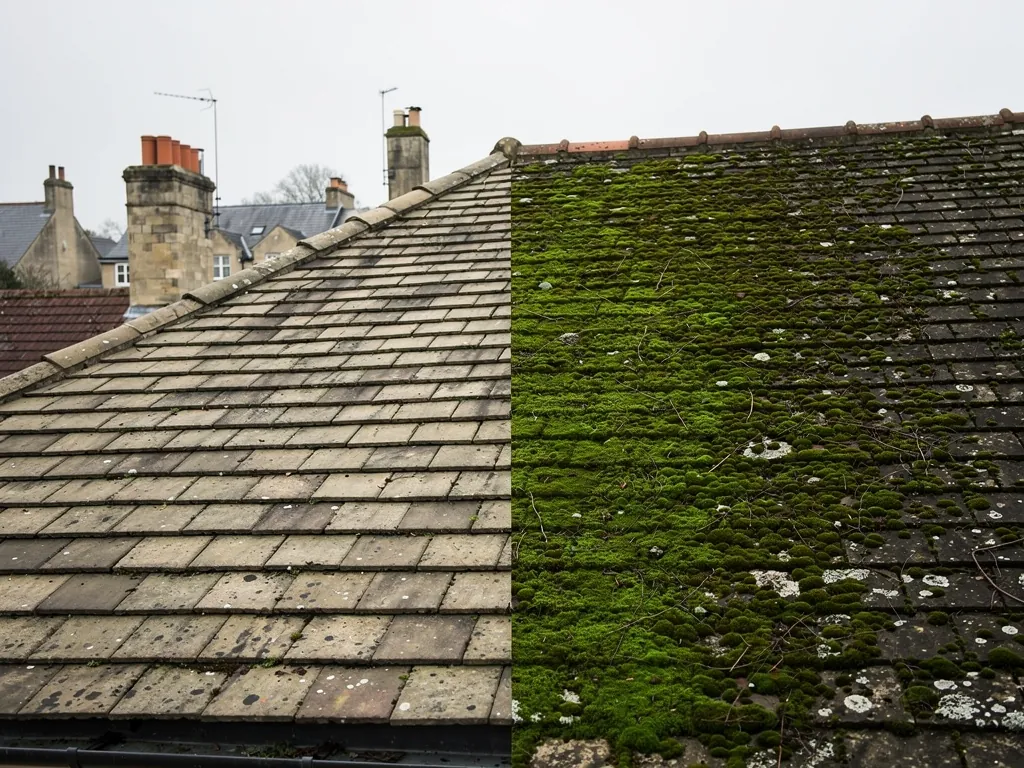
Steam cleaning uses hot water and steam at low pressure to loosen the growth without chemicals. The best-known system for roofs is called DOFF, after the machine that produces it. The heat and moisture lift moss, lichen and algae from the surface, and a gentle spray then rinses it away.
Its appeal is that it removes the growth on the day and does not leave a chemical in the water. It is a popular choice for historic roofs, for coverings that do not take biocide well, and for owners who want the roof clean straight away. Steam gets into the texture of rough surfaces, such as stone slate and weathered clay, with little force.
The limitations
It is more equipment-intensive, so it generally costs more, and it needs a good supply of water on site. It also does nothing to slow regrowth by itself. Unless a treatment follows, moss will come back at its own pace. The operator needs to control the temperature and the angle of the lance, because heat is not harmless on every surface.
MyBuilder's guide, updated 21 August 2026, puts DOFF cleaning at £20 to £30 per m², the highest of the four methods. Our page on DOFF steam roof cleaning explains how the process works and which roofs it suits.
As a rule of thumb, steam is worth considering where gentleness matters more than speed or price, and where a chemical wash is not wanted: a listed or conservation-area roof, a roof on a building with an organic garden below it, or old tiles that are already fragile. Where the covering is a plain modern concrete tile, soft wash usually gives the same result for less.
Pressure washing
Pressure washing is the method most people picture: a jet blasting the roof clean. It is also the one that does the most harm in untrained hands. The force that moves moss will also move the tile's own surface, and it will drive water sideways and upwards under the laps, into the batten space and onto the underlay.
MyBuilder's guide, updated 21 August 2026, lists pressure washing at £10 to £15 per m² and notes that it may damage delicate tiles. That sentence summarises the issue. On concrete tiles the jet can strip the coloured face, leaving a rough and more porous tile that grows moss faster than before. On clay it can chip edges and open old cracks. On slate and stone slate it can split layers.
Some roofers use pressure washing at a very low setting or with a fan nozzle held well off the surface, and in careful hands that can be acceptable on a hard, sound covering. We have written a separate guide, why pressure washing can damage roof tiles, which goes through the risks and the questions to ask.
If a firm quotes pressure washing, ask what pressure they will use, what nozzle, how far from the tile, and what they will do about water getting under the laps. A firm that cannot answer is probably not the one to trust with your roof.
Cheap per square metre can become expensive when a stripped tile face means a roof that needs recoating or replacing years early.
Matching method to roof
The table below sets out how we think about the choice. It is a starting point, not a rule, and the survey changes the answer.
| Covering | Usually suits | Take care with |
|---|---|---|
| Concrete tiles | Scrape heavy growth, then soft wash | Pressure, which strips the coloured face |
| Clay tiles | Soft wash or steam | Brittle edges on old plain tiles |
| Natural slate | Soft wash, light brushing | Walking on the roof, hard scraping |
| Stone slate | Steam or gentle hand work | Anything forceful; check consent if listed |
| Flat roof membranes | Soft brushing and mild wash | Cutting the surface with a scraper |
Many roofs end up with a combination. A heavy mat is taken off by hand, the roof is treated, and anything that needs detail work, such as a valley or a lead flashing, is done carefully by hand. Roofs also differ from one slope to another, so a north-facing side may need more than the south.
Access is part of the choice too. A steep or tall roof may need scaffolding or a tower, and that cost belongs in the quote whichever method is used. When quotes arrive, see if VAT and the access equipment are in each one. Our guide to what roof cleaning costs explains how those items move the total.
After the clean: what keeps the roof clear
Cleaning is half the job. The conditions that grew the moss are still there afterwards, so the best results come from a method that treats the cause as well as the symptom.
A scrape plus a biocide gives a surface that resists regrowth for a period, and soft wash on its own does the same. Steam cleaning gives the cleanest immediate look but does not protect, so many owners add a treatment to it. A protective coating can lengthen the clean period further, though it is a bigger decision and it only works on a properly clean, sound roof.
Day to day, the same few habits help whatever method was used. Keep the gutters clear so water does not stand along the lower courses. Cut back overhanging branches where you can, since shade and leaf fall feed growth. Look at the slopes from the ground twice a year, and act when you see green creeping back along the north side and the eaves, before it builds into a mat.
Do not expect the roof to stay clean forever. Moss is a natural recolonist, and how fast it returns depends on shade, tree cover, the tile surface and how well the first treatment was done. A roof that is shaded and damp may need attention sooner than an open, sunny one.
When we survey a roof for cleaning, you get photographs of the tiles and a written quote. The quote names the method and the access, and anything we carry out is covered by a written 10-year workmanship guarantee. Debris is bagged and removed. To arrange a survey, ring 01793 626096 or message us on WhatsApp.