Edwardian brick villas with clay tile roofs and decorative ridges

Roofers in Shippon

Slate, tile, lead and flat-roof work in Shippon, the village a mile west of Abingdon on the edge of the Thames valley, covering Victorian church streets and the homes built since.

Shippon's roofs, from abbey manor to barracks edge

Old brick farmhouse with mixed tile patches
The old manor village

Shippon was a manor held by Abingdon Abbey until the Dissolution in 1538, after which the Duchy of Cornwall acquired it, and the Duchy owns it still. A village with that continuity of ownership tends to keep a mixed stock of old houses and farm buildings, each altered over the centuries. Their roofs seldom follow a single pattern. One slope may be old clay tile, another a later patch in different tile, and the chimney flashings may belong to a third era. On buildings like these we begin by working out which parts are original and sound, which are repairs of different dates, and which are simply worn out and due for renewal. That sorting is what keeps the quote to the work that is needed. Where several patches of different tile meet, the joins between them, along valleys and at the abutments, are checked closely, since mismatched laps are where rain gets in.

Victorian slate roofs and chimney pots
The Victorian church streets

The parish church of St Mary Magdalene was built in 1855 to a design by Gilbert Scott, and Shippon became a separate ecclesiastical parish in 1865. Houses from those same decades may well carry Welsh slate, which railways made cheap to move across the country. Nineteenth-century slate roofs fail in familiar ways: nails rust through so slates slide, lead soakers and flashings tire at chimneys and abutments, and ridges rely on old bedding. A slate roof with sound slates and failed nails can be refixed instead of replaced, and our survey photographs the nail heads and the underside of the slates in the loft to show which applies.

Brick bungalow with a rear extension
Between Abingdon and the barracks

Shippon lies about a mile west of Abingdon, and Dalton Barracks stands within the village. Around a place like this you find houses and bungalows built across many decades, rear extensions, garages and outbuildings, with tile or flat roofs added as families grew. Flat roofs tend to need work sooner than pitched ones: felt, rubber or fibreglass membranes wearing out, with trouble at the upstands and where the felt meets the house wall. Pitched roofs show ridge and verge problems and perished underlay. Larger buildings with flat or low-pitched roofs have their own page on commercial roofing, if that is what you manage.

From Swindon to the edge of Abingdon

Map showing Shippon and central Swindon. 25 road miles east-north-east of central Swindon.

Distance
25 road miles east-north-east of central Swindon
Council
Vale of White Horse District Council
Council
Vale of White Horse District Council
Parish
St Helen Without, with Shippon its largest village
County
Berkshire until 1974, now Oxfordshire

Shippon roof questions

Is Shippon still treated as Berkshire for planning?

No. The village moved from Berkshire to Oxfordshire in 1974, and the Vale of White Horse District Council now handles planning for it.

Can slipped slates on a Victorian Shippon house be refixed?

Frequently. Where the slates are good and just the nails have rusted away, new fixings can hold them, so the roof stays and a full re-slate is avoided.

Who handles building control for a Shippon re-roof?

Southvale Building Control, the shared service for South Oxfordshire and the Vale, or a registered building control approver. For notifiable work we explain the steps.

Q1

What does Scott's 1855 church tell us about Shippon roofs?

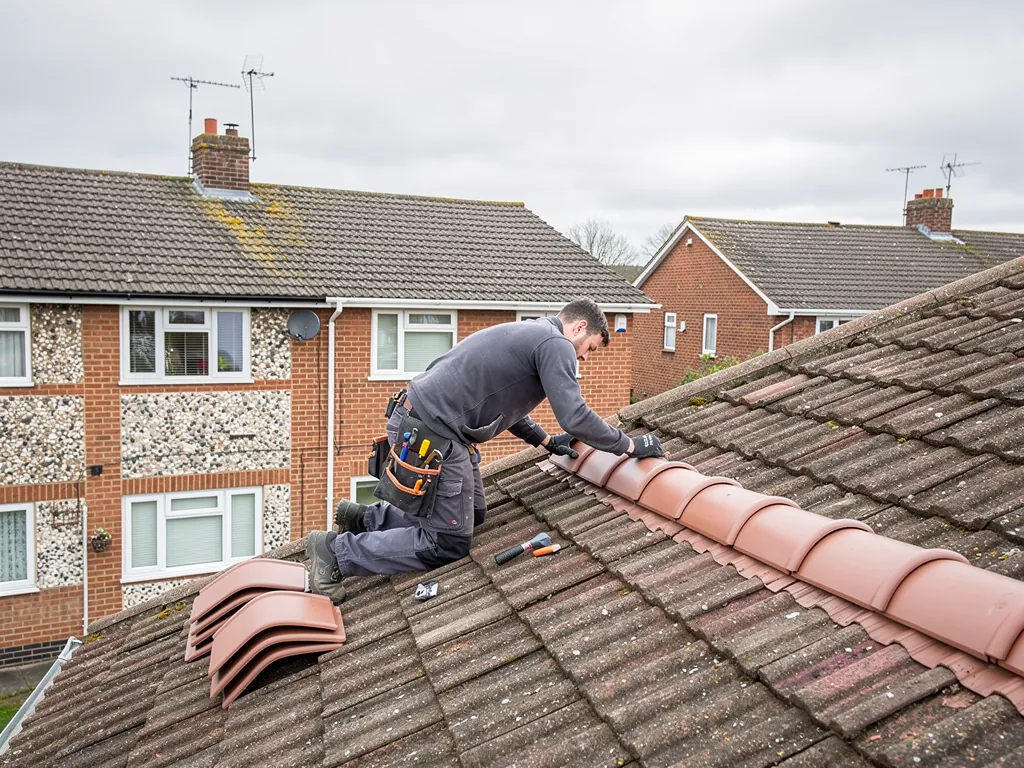
Roofer fixing new red ridge tiles along a concrete tile roof
Concrete tile roof with moss, lifted tiles and a cracked ridge

The short answer

It dates the village's Victorian growth, and puts a rough date on the roofs of that generation. Houses from the mid-nineteenth century onward may well have slate, with lead flashings and chimney stacks that now need attention. Slate is long-lived, but its nails, lead and ridges age much faster than the slate itself.

St Mary Magdalene was designed by Gilbert Scott and built in 1855, and Shippon became a separate ecclesiastical parish a decade later. Streets that grew around those years belong to the age of slate, the covering that spread when rail freight made Welsh quarries easy to reach.

Why do slate roofs fail at the nails?

Slate itself can outlast a century. The weak link is the fixing: early nails were iron, and they rust through, and a slate that looks fine can drop out of line with little warning. Slipped slates are often the first sign, followed by gaps along the roof that let rain in at the top of the wall. Up in the loft we look for a dark line of damp on the underside of the boarding or battens just below each gap, which marks where water has been entering.

What about lead and ridges?

Lead soakers, flashings and valley linings were fitted when the roof was built, and they tend to crack and lift with age. A soaker is a small folded piece of lead that sits under each slate course beside a chimney or wall. Repairs with sealant buy a season at best. Ridge tiles on these roofs were originally bedded in mortar, and since BS 5534:2014 they are also fixed mechanically.

Repair the slates or start again?

If the slates are sound, refixing is cheaper and keeps the original covering. If they are delaminating, soft or cracked in bulk, re-slating is the right answer. A section of the roof can sometimes be done with reclaimed slate matched for size and colour. The choice also depends on the pitch of the roof, its exposure, and the state of the battens beneath. Our slate roofing page describes how we decide.

Q2

Who must agree to a re-roof on long-held estate land?

The answer

If you own your house freehold, the main permissions are the planning and building rules. If it is rented or leasehold, the landlord or freeholder may have to agree to roof work, and their own conditions may apply. Check your lease or tenancy first, and ask the landlord before work is booked, since an unapproved change can become a dispute later.

The Duchy of Cornwall acquired the manor of Shippon after 1538 and still owns it. That does not mean every house is on Duchy land, and we do not know which ones are. It is a reminder that in a village with a long-standing landowner, ownership and tenure are worth checking before roof work is priced.

Do I own the roof?

For a freehold house, yes, along with the responsibility for it. For a leasehold house or flat, the lease usually says who maintains the roof and who must approve alterations. For rented property, the landlord is normally the person to ask. Legal advice is for a solicitor, but we can supply photographs and a clear description of the work so that you or the landlord can decide quickly. A landlord who sees the cause of a leak and the proposed fix in writing, with pictures, can usually give an answer much sooner than one who is asked cold.

What about covenants?

Older estates sometimes carry covenants on the look of buildings, such as the roofing material. These are private obligations, separate from planning, and they can apply even when the council needs no application. If you have deeds that mention restrictions, read them before choosing a different covering, and ask a solicitor if the wording is unclear. Tell us about anything you find, since it may affect which tile or slate we can propose.

What stays our job?

We survey, photograph the roof, explain the options and write the quote, and we handle the building control notification where work is notifiable. Our roof repairs page explains how we choose between repairing and replacing.

Q3

Does a Shippon flat roof extension need building control?

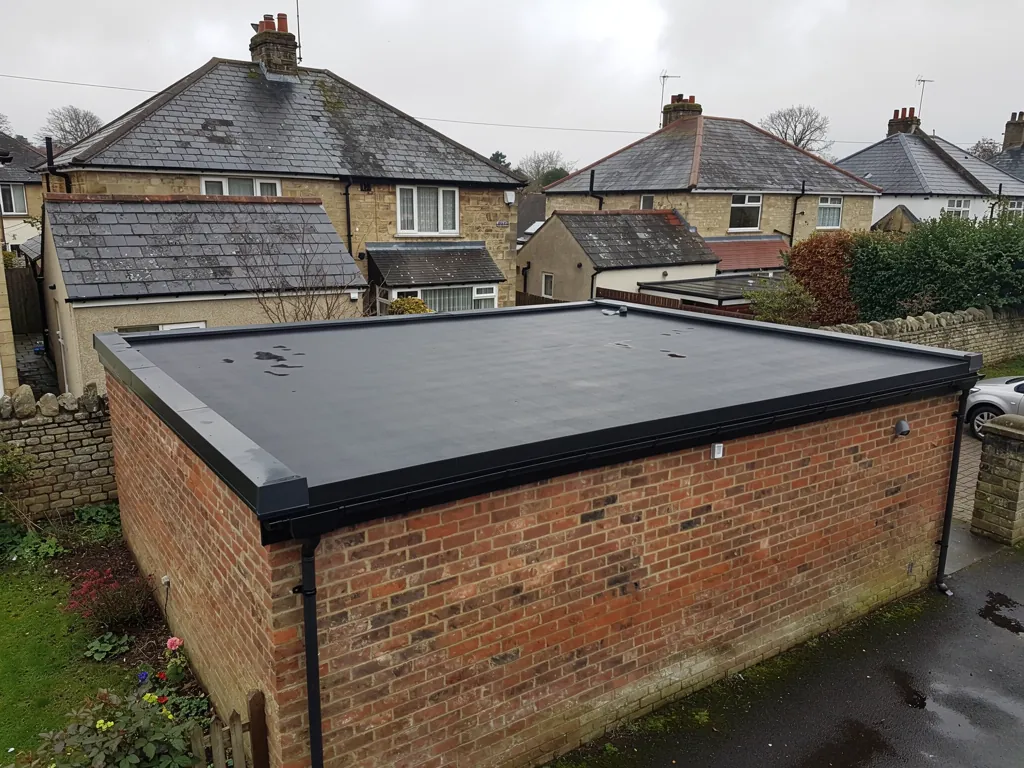
Brick garage finished with a black rubber flat roof
Roofer rolling torch-on felt on a rear extension flat roof

The short answer

Re-covering a small flat roof often needs no application, but a new roof or a major renovation can. Under Part L a new waterproof layer can pull the roof's insulation into the job, so an upgrade may be needed. Southvale or a registered approver can confirm.

Garages, kitchen extensions and porches with flat tops are part of village life around Abingdon, and they usually need attention before the pitched roof does. The rules turn on how much of the roof and the building is affected.

When is an application needed?

Planning Portal guidance gives two limits, 25 per cent of the total building envelope and 50 per cent of the roof, and staying below both normally means no application. A small garage roof usually falls under them, since it is a modest part of the building. Ask before you start rather than after, because regularising finished work is slower and can mean opening up the roof. A full-width kitchen extension may not.

What does Part L add?

Approved Document L lists a replacement waterproof membrane among the works that renovate the roof as an insulating element. Where more than 50 per cent of that surface is renovated, all of it should reach the improved U-value, 0.16 W/(m²·K) for a roof. In practice that can mean new insulation above or below the deck.

Who do I ask?

Southvale Building Control is the council route, a joint team for the Vale of White Horse and South Oxfordshire, with a registered building control approver as the private option. Our survey says whether the job looks notifiable, and we make the notification when it is. Keep the completion paperwork with the deeds, because a buyer's solicitor may ask for it years later.

Which covering suits a Shippon extension?

EPDM rubber, GRP fibreglass and torch-on felt each suit different roofs and budgets. Our flat roofing page sets out the differences and the lifespans that third-party guides publish. Whatever the covering, the fall of the deck matters, because ponding water cuts short the life of any membrane.

MythRe-covering a flat roof never involves insulation.

FactUnder Part L, a new waterproof layer on a flat roof can bring in an insulation upgrade.

Roofing services in Shippon

Questions from west of Abingdon

Why do some Shippon roofs have slate and others clay tile?

Roofs in the village went on at different times, and houses from the Victorian decades could take Welsh slate once the railways made it cheap to bring in. Over the years many roofs were patched with whatever was available, so a single slope can contain more than one kind of covering.

Do you work on roofs near Dalton Barracks?

Yes, for houses, outbuildings and commercial units in the village and close by. All of them fall inside our working area, and photographs and a written quote follow the survey.

Is my Shippon house in a conservation area?

Check with the Vale of White Horse District Council, whose planning team holds the maps and the list of listed buildings. We do not assume either way. If you send the address and a roof photograph, we can help you read what the council says before any work is priced.

My porch roof in Shippon is slipping tiles. Is it a quick repair?

Often it is. Small roofs have a short run of battens, and a few slipped or cracked tiles can be refixed or replaced in a single visit. If the battens are soft or the underlay has perished, those are renewed in the same section so the repair lasts.

Ask us about your roof

Tell us what’s happening and we’ll call you back.

  • Photos of what we find
  • A written quote
  • 10-year workmanship guarantee

Or call 01793 626096

Call Get a quote