1980s estate houses with brown concrete tile roofs

Roofers in Culham

Mending, re-covering, stacks and flat-roofed units in Culham, from the old houses by the church and the river to the newer homes and workplaces on the road towards Abingdon.

Culham's roofs, from the old bridge to the science site

Half-timbered house with a steep roof
Timber, stone and the oldest houses

Culham Manor is Grade II* listed, its west wing half-timbered above a stone ground floor from the fifteenth century. Nothing about a house like that resembles a street of terraces. The roof rests on old oak, the walls shift slightly through the year, and the places where timber, stone and covering meet are the places water exploits. Before any work, we find out what the roof is built from, how the frame has settled and what earlier hands have altered. Listed status puts consent into the plan, so the method is talked through with you and the council before an order is placed.

Brick Georgian house with tall chimneys
Georgian brick and the village streets

Culham House is a brick Georgian house from the middle of the eighteenth century, listed Grade II and standing on the High Street. Brick houses of that era carry heavy stacks that need regular repointing, because lime mortar weathers faster than the brick it binds, and the lead flashings round their bases tend to be what gives up first, letting water run down the flue. St Paul's church was rebuilt in 1852 in Gothic Revival style, keeping its earlier tower of 1710, and it shows how many layers a single village can hold. Between them, the housing of the village adds ordinary tiled roofs of every later decade, and those are where small jobs such as a cracked ridge or a failed felt are most often found.

Flat commercial roof with rooflights
Railway, airfield and later building

The Great Western Railway opened its line through the parish in 1844, and the wartime naval airfield, commissioned as HMS Hornbill in 1944, is now the Culham Science Centre, a fusion research site. Those layers brought building in different forms: wartime and later structures, and large modern units with flat or low-pitched roofs. Flat roofs and membranes need different care from pitched ones, with outlets, upstands and falls to check, and how old the membrane is gives a fair guide to the years it still has in it. We survey commercial and industrial roofs on their own terms, and give the same photographs and written quote as we do for a house.

From Swindon east to the Thames bend

Map showing Culham and central Swindon. 28 road miles east-north-east of central Swindon.

Distance
28 road miles east-north-east of central Swindon
Council
South Oxfordshire District Council
Local authority
South Oxfordshire District Council
Conservation area
Culham has a conservation area, held by South Oxfordshire
Setting
A bend of the Thames, about a mile south of Abingdon

Roofing questions from the Thames bend

Can a half-timbered roof like Culham Manor's be repaired?

Yes, with care. The frame, the junction with the stonework and the covering all need to be understood first, and listed status brings consent into play.

Do Georgian chimney stacks in Culham need regular checks?

They do. Tall brick stacks take weather on every face, and their pointing and lead flashings are the first things to wear.

Is Culham's conservation area managed by Abingdon's council?

No. Culham falls under South Oxfordshire District Council, so planning questions go there, not to the Vale.

Q1

How do you approach a listed roof in Culham?

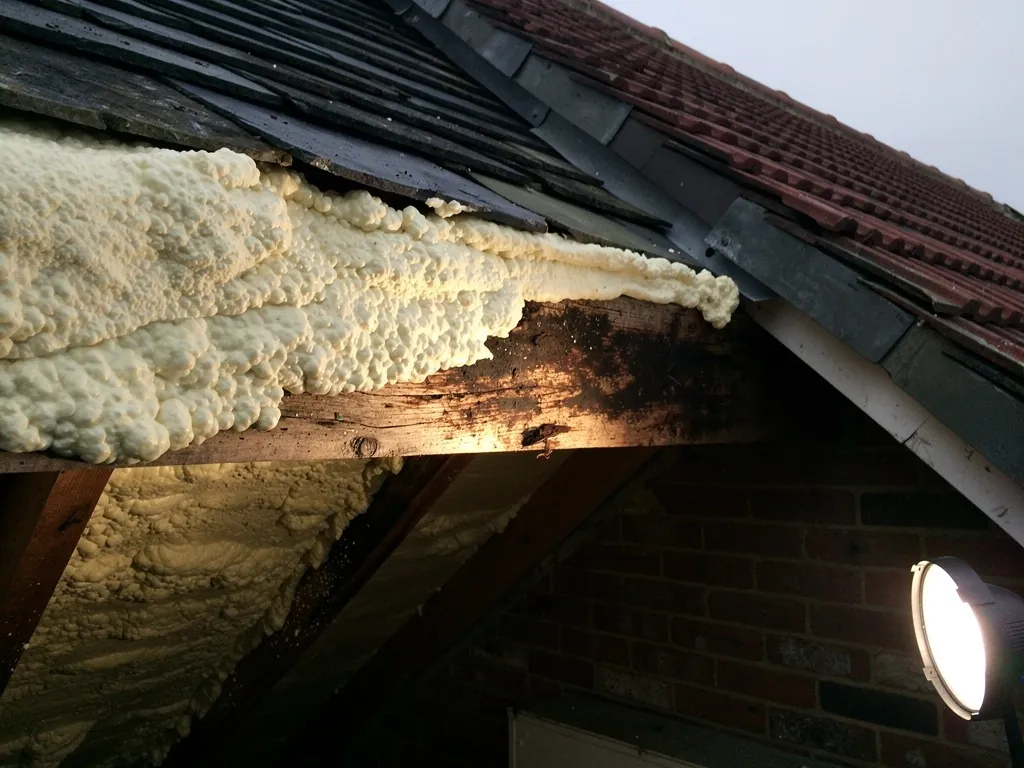
Spray foam cut away revealing damp-stained rafter timber
Torch showing a water-stained rafter beneath slates in a loft

The short answer

Slowly, and on the evidence. We establish the materials, see how the frame has moved and note what earlier repairs have altered. Then we propose the least that will cure the fault for good, and talk consent through with you before anything is ordered or lifted.

Culham has listed buildings of real quality: a fifteenth-century manor, an old bridge begun in 1416, a Georgian house and a church with a tower from 1710. Roof work on any of them is not routine, and it should not be sold as if it were.

What is the survey hunting for on an old frame?

It looks for the route water takes through the roof. On a timber roof, water that gets in will follow a rafter or a purlin and soak the oak where it sits in the wall, long before it appears as a stain. We look for softened timber at the wall plate, for rafters that have moved, for patches of newer material and for sealant used where lead or mortar should be. The photographs of each find are sent to you alongside the quote, so that nothing is left to description.

What is the smallest job that would work?

Often it is a localised repair: refix a few units, renew a flashing, rebuild a short length of ridge, clear a valley. Each is quicker, cleaner and kinder to the old fabric than stripping a slope. When the covering has tired across an entire slope, the sound advice is a larger job. Our roof repairs page explains how we weigh that choice, and what each option involves.

Does listing change what is allowed?

It does. A listed house cannot be altered in ways that touch its special interest without listed building consent, and a roof covering is part of what makes the interest. Mending in matching material, fixed by the old method, is what a conservation officer usually hopes to see. A plan that departs from it goes to the council first, with the reasons. St Paul's is different: it is a working Church of England church, so work on its roof goes through the diocese's faculty system rather than listed building consent from the council.

If a job needs a structural engineer or a conservation specialist alongside a roofer, we tell you so at the survey, and suggest who to involve before a price is agreed.


Q2

What does a roof beside the Thames have to cope with?

The answer

Mostly damp. A village inside a river loop sits in air that holds moisture, so moss, algae and slow drying are common on shaded slopes. They shorten the life of some coverings and block gutters. Regular clearing and clean drainage do more good than most repairs.

Culham sits in a loop of the Thames, with the river on three sides of the parish. A roof there is rarely tested by altitude, but it is tested by moisture, and the faults that follow are slow rather than dramatic: a tile that crumbles, a gutter that sags, a ridge that loosens one winter at a time.

Why does moss matter on a roof?

Moss holds water against a tile or slate, and in a cold spell the trapped water freezes and splits the surface. It also lifts the edges of tiles, and a thick cushion can send rain sideways under the course above. Light moss on a sound roof is cosmetic. Heavy growth on an ageing roof is a sign that the surface is softening. Our roof cleaning and moss removal page sets out the methods, and the one to avoid is a hard jet that scours the face of soft tiles.

What happens to the gutters?

Trees near the water drop leaves and seed, and gutters fill. A full gutter overflows behind itself, so water runs down the wall or soaks the fascia until the board rots. Clearing the run and checking its falls is cheap work, and the difference shows in the before and after photographs we take on site. A sagging section or a leaking joint is easier to deal with in a dry spell than in the middle of a storm.

Should the roof be checked after a wet winter?

Yes, it is a sensible habit. From the ground, look for slipped tiles, sagging gutters and green streaks along the lower courses, and if anything seems wrong, send us a photograph. A short visit in spring costs far less than repairing a ceiling stain in the autumn, and it shows whether the roof will see out another winter without help.

Keep the water moving

Near the river, clear gutters and a clean roof surface prevent more trouble than any single repair.

Q3

Who do I ask before re-roofing in Culham?

Rolled lead roof covering over a bay above white windows
Roofer repointing a stone chimney stack above lead flashing

The short answer

South Oxfordshire District Council, not the Vale, handles planning for Culham, including questions about its conservation area. For notifiable roof work, building control comes from the Southvale service or a registered approver. Listed buildings need consent for anything affecting their character.

Culham is a small parish with a lot of protected buildings, so asking first is cheap and guessing is not. Here is how the pieces fit together, and who answers which question.

Which council deals with Culham?

South Oxfordshire District Council. The village lies about a mile from Abingdon, which is in the Vale of White Horse, and that confuses many people. Planning and conservation questions for Culham go to South Oxfordshire. Building control is provided through Southvale, a shared service operating across South Oxfordshire and the Vale, or through a registered building control approver.

When does a Culham re-cover bring in building control?

Two limits come from the Planning Portal for a re-cover. Touch less than 25 per cent of the total building envelope and less than 50 per cent of the roof, and the work is not normally notifiable. Pass either and approval applies, with insulation to be brought up to date. So does a new covering at least 15 per cent heavier than the one it replaces. Which of these your job meets is something we explain, and the notification is ours to manage.

Does the conservation area change a repair?

Putting right a fault with matching materials seldom needs permission. A different material, or any alteration visible from the street, may. The boundary is drawn and held by the council, so put the question to them when the map leaves you unsure whether your house lies within it, ideally before the work is priced. Our chimney repairs page covers stacks, which are often the most visible part of a village roof.

Who to ask in Culham
QuestionWho to ask
Planning or conservation areaSouth Oxfordshire District Council
Listed building consentSouth Oxfordshire District Council
Building control for a notifiable re-roofSouthvale, or a registered building control approver
Shared wall or stackYour neighbour, with a party wall notice where it applies

Questions from the bridge to the science centre

Why are the roofs of old Culham houses so often damp at the wall plate?

Because the wall plate is where the roof frame bears on the wall, and any water that runs down a rafter ends up there. Failed gutters, a slipped flashing or a blocked valley can wet the timber for years without any ceiling stain. We look there first, with photographs, before recommending work.

Can you quote for flat roofs near Culham Science Centre?

Yes. We survey a flat or low-pitched commercial roof area by area, checking and photographing the falls, outlets and upstands. Access, working hours and the state of the existing membrane are discussed before the price is set. A written ten-year workmanship guarantee covers the work we do.

Does Culham's position on the Thames make storm damage more likely?

Storm damage depends on the condition of a roof far more than on its postcode. A roof with loose ridge tiles, tired flashings or blocked gutters is at risk wherever it stands. After a storm we put leaks at the front of the queue, and make a leaking roof safe before the permanent fix.

Do you cover Abingdon and the villages around Culham?

Yes. The Thames valley villages and towns inside our 30-mile road radius from Swindon are all on the areas page. For an address near the edge, ring us or use WhatsApp, and we will give you a clear answer on coverage.

Ask us about your roof

Tell us what’s happening and we’ll call you back.

  • Photos of what we find
  • A written quote
  • 10-year workmanship guarantee

Or call 01793 626096

Call Get a quote