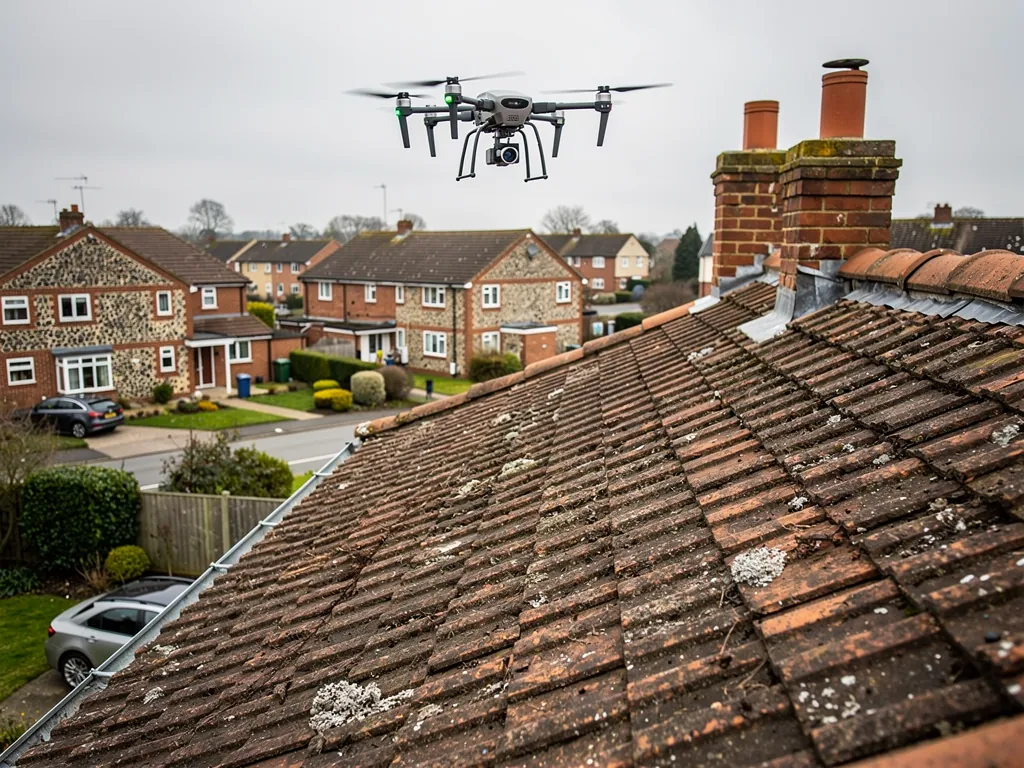
Wet slate and clay tile rooftops with chimney stacks after rain

Roofers in Clifton Hampden

Repairs, replacement coverings, chimney stacks and flat extension roofs in Clifton Hampden and Burcot, from the cottages on the riverbank road to the Victorian buildings that George Gilbert Scott left beside the Thames.

Roofs above the Thames and Scott's village

Old brick and tiled cottages along a village road
Sixteenth and seventeenth century cottages

Several cottages from the late sixteenth and early seventeenth centuries survive in Clifton Hampden, which makes it a village where the roof is often older than anything else on the street. Buildings of that age were put up with steep pitches and heavy, hand-cut timbers, and later owners have re-covered them more than once. A survey on such a house starts under the covering: rafter feet that have sat in damp, battens that have softened, and ridge timbers that have dropped. Only then does it make sense to price a repair, and the written quote we send afterwards reflects what the survey found. A cottage of this kind rewards the smallest intervention that works, and where a roof must be stripped we photograph it as it comes off so the old pattern can be followed.

Victorian gabled house with tall chimneys
Scott's church, manor and bridge

George Gilbert Scott left his mark on the village. He rebuilt the village church between 1843 and 1844, designed Clifton Hampden Manor (listed Grade II) around 1843 to 1846 as a parsonage for Henry Hucks Gibbs, and designed the brick bridge that replaced the ferry in 1867. Victorian roofs of this quality carry steep pitches, tall chimneys and plenty of valleys, hips and abutments, all of which depend on lead and on sound battens. Leadwork from that period has often reached the end of its life, and chimney stacks need their own check. On a building with this much detail, repairs are best planned from the ground up.

Terraced and detached houses under tile
Riverside lanes and newer houses

Clifton Hampden stands on the north bank of the Thames, a little over three miles east of Abingdon, and Burcot joined the parish in 1932. Away from the oldest cottages, houses were built in different decades, so one lane can carry clay tile, concrete tile and the occasional flat extension roof. Riverside air and shade from mature trees keep a roof damp, so moss, blocked gutters and leaf-filled valleys are a regular call-out here. Cleaning gutters twice a year, usually once after the autumn leaf drop, prevents more damage than most people expect. Flat roofs over a garage, a porch or a kitchen addition need their own attention, because a felt or single-ply membrane in its last years gives little notice before it lets water through.

From Swindon to the Thames bridge

Map showing Clifton Hampden and central Swindon. 30 road miles east-north-east of central Swindon.

Distance
30 road miles east-north-east of central Swindon
Council
South Oxfordshire District Council
Council
South Oxfordshire District Council
Conservation area
Clifton Hampden Conservation Area
Setting
North bank of the Thames, east of Abingdon

Clifton Hampden owners: what to settle before roofing starts

Is my Clifton Hampden cottage roof inside the conservation area?

Possibly. The village has a conservation area, and its boundary is a matter for South Oxfordshire District Council. Check the map with the council before you plan anything beyond like-for-like repair.

Why do roofs near the Thames go green so quickly?

Shade, damp air and leaf fall keep the surface wet, and moss follows. We look beneath the growth for slipped tiles before suggesting a clean.

Can you repair roofs on Scott-era Victorian houses?

Yes. We check the lead, valleys and chimney stacks first, because those are what fail on Victorian roofs, then match the replacement tile or slate to the original in dimensions, colour and surface, which lets the mended patch sit quietly among its neighbours.

Q1

How old is the oldest roof in Clifton Hampden?

Torch showing a water-stained rafter beneath slates in a loft
Row of stone cottages with steep stone slate roofs

The short answer

Nobody can date a roof from the road, but Clifton Hampden has cottages from the late sixteenth and early seventeenth centuries, and the structure beneath their coverings may be original. That timber needs careful inspection, because repairs to old frames are different from repairs to modern trusses.

Old roofs are rarely a single age. The frame may be four hundred years old, the battens a century younger and the covering whatever the last owner could afford. When we survey a cottage of that sort, we are reading layers.

Why does the roof timber matter more than the tiles?

Because the tiles are replaceable and the frame is the building. If a rafter foot has rotted where it meets the wall plate, new tiles on top will only hide the problem for a season. We look from inside the loft wherever we can reach, probe the timber with a screwdriver blade, and photograph anything that moves or feels soft.

Will repairs make the roof look new?

Not if we can help it, and it should not. On a house of this age, patched areas should blend with the weathered tiles around them, so we match tile size, colour and texture, and reuse sound existing tiles on the visible slope where we can. The pitched roofing page explains the different coverings.

Does the whole roof have to come off?

Rarely. Repairs confined to the leaking area, with sound tiles reused around it, protect both the building and the budget. If the battens have gone along a full slope the answer changes, and the survey photographs will have shown you why before we say it.

Should an old roof be insulated?

Often it can be, but not with anything that traps moisture against old timber. Good ventilation matters more in a historic roof than a thick layer of insulation, and a poor choice can cause the rot you were hoping to avoid. We will say so if a plan looks risky, and suggest asking a conservation specialist where a building is listed. A loft that has stayed dry for centuries can be upset by one well-meant change, which is another reason to look before you act.


Q2

What do Scott's Victorian buildings need from a roofer?

The answer

They need a roofer who treats the details as the job. Valleys, hips, chimney flashings and verges on Victorian buildings carry far more lead and craftwork than a modern roof, and those details are where the water gets in once the original lead tires.

Victorian roofs were built to be seen. Steeper pitches, tall stacks and decorated ridges give a village its character, and they give a roof more joints than a plain gable. Each of those joints gives rain a chance to find a way inside.

Is old lead worth keeping?

Sometimes, but not often. Lead dressed over a hundred years ago may still be doing its job in a sheltered spot, yet at chimneys and valleys it tends to split, lift or creep downhill, especially where the sheet is long and the fixings were few. Lead is rated by code, from code 3 for soakers to heavier codes for valley gutters, and a modern repair should use a thickness chosen for the position. A short lead flashing in the wrong code fails early. Our lead roofing page explains the codes in detail.

What goes wrong on tall chimney stacks?

Mortar joints weather, pots loosen and flaunching cracks, then rain finds the gaps around the flashing. A stack can look sound from the ground while water is running down the flue. We inspect from the roof, not through binoculars, and photograph the joints so you can see what we mean. A stack that is leaning, shedding brick or bleeding damp into the chimney breast tells its own story, and we describe it in the same words in the written quote.

Do I need scaffolding?

For a stack, a valley or any repair beyond the reach of a ladder, usually yes, and a low figure that leaves it out tends to return as an extra charge. Whoever quotes, ask them to confirm that scaffolding and VAT are included.

Q3

Who approves roof work in Clifton Hampden?

Roofers on a slate roof along a limestone village street
Drone hovering above a tiled roof during a roof survey

The short answer

Clifton Hampden is in South Oxfordshire. The district council handles planning, and building control is shared with the Vale of White Horse through the Southvale service. Notifiable roof work goes to that team or a registered building control approver, and listed buildings need listed building consent.

For most repairs the answer is nobody, because patching and replacing like with like is maintenance. When a job goes further, three routes apply.

What counts as notifiable?

The Planning Portal draws the line at 25 per cent of the total building envelope and 50 per cent of the roof: re-covering that stays beneath both figures is not normally a building control matter, while going over either makes it one, sometimes with a thermal upgrade attached. A replacement covering that adds 15 per cent or more to the roof's weight needs approval as well. We talk through where your job sits at the survey, then handle the notification with the right body.

Does the conservation area change anything?

A repair in kind keeps the village looking as it did, so it is unlikely to need an application. A different material, or any change to how a roof reads from the street, is where South Oxfordshire District Council takes an interest, and early questions save awkward ones later. The council's conservation team can confirm where the boundary runs.

What about Clifton Hampden Manor and the church?

The Manor is listed Grade II, so changes harming its special character need listed building consent, covering included. The church is Anglican, and Church of England buildings used for worship are exempt from the usual listed-building route; the faculty system takes the council's place. Either way we begin from matching materials and tell you the method before anything is ordered.

Our view

Before ordering materials for any job that alters the roof's appearance from the lane, ask the council.

Roofing services in Clifton Hampden

Questions from the riverbank road

Can roof tiles on a sixteenth-century cottage be reused?

Where they are sound, yes, and it is often the right approach on a visible slope. We sort the tiles as they come off, set aside any that are cracked or laminating, and make up the shortfall with matching reclaimed stock. The written quote follows the survey, so you know in advance how much we expect to reuse.

Why does water stain my ceiling when the roof looks fine?

Water often enters a long way from the stain, tracking along a timber or through insulation. Common entry points on older houses are lead at a chimney, a slipped tile above the mark or a blocked valley. Climbing onto the roof and photographing the likely points is faster than guessing from the landing, and it gives you pictures to keep. If the stain grows after heavy rain but not in dry spells, that pattern points to an external entry point; if it appears on cold mornings, condensation is the more likely culprit, and the fix is ventilation rather than tiles.

Do you cover Burcot, Culham and Sutton Courtenay?

We cover Burcot, which joined Clifton Hampden's parish in 1932, along with Culham, Sutton Courtenay, Radley and Abingdon. The areas page lists every place, so you can check an address before you ring.

What does your written guarantee cover on a riverside roof?

Every job comes with our 10-year workmanship guarantee, issued in writing. It stands behind the repair or replacement we carry out. Photographs taken at survey show how the rest of the roof looked when we arrived, so nobody has to argue afterwards about which part was ours.

Ask us about your roof

Tell us what’s happening and we’ll call you back.

  • Photos of what we find
  • A written quote
  • 10-year workmanship guarantee

Or call 01793 626096

Call Get a quote