Flat-roofed garages behind brick semi-detached houses

Roofers in Abingdon

Roof repairs, re-roofing, lead work and flat roofs across Abingdon, from the streets around County Hall and St Helen's to the Victorian terraces and the housing that grew up around the town's brewery and car works.

Abingdon's roofs, from the abbey to the Ock

Old civic roofs and a church tower
Around County Hall and St Helen's

Abingdon grew around its abbey, founded in Saxon times and dissolved in 1538. What survives in the centre is a run of public and church buildings that have been re-covered many times: County Hall, built between 1678 and 1682 on open columns, St Helen's Church, which dates from around 1100, the Guildhall with parts from the 15th century, and the Long Alley Almshouses. Roofs this old are rarely one material from end to end. A slope gets patched, a valley is relined in lead, a parapet gutter is renewed, and the result is a record of past repairs. On a building like this we start by reading that record, so a repair follows what the roof already is instead of imposing something new.

Slate terrace roofs with brick stacks
Canal and railway terraces

The Wilts and Berks Canal opened in 1810 and the railway followed in 1856, and the streets built around that growth are where Victorian roofing shows up. Terraced and paired houses of the period commonly carry slate or clay tile, with brick chimney stacks that have lead flashings at their base, and shallow valleys between neighbours. The faults are familiar ones: nail fixings that have rusted so slates slip, flashings that have split along their folds, and ridge tiles whose mortar bedding has crumbled away. Because these houses sit in rows, a mismatched repair stands out, so we match slate or tile by size, colour and weathering before anything is ordered. Shared stacks and party walls also mean one roof's works can touch the next.

Concrete tile roofs on suburban houses
Twentieth-century estates and extensions

Morland Brewery dates from 1711 and the MG car factory opened in 1929 and closed in 1980, and the town kept growing through the twentieth century around workplaces like these. Houses from the interwar years onward more often carry concrete interlocking tiles, and many have had a flat-roofed kitchen, garage or porch added later. These are the roofs where we meet loosened ridge tiles, tiles cracked by someone walking on them, and flat roofs that hold water. Houses close to the Thames or the Ock, or under big trees, collect moss and leaf litter in valleys and gutters, which is a cleaning and drainage job before it is a roofing one. A short survey separates a nuisance from a real fault.

From Swindon to the Thames at Abingdon

Map showing Abingdon and central Swindon. 26 road miles east-north-east of central Swindon.

Distance
26 road miles east-north-east of central Swindon
Council
Vale of White Horse District Council
Council
Vale of White Horse District Council
Conservation areas
Abingdon Town Centre, Albert Park and Northcourt
Setting
A market town where the Ock meets the Thames, once Berkshire's county town

Abingdon roof questions

Is my Abingdon house inside one of the three conservation areas?

Abingdon Town Centre, Albert Park and Northcourt are all designated. Look at the council's map for your street before changing how a roof looks. Repairs in matching material rarely need anything.

Does the Article 4 direction on Thames Street cover my roof?

Only the four houses at 13 to 16 Thames Street are covered, so most Abingdon homes are unaffected.

Can a split lead valley on an old Abingdon roof be repaired?

Usually, yes. Lead tends to crack at its folds and laps instead of wearing evenly, so a patch or a relined section can leave sound lead alone. The survey shows which.

Q1

What does a roof near County Hall need?

Lead-lined valley gutter between two slate roof slopes
Reclaimed Cotswold stone slates sorted by length beside a limestone wall

The short answer

Care first, and a light hand. Old roofs in Abingdon's centre have usually been mended many times, so we read the existing work before touching it, repair the part that has failed, keep sound material, and match anything new to what is already there.

The centre of Abingdon was built up over many centuries, and its roofs show it. The abbey was dissolved in 1538, County Hall went up in the late seventeenth century, and the Guildhall and St Helen's carry work from much earlier. A roof in streets like these has usually been mended, relined and partly re-covered more than once, so the first job is reading what is already there.

Why is lead used so much on old roofs?

Lead can be dressed into awkward shapes, which is why it turns up in valleys, parapet gutters, hips and the flashings around chimneys and walls. A valley forms wherever two slopes run together, and lead carries the water down that joint instead of through the ceiling. It fails in predictable ways: splits at the folds, cracks where it was folded too sharply, and lifted edges where the fixings have given way. A split in one section often means a patch or a relined length rather than a new roof, and our lead roofing page explains how a lead code is chosen for the job.

What do you check before touching a historic roof?

We look at the structure first. Rafters, purlins and wall plates that have moved over centuries tell you whether the problem is the covering or what holds it up. We photograph every slope, then repair the failed part and keep the sound material around it. Where new slates, tiles or stone are needed, they are chosen to suit the existing roof in size, thickness and tone so the repair settles in. Our roof repairs page covers the way a repair is planned.

Does a church or listed building follow different rules?

Yes. Where a church is in Church of England use, the faculty system applies and listed building consent is not the route. Other listed buildings need consent for alterations that change their character, and a different roofing material counts. We explain which route applies before any work is priced, and the council's conservation team has the final say on what counts as a change of character.


Q2

Who approves roof work in Abingdon?

The answer

For planning, the body to ask is the Vale of White Horse District Council. Southvale, the shared building control service, or a registered building control approver checks notifiable roof work. Plain repairs seldom involve either, whereas a large re-roof or a listed building will.

Most roof work in Abingdon needs no application at all. Refixing slates, replacing broken tiles and re-bedding a ridge in matching material counts as maintenance. Three situations change that.

Where does a larger re-roof tip into approval?

Under the Planning Portal's guidance, repairing or re-covering a roof is not normally a building control matter provided less than 25 per cent of the total building envelope is affected and less than 50 per cent of the roof. Beyond either figure, approval is required, and insulation may be upgraded as well. It also applies where the new covering is 15 per cent or more heavier. The Vale of White Horse uses the shared Southvale building control service, with a registered building control approver as the private alternative. On a notifiable job we do the paperwork and tell you which route applies.

What changes inside the three conservation areas?

Abingdon Town Centre, Albert Park and Northcourt are all conservation areas. Putting back what was there, in the same pattern, is not normally development, so planning permission is rarely needed. A different covering or a reworked front slope is what the council's planning team will want to see first. Our guide to tiled roofs in conservation areas covers the points councils care about.

Does the Thames Street direction affect my house?

It matters only for the four houses at 13 to 16 Thames Street. The Vale's one effective Article 4 direction, served in 1995, covers those four houses and removes the right to alter or enlarge the dwelling and to paint its exterior without an application. For every other Abingdon home it does not apply, though a listed building or a planning condition can still limit what you do.

If you cannot tell which of these fits your address, ring the council to check; we can help you phrase the question ahead of the survey.

Our view

Ask the council about the address before the work is priced, not after the scaffold is up.

Q3

Should I patch or re-slate a Victorian terrace roof in Abingdon?

Terraced house roof stripped to rafters inside scaffolding
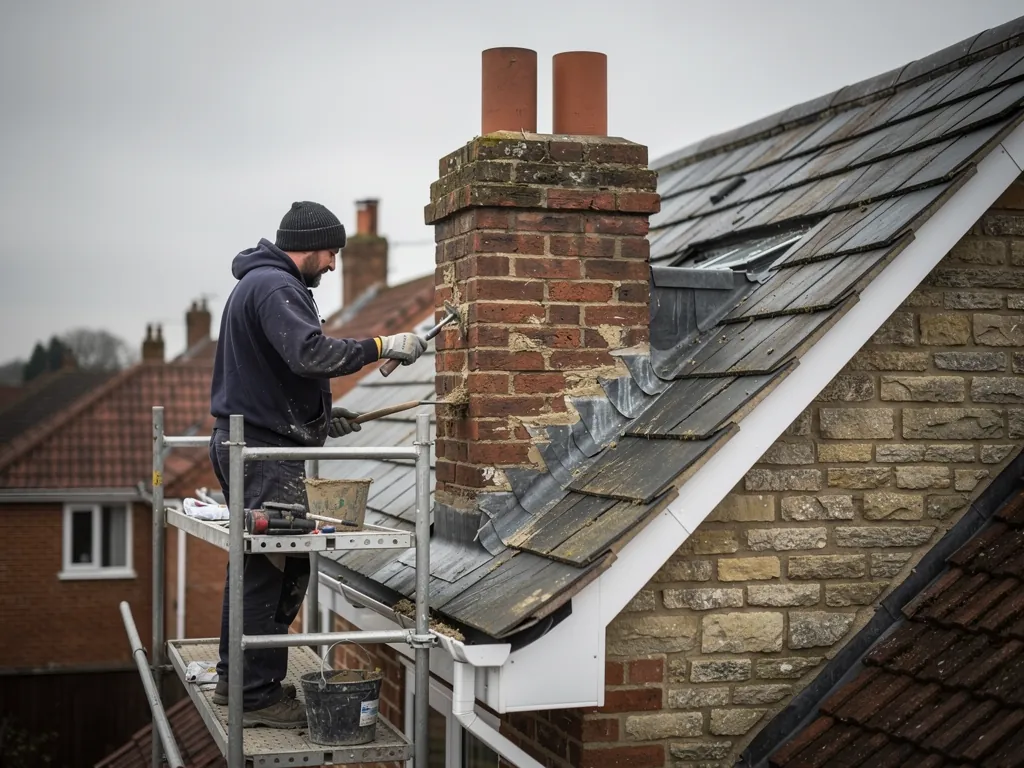
Roofer repointing a brick chimney stack from scaffolding

The short answer

Patch when the slates are sound and the fixings have failed in places. Re-slate when the slate itself is breaking up. The survey photographs show which applies, and we recommend the smaller job whenever it properly cures the fault.

Abingdon grew quickly after the Wilts and Berks Canal opened in 1810 and the railway arrived in 1856. The terraces and pairs of houses from those years are some of the town's oldest ordinary roofs, and the decision that comes up on them is whether to patch or re-slate.

How do I tell whether the slates have reached the end?

Look at the nails, not only the slates. MyBuilder's slate roof guide (updated 21/08/2026) puts the life of Welsh slate beyond a hundred years, so the stone often outlives the iron nails that hold it. When slates slide, the fault is usually the fixings, and a slope with a scatter of slipped slates but sound battens and underlay can be repaired. Once the slate itself delaminates, flakes or breaks underfoot, re-slating is the honest answer. Survey photographs show the difference.

What does re-slating cost per square metre?

MyBuilder prices an installed slate roof at £100 to £180 per m²: £140 to £180 for Welsh, £100 to £130 for Spanish and £110 to £150 for reclaimed (updated 21/08/2026). Those are national typical figures, not our prices. On a terrace, what moves the cost is access, how much of the roof is stripped and whether the timbers beneath need work. Our written quote arrives after the survey. Whichever firm you ask, check whether the price covers VAT and scaffolding. Our slate roofing page goes further.

What about the chimney stacks on a terrace?

Stacks on Victorian terraces are often shared, so the work can reach a neighbour's roof. Leadwork round the base, pointing on the stack and the flaunching on top (the mortar that holds the pots in place) wear out before the slate does. Our chimney repairs page explains the order of work. A neighbour notice under the Party Wall etc. Act applies only where work cuts into a shared wall or takes a chimney off one.

MythAny slipped slates call for a brand-new roof.

FactSlipped slates on an otherwise sound roof are usually a fixing problem, and a repair can put them right.

Roofing services in Abingdon

Questions from Abingdon's old streets and newer estates

Why do old Abingdon roofs need lead as well as tile or slate?

Slate and tile shed water well across a plain slope but cannot seal the awkward joints: valleys, the foot of a chimney, a wall abutment, a parapet gutter. Lead is dressed into those places, and it is usually the first part of an old roof to need attention. A split in lead can look like a failed covering from inside the house, which is why the survey traces the water back before anything is replaced.

Do you take on roofs beside the Thames or the Ock?

Yes. Roofs near water and under mature trees tend to collect moss, leaf litter and damp in gutters and valleys, so we start by clearing and checking drainage, then look at the covering. Our written quote follows the survey and carries a 10-year workmanship guarantee in writing. Access is planned beforehand, and clearing up after ourselves is part of the job: all the waste goes with us.

Do you reach the villages around Abingdon?

Yes, wherever they fall within 30 road miles of Swindon. Abingdon sits towards the edge of the area we cover, so some of the villages on its far side may fall outside it. The areas page names every place within reach, and a call to 01793 626096 or the enquiry form will settle any doubt.

Is a garage-block or workshop flat roof something you take on in Abingdon?

Yes. Flat roofs on garages, workshops and small commercial units are repaired or recovered with felt, EPDM or GRP, depending on the deck and the fault. We trace the leak, tell you whether a repair properly solves it, and if it does not, say why. Our flat roofing page explains the choices.

Ask us about your roof

Tell us what’s happening and we’ll call you back.

  • Photos of what we find
  • A written quote
  • 10-year workmanship guarantee

Or call 01793 626096

Call Get a quote