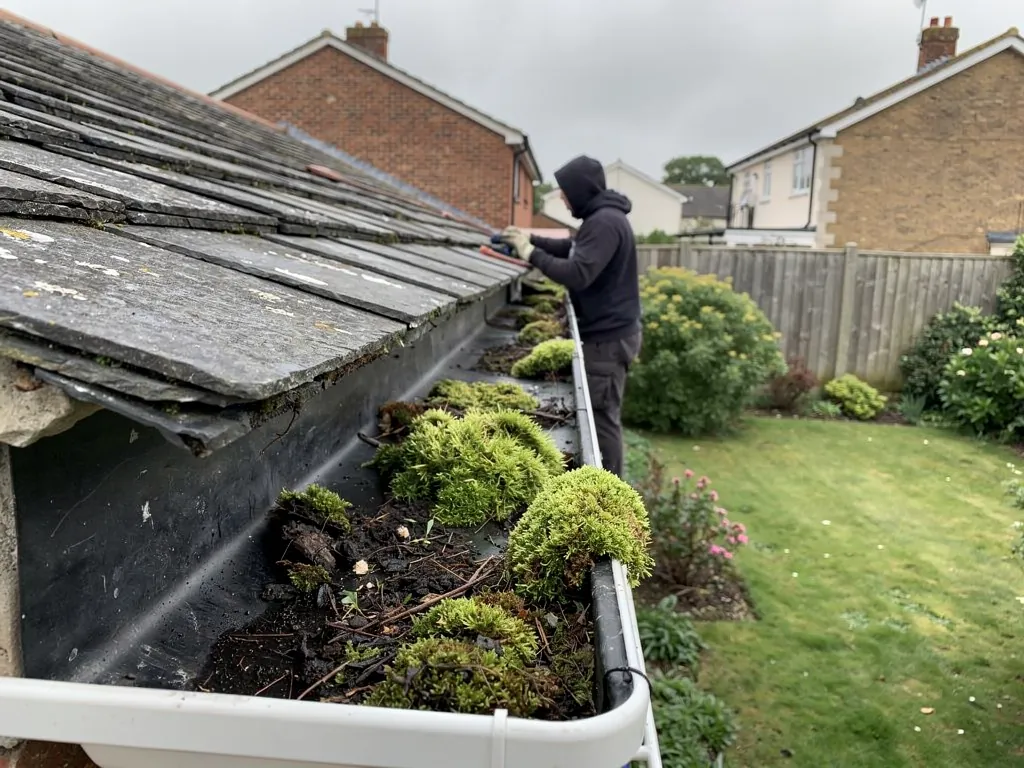
Rear tiled roof of a brick semi seen from the garden

Roofers in Marcham

Roof repairs, new coverings, stacks and flat roofs for Marcham, from the stone cottages near All Saints to the newer streets, the hamlets of Cothill and Gozzard's Ford, and neighbouring Frilford and Garford.

Marcham's roofs, from Priory to hamlet

Stone cottages with thatch and tile
Stone cottages and the Priory

A Victoria County History account written in 1924 says most of the cottages in Marcham are built of stone, with several carrying thatched roofs, and describes the Priory as a mid-sixteenth-century stone building. Thick stone walls change how a roof is repaired. They hold the weight of the rafters well, but they also take in water through failed flashings and cracked pointing, and they dry slowly. So at the abutments, chimneys and eaves of a cottage like this we look at the lead and the mortar joints as carefully as the tiles. Thatch is its own trade; our work sits beside it, on the tiled and slated roofs, the stacks that rise through a thatched one, and the porches and extensions added behind.

Victorian terrace with clay tile roofs
Church, mill and the village core

All Saints is a Perpendicular Gothic church with an early thirteenth-century west tower, largely rebuilt in 1837 and 1838, and a mill has stood on the Ock at Marcham since the eleventh century. Around buildings of this standing, the tiled and slated houses of later centuries mark the village's growth. The common fields were enclosed in 1836, and the village's Victorian houses tend to carry clay tile or Welsh slate. Typical faults on them are slipped and cracked tiles, rotten battens under old felt, lead gutters that have split along their seams and ridge tiles whose bedding has let go. Roofs of this age reward inspection from inside the roof space as well as from the ladder, because the timbers and the underside of the covering tell the longer story. Daylight showing through the boards, damp patches on rafters and old drips marked in the dust all point to where water has been getting in.

Modern bungalows with concrete tiles
Newer streets and the outlying hamlets

The parish reaches beyond the village to Cothill and Gozzard's Ford, and Frilford and Garford, once part of it, lie close by, so the building stock ranges widely. Houses and bungalows built later often carry concrete interlocking tile on shallow pitches, with garages, porches and rear extensions under flat roofs. Their roofs fail in different ways from the old cottages: tired underlay at the eaves, ridge tiles held by mortar alone, valley gutters that clog and cracked bonding along a flat roof's upstand. A garage roof that has been patched twice usually wants a proper survey before a third patch goes on, because the deck may be wetter than the surface suggests. If the boards have started to soften, a patch only hides the problem for a season or two, and the smallest job that properly fixes it may be a new covering over a sound deck.

From Swindon to the Ock valley

Map showing Marcham and central Swindon. 23 road miles east-north-east of central Swindon.

Distance
23 road miles east-north-east of central Swindon
Council
Vale of White Horse District Council
Council
Vale of White Horse District Council
Conservation area
Marcham, shown on the council's map of designated areas
Setting
An Ock valley village between the River Ock and Sandford Brook

Marcham roof questions

Is Marcham a conservation area?

Yes, the Vale of White Horse council maps one. A repair in matching materials rarely needs consent, but check the map and ask the council before you alter a roof's look.

Will you work beside a thatched cottage in Marcham?

Yes. Our remit is the tiled and slated parts of a house, its stacks and its flat roofs, and we shield any thatch beside the scaffold while we are up there.

Does the Ock valley setting affect roof upkeep?

It makes shaded slopes, gutters and flashings worth a regular check, since moss and blocked drainage build up where air moves slowly.

Q1

What should a Marcham stone cottage roof be made of?

Lead-lined valley gutter between two slate roof slopes
Brick and limestone cottages around a small village green

The short answer

Whatever was fitted when the cottage was built or last properly renewed. A 1924 history records the village cottages as stone, several of them thatched. Repair in the same covering, and spend the money on the unseen parts: battens, underlay, lead and the stack.

The 1924 Victoria County History entry for Marcham notes that most village cottages are of stone and several have thatched roofs. A century has passed since then, so the sensible approach is to read each roof for what it is rather than assume.

How do you read an old roof?

A tiled cottage roof will often show its history in layers: handmade clay tiles on the oldest slopes, machine-made replacements where a section was redone, and a mixed patch where a repair used whatever was to hand. We survey the whole slope, photograph the underside where we can reach it, and note which parts are original so the repair plan respects them. That record also helps you later: if a new owner or the council asks what the roof was like, you have dated pictures.

Why do stone walls and wet roofs mix badly?

Solid stone walls cope with damp by drying outwards, and that only works if the roof sheds water cleanly. A leaking gutter or a failed lead tray can keep a wall wet through several winters while the inside face stays dry-looking. Our roof repairs page explains how we trace leaks back to their source before fixing the symptom.

Where does thatch meet other roofs?

Thatched cottages usually have a tiled or slated outbuilding, porch or extension next to them. Thatch is specialist work and belongs with thatchers, but the junction between the two coverings, the chimney stack through the thatch and the gutter below are ours to look after. We keep sparks, hot work and falling debris well clear of the straw, and lay sheeting before any lead is dressed beside it.

Unsure what covers your cottage? Photographs or a survey will settle it. Naming the covering is quick, and it comes with a clear note of what needs doing.

Q2

Does Marcham's conservation area limit a re-roof?

The answer

Seldom for a like-for-like job. The Vale of White Horse council maps a Marcham conservation area and its only Article 4 direction in force is at Thames Street in Abingdon, so none reaches Marcham. Changes to how the roof looks, or work on a listed building, are where consent comes in.

Conservation areas control demolition and trees, and they can limit changes that alter a building's appearance. They do not prevent ordinary roof maintenance. The council lists Marcham among its designated conservation areas and publishes a map of the boundary. Its planning team can say what matters for your house, and a short email with a photograph and your address is usually enough to start the conversation. Do it before work is priced, because the answer can change the specification, and a roofer who finds out halfway through a job has already spent your money.

What does the Article 4 position mean?

An Article 4 direction withdraws permitted development rights that would otherwise apply. The district council lists a single direction in force, covering 13 to 16 Thames Street in Abingdon. Nothing in Marcham is covered, so permitted development rules for houses apply as normal, with the usual conservation area limits.

When should I ask the council first?

Swapping clay tile for concrete, opening a new window in a front slope or rebuilding a stack that faces the street are changes worth raising with the council first. Our roof window pages cover the planning rules for those jobs, so we do not repeat them here.

What about listed buildings?

The church and the Priory are historic buildings, and a listed property anywhere in the village needs listed building consent for any change touching its character.

Where Building Regulations apply to a larger re-roof, the Vale of White Horse uses the Southvale building control service shared with South Oxfordshire, or the private route through a registered building control approver is open to you. We explain the choice and deal with the notification.

MythIn a conservation area, every roof repair needs an application.

FactMatching repairs usually do not; a change in how the roof looks does.

Q3

Should roofs beside the Ock be checked more often?

Blocked gutter full of leaves overflowing down a brick wall
Roofer clearing clumps of moss from a gutter below old tiles

The short answer

A little more often, yes, if the slope is shaded or the gutters are old. Marcham lies between the River Ock and Sandford Brook on low ground, where damp air lingers. A yearly look at gutters, valleys and flashings catches most problems while they are cheap to fix.

Marcham sits between the River Ock to the south and west and Sandford Brook to the east, at roughly 200 to 300 feet above ordnance datum, and a mill has stood on the Ock here since the eleventh century. Valley settlements like this are not exposed in the way a hilltop is, but damp lingers in them, and roofs under trees stay wet for longer.

What do moss and shade do to a roof?

A thick mat of moss on a shaded slope keeps the tile wet, and frost then flakes its face. Brushing it off gently and clearing the gutters below is usually enough. We advise against pressure washing, which drives water under the laps and strips the face of old tiles, so any cleaning we do is by hand and brush. Our moss removal page covers when cleaning helps and when it hides a bigger fault.

Why do gutters matter so much?

Gutters that overflow soak walls and rot fascias on old cottages. Look for stains under joints, plants growing in the run and water running down the wall in rain. A blocked outlet takes minutes to clear and can save a repair that costs far more.

What about flat roofs and extensions?

Rear extensions and garages with flat roofs collect leaves and standing water. If a puddle is still sitting there two days after rain, the fall is poor, and the membrane will age faster beneath it. Ponding is worth a photograph, because it tells us whether a repair will hold or whether the deck needs attention.

None of this is dramatic. After a storm, look for slipped tiles on the lawn, a gutter hanging away from the fascia or a dark streak on a bedroom ceiling, and call us if you see one. A short check each autumn and after any storm is the lightest maintenance a roof can have.

Our view

In a valley village, clear gutters and shaded slopes each autumn before they cause damage.

Questions from the Ock valley

Why do Marcham's cottages mix stone walls with tile and thatch?

Stone was the building material to hand, and the roofs on top changed with fashion and cost. A 1924 account records most cottages as stone with several thatched, and clay tile and slate came in later. A single house can carry more than one covering after centuries of repairs and extensions.

Can you repair a chimney that rises through a thatched roof at Marcham?

Yes. Stacks need flashing, flaunching and pointing like any other, and we work carefully around the thatch, keeping flame and debris away from it. Where the stack meets the straw, a thatcher should be involved in the finish, and we coordinate with them.

Do you cover Frilford, Garford, Cothill and Gozzard's Ford as well as Marcham?

Yes. Each sits well inside the 30-mile ring of roads around Swindon that we cover. Name your settlement on the enquiry form, and the survey visit can be planned with others in the area.

Are ridge tiles on Marcham's older tiled houses bedded in mortar alone?

Often, because that was normal for generations. Since the 2014 revision of BS 5534, ridges are not left to mortar alone, so we bed them with mechanical fixings or a tested system that clips the ridge down. The extra step costs little and keeps a tile from working loose.

Ask us about your roof

Tell us what’s happening and we’ll call you back.

  • Photos of what we find
  • A written quote
  • 10-year workmanship guarantee

Or call 01793 626096

Call Get a quote