Clay tile and slate rooftops of brick market-town terraces

Roofers in Seend

Seend roofing for houses old and new: leak repairs, full re-coverings, chimney stacks and flat extensions, from stone and brick near Holy Cross church to the modern streets across the hill.

Seend's roofs, high above the canal

Stone church tower beside old roofs
Around Holy Cross church

Holy Cross church is built of rubble stone faced with ashlar, which is cut and squared stone, and was listed Grade I in 1962. Seend Manor House, dated 1768, and its neighbour Seend House both sit at Grade II*. Buildings with that pedigree set the tone nearby, and a roof on or beside one is worked on with the listing firmly in mind. The faults we meet are the slow kind: lead worn thin where a roof touches a chimney or a wall, ridges that have crept out of line, verges that let rain into the top of the wall. We begin by finding which one is actually leaking, since the narrowest repair is nearly always the gentlest on an old roof.

Red brick gable with stone corner quoins
Chapel brick and stone quoins

Seend Methodist Chapel, put up in 1774 and 1775, is red brick with ashlar quoins, the squared stones that pick out the corners of a wall. It shows how brick and stone were paired on older buildings here. A brick house of that kind normally ends in gables, and the gable verge, where tile or slate finishes against the end wall, is its soft spot. Bedding mortar weathers, the roof edge lifts in a blow and rain tracks in behind it. Brick chimney stacks bring a matching pair of troubles: pointing that has eroded and flashings that have pulled out of their joints. Both call for a repair, not a new roof.

Slate and tile roofs across a village hilltop
Ironstone years and newer streets

Ironstone quarrying got going after the railway opened, and 77,984 tons of brown haematite came out of the ground between 1855 and 1861. Across Wiltshire, houses of that period were often covered in Welsh slate or clay tile, which the railways made easy to bring in, and the survey tells us which a Seend house of that age actually has. Beyond the old core stand later houses, along with low-slung garages, porch roofs and rear extensions that sit flat or nearly so. Their usual complaints are ridge tiles that have worked loose, tiles split by frost, felt that has worn out on a porch and guttering that droops between its brackets.

From Swindon to the hilltop above the canal

Map showing Seend and central Swindon. 24 road miles south-west of central Swindon.

Distance
24 road miles south-west of central Swindon
Council
Wiltshire Council
Council
Wiltshire Council
Conservation area
Seend, designated in 1973
Setting
A hilltop village, with the Kennet and Avon Canal about 0.4 miles to the north

Seend roof questions

Does Seend's conservation area affect a re-roof?

Seend's conservation area dates from 1973, and Wiltshire Council expects a call about anything visible. Repairs that copy the old material rarely mean an application, whereas a changed covering or a listed house deserves that call first.

Do Seend's Grade II* houses need special roofing?

For a Grade II* house, listed building consent stands in front of any alteration to its character, roof covering included. We copy what is already up there and settle the method with you before any price is set.

How does a roof on Seend's hilltop cope with wind?

A roof more than 90 metres above sea level on open ground has more edges facing the weather than one tucked into a street. Ridge, verges and hips take the load, so their fixings are checked first.

Q1

What makes old Seend roofs leak?

Weathered brick chimney stack with eroded joints and cracked pot
Blocked gutter full of leaves overflowing down a brick wall

The short answer

With old stone and brick, the tiles or slates themselves are seldom what lets go first. Lead against a chimney or wall, the mortar along verges and ridges, and the fixings underneath fail ahead of them. Tracking down which one is the real task.

A roof that has sat on a hilltop for generations picks up small faults, and rain exploits the weakest. In Seend the older houses are stone and brick, so wall heads, chimney stacks and roof edges meet the weather first.

Why does lead fail at the junctions?

Flashing is the lead, or in cheaper repairs mortar, that seals a roof to a wall or stack rising beside it. Lead that was fitted properly outlasts most things on a roof, yet it creeps downhill and splits, and old mortar fillets crack away from the brick. Around a stack or gable wall, a leak usually means a flashing edge has risen or a joint has opened. A soaker, the folded lead piece under each course of slate or tile against a wall, stays hidden until the covering is lifted, so we inspect the visible flashing and open up only what we must. More on stacks sits on our chimney repairs page.

What goes wrong at verges and ridges?

The verge is the sloped rim of a roof where it ends beside a gable wall. If it relies on mortar, the bedding weathers and a gale can get under the edge. Ridge tiles on older houses were often bedded on mortar by itself. Since BS 5534:2014, a ridge cannot lean on mortar alone, so any ridge we rebed is also mechanically fixed. Up on an open hilltop, that extra grip is worth having.

What is going on behind the covering?

Under the tiles, old battens go soft, nails rust through and the timber at the eaves soaks up damp. A tile that has slid is often a symptom of this, not the cause. When we find it, the survey photographs show you the same thing, so the written quote answers the actual fault rather than a guess.

Gutters cause quiet damage. A blocked or sagging run pours water down a brick or stone wall in place of carrying it away, and staining beneath the eaves gives it away. Clearing and realigning a gutter is a small job that can head off a bigger one.


Q2

Should a worn Seend roof be repaired or replaced?

The answer

Mend it when mending properly cures the fault, replace it when it does not. A roof with a handful of slipped tiles and sound timbers wants a repair. A covering failing across a whole slope, or soft rafters and battens, points towards a new one. The survey photographs settle it.

Repair wins more often than owners expect, and we recommend it whenever it truly cures the problem. A new covering earns its place when repairs would only follow a worn-out roof from one leak to the next.

When is a repair enough?

One cracked tile, a raised flashing, a loose ridge or a crumbling length of verge is a local fault. It can be cured without touching the rest, and the covering beside it keeps working. On a listed or ageing house, the smaller job also leaves more of the original in place. Our roof repairs page explains how we go about it.

When is replacement the better call?

Where a whole slope is shedding tiles, slate is splitting into layers, battens crumble in our hands or one patch leaks again after a mend, stripping and re-covering makes sense. A slate roof can often be re-laid with its sound slates reused. A later concrete-tiled house usually gets a new covering over new battens and underlay. Our roof replacement page sets out the process and what moves the price.

What moves the cost of a Seend roof?

Access comes first. A house on a narrow lane may need scaffold in one precise place, and a chimney asks for a platform of its own. The covering you pick, the size and pitch of the roof and whatever the survey finds under the old material decide the rest. National guides put a roof replacement for a semi-detached house at £5,000 to £12,000 (MyBuilder, updated 21 August 2026), and a hilltop house could land inside or outside that band. A written quote follows the survey, one total for your roof. If other quotes are on your table, see whether VAT and scaffolding are inside them.

Our view

Fix what is leaking, and replace the roof only when it has stopped being worth repairing.

Q3

Which roof jobs in Seend need approval?

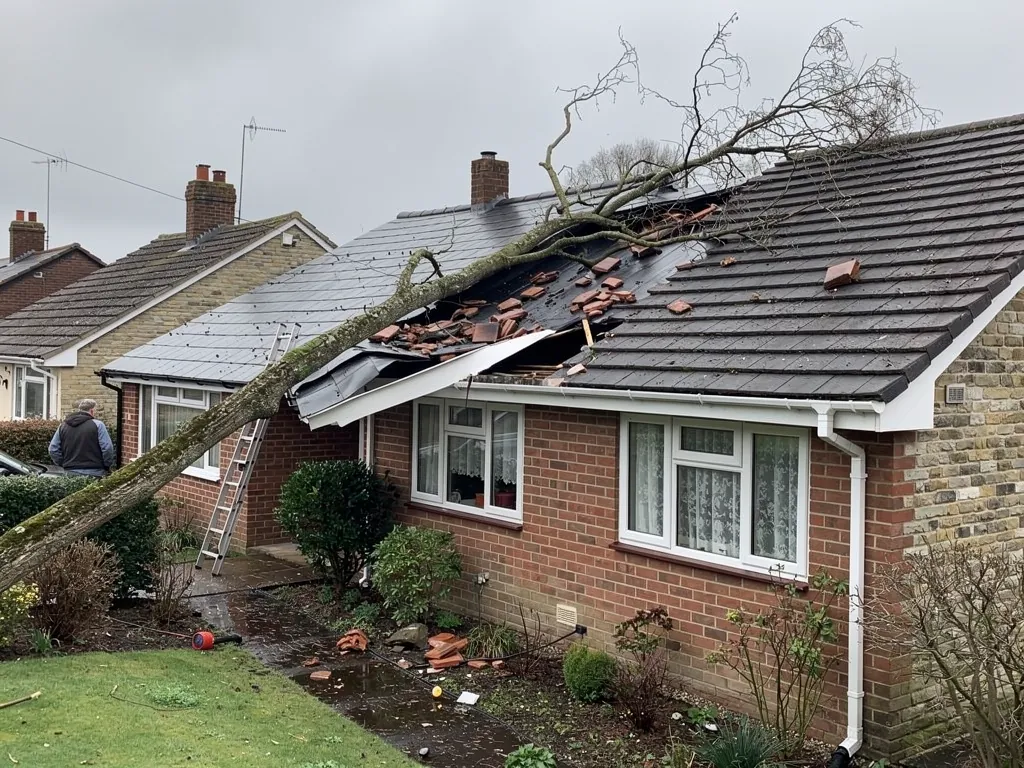
Fallen tree branch lying across a damaged bungalow roof
Brick end-of-terrace gable beside a limestone house, slate roofs

The short answer

Most repairs need nothing. Re-covering a large part of a roof can fall under Building Regulations, a much heavier covering needs approval, while a listed building must have listed building consent before its character is altered. Notifiable work goes to building control, either Wiltshire Council's team or a registered approver.

The great majority of Seend roof jobs need no permission whatever. Renewing broken tiles, refixing slates or rebedding a ridge in matching material is upkeep. Three situations differ, and each is covered below.

When does a large re-covering need approval?

Under the Planning Portal's test, you normally avoid a building control application when under 25 per cent of the total building envelope and under 50 per cent of the roof is touched. Go further and Building Regulations approval applies, and the roof's insulation may then need upgrading under Building Regulations too. A covering 15 per cent or more heavier needs Building Regulations approval as well. On notifiable jobs we tell you what consent is needed and deal with the Building Regulations notification, using Wiltshire Council's building control team or a registered building control approver.

What if the roof will look different?

Seend's conservation area dates from 1973, and Wiltshire Council's planning and conservation teams decide what counts as a change to its character. A re-roof in identical material leaves the house looking the same and seldom needs planning permission. A new type of covering, or alterations you can see from the lane, are best raised with the council before you commit, because asking first costs far less than undoing work afterwards.

What about the listed houses and the church?

Holy Cross is a Grade I church, and Seend Manor House and Seend House are Grade II*. A listed building is protected in law: any change touching its character requires listed building consent, and the roof covering falls within that. The Church of England's churches in use sit outside that system, which works through a faculty instead. For a house you think may be listed, we help you check the council's records before pricing starts.

MythAnything you do to a roof in Seend's conservation area needs planning permission.

FactRarely, for a matching repair. The council examines a change of material or of appearance.

Hill, canal and chimney questions

What suits a red brick house with stone corner quoins?

A covering and fixings chosen for that house, not a standard job. Brick with stone quoins, like the Methodist chapel, usually ends in gables, so verges and corner junctions get our attention first. We mend them in matching tile or slate, rebed or fix the ridge, and leave the brickwork and quoins alone wherever we can.

Do you cover Seend and the villages between Devizes and Melksham?

Yes. Seend is well inside our 30-mile patch around Swindon, along with the villages and market towns beside it. The areas page names each place if you want to check yours.

What do you put in writing after a Seend survey?

The quote is written, and your own roof's survey photographs travel with it. Our workmanship is guaranteed for 10 years, in writing. Offcuts and old tiles leave with us, and nothing is left behind.

Do old Seend chimneys need scaffolding to repair?

A stack that rises well above the eaves often needs a proper platform, for safe working and to reach flashings and pointing on every face. A low stack beside an easy slope may not. The survey decides, and the written quote says whether scaffolding is in the price.

Ask us about your roof

Tell us what’s happening and we’ll call you back.

  • Photos of what we find
  • A written quote
  • 10-year workmanship guarantee

Or call 01793 626096

Call Get a quote