Roofers on a buff brick estate house with grey tile roofs

Roofers in Rowde

Pitched roofs, flat porches and garages, chimneys and lead work in Rowde, from the seventeenth-century buildings near the George and Dragon to the modern brick-built houses that make up most of the village.

Rowde's roofs, from Tanis to the canal

Old timber-framed cottage with a tiled roof
The village centre

Some seventeenth-century buildings survive in the middle of Rowde, the George and Dragon among them. A thatched, timber-framed pub on the site now occupied by the Cross Keys burned down in 1938. What survives from that era needs sympathetic handling. Buildings that old are often timber-framed or have thick, soft walls built in lime, and these walls breathe in a way modern cement-rich mortar does not allow, and their roofs have moved and settled for centuries. A repair has to respect that: stiff modern mortar against old masonry causes damage, and gutters fixed too tight to a wavy fascia leak at every joint. We keep repairs small and use materials that suit the wall they sit on.

Brick houses with tiled roofs and chimneys
Brick-built housing

Most of the village's houses are modern and brick-built. Where houses of that kind carry tiled roofs, the weaknesses are predictable. Ridge and hip tiles bedded only in mortar loosen over the years. Verges, the sloping edges of the roof where it finishes beside a gable wall, crack and let wind-driven rain in behind the tiles. Felt under the battens tears where it was lapped badly, and lead around chimneys splits when it has been squeezed into a groove without room to move. Many of these are repairs rather than replacements, and a good survey separates the two quickly.

Flat garage roof edge with a small gutter
Extensions, garages and outbuildings

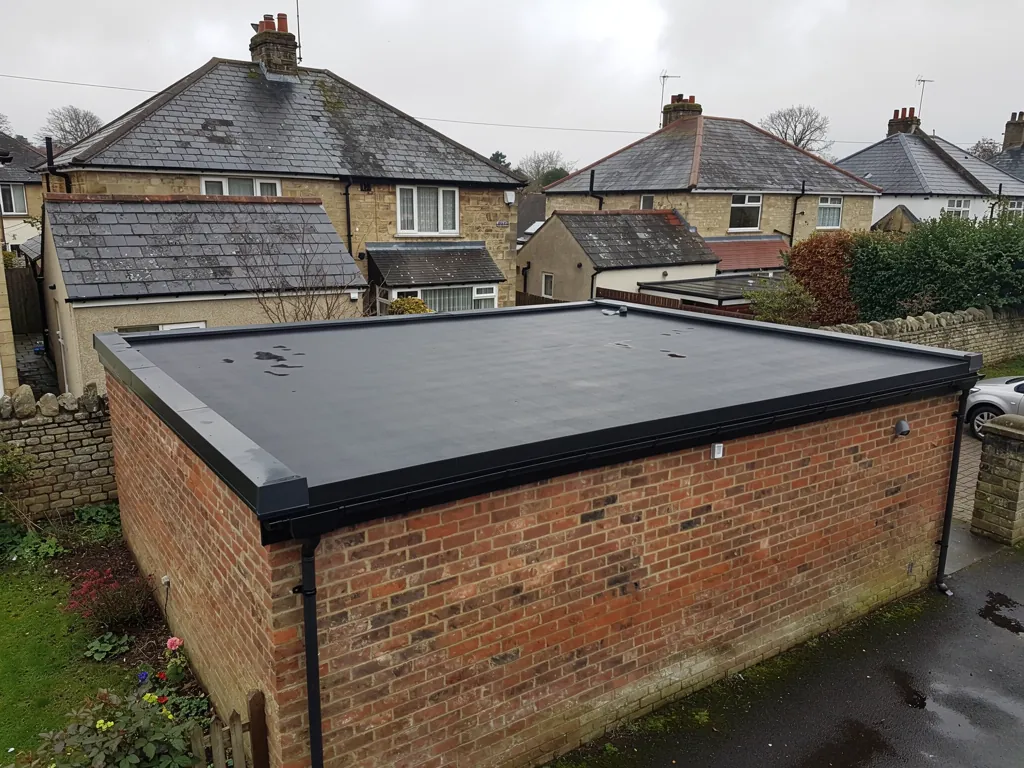
Alongside the houses you find garages, porches, conservatory roofs and rear extensions, and several of these have flat or very shallow roofs. Those roofs behave differently from the main house. A flat roof needs a fall so water runs off, outlets and gutters that stay clear, and upstands where it meets a wall that are sealed and flashed properly. When one fails, the leak often shows up in a ceiling far from the cause. We trace it from the surface, tell you whether patching will hold, and say plainly when a flat roof has reached the point where re-covering is the sensible choice.

Rowde, on the A342 north-west of Devizes

Map showing Rowde and central Swindon. 22 road miles south-west of central Swindon.

Distance
22 road miles south-west of central Swindon
Council
Wiltshire Council
Council
Wiltshire Council
Setting
A village beside the Caen Hill flight of the Kennet and Avon Canal, west of Devizes

Rowde roof questions

Is Rowde's old centre protected for roof work?

Individual buildings may be listed, and St Matthew's church is Grade II*. Whether your own address has any protection is something Wiltshire Council's planning team can tell you before work starts.

Why does the flat roof on my Rowde garage keep leaking?

Usually at the edges: a split upstand, a blocked outlet, or water ponding where the fall has gone. We trace the point of entry before recommending a patch or a new covering.

Do brick-built Rowde houses need roof attention as they age?

Yes, typically at the ridge, the verges, and the lead at chimneys. These are fixings and flashings rather than whole-roof failures, and they respond well to repair.

Q1

What lies behind a leak in a Rowde garage roof?

Blocked gutter full of leaves overflowing down a brick wall
Brick garage finished with a black rubber flat roof

The short answer

Most flat garage and porch roofs leak at the edges and junctions, not in the middle of the covering. Splits at the upstand, a blocked outlet, a gutter that has dropped, or ponding in a dip are the usual causes, and a survey finds which one it is before anyone talks about replacement.

A flat or shallow roof is a sheet of waterproofing laid over a deck, with a slight fall to move water to one edge. When it leaks, people tend to assume the whole covering has failed. Often it hasn't, and treating it as if it had can mean paying for a new roof when a repair would have held.

Why do edges and upstands fail first?

The upstand is the strip where the waterproofing turns up a wall. If the wall is brick, the top edge needs a flashing or a chased-in lead strip that sheds water over it. Sealant alone dries and cracks. A failed upstand lets rain run down behind the covering, and the stain appears inside several feet away from the real fault.

Does ponding on a garage roof matter?

Water that sits on a flat roof for days is a warning, and a pool that is still there two days after rain deserves a proper look rather than a hope that it will dry. Standing water speeds up the ageing of every covering, from felt to rubber. Dips form over weak decking or where insulation has compressed, and the waterproofing wears quickly under a permanent pool. Outlets and gutters need to be clear and set low enough for water to leave the surface. Where a dip is shallow, a repair may be possible; where the deck has softened, the deck needs replacing first.

Which covering is on my Rowde flat roof?

Garage roofs in the village could be torch-on felt, EPDM rubber or GRP fibreglass, or something older and bituminous. Each has its own repair method, and mixing them rarely works. Our flat roofing page explains how they compare, and the survey photographs show you which one your roof has.

A flat roof does not always need to be taken off to be fixed, but it should never be left leaking over winter. First we make a leaking roof safe, and the longer-term fix is discussed once the water is stopped.


Q2

How are the roofs near the Caen Hill locks different?

The answer

They are not special in material, but they are exposed to what a canal valley brings: damp air, trees along the towpath, and moss on shaded slopes. Roofs under trees collect leaf litter in valleys and gutters, and moss holds water against the tiles, so the maintenance matters more than the covering.

On the edge of Rowde lies the Caen Hill flight of the Kennet and Avon Canal, which dates from 1794 to 1810. The canal rises through 29 locks, 16 of them in a straight line at Caen Hill. Houses and outbuildings near it sit among mature trees and in damp, sheltered ground, which shapes how their roofs age.

How do trees by the towpath affect a roof?

Overhanging branches drop leaves, twigs and seed into gutters and valleys, and in a wet autumn that debris can fill a narrow valley in a few weeks, leaving water nowhere to go but sideways under the tiles. A blocked valley sends water over its edge and under the tiles beside it. A blocked gutter spills down the face of the wall. Both are simple to prevent and expensive to ignore. We clear and check them during a survey, and we tell you if a branch is the real cause.

Does moss harm a slope that never sees the sun?

A slope that never gets direct sun stays damp, and moss grows readily on concrete and clay tile. A thin layer does little harm. A thick mat stays wet, pressing damp into the tile surface and lifting the edges as it grows. It is not something to power-wash aggressively, because that strips the surface of the tile and forces water under the laps. Our roof cleaning and moss removal page explains the gentler way to do it.

Does damp air from the canal reach the loft?

Damp air from the ground finds its way into lofts, and a loft without ventilation turns that moisture into condensation on the underside of the felt. Staining on rafters and the smell of damp are signs of it. Keeping ventilation clear at the eaves and ridge is part of keeping the roof dry from the inside.

None of this means a canal-side roof is a poor one. It means a shaded, tree-lined plot rewards a regular look from the ground and a clear gutter more than a sunny open one does.

Q3

Who checks roof work on a Rowde house?

Industrial units with grey metal roofs beyond a roof under repair
Roofer repointing a stone chimney stack above lead flashing

The short answer

Most repairs need no sign-off at all. Larger re-roofs that affect a big share of the roof or building may need Building Regulations approval, handled through Wiltshire Council's building control team or a registered building control approver. Planning questions go to Wiltshire Council, and we explain which applies to your job.

Rowde is in Wiltshire Council's area, so any question about permissions goes to Wiltshire rather than Swindon. We do not give legal advice, but we can tell you what the usual thresholds are and when it is worth asking.

Does a small repair in Rowde need sign-off?

Replacing a few tiles, refixing slipped ones and renewing a flashing are maintenance. They need no application. A roof recovered in the same material, over a small part of the building, will not normally need building control either.

When does a bigger re-roof need approval?

Under the Planning Portal's guidance, building control approval is not usually needed while under 25 per cent of the total building envelope and under 50 per cent of the roof is touched. Past either figure the work is notifiable, with a possible thermal upgrade to follow. Swapping to a heavier covering is a separate trigger: the Planning Portal gives 15 per cent or more as the point where approval comes in. We explain the position and handle the Building Regulations notification where work is notifiable.

What about St Matthew's and listed houses?

St Matthew's church was rebuilt in 1832 and 1833 apart from its fifteenth-century tower, and its Grade II* listing dates from 1962. Church of England churches in use come under the ecclesiastical exemption, with a faculty system, so they follow a different route from houses. For a house, we suggest checking with Wiltshire Council's planning team whether it is listed or lies in a conservation area before you commit to anything beyond like-for-like work.

Our pitched roofing page sets out when a re-cover is the right call and what is involved.

MythEvery re-roof needs sign-off from the council.

FactSmall, like-for-like work usually needs none; the thresholds apply to larger re-covers, and the council or an approver can confirm.

Questions from along the A342

Do the older buildings in Rowde need special roofing methods?

Where a building is seventeenth century or timber-framed, yes: softer walls, uneven timbers and old fixings all argue for smaller, gentler repairs. We look at what is there, keep as much of it as we can, and avoid stiff modern materials against old masonry.

Can a leaking flat porch roof in Rowde be repaired without replacing it?

Often, if the fault is at an edge, a seam or an outlet and the deck beneath is sound. If the deck has softened or water lies in a dip, a new covering is the more honest answer. The survey photographs show which you have, before any quote is agreed.

Do you cover Devizes and the villages near Rowde?

Yes. Devizes, Bromham, Melksham and the other places within 30 road miles of Swindon are covered, with every place named on the areas page. You can ring 01793 626096, write on WhatsApp or fill in the form; add your postcode and we will confirm.

Is moss on the roof a problem for a house near the canal?

In a thick mat, yes, because it keeps the surface wet and can raise the tile edges. A thin film is mostly cosmetic. We remove heavy growth gently, check the tiles beneath, and suggest clearing gutters and valleys as well, since the leaves that feed moss also block outlets.

Ask us about your roof

Tell us what’s happening and we’ll call you back.

  • Photos of what we find
  • A written quote
  • 10-year workmanship guarantee

Or call 01793 626096

Call Get a quote