Rear slate roofs and chimneys of Victorian terraces

Roofers in Devizes

Devizes is a market town of hundreds of listed buildings, and its roofs range from the streets around the Market Place to the yards, workshops and houses that grew along the canal.

Devizes roofs, from Market Place to canal

Terraced town-centre roofs behind a parapet
Around the Market Place

The first known market in Devizes was held in 1228, outside St Mary's Church, and the Market Cross in the Market Place was rebuilt in 1814 to designs by James Wyatt. The streets that fan out from it carry some of the town's oldest and most valued buildings, and a good number are listed. Roofs on a town-centre terrace often sit behind a parapet or between party walls, with valley gutters and lead flashings that are hidden from the street and easy to neglect. Those concealed channels are where water collects, and a slipped slate or a split seam can run for months before a stain shows on the ceiling below. We reach them with a camera and a ladder, and the photographs show the fault in your own roof.

Slate and tile roofs near a town church
Castle, churches and nineteenth century work

Devizes Castle was founded in 1080 by Osmund, Bishop of Salisbury, was slighted on Parliament's order in 1648, and almost all of the present structure dates from the nineteenth century. St John's and St Mary's are both twelfth century parish churches and both are Grade I listed. Buildings of that age and stature set the tone for their neighbours, and owners nearby often want their own roofs repaired with the same respect for the original. Where a house or shop shares its street with a Grade I church, matching colour, texture and detail matters as much as the repair itself, so we hold sample tiles against the existing roof in daylight before we specify anything. A match that looks right on a bench can look wrong from the pavement.

Shallow roofs over workshop and yard buildings
Canal, brewery and working yards

The Kennet and Avon Canal, built between 1794 and 1810 under John Rennie, climbs 72 metres through 29 locks near Devizes, and Wadworth Brewery was founded in the town in 1875. That working heritage shows in the number of workshops, yards, stores and commercial units around the town. Their roofs are different animals from a house roof: wide spans, low pitches, rooflights, and flat or shallow coverings that need an inspection routine as much as a repair. Alongside them sit the newer estates on the edges of town, where concrete tiles, porches, garages and extensions bring the everyday faults: loose ridge tiles, cracked tiles after frost and felt that has split on a lean-to.

Out to the edge of Salisbury Plain

Map showing Devizes and central Swindon. 20 road miles south-south-west of central Swindon.

Distance
20 road miles south-south-west of central Swindon
Council
Wiltshire Council
Council
Wiltshire Council
Conservation areas
Devizes, and a second area, Devizes Victoria Road Quarter
Setting
Where the Vale of Pewsey ends, beside Salisbury Plain

Devizes roof questions

Is my Devizes house in a conservation area?

There are two: Devizes, and the Victoria Road Quarter. Wiltshire Council can confirm your boundary, and also whether any listing applies to the house itself.

Is a scaffold practical around the Market Place?

Usually, with planning. Tight streets and party walls make access the real question, so ladders, scaffold and any pavement licence are agreed with you before a date is fixed.

What roofing do the canal-side units usually need?

Most need regular inspection and gutter clearance first, then recoating or a new membrane when a flat covering reaches the end of its life.

Q1

How should a listed Devizes roof be repaired?

Lead-lined valley gutter between two slate roof slopes
Blocked gutter full of leaves overflowing down a brick wall

The short answer

Like for like, and no more than the fault needs. With hundreds of listed buildings in the town, we begin by confirming whether yours is one, because changes to its character need listed building consent. Then we repair in matching material, fastened by the original method.

A town with hundreds of listed buildings has a lot of roofs that cannot simply be stripped and replaced. The question is rarely whether a roof can be repaired, but how much of it should be touched.

Is the building on the list at all?

Before pricing, we establish the building's listing status and its grade. St John's and St Mary's are Grade I; most houses and shops are of a lower grade, and some are not listed at all. One rule applies at every grade: alterations that alter the building's special character need listed building consent. Roofing material is part of what is protected, so a switch from slate to tile, or handmade tile to machine-made, is for the council to decide. Wiltshire Council's planning and conservation staff are the right people to ask.

Can the old covering stay on?

On a listed roof we try to retain every piece of original covering that will stay sound. Slipped slates are refixed with copper nails, cracked ones are swapped for matching second-hand or new stock, and failed lead is replaced in the same weight and pattern. For a closer look at how these jobs run, see our page on roof repairs.

What about gutters behind a parapet?

Town-centre buildings often drain through parapet gutters, valleys between two roofs, or a stone gutter over a party wall. These are slow to show faults and costly to ignore. A blocked outlet floods a gutter, the water backs under the covering, and the first sign is a damp patch on an internal wall. We clear, test and, where needed, re-line them with new lead, and our lead roofing page explains how the codes and weights are chosen.

Photographs are taken at the start and the finish of the job, which gives a conservation officer, a surveyor or a future buyer a clear record of what was done.

Q2

Which Devizes conservation area covers my street?

The answer

There are two: the Devizes Conservation Area and a second one, the Devizes Victoria Road Quarter, both on Wiltshire Council's register. Which applies depends on your street. The council can tell you, and can also say whether any extra restrictions have been added to your property.

Devizes is unusual in having two conservation areas, and that catches people out. A house a few streets from the Market Place may be in one, the other, or neither.

How do I find my conservation boundary?

Wiltshire Council holds the boundaries, and the national planning dataset lists both areas. We cannot read your boundary from a survey, so we ask you to check, ideally before you ask for any quotes. If you are inside one, mention it at the first call. It shapes how the job is planned, though rarely whether it can go ahead.

What does that change for the roof?

Laying the same covering back in the same style does not usually need planning permission, and an unlisted house in a conservation area is no exception. What it does is make the council more interested in anything visible from the street. A different tile colour, a new opening in the street-facing slope, or changes to a chimney could draw a question. Our page on roof window planning covers the rules for new openings, so we leave them there.

Could an Article 4 direction apply?

Some conservation areas carry an Article 4 direction, which removes rights that would otherwise apply. Whether one covers your street is a question for Wiltshire Council, so the sensible step is a short enquiry before work is booked. A short email to the council's planning team takes the guesswork out of the decision, and we can tell you what to ask.

A conservation area is a reason to be careful, not a reason to delay a repair that is leaking. If water is coming in, we make it safe first and settle the finer points as the work is planned.

MythAnything done to a roof in the Devizes conservation areas needs a planning application.

FactRepairs that keep the same look usually do not; the council examines changes to what the street sees.

Q3

What lasts on a flat roof near the canal?

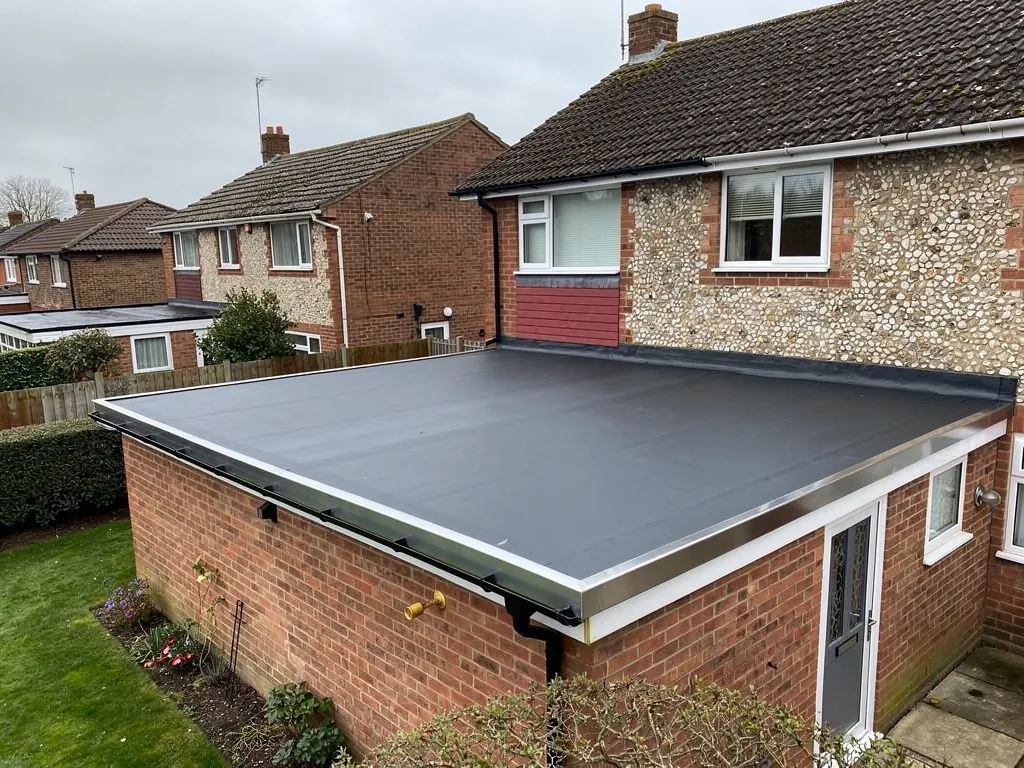
Finished black rubber flat roof on a brick single-storey extension
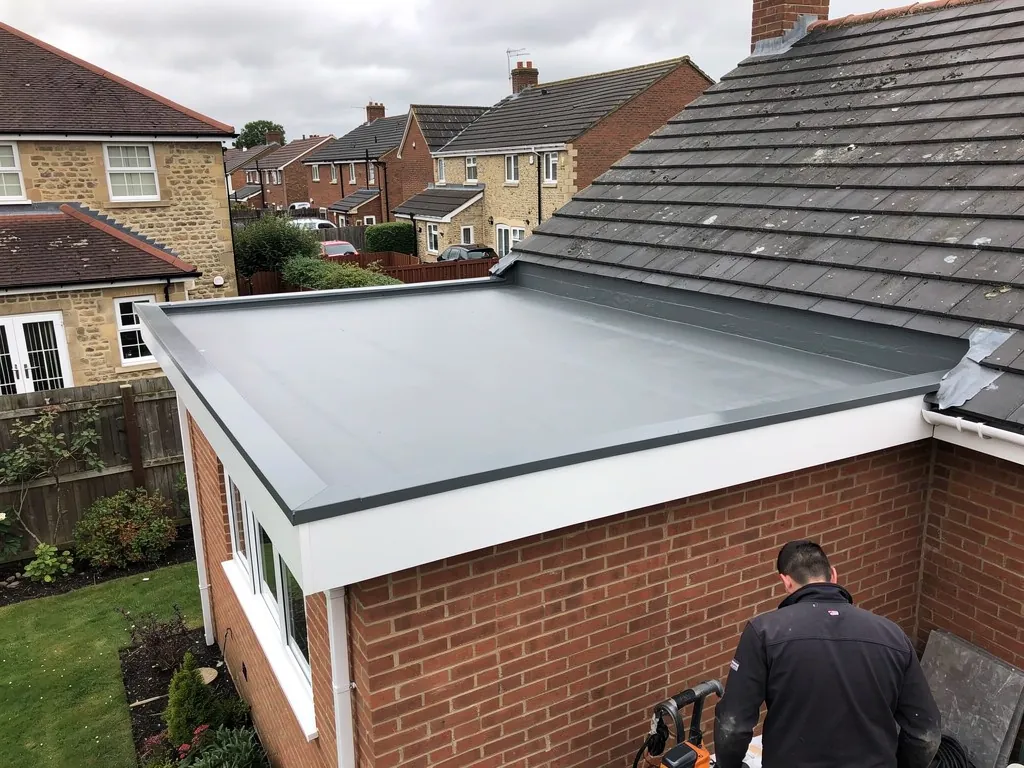
Finished grey GRP flat roof on a single-storey brick extension

The short answer

The covering and its upkeep decide it. Published guides put a flat roof at roughly 15 to 30 years, with EPDM, GRP and felt each sitting at different points in that range. Regular clearing of outlets and a look after storms usually adds more life than any coating.

Workshops, stores, garages and extensions around the canal and the yards behind the town centre often have flat or shallow roofs. They are cheaper to build than a pitched roof, but they ask more of the person who owns them.

Which covering suits a canal-side roof?

EPDM is a flexible rubber sheet that can often be laid in a single piece over a small roof, which keeps the number of joins low. GRP is glass-reinforced plastic, a hard-wearing fibreglass finish. Torch-on felt is bitumen sheet welded down with a gas flame; a careful installation lasts well, while a hurried one can fail early. Each suits a different roof, and the choice depends on size, access, upstands and what stands on top. Our flat roofing page compares them side by side.

Why does water pond on flat roofs?

No flat roof is truly level. IKO, citing BS 6229, gives 1:80 as the recommended minimum fall and says to design for 1:40 so the finished roof still reaches it. Ponding water is the sign that the fall has failed, and it accelerates wear. Rebuilding the fall is a bigger job than patching the covering, but patching a ponded roof is rarely a lasting answer.

When do Building Regulations step in?

Under Approved Document L, putting a new waterproof layer onto a flat roof is renovation of a thermal element, which can bring the insulation up for review. We check this during the survey, explain what it means for your job, and handle the notification.

For commercial owners, the quote comes in writing after the survey, and the work is sequenced around trading so deliveries, shutters and customers keep moving. Where a unit has rooflights, we check the kerbs and glazing seals at the same visit, since they leak as often as the covering.


Roofing services in Devizes

Questions from the Market Place to the canal

Why do Devizes town-centre roofs leak behind parapets?

Because the water has nowhere obvious to go. A parapet gutter or valley can block with leaves or silt, then overflow into the wall. Because the channel is out of sight, the first sign is usually damp inside. We clear it, test the fall, and replace worn lead where the repair needs it.

Is working near the Market Place harder than in a quiet street?

It takes more planning, not more skill. Access is tight, pavements are busy, and a scaffold may need a licence. We agree the logistics before the date is fixed, and when we finish the area is swept and the rubbish is carted off.

Do you repair roofs on canal-side buildings?

Yes. The Kennet and Avon Canal climbs through 29 locks near Devizes, and the town falls inside the thirty road miles we cover from Swindon. Tell us whether the site is reached by lane, yard or towpath, and deliveries and ladders are planned around that.

Do the Devizes churches mean my roof needs special consent?

Not on its own. A neighbour being Grade I listed does not list your building. Your own listing, or a conservation area boundary, is what counts, and Wiltshire Council can tell you both. St John's and St Mary's are Church of England buildings, and they follow the church's own faculty route, not yours.

Ask us about your roof

Tell us what’s happening and we’ll call you back.

  • Photos of what we find
  • A written quote
  • 10-year workmanship guarantee

Or call 01793 626096

Call Get a quote