Wet slate and clay tile rooftops with chimney stacks after rain

Roofers in Worton, Wiltshire

Worton's roofs range from sixteenth-century timber frames to garages built last decade. Our crews work the whole length of the High Street, from a single slipped tile to a full strip, and the survey of your own roof ends in a written quote.

Worton's roofs along the elongated High Street

Brick and timber-framed houses in a village
Timber-framed houses with later skins

Worton is first recorded in a document of 1173, and some of its houses are older than the roofs over them. Manor Farmhouse was timber-framed in the sixteenth century and encased in brick in the eighteenth, and The Grange is a seventeenth-century timber-framed building with later extensions. Houses like these grew in stages, so a single roof can hold several rafter patterns, a change of pitch where an extension begins, and valleys or abutments repaired by different hands over the years. The joins are our first stop, because leadwork and flashings there tire long before the plain slopes do. An old frame is seldom square, so repairs follow the roof as it stands, not the roof a drawing would suggest.

Stone church with a small roof turret
Christ Church and the Rose and Crown

Christ Church, the parish church, is Grade II listed, built in ashlar blocks with an octagonal stone bellcote. A bellcote sheds water from several faces at once and depends on sound joints and flashings around its base. The Rose and Crown, a seventeenth-century pub, is Grade II listed as well. With listed buildings the first question is what already exists: the covering, the fixings and the lead, and whether each can be mended in kind. Matching repair is ordinary maintenance. A change of material or a visible alteration needs the council's view and, for a listed building, formal consent. The church itself sits under a separate faculty process, covered in the second chapter below, because it is still used for worship.

Tiled houses and garages on a village street
Later houses, porches and garages

A long village street gathers houses from every period, and each roof ages by its own clock. Twentieth-century houses typically wear machine-made tiles on softwood battens over bitumen underlay that has sat there for decades. The faults we meet are slipped and cracked tiles, ridge tiles whose bedding has crumbled, and underlay torn at the eaves where it was never lapped into the gutter. Porches, garages and flat-roofed extensions turn up all along a street like this, and their coverings give out well before the main roof does. The northern edge of Salisbury Plain lies close, so a house on an open plot catches weather arriving across high ground, and fixings at the ridge, verge and gable get checked as routine.

Out from Swindon to Worton

Map showing Worton and central Swindon. 23 road miles south-west of central Swindon.

Distance
23 road miles south-west of central Swindon
Council
Wiltshire Council
Setting
A village near the northern edge of Salisbury Plain, south-west of Devizes
Conservation area
Worton, on Wiltshire Council's record
Council
Wiltshire Council

Questions about Worton's old frames and listed roofs

Is Worton's conservation area a problem for a re-roof?

Not for a matching repair, which seldom needs an application. If you want another material, or a change people would see from the street, ask Wiltshire Council's planners while you are still collecting quotes.

Can a timber-framed Worton house take a heavier covering?

Only after the structure has been checked. Approval is also needed, says the Planning Portal, where the new covering weighs 15 per cent or more above the old, and an old frame may have little spare strength.

Does the Salisbury Plain edge change how Worton roofs are fixed?

It raises the stakes at ridges, verges and gables, where wind lifts first. Since BS 5534:2014 the ridge and hip tiles on a re-bedded roof are clipped or screwed, not left to mortar.

Q1

What suits a timber-framed Worton house roof?

Torch showing a water-stained rafter beneath slates in a loft
Blocked gutter full of leaves overflowing down a brick wall

The short answer

The repair that disturbs the least. A timber-framed house moves, and its roof has been altered several times, so the right fix is local, at the weak point, in a covering that matches what is there, with the frame inspected before anything comes off.

A roof on a house like Manor Farmhouse or The Grange is not one roof but several, added over centuries. That shapes how we work on it.

Where does the water really get in?

Where an extension meets the older range, rainwater has to cross a join between two structures that move at different rates. A valley gutter, a lead abutment or a short run of flashing is doing a great deal of work there. When one fails, the water often travels along a timber and shows as a stain a metre from where it came in. We trace it back up the slope, not forward from the stain, before proposing any repair.

What is going on under the tiles?

The tiles are the last thing to reveal a roof's condition. Rotting battens, soft rafter feet and failed nails do the harm underneath. Where a house was cased in brick, as Manor Farmhouse was in the eighteenth century, the eaves detail can hide the oldest timber, and a leaking gutter may have been feeding it for years. The survey includes the loft, because a dry loft with a stained wall plate says something different from a dry loft with a clean one.

Is a strip ever the better answer?

Refixing a handful of tiles and renewing one valley is a smaller job than a strip, and it is the right job when the frame is sound. If the frame is not sound, we show you the photographs and explain what has to change. Our pages on roof repairs and lead roofing describe the work at the joins.

Q2

Who approves work on a listed Worton roof?

The answer

For a house or pub, the council decides, and consent is required for alterations that touch the building's special character. The parish church, while in use for worship, is dealt with through the faculty system instead. Matching repairs usually stay on the right side of the line, and the survey tells you which side your own job sits on.

Worton has a conservation area, and its listed buildings include Christ Church and the Rose and Crown, both Grade II. Neither fact stops roof work, but both shape how it is done.

What about the houses and the pub?

Consent is needed where works would affect a listed building's character. Putting back identical material in an identical pattern counts as upkeep, and a handful of refixed slipped tiles is the obvious example. Changing the covering, cutting new openings or reshaping a chimney is the kind of step the council examines. For a Grade II building like the Rose and Crown we would agree the method with you before anything is priced and, if there is any doubt, suggest a word with Wiltshire Council before pricing.

Is Christ Church treated differently?

Christ Church is an Anglican parish church. While it stays a place of worship, roof works are put through a faculty application, not through the council's listed building route. The parochial church council normally leads on that. A roofer's part is to describe the fault and the repair clearly enough for the application to be judged.

Does the conservation area reach unlisted houses?

The designation reaches unlisted houses too, mainly where a visible change is proposed. A matching repair is rarely caught by it. Our page on tiled roofs in conservation areas sets out the usual questions.

Unsure about your own house? A short enquiry to the council settles whether it is listed, and we will talk you through what the reply means. Bats and nesting birds are protected, which matters if a roof void is disturbed.


MythLiving in a listed village means every roof repair needs consent.

FactMaintenance in matching materials is a different thing from altering a building's character, and most repairs sit on the maintenance side.

Q3

When does a Worton re-roof need Building Regulations?

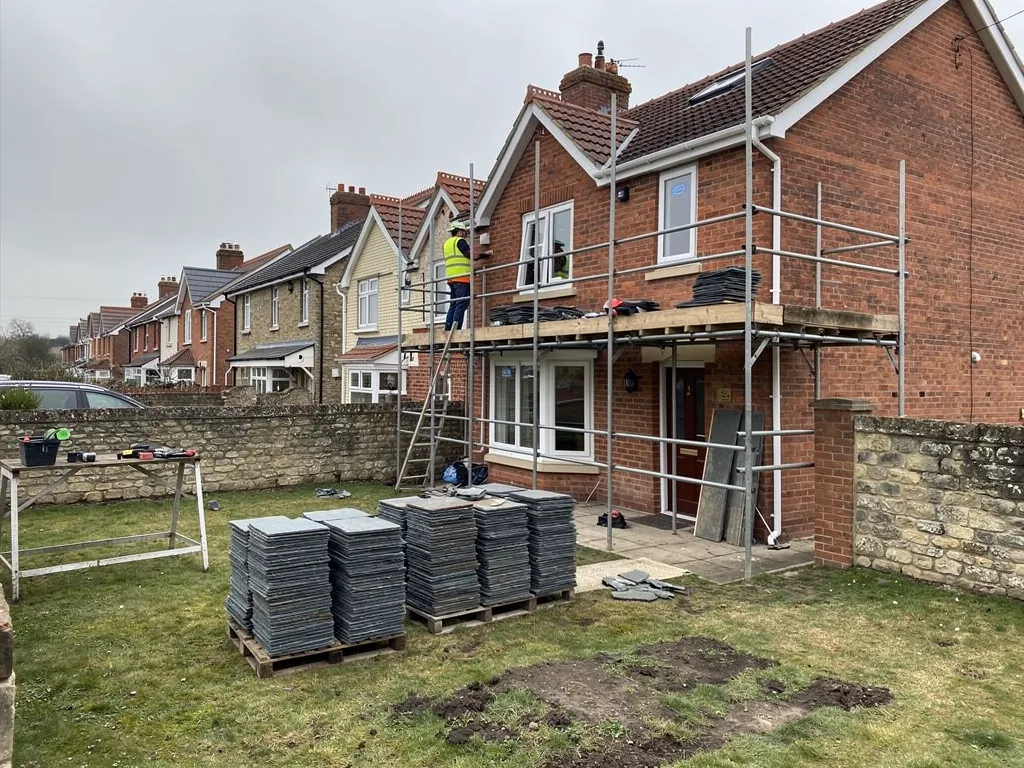
Pallets of new slates in a garden beside a scaffolded house
Brick end-of-terrace gable beside a limestone house, slate roofs

The short answer

When it passes the limits set out by the Planning Portal: 25 per cent or more of the building envelope, 50 per cent or more of the roof, structural alterations, or a covering 15 per cent or more heavier. Below those limits a re-covering does not normally need a building control application.

Many jobs on village houses are smaller than owners expect, and plenty stay beneath the limits. The sums are worth knowing before you start collecting prices.

Where are the limits drawn?

Under the Planning Portal's guidance, re-covering normally needs no building control application while less than 25 per cent of the total building envelope and less than 50 per cent of the roof is affected. Pass those limits, alter the structure, or choose something heavier by that margin, and a formal application follows. In Worton the route is Wiltshire Council's building control team or a registered building control approver.

Why does weight matter on an old frame?

An old timber frame carries a covering sized for its day. Swapping clay or slate for a heavier concrete tile is the usual way across the weight line, and an older roof may need strengthening before it can take the change. We establish what is on the roof now, compare it with the proposal and tell you whether approval is needed, so the question is answered before the first tile is lifted.

Does insulation come into it?

When a whole slope is stripped, the roof may have to meet current thermal standards under Part L, and the survey notes where that is likely. The consent side is explained to you at the survey, and where the work is notifiable the Building Regulations notification becomes our job. Planning a whole-roof job is covered on our roof replacement page, and the survey photographs support the paperwork.

When a re-roof moves into Building Regulations territory
What the job involvesBuilding control position
Small repair or re-cover inside both limitsNo application normally
Over 25 per cent of the envelope or 50 per cent of the roofApplication; a thermal upgrade may follow
Covering that adds 15 per cent to the loadApplication needed
Changes to rafters or wallsApplication needed

Worton roof queries, from the High Street to the brook

Why do roofs on Worton's older houses leak at the joins?

Houses here were extended in stages, so a roof often has places where two structures meet. Lead, valley gutters and mortar fillets at those joins age faster than the open slopes. Tracing the water to its true entry point comes first, and the repair goes at the join, not the stain. Our work comes with a 10-year workmanship guarantee in writing.

Do you work in Devizes and the villages around Worton?

Yes. Devizes is the nearest town to Worton, and we take on work there and in the surrounding villages. Everything inside 30 road miles of Swindon is covered, and the page of areas lists each place. Phone, WhatsApp or the enquiry form will get a survey booked.

Can you find where a leak enters an old Worton roof?

Usually, though old roofs can be awkward. We begin in the loft, follow staining along the timbers back up the slope, then check the likely entry points outside: valleys, abutments, chimney flashings and ridges. Photographs of your own roof are taken as we go, and they sit alongside the written quote that arrives afterwards. A stain on a ceiling is where water ended up, not where it started, which is why the loft comes first.

Should the old roof on a listed Worton house be repaired or replaced?

Repaired, wherever the frame and covering allow it. Keeping the existing material respects the building and avoids awkward questions with the council. If the covering has genuinely run its course, we explain why with photographs and set out what a like-for-like replacement involves, including whether the structure needs attention first. Listed status does not forbid replacement; it asks that the character of the roof survives it.

Ask us about your roof

Tell us what’s happening and we’ll call you back.

  • Photos of what we find
  • A written quote
  • 10-year workmanship guarantee

Or call 01793 626096

Call Get a quote