Rear tiled roof of a brick semi seen from the garden

Roofers in Bromham

Tiled and slated roofs, lead and chimney work in Bromham, from the old houses and chapels near the spire of St Nicholas to the newer homes and garages on the lanes running out towards Devizes and Melksham, with the price confirmed in a written quote after the survey.

Bromham's roofs, from spire to garden wall

Old village houses beside a church spire
Around St Nicholas and Spye Arch

The church of St Nicholas is Grade I listed, dates from the thirteenth century and carries a fifteenth-century spire, and it sets the scale for the oldest part of Bromham. Battle House, partly fifteenth century and largely rebuilt around 1760, and Spye Arch, the sixteenth-century former gatehouse of Bromham House that now serves as a lodge to Spye Park, are both Grade II* listed. Buildings with histories like these have usually been altered, extended and re-roofed more than once, so their roofs are a patchwork of ages. Valleys, abutments where a later wing meets an older wall, and long-neglected chimneys are where leaks tend to start. On listed buildings we plan around keeping what is original and repairing like for like.

Gabled chapel roof with a small porch
Chapels and nineteenth-century buildings

Bromham Methodist Church was built in 1799, and a Baptist chapel followed in 1873. Chapel roofs are different from house roofs: wide spans, steep gables, long gutter runs and often a bell-cote or porch with its own small roof joining the main one. Water finds its way in at those junctions and at the lead gutters tucked behind parapets. Older houses in the village face the familiar problems of a roof that age: slipped or cracked coverings, tired flashings where roof meets wall, and gutters that have been blocked for years and are now soaking the eaves timbers.

Garage and porch roofs on newer homes
Newer homes, garages and extensions

Away from the church and the older lanes, Bromham has later housing, with garages, porches, conservatories and kitchen extensions bolted on as families have needed the room. Their roofs have different faults from the old centre. Interlocking tiles lose bedding at the ridge, cheap felt under a flat porch roof splits at the upstand, and an extension tied into an older house can open a gap at the abutment where the two roofs meet. These are often quick, sensible repairs rather than anything bigger. We look at the junctions first, because that is where a modern roof most often lets water in, and we tell you plainly when a repair is enough.

Bromham, on the Devizes to Melksham side

Map showing Bromham and central Swindon. 22 road miles south-west of central Swindon.

Distance
22 road miles south-west of central Swindon
Council
Wiltshire Council
Conservation area
Bromham, recorded by Wiltshire Council
Setting
A village between Devizes and Melksham, north of the Kennet and Avon Canal

Bromham roof questions

Does my Bromham address fall inside the conservation area?

Bromham has one, which makes it sensible to look at your own boundary before planning anything bigger than a matching repair. Wiltshire Council's planning team can say if your address falls inside the line.

Can you repair a roof near Spye Arch without altering it?

Yes. On listed or historic buildings we aim for the narrowest repair in matching materials, photograph the roof before work starts, and agree anything that changes its appearance with you first.

Do chapel-style roofs need different repairs?

Often. Long gutter runs, steep gables and small porch roofs joining a big main roof mean the leaks are usually at the junctions, so the repair concentrates there.

Q1

What does Bromham's conservation area mean for a re-roof?

Victorian brick terrace street with slate roofs and chimneys
Roofers on a slate roof along a limestone village street

The short answer

Bromham has a conservation area recorded by Wiltshire Council, so altering the look of a roof can mean a word with the planners first. A repair that puts back what was there seldom does. Listed buildings follow their own rules, and consent is needed where the work touches their character.

Conservation areas exist to protect the look of a place, and Bromham's is recorded by Wiltshire Council, whose map shows exactly which streets and buildings fall inside it. A roof is one of the first things anyone sees, and that visibility explains the planners' interest in any change to it.

Which Bromham repairs need no application?

Swapping broken tiles, refixing slipped slates, renewing a failed flashing and rebedding a ridge in kind is upkeep. The street looks the same afterwards, and that is the test. We size the written quote to the fault itself, so a repair does not quietly turn into a re-roof.

When should I ring Wiltshire Council first?

Changing the covering from one material to another, adding roof windows on a slope the street can see, or altering a chimney are the changes most likely to interest the council. The sensible order is to ask Wiltshire Council's planning team before you commit to a design, not after the work is priced. Conservation area status and Article 4 directions can both change what is permitted, and an Article 4 direction can remove rights that houses elsewhere take for granted, so it is one more reason to ask before you plan.

What if my Bromham house is listed?

Bromham has several. The church of St Nicholas is Grade I, and Battle House and Spye Arch are Grade II*. Should your own house be listed, anything that alters its character, roofing material included, needs listed building consent. The council can tell you whether a building is listed, and we are happy to read the entry with you before any work is priced.

Our roof repairs page sets out when a local fix is enough and when it is not, and the survey photographs that arrive with the written quote show you the fault as we found it, so you are never asked to take our word for it.

Q2

How do you repair a roof that has grown in phases?

The answer

By finding where the phases meet. A building that was partly medieval, rebuilt in the eighteenth century and extended since has joins between roofs, and those joins are where water gets in. We repair the junction, not the whole slope, and keep each period's covering where it is sound.

Battle House is a good example of how English buildings grow: partly fifteenth century, largely rebuilt around 1760, and presumably altered since. Plenty of ordinary Bromham houses have the same layered history on a smaller scale, and a roof that looks like one surface from the lane may in fact be three, with an old range, a Victorian back wing and a modern extension all under different roofs.

Where does water get into a layered building?

On a building like this the weak points are nearly always the lines where one roof butts into another or climbs a wall. A valley between two pitches, a lead flashing where a lower roof butts against a gable, or a stack that now stands in the middle of a junction all carry more water than a plain slope does. We start our inspection there, up in the loft as well as out on the slope, because staining on rafters often shows where a leak is travelling from.

Why repair each phase differently?

Different ages mean different coverings, different battens and different fixings. An old roof might have nails that have corroded; a newer one might have felt that has torn at an overlap. Treating them all with the same fix is how repairs fail, and it is why a roof can be repaired twice in five years and still leak at the same corner. We repair each section in a way that suits its age and leave sound areas alone, which also keeps the cost down.

Lead is the usual answer at the awkward joins, and our chimney repairs page covers the stack flashings that often sit at those junctions.

Where a repair would disturb something historic, such as old pegs or hand-made tiles, we explain the options before touching it, and the written quote follows only once you have seen the photographs and agreed the approach.

Our view

Repair the join, keep the sound covering, and treat each phase of the building on its own terms.

Q3

What should a Bromham chapel or older house check each year?

Blocked gutter full of leaves overflowing down a brick wall
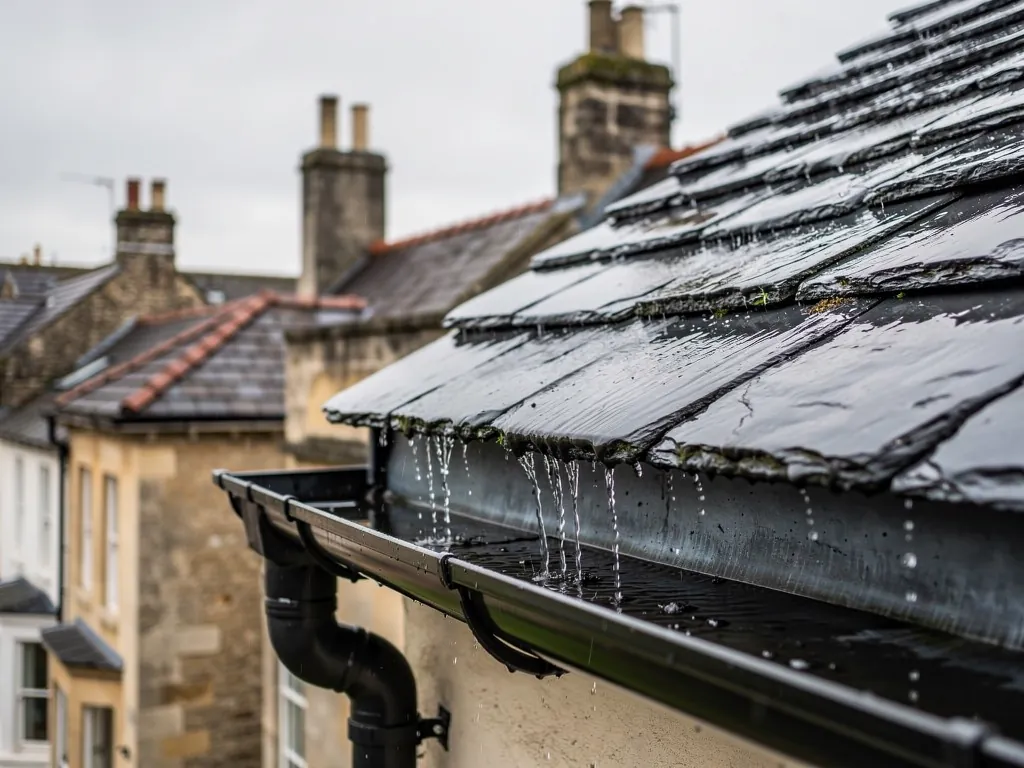
Rainwater running off slates into a black gutter and downpipe

The short answer

Gutters and downpipes, the lead at every junction, the ridge, the chimney flaunching, and any tree growing close enough to drop leaves into a valley. A short look each autumn catches the small faults before they become damp patches indoors.

Older buildings tolerate a lot, but they do not forgive being ignored. A yearly check, done on the ground and from inside the loft, is the most economical roof maintenance there is, and it takes an hour.

What can I spot from the lane?

Look along the roof line with binoculars if you have them. Slipped or missing tiles show as gaps or dark patches, a sagging ridge shows as a dip, and gutters that overflow in rain leave green or dark streaks down the wall below. Chapels and larger houses with long gutter runs deserve more attention, because a single blocked outlet can send a whole roof's worth of water down one wall.

What should I look for in the loft?

On a dry day with a torch, check the underside of the roof for daylight, damp rafters or stained timber. Look at the chimney breast where it passes through the loft: a damp patch there often points to failing flashing. Droppings, nesting material or bats are a reason to stop and be careful, because bats and nesting birds are protected.

When is it time to call a roofer?

If you find anything on either list, a survey will tell you how serious it is. Our pitched roofing page sets out what we look at on a tiled or slated roof, and we send photographs of your roof with the written quote so that you can see the fault for yourself.

Moss and leaf litter in valleys are worth clearing before winter, and so are gutters under overhanging trees. None of that is skilled work, but a roof with a long run of small neglect is the one that ends up needing a bigger repair than it should.

Questions from around St Nicholas

Why do old Bromham roofs leak at the joins between buildings?

A building extended over centuries has several roofs meeting at valleys and walls, and each join depends on flashings and lead that wear out. The slopes can be sound while the junction fails. We trace the leak from the loft first, then repair only the part that has gone.

Can you work on a listed building in Bromham?

Yes, in matching materials and methods. If the work would affect the building's character, listed building consent may be needed, and Wiltshire Council can advise. We photograph the roof first and agree the approach with you before anything is touched.

Do you cover Rowde and the villages around Bromham?

Yes. Rowde, Devizes, Melksham and the other places within 30 road miles of Swindon are on our list, and the areas page shows every one. Give us your postcode when you ring or message on WhatsApp and we can confirm whether we reach you, then book a survey.

My chapel-style gutters keep overflowing. Is that a roof problem?

Often it is the gutter, not the roof: a blocked outlet, a sagging run or a joint that has opened. Left alone it soaks the wall, stains the stonework or render, and slowly rots the eaves timbers and the ends of the rafters behind. We check the falls and the outlets first, and renew only the sections that have failed, so the cost stays proportionate. If the fascia behind the gutter has gone soft, we show you that on the survey photographs too, because it changes what the right repair is.

Ask us about your roof

Tell us what’s happening and we’ll call you back.

  • Photos of what we find
  • A written quote
  • 10-year workmanship guarantee

Or call 01793 626096

Call Get a quote