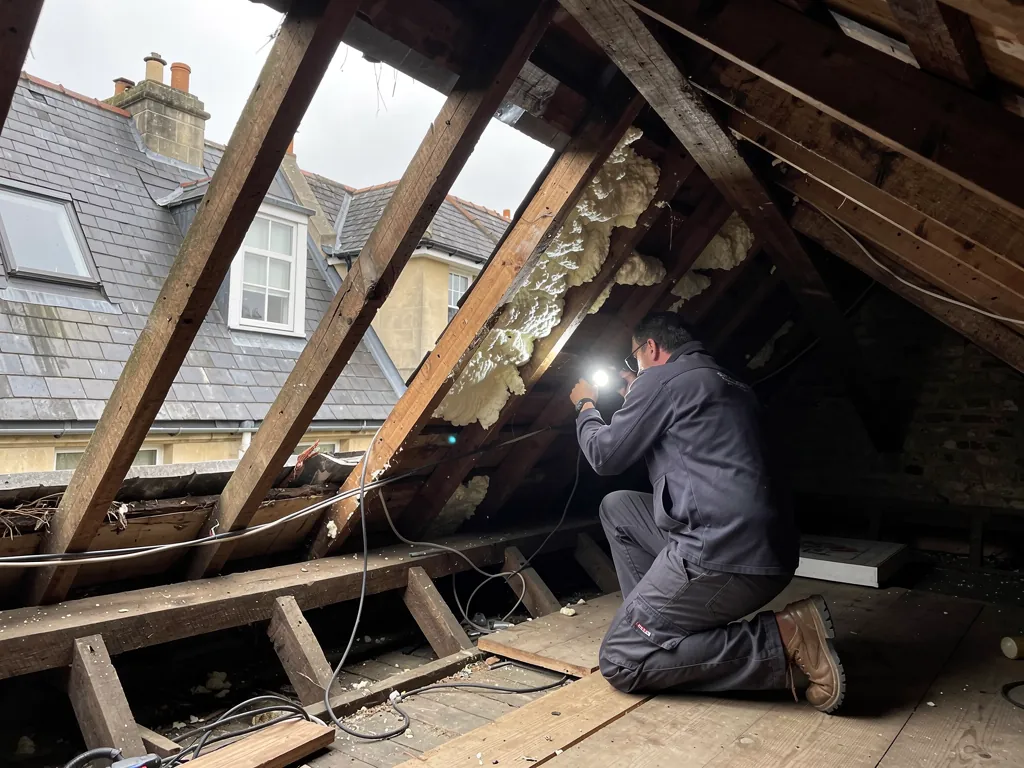
Semington House and Highfield are three-storey stone houses of the late eighteenth or early nineteenth century, and their ridges and chimneys stand a long way up. Reaching them safely is the first question, not the last.
Q2.1Why is high-level work more expensive?
Because the platform has to be built, inspected and taken down, and the taller it is the more tube, boards and hours it takes. A ladder is not an option for work at height on stone, where tools, stones and lead all have to be carried up. We would rather price access properly than cut it and put someone at risk.
Q2.2What drives the figure up or down?
Footprint, number of lifts, how much of the building needs wrapping, and whether the ground beside the house is firm and level. Narrow lanes, canal edges and neighbouring walls can make setting up harder, which may mean hand-carrying stone, tile and lead further than on an open plot, and some sites need a pavement or highway licence, which adds a charge. Whoever quotes, ask whether scaffolding and VAT are inside the price, since the answer can shift a total a long way.
Q2.3Can a chimney be reached without scaffolding the whole house?
Sometimes. A smaller tower or a single-elevation scaffold may be enough for a stack on one gable. We decide that on site after studying the roof from below, and the access we recommend is built into the written quote. Where a stack sits above a complicated roof, a chimney repairs visit often starts with the lead and pointing, because they let water in first.