Roofers on a buff brick estate house with grey tile roofs

Roofers in Keevil

We repair and replace roofs in Keevil, from the old stone and timber-framed houses along Main Street to the farmhouses and later infill on the slope above Semington Brook.

Keevil's roofs, from manor to brookside

Old stone and timber-framed houses on a village street
Manor, Talboys and Main Street

Keevil's grandest houses are also its oldest. Keevil Manor is Grade I listed, built around 1580 for the Lambert family, with its front faced in limestone ashlar and a central porch dated 1611. Talboys, a timber-framed house, is Grade I listed too, alongside the boundary wall to Main Street from about 1600. Roofs on houses of this rank have usually been mended again and again, and the timbers beneath have shifted with each change. Before anything is priced we sort out what is original, what is a later patch and where water truly enters. With a listed owner in mind, slates or tiles, nails and lead work are treated as part of what makes the house what it is, so any repair is drawn up to change as little as possible.

Tiled farmhouse roof beside a chimney stack
Farmhouses and cottages on the slope

Keevil sits on a slope between Great Hinton and Bulkington, and its older houses and cottages follow the lie of the land rather than a grid. Because cottages were added in different periods, one lane can hold roofs of quite different ages: a clay-tiled farmhouse, a slated cottage with a tall chimney, an outbuilding whose sheeting has outlived its usefulness. Each gets its own assessment. A slipped tile beside a chimney, a tired ridge, a valley lined with failing lead or a verge that has lost its bedding point to different, usually modest, repairs. Where a covering is simply worn out across a whole slope, you hear that plainly, along with the reasoning and the options.

Flat roof and low-pitched extension on a house
Newer homes, extensions and outbuildings

Away from the old core, Keevil has later houses, bungalows, barn conversions and extensions, plus garages, porches and lean-tos that attract no attention until a stain spreads across a ceiling. Their faults follow their age: concrete tile ridges whose bedding has crumbled, flat roofs that hold water, felt split along a joint and guttering pulled away from the fascia. A flat or low-pitched roof is dealt with differently from a tiled one, with a fall towards the outlet and a membrane suited to how the roof is used. What we propose depends on what the roof is made of, and the aim stays the same: the least work that genuinely cures the fault in front of us.

Keevil in context

Map showing Keevil and central Swindon. 27 road miles south-west of central Swindon.

Distance
27 road miles south-west of central Swindon
Council
Wiltshire Council
Council
Wiltshire Council
Setting
A village on a slope by Semington Brook, east of Trowbridge

Keevil roof questions

Is my Keevil house listed, and does that change the roof job?

The village has Grade I and Grade II* buildings. If yours is listed, altering the covering can need consent, so ask Wiltshire Council's planning team before anything is priced.

Can you cure damp on a roof beside Semington Brook?

Yes. Finding the entry point comes first, since damp near a brook often turns out to be a gutter, flashing or ground-level fault rather than the covering.

Who looks at roof work on a Keevil farmhouse?

Wiltshire Council's building control team handles notifiable work, and its planning team handles listing questions. We explain which applies and sort out the notification.

Q1

What should I know about roofing Keevil Manor-age houses?

Brick end-of-terrace gable beside a limestone house, slate roofs
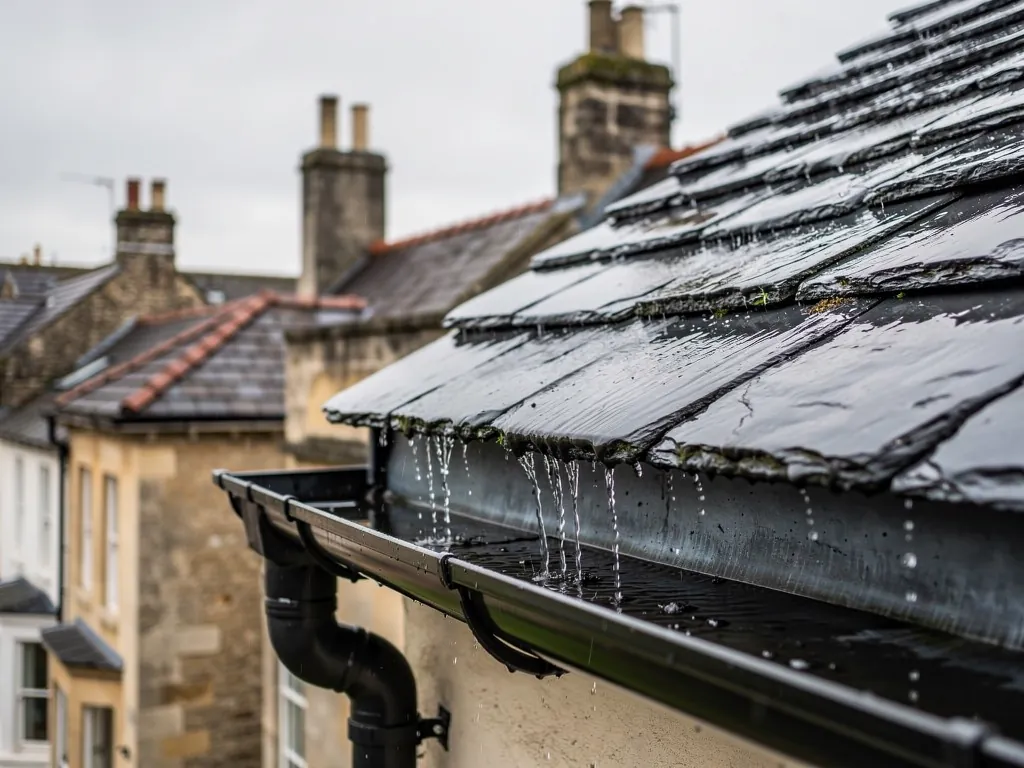
Rainwater running off slates into a black gutter and downpipe

The short answer

Older Keevil houses, such as the Grade I listed Keevil Manor and the timber-framed Talboys, carry roofs altered across centuries. Work begins by finding what is original, then uses matching materials and methods so the building keeps its character.

Keevil has a small number of very old and very significant houses. Keevil Manor, built about 1580 and faced in limestone ashlar, and Talboys, the timber-framed house, are both Grade I listed. Few roofs in the village are on that scale, but they set the tone: appearance matters here as much as keeping rain out.

Where does water get into an old roof?

Seldom across the open face of a slope. In a house with this much history the weak spots are the junctions: a chimney base, a taller gable, a valley between two ranges or the verge at the end of a slope. Lead flashings crack with age and with the movement of old walls, and mortar fillets shrink away from stone. Much of what looks like a failed roof is a failed junction, and curing that is a far smaller job than re-covering the slope.

What does a timber-framed building need from its roof?

A frame has to breathe and shed water cleanly. A roof that drips onto the frame, or a gutter that overflows against it, causes damage that surfaces years later as rot at the foot of posts and the ends of beams. So the eaves, gutters and the way rainwater leaves the building get as much attention from us as the tiles do. Straightening a sagging gutter is a modest job, yet on a frame like this it protects something worth far more.

Do I need consent before work starts?

On a listed building, listed building consent is needed for work that touches its character, and swapping the roof covering for another material falls squarely in that. A like-for-like repair is a different question from a change of material. Wiltshire Council's planning team can say where a particular job falls, and we describe the work in plain terms so that conversation is quick. Our roof repairs page shows how we judge a fault before suggesting a cure.

Q2

Does St Leonard's roof follow different rules?

The answer

St Leonard's is a Church of England church, Grade II* listed. Because it is in use for worship, it falls under the ecclesiastical exemption, and its roof work goes through the faculty system. Houses and cottages in the village follow the council's ordinary rules.

St Leonard's has late thirteenth-century lancet windows and a south aisle added in the fifteenth to early sixteenth centuries, and it was listed Grade II* in 1968. Most people never need to think about how a church is regulated. If you sit on a parochial church council, though, it helps to know it is a separate system from the one covering your own roof.

Who decides on work to a church in use?

Church of England buildings are dealt with through the faculty jurisdiction instead of listed building consent from the council. A handful of other denominations hold the same protection under the 2010 Order, with Methodist and Catholic churches among them. Once a church has closed for regular worship the exemption falls away, and Unitarian and Quaker buildings never had it.

Does any of that touch a Keevil cottage?

No. The exemption is only about places of worship. A house, barn conversion or cottage in the village goes through Wiltshire Council in the usual way. If it is listed, consent covers changes to its character. If it is not, a re-cover in matching material rarely calls for a planning application, and building control is involved only once the job passes the notifiable thresholds.

How can I find out whether my house is listed?

The National Heritage List for England names every listed building, and the council can confirm the position for a particular address. Keevil's best-known entries are the Manor, Talboys and the church. Plenty of ordinary cottages here are older than they look, so a quick check before you commit to a roof job is time well spent.

Where the work is on a pitched roof, we set out the method, the materials and the reason for each before you decide.

MythEvery old building in a village can be re-roofed under the church's exemption.

FactThe exemption covers places of worship in use only; houses and cottages follow the council's ordinary rules.

Q3

How does a Keevil roof job get priced?

Drone hovering above a tiled roof during a roof survey
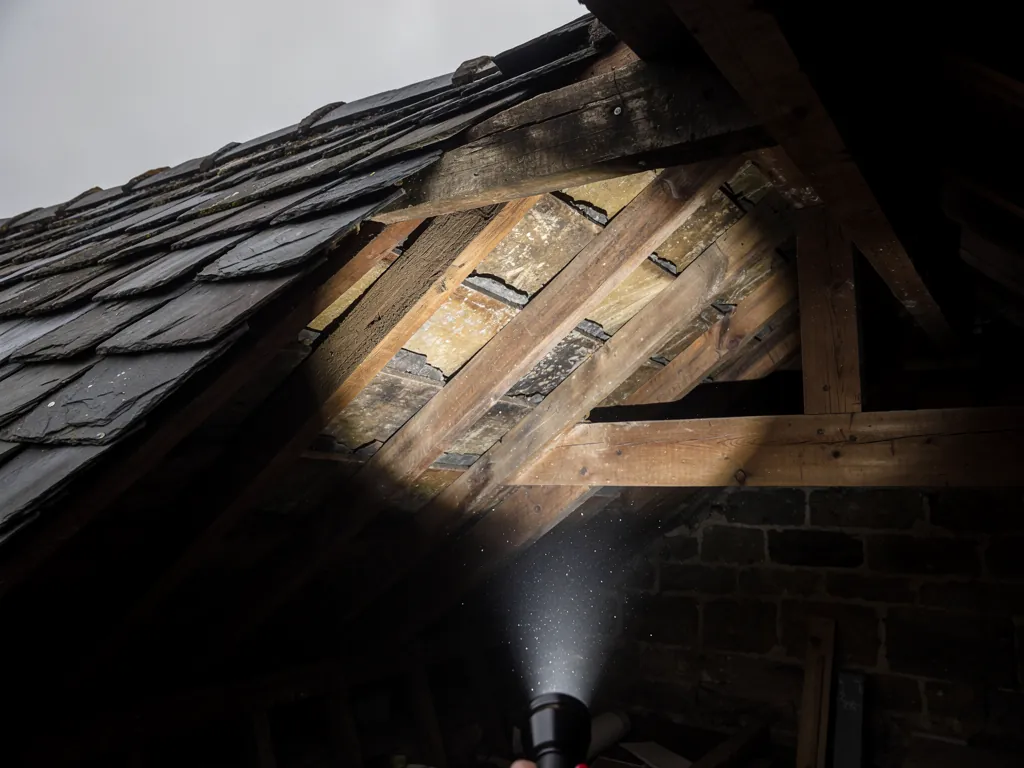
Torch beam lighting slate undersides and timbers in a loft

The short answer

A visit and survey come first, with pictures of your own slopes, then a written quote. Notifiable jobs go to Wiltshire Council's building control team or a registered building control approver, and the paperwork is ours to do. Anything about listing is a planning-team question.

A lot of work on village roofs needs no consent whatever. Putting back some slipped tiles, bedding a ridge afresh or fitting a flashing in the same material is upkeep. Bigger jobs and older buildings bring in extra steps, and none is hard to follow when it is explained at the start.

What happens at the survey?

Someone walks the outside, climbs into the loft, photographs each fault and notes the state of the timbers. Your quote arrives in writing afterwards, with those pictures attached, so the evidence is yours to look at. If a repair cures the problem, a repair is what we recommend. If the covering is spent, you are told so, with the alternatives.

Will a bigger Keevil re-roof bring in the council?

The Planning Portal puts the line at 25 per cent of the total building envelope or 50 per cent of the roof: stay under both and building control approval is not normally needed for re-covering. Cross either, or choose a covering 15 per cent or more heavier, and approval can apply, with the insulation sometimes needing an upgrade. In Keevil the route is Wiltshire Council's building control team or a registered building control approver, and for notifiable jobs the notification is something we take on.

What do I get when the job is done?

A ten-year guarantee on our workmanship, in writing, and a cleared site with the waste taken away. Where building control was involved, keep the completion paperwork with your deeds, since whoever buys the house later will want to see it.

When the structure needs a closer look first, our roof inspections and surveys page explains what is recorded and how the photographs are used.


Our view

Start with the survey photographs, and let the roof decide the size of the job.

Questions from Main Street to Gayford

Why do Keevil roofs vary so much from one house to the next?

The village has grown in layers. Keevil Manor dates from about 1580, the boundary wall to Main Street from around 1600, cottages followed in later centuries and the houses built since are different again. Every era brought its own coverings and detailing, which is why the fix for one roof may do harm next door. We judge each roof by what it is made of and how it was put together.

Will rain running off the slope towards Semington Brook affect my roof?

A sloping site shapes how water leaves a building. Gutters and downpipes need enough fall to carry it clear, and the ground at the foot of a wall should drain away from the house. During a survey we look at outlets, joints and gutter condition, because overflow against a wall can pass for a roof leak.

Can you work on outbuildings and old mill-type buildings in Keevil?

Yes. Two mills on Semington Brook were recorded in Domesday, and the one at Gayford was used for cloth working into the early twentieth century. Barns, workshops and older ranges are common in villages like this. Each is surveyed on its own terms, with the covering, the timbers and the drainage all looked at in turn.

Do old Keevil ridges sit on nothing but mortar?

Many do, since that was how it was done for generations. BS 5534:2014 changed the picture: a ridge or hip is now fixed mechanically as well, using clips or a tested dry-fix kit beneath the line you see. On a listed house the outline stays exactly as it was; only the hidden fixing differs.

Ask us about your roof

Tell us what’s happening and we’ll call you back.

  • Photos of what we find
  • A written quote
  • 10-year workmanship guarantee

Or call 01793 626096

Call Get a quote