Concrete tiled estate rooftops towards green hills

Roofers in Hilperton

Roof repairs, re-roofing, chimney work and ridge refixing across Hilperton, from the old lanes round the parish church to the canalside at Hilperton Marsh and the fields of the Hilperton Gap.

Roofs between the church and the canal

Old stone and tiled buildings on a village lane
The old village core

Hilperton has two conservation areas on Wiltshire Council's records, labelled Hilperton No 1 and No 2, and between them they take in the oldest part of the village. The parish church was largely rebuilt by T.H. Wyatt in 1852, Hilperton House is an eighteenth-century listed building at Grade II*, and the Blind House, the old village lock-up, is mid-eighteenth-century limestone. Roofs of this age have been patched by several generations, so a survey has to separate old work that still holds from earlier repairs that have quietly failed. Lead at chimneys and abutments is a frequent weak point, and so are ridges that rely on mortar alone.

Moss-covered tiles on a pitched roof
Along the Kennet and Avon Canal

The Kennet and Avon Canal crosses the rural north of the parish, with Hilperton Marsh lying beside it. Roofs close to open water and low ground stay damp for longer after rain, which suits moss, algae and blocked valleys. On a canalside house we look hard at north-facing slopes, at gutters that spill behind the fascia, and at the timbers beneath any patch where growth has been left to build. Cleaning is sometimes all a roof needs, but we check the covering first, because heavy moss can hide slipped tiles, and a hard wash on tired tiles does damage that a soft brush would not.

Tiled semi-detached houses with a garage roof
Houses on the Trowbridge side

Hilperton sits on the edge of Trowbridge, held apart from the town by the few fields called the Hilperton Gap, so plenty of its houses are later than the church and the lanes round it. Roofs from more recent building often carry concrete or clay tile, with flat or low-pitched sections over garages, porches and extensions. Typical findings are ridge tiles that have shifted, tiles cracked by frost or a careless ladder, eaves felt that has perished, and flat coverings well beyond their best. Most of it is repair work, and the point is to deal with the fault in front of us rather than sell a larger job than the roof needs. A garage roof that leaks is a garage roof job, not a reason to re-tile the house.

From Swindon to the Hilperton Gap

Map showing Hilperton and central Swindon. 30 road miles south-west of central Swindon.

Distance
30 road miles south-west of central Swindon
Council
Wiltshire Council
Council
Wiltshire Council
Conservation areas
Hilperton No 1 and No 2
Setting
Canalside village next to Trowbridge

Hilperton roof questions

Do I need consent to re-tile near Hilperton church?

A matching repair normally needs no application. The village has two conservation areas and several listed buildings, though, so put the question to Wiltshire Council before you change what a roof is made of.

Why does moss build up on canalside roofs?

Low, damp ground and shade near water keep a roof wet for longer, which feeds moss. We check the covering underneath before anything is scraped off or washed.

Can you mend the roof of an old Hilperton outbuilding?

Yes, small stone and tiled outbuildings are routine for us. The method follows the building: matching materials, careful lifting of the old covering and the lightest repair that stops the water.

Q1

What goes wrong on older Hilperton roofs?

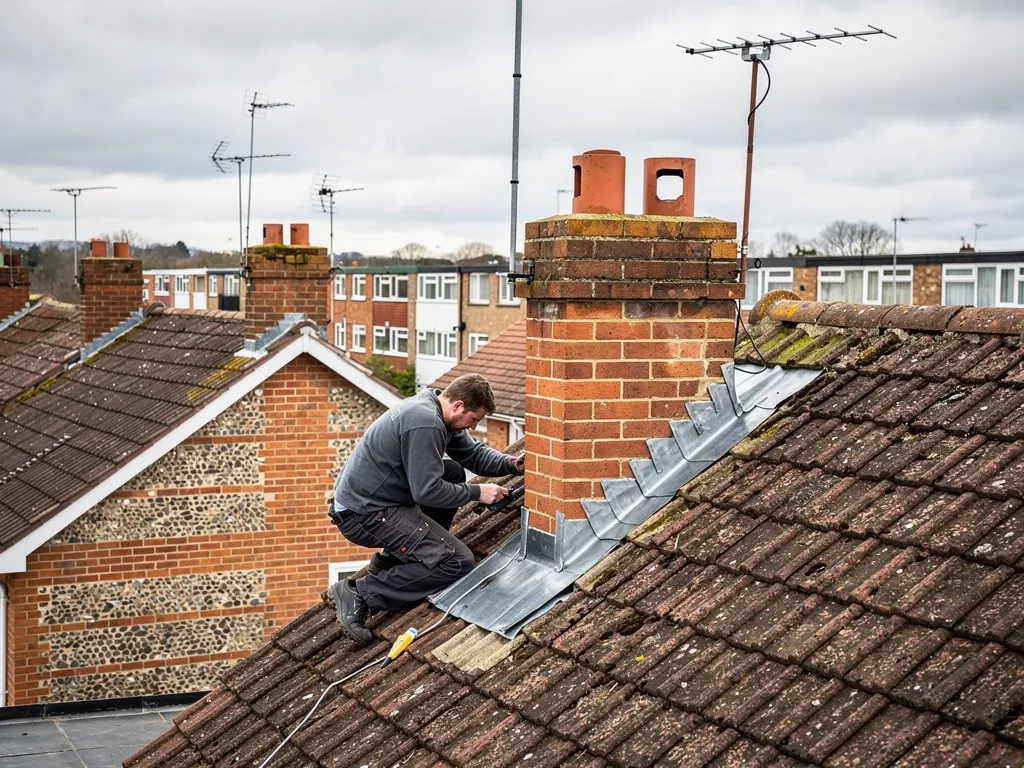
Roofer dressing stepped lead flashing around a brick chimney
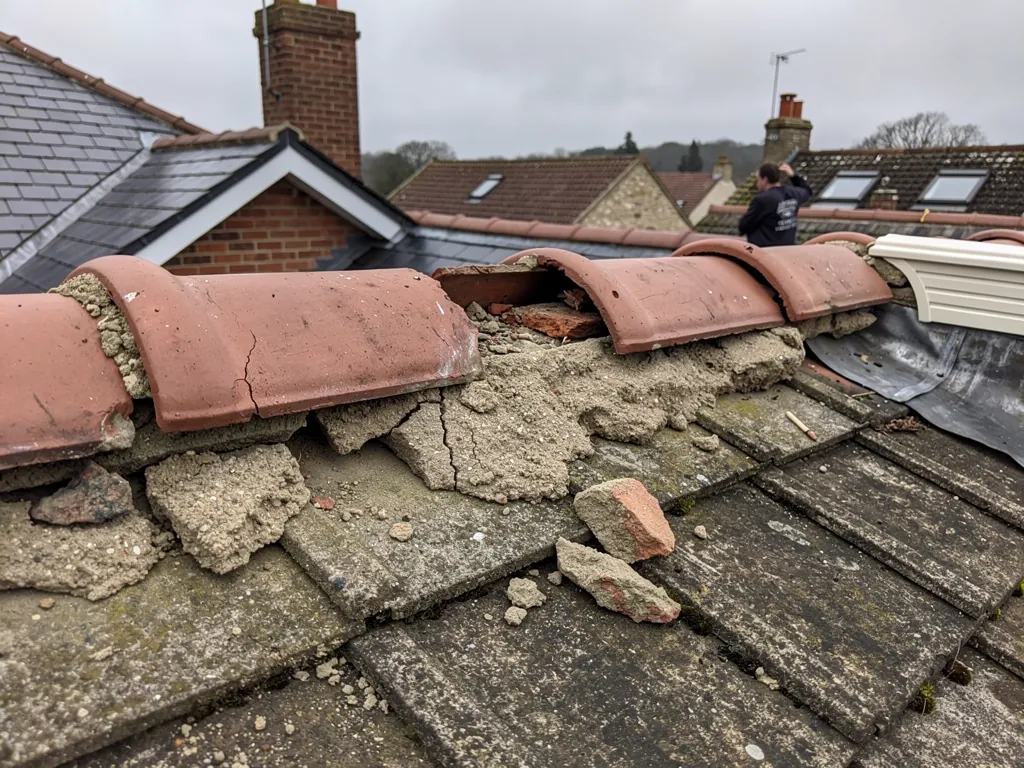
Crumbling mortar beneath old half-round clay ridge tiles

The short answer

On roofs in the old village the usual faults are worn lead where roofs meet chimneys and walls, slipped or cracked coverings, softened battens and ridges that rely on mortar alone. Water often travels some distance before it shows inside, so the visible stain is rarely sitting under the fault.

A roof beside the lanes round the church has usually seen several owners and several rounds of repair. Some of that work is good. Some is a smear of sealant or a mismatched tile that did its job for a few winters and no longer does. The first task in a survey is sorting one from the other, and the photographs we take on the roof record what we found.

Why is the stain nowhere near the hole?

Water seldom drops straight through the spot where it enters. It runs along a rafter or a batten, soaks into the insulation and appears as a mark a couple of metres away. We follow that line back to its origin. The usual culprits are a lifted flashing at a chimney, a slipped tile higher up the slope, or a valley with debris lying in it. With the photographs you see the fault itself, not only the damp patch it caused.

Is a patch repair ever the right answer?

Yes, as long as the tiles or slates around the fault have plenty of life left. Swapping a handful of tiles, renewing a length of flashing or refixing a ridge properly can buy a roof many more years. Where the battens have softened or the covering is giving up across a whole slope, a patch simply moves the cost to next winter, and we will say that when we see it. Our roof repairs page sets out the range of fixes.

What should I do while I wait for a repair?

Shift belongings from beneath the stain, put a bucket under any drip and photograph the damage with the date. If a leak is active, we prioritise making the roof safe, then plan the lasting repair when the weather and the survey allow it.

Q2

Does living by the canal change how a roof ages?

The answer

In a quiet way, yes. Roofs by the towpath and the low ground at Hilperton Marsh stay damp longer, so moss, choked gutters and softening fascias appear sooner. Regular clearing, and a look at what sits beneath the moss, prevents a good share of the trouble.

A canal is a long strip of open water, and the land beside it holds moisture. Nothing dramatic happens to the roofs nearby, but small faults that a dry hilltop roof would shrug off are given longer to develop here.

Can I just have the moss cleaned off?

Sometimes, and it is often a sensible job. Moss holds water against a tile and can lift its edges as it grows. The catch is that thick growth hides slipped, cracked or porous tiles. We walk the roof, check the covering and then advise: brushing, a gentle clean, or a repair first. Hard pressure washing can strip the face of an older tile, so it is not our first choice. The roof inspections and surveys page explains what a visit covers.

Why do gutters matter so much beside water?

A gutter that overflows behind the fascia soaks the board, the rafter ends and the wall below. In a damp spot that rot starts quietly and is found only when a fascia sags or a ceiling stains. We clear and check runs during a survey, looking at joints, brackets and the fall to the outlet, because a sagging run holds water that a straight one would shed.

Do overhanging trees make a difference?

They do. Leaf litter in valleys and gutters keeps the roof wet, and branches rubbing across tiles wear them. Cutting back growth and clearing litter costs little and keeps the covering drier between visits. If nesting birds or bats are using a roof space, we stop and take advice, since both are protected.

Our view

Look under the moss before deciding between a clean and a repair.

Q3

Who deals with roof permissions in Hilperton?

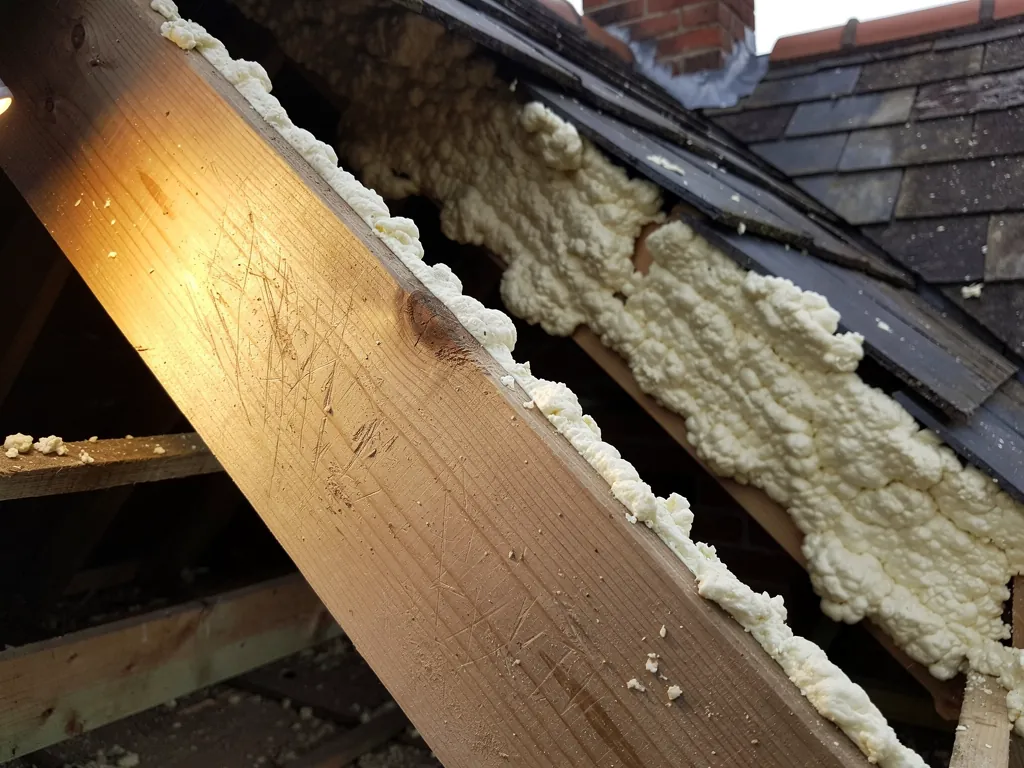
Scraped-back rafter beside thick spray foam under a slate roof
Gloved hands fitting a weathered Cotswold stone slate

The short answer

Because Hilperton lies in Wiltshire, planning queries go to Wiltshire Council, while notifiable roof work is checked by Wiltshire Council's building control team or by a registered building control approver. A listed building also needs listed building consent for alterations touching its character.

Plenty of roof jobs in Hilperton never touch the planning system. A few new tiles, a refixed ridge, a length of replacement flashing: that is upkeep. Bigger or more visible work follows other rules, laid out below, and it pays to understand them before you sign a contract.

How large can a re-roof grow before it needs sign-off?

The Planning Portal sets two limits for this. Stay under 25 per cent of the total building envelope and under 50 per cent of the roof, and re-covering normally needs no building control application. Go past either mark and you need approval, with better insulation possibly following. Separately, a covering that makes the roof 15 per cent or more heavier needs approval. Tell us what you are planning and we place the job against those limits, then look after the Building Regulations notification wherever work is notifiable.

What about the two conservation areas and Hilperton House?

Putting back what was there leaves a street looking as it did, so a repair that copies the existing roof seldom needs a planning application. Changing the material, or adding something new to a slope people can see, is another matter, so raise it with Wiltshire Council before the job is priced. Hilperton House is listed Grade II*; on a listed building, works altering its special character need listed building consent, covering included.

Does the parish church follow different rules?

The parish church here is Church of England, and a church that is in worship use sits under the ecclesiastical exemption, with changes decided through the faculty system rather than by the council. If you look after the church or a building it owns, start with the diocese. A written survey from us can go with the request.


MythMy house is in a conservation area, so every roof repair needs an application.

FactRarely: the council cares about changes of material and appearance, not the replacement of what is already there.

Questions from the Hilperton lanes

How do you repair lead at the chimney of an older Hilperton house?

We strip back the failed flashing, check the stack and its joints, and fit new lead dressed into the brickwork in a code suited to the position. A corner that has split or an edge lifted from the brick is among the commonest reasons for a stain on a chimney breast. Our chimney repairs page goes through the work, and we send a written quote after seeing and photographing it.

Are ridge tiles near the Hilperton Gap held on with mortar?

Older roofs frequently were, since sand and cement bedding was standard practice for generations. BS 5534:2014 changed that: ridge and hip tiles are now fixed mechanically as well, and BS 8612:2018 covers dry-fix systems. On the open edge facing the fields the ridge takes wind from every direction, so we bring the subject up whenever a survey shows a tired ridge line. See ridge, verge and dry-fix for how the systems work.

Can you reach Hilperton Marsh and the canal bank properties?

Yes. Hilperton and Hilperton Marsh are both within our working range from Swindon, as are nearby Trowbridge, Semington and Steeple Ashton. Check the areas page if your address is somewhere else and you want to confirm it is covered.

Do you guarantee repairs on a Hilperton roof?

Yes. Our workmanship carries a 10-year guarantee, in writing. It stands behind the work we do, not the age of the untouched parts of the roof, and that is where the survey photographs earn their place: they record the roof as it was on the day we started, which keeps the position clear for you and for us.

Ask us about your roof

Tell us what’s happening and we’ll call you back.

  • Photos of what we find
  • A written quote
  • 10-year workmanship guarantee

Or call 01793 626096

Call Get a quote