Wet slate and clay tile rooftops with chimney stacks after rain

Roofers in Oxford

Tiled roofs, lead gutters behind parapets and chimney stacks for Oxford, the city where the Thames meets the Cherwell: a medieval core, Georgian fronts, canal-age streets and the housing that grew around Cowley.

Oxford's roofs, from stacks and tiles to hidden parapet gutters

Tiled roofs and chimney stacks over a city street
The medieval and commercial core

The council's appraisal of the Central (City and University) Conservation Area describes the medieval and commercial core as a place of lively roofscapes: pitched tiled roofs animated by chimney stacks. That is a good description of what a roofer sees from a ladder. Each stack is a flashing to check, each valley between two roofs a place for leaves to gather, and each tiled slope a job that has to be reached from a street or yard with little room. Oxford Castle dates from 1071 and the university from the late twelfth century, so some buildings here have been repaired for centuries, and the plain fact is that tiles which are matched well disappear into the roofscape.

Brick parapet wall concealing a pitched roof
Georgian fronts and hidden gutters

The same appraisal notes that eighteenth-century re-fronted buildings often hide pitched or gabled roofs behind parapets. The street sees a flat-topped brick or stone face, while behind it the roof runs the other way, and the water that falls on it collects in a gutter set behind the parapet wall. These parapet gutters are lined in lead, drain through narrow outlets, and cannot be seen from the pavement. When they fail, the first sign is a stain on an upper-floor ceiling or a damp patch in the wall below, far from where the water actually entered.

Terraced brick houses with pitched roofs
Jericho, Cowley and the later streets

The Oxford Canal reached the city in 1790, and William Morris started his car business in 1910 with an assembly plant at Cowley, so Oxford spread outward in successive waves of building. Jericho has its own Article 4 direction covering roof alterations, rooflights, roofing material and solar equipment, made on 31 March 2011. Streets of later periods bring different problems: flat extensions, concrete tile, porch roofs and garages. The rivers and their flood plains stop the city sprawling freely, so homes sit close together, which means shared walls, shared access and neighbours to talk to before work starts. A porch roof here, a rear extension there, a garage with a felt covering that was last attended to years ago: each is a small roof with its own story, and the survey takes them in together.

From Swindon across to the city

Map showing Oxford and central Swindon. 30 road miles east-north-east of central Swindon.

Distance
30 road miles east-north-east of central Swindon
Council
Oxford City Council
Council
Oxford City Council
Conservation area
Oxford Central (City and University), plus Jericho and others
Article 4
Jericho direction, in force from 28 April 2011

Oxford roof questions

Does Jericho's Article 4 direction cover roof work?

Yes. The direction covers altering roofs, rooflights, roofing material and solar equipment, so changes there need a planning application. Like-for-like repairs are treated differently; Oxford City Council can confirm the position for your own address, and the answer is quick.

What leaks behind an Oxford parapet gutter?

Usually the lead lining or a blocked outlet. Water spills over the lip or soaks into the wall, and the stain shows lower down. The survey photographs trace the real source.

Can tiles be matched inside the Central conservation area?

Yes, by size, colour and texture, often from reclaimed stock. Matching preserves the roofscape the council's appraisal values, and a matched repair seldom calls for an application.

Q1

What leaks behind an Oxford parapet wall?

Blocked gutter full of leaves overflowing down a brick wall
Lead-lined valley gutter between two slate roof slopes

The short answer

The gutter. Eighteenth-century re-fronting often left a pitched roof hidden behind a parapet, with a lead-lined gutter collecting the rain. When the lead splits, the outlet clogs or the fall is wrong, water makes its way into the wall or the ceiling below, a long way from its source.

The Central Conservation Area appraisal describes how eighteenth-century fronts were often added to older buildings, leaving pitched or gabled roofs behind a parapet. Behind that straight line sits a gutter that has a hard job and almost no daylight.

Why do parapet gutters fail?

Lead moves as it warms and cools, and over decades it can crack along folds, lift at the edges or wear thin where leaves and grit sit. The outlet at the end is narrow and clogs easily, so a pool builds behind it, climbs the lining and seeps into the wall. Fall matters too: a gutter that dips in the middle holds a pool that never drains.

What is the right lead for the job?

Sheet lead is graded in numbered codes by weight. Royston Lead's brochure lists code 5 and above as suitable for parapet and box gutters, with the heaviest codes for the toughest duty. Our lead roofing page explains codes and detailing in full.

Can you repair it without taking the roof off?

Often. A localised split can be mended, a blocked outlet cleared and a failing joint rewelded or replaced. When the whole gutter has gone, it is stripped back to the boards, the fall corrected and a new lining laid in sections. We recommend the smaller job when it will do, and the photographs show which one you are facing.

Several lengths of parapet gutter are often joined by a lead roll or a step, and those joints are where fatigue shows first, so the survey checks each one. Access is the real cost on these buildings, because the gutter is reached from above or from a scaffold, not from the pavement. Our roof repairs page explains how we decide what a fault deserves.

Lead codes by use, from the Royston Lead brochure
CodeThicknessTypical use
Code 41.80 mmSoakers, flashings, pitched valleys
Code 52.24 mmFlashings, valleys, parapet and box gutters
Code 62.65 mmFlashings, valleys, parapet and box gutters
Code 73.15 mmValleys, parapet and box gutters
Q2

Does Jericho's Article 4 direction affect my roof?

The answer

If you are in Jericho, yes, for alterations. Oxford City Council's direction, made on 31 March 2011 and in force from 28 April 2011, covers altering roofs, rooflights, changing roofing material and solar equipment. Matching repairs are a different question, so check your own address with the council.

An Article 4 direction withdraws specified permitted development rights across a defined area. Oxford City Council made one for Jericho, and the statutory notice lists what it covers: any other alteration to the roof of a dwellinghouse, including rooflights facing a highway or waterway, changes in roofing material, and solar PV or solar thermal equipment on a roof visible from a highway or waterway.

What does that mean in practice?

Work that would normally be allowed without an application needs one. Swapping slate for tile, fitting a rooflight on a front slope or adding panels all count. Restoring what was there is not an alteration, yet the boundary can be fine, so it pays to phone the planning team before ordering materials. For roof windows in particular, our roof window planning guide covers the rules.

What about the rest of Oxford?

Oxford has many conservation areas, and Article 4 directions reach beyond Jericho, so check your own street with the council. The Central conservation area appraisal sets out what the council values about roofs, such as chimney stacks and tiled slopes. Listing is another layer. Altering the roofing material of a listed building changes its special interest, and listed building consent comes first.

Who handles the Building Regulations?

Re-roofing becomes notifiable beyond the Planning Portal thresholds of 25 per cent of the building envelope and 50 per cent of the roof, or where the new covering is 15 per cent or more heavier. The city council or a registered building control approver takes the application, and we talk you through the steps.

Asking first costs a phone call, whereas undoing work later costs a great deal more. If you are unsure which area your street belongs to, the council's published conservation area appraisals show the boundaries and describe the character each one protects, including the roofs.


MythAn Article 4 direction means roof repairs are banned.

FactIt removes permitted development rights, so alterations need a planning application. Restoring what was there is a different matter.

Q3

How is a roof reached in central Oxford?

Roofer on a scaffold tower working on a brick chimney stack
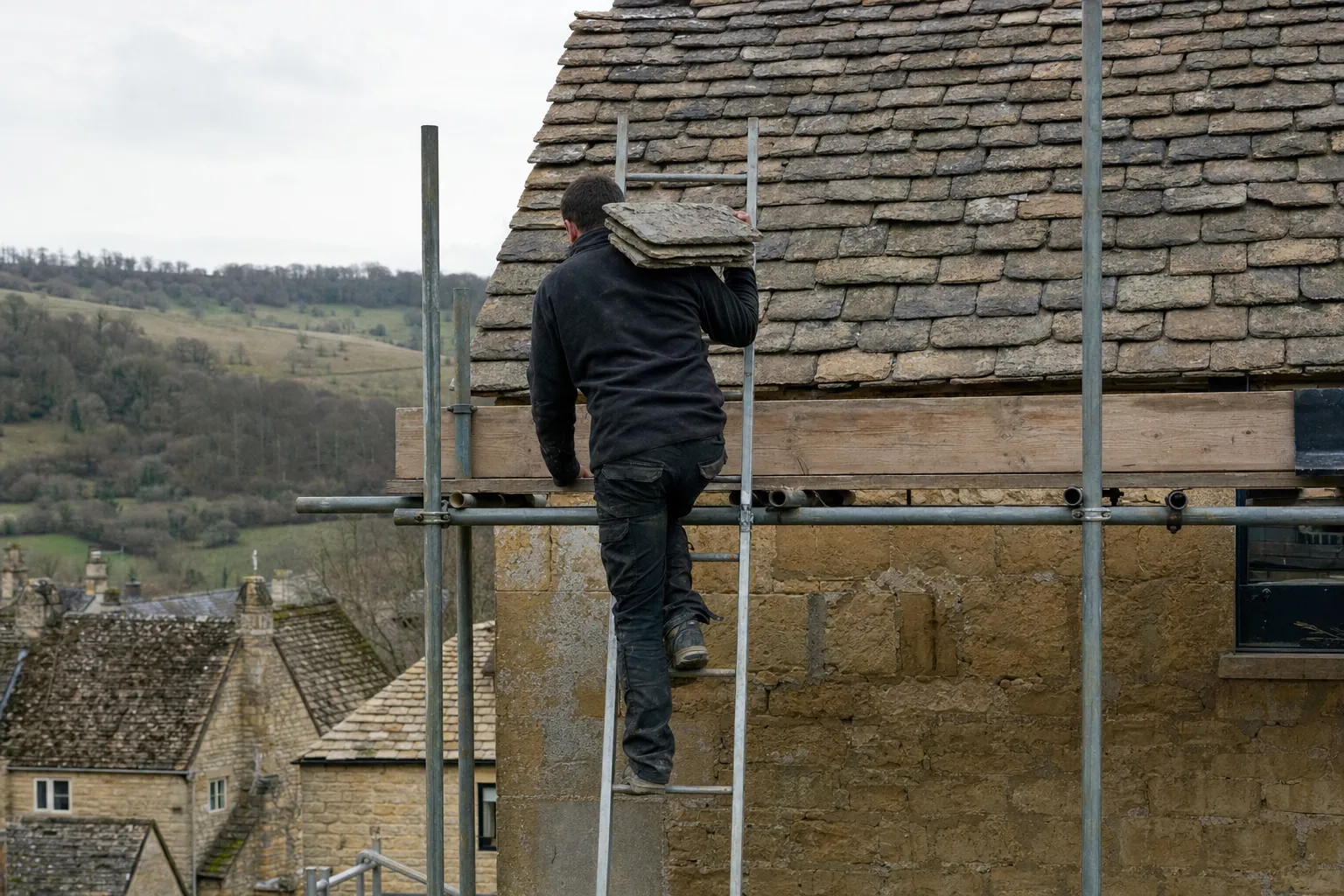
Roofer carrying stone slates up a ladder on scaffolding

The short answer

With planning. Access shapes the job in the city centre, where roofs sit behind parapets, over yards and above busy pavements. Towers, scaffolds and sometimes a pavement licence are involved, and the written quote follows a survey that decides which is needed.

Oxford's rivers and their flood plains limit how far the centre can spread, so buildings stand close together and roofs often have to be reached from awkward directions. Access is as much of the job as the roof itself.

Will the work need scaffolding?

For a chimney, a parapet or a roof of two storeys, almost always. MyBuilder's guide, updated on 21 August 2026, gives around £850 to £1,200 for a two-storey house, a typical setup, and £50 to £200 for a pavement licence where poles stand on the public footway. Those are typical national figures, and they show why a scaffold is a real part of the bill. Ask each firm whether VAT and scaffolding sit inside its quote.

How do you work around neighbours and the street?

Shared walls, narrow access and busy frontages call for notice and tidiness. We let neighbours know what is happening, keep materials off the footway, and leave the site tidy, with the waste carted off when we finish. Should the work involve a shared wall, a formal notice under the Party Wall etc. Act 1996 may be needed.

Can a small repair be done without all that?

Sometimes. A few slipped tiles on a low rear slope may need only a ladder or a tower, and a make-safe visit to stop a leak can be much lighter than a full job. We prioritise leaks and storm damage, and the survey explains which approach your roof needs.

For larger work, our roof repairs page sets out how we match the size of the job to the fault.

Oxford questions, from Jericho to the Cherwell

Why does a stain appear on an Oxford ceiling when the roof outside looks fine?

The water often enters behind a parapet or around a chimney stack, then travels along a rafter or a wall plate before it shows. Old plaster hides it for a while, which is why a ceiling can look dry for months and then bloom in a week. The survey follows the stain back to the junction or gutter at fault, and the photographs show the exact joint, which keeps the repair to the smallest job that works.

Do you work on roofs in Jericho and Cowley?

Yes. Both are part of the city we cover. Check the areas page or phone to confirm your street, and a survey comes next, with photographs and a written quote.

Can I swap a clay roof for concrete tile on an Oxford terrace?

In Jericho, changing the roofing material falls under the Article 4 direction and needs an application. Elsewhere the answer depends on conservation area and listing status, so ask Oxford City Council. A concrete tile is also heavier, which can trigger a Building Regulations check.

Will scaffolding block the pavement outside my Oxford house?

It can, if there is no other way to reach the roof. A scaffold on the public footway may need a licence, and a walkway is normally kept clear for people passing, so we explain what is involved, and how long the poles will stand, before booking a date. Whether VAT and scaffolding are in a quote is worth asking each firm.

Ask us about your roof

Tell us what’s happening and we’ll call you back.

  • Photos of what we find
  • A written quote
  • 10-year workmanship guarantee

Or call 01793 626096

Call Get a quote