The short answer
The council's appraisal names three coverings on the High Street: Cotswold stone slates, clay tiles and slate. Behind them stand coursed rubble walls, houses of the seventeenth and eighteenth centuries and a medieval plan, so each roof has to be mended in its own material.
Marshfield sits at the southern end of the Cotswold hills, and its High Street runs almost straight for about 350 metres. The buildings along it were raised in the seventeenth and eighteenth centuries on the long narrow plots of a medieval market town. Their roofs came from three different supply lines.
Q1.1How can I tell stone slate from tile or slate?
Start with the coursing. Stone slates shrink as they climb the slope, big ones along the eaves and tiny ones by the ridge, and their surface is rough and uneven. Clay tiles are small, regular and gently curved. Slate is flat, thin and even. A stone roof also has a depth and weight that the others lack, and the rafters beneath it are sturdier.
Q1.2What fails first on a pegged stone roof?
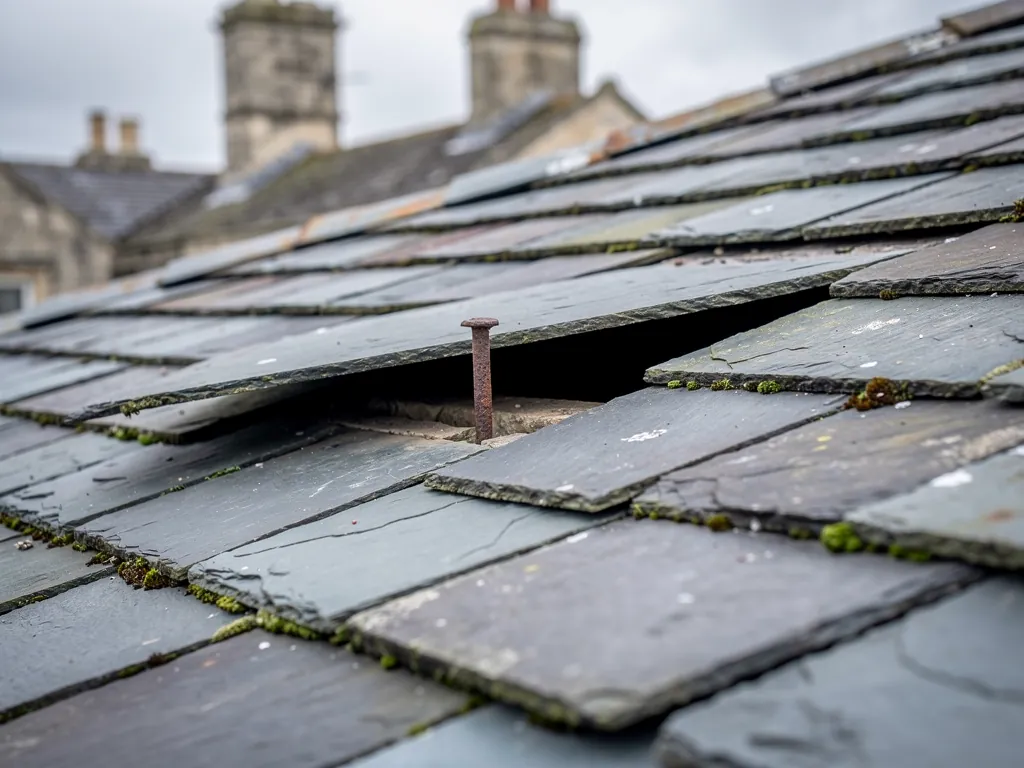
The fixings, ahead of the stone. Traditionally each slate hangs over a batten on one or two oak pegs, and when a peg rots or a batten softens, the slate slides. Rain then gets under the course above. We open the affected area, renew the timber and rehang the stones in their courses, without stripping the whole slope.
Q1.3Why do the stones change size?
Because the rock splits that way. The biggest pieces, about 600 millimetres long and sometimes more, run along the eaves, and the smallest, around 150 millimetres, finish the slope near the ridge. Laying them in diminishing courses gives the roof its look and its tight lap.
Our pages on Cotswold stone roofing and roof repairs follow each case through in turn.
Lead is what keeps a stone roof watertight against a chimney or gable wall, dressed into the masonry joint, and it is often the oldest repair on the whole roof. So the lead is examined early at every Marshfield survey.